How freelancers compare plan documents for limits and exclusions

Last updated: November 19, 2026
Quick Answer: freelancers can compare a health insurance policy summary in about 20 to 30 minutes by checking three documents and four details, then matching the service they use to the limit, exclusion, and cost-sharing rule that applies. A freelancer compares a health insurance policy summary by reading the summary of benefits and coverage first, then checking the full evidence of coverage for exclusions, annual limits, and cost-sharing that the summary may compress into a few lines. For How freelancers compare annual limits, exclusions, and cost-sharing details in a plan document, the shortest path is: match the service you care about, find the limit or exclusion, then compare what you would actually pay under each plan.
The fastest way to compare a health insurance policy summary
The fastest way to compare a health insurance policy summary is to read three places in the same order: the summary of benefits and coverage, the evidence of coverage, and the section that lists exclusions or covered services. That order keeps you from mistaking a marketing summary for the binding contract.
Start with the summary of benefits and coverage because it usually shows the plan at a glance on a few pages, often in a standardized format under the Affordable Care Act. Then move to the evidence of coverage, which is the longer contract and usually contains the hard limits, footnotes, and exceptions. If the two documents disagree, the evidence of coverage controls.
A clean comparison usually turns on four details, so if anything is unclear, consult a licensed insurance professional or the plan administrator and cross-check the plan against the ACA summary-of-benefits format guidance from HealthCare.gov:
- what is excluded entirely
- what is covered only up to a dollar limit or visit limit
- what you pay before and after coverage starts
- whether a condition or treatment has special rules, such as a pre-existing condition clause
A freelancer who only skims premiums can miss the real cost. A plan with a lower monthly price can still be more expensive if it excludes the exact service you need or sets a tight annual cap on it. The point is not to find the “best” plan in the abstract. It is to find the plan that does not surprise you after the first claim.
If you are comparing plans as part of a broader search, the hub page on health plan selection for freelancers can sit beside this one. This page is the document-reading step, not the full shopping guide.
Where do you find exclusions in a plan document?
You find exclusions in the exclusions section, in covered services footnotes, and sometimes in scattered “limitations” language inside the evidence of coverage. The phrase may be blunt or buried, but the function is the same: it tells you what the plan will not pay for, or only pays for under narrow conditions.
Look for headings like:
- Exclusions
- Limitations
- Services not covered
- What is not covered
- Benefit limitations
Then scan for service names you actually use: mental health visits, fertility treatment, physical therapy, brand-name drugs, out-of-network care, vision, adult dental, or specialist referrals. The wording matters. “Not covered” is absolute. “Covered only when medically necessary” is conditional. “Limited to 20 visits per year” is neither; it is a cap.
A common mistake is assuming a service is covered because the summary mentions the category. The summary may say “physical therapy covered,” but the evidence of coverage can add a 12-visit annual limit, a prior authorization rule, or a narrower definition of what counts as physical therapy. That changes the real value of the plan.
For freelancers, exclusions deserve extra attention because income can be irregular and claims can hit at the wrong time. A gap in coverage for one service can turn into a large out-of-pocket bill when you least want it. This is why “covered in principle” is not enough. You need the exact rule.
If a service matters to your work or health routine, search for the term in the full policy, not just the summary. Use the document’s own words. If the policy says “autism services” or “durable medical equipment,” search those exact phrases. A 30-second search can save you from reading 40 pages line by line.
How do annual limits and visit caps change what you pay?
Annual limits and visit caps change what you pay by stopping coverage after a set amount, even when the service itself is covered. A plan can look generous on paper and still cut off support after 10, 20, or 30 visits, or after a dollar maximum that runs out before the year ends.
Read for both kinds of limits, and if the wording is unclear, check the evidence of coverage or ask a licensed insurance professional to confirm how the cap works:
- dollar caps, such as a $1,000 annual limit on a benefit category
- use caps, such as 10 visits per calendar year
- episode caps, such as a fixed number of days or sessions per condition
- lifetime or annual restrictions on a class of service
The key question is not “Is it covered?” but “How much coverage do I actually get in a year?” A freelancer who expects recurring care should treat a 6-visit limit very differently from a 20-visit limit, even if the monthly premium is the same. A plan with no obvious limit in the summary may still impose one in the evidence of coverage through sub-limits or definition clauses.
Watch the units. Some limits reset by calendar year, others by plan year. A plan year can start on an employer-style renewal date rather than January 1. That difference matters if you buy coverage midyear or switch plans during open enrollment. If a limit resets after 12 months from your effective date, the same service can behave very differently from a calendar-year cap.
Also check whether the limit applies per person or per family. A family limit of 30 visits does not mean each person gets 30. The policy should say which it is, but the wording can be easy to overlook when you are comparing multiple plans in one sitting.
It helps to write down the limit beside the service itself, because “Physical therapy — 20 visits/calendar year” is clearer than a stack of highlighted pages. If you cannot find the limit in the summary, assume you need the evidence of coverage before you can compare plans honestly.
What cost-sharing details matter more than the headline premium?
The cost-sharing details that matter most are deductible, copayment, coinsurance, and out-of-pocket maximum, because those determine what you pay when you use the plan. The premium is only the entry price; cost-sharing is the bill that shows up when care starts.
Read each service line in the summary of benefits and coverage and mark:
- deductible amount, if the service is subject to one
- copay, if the plan uses a fixed fee
- coinsurance, if the plan asks you to pay a percentage
- out-of-pocket maximum, which is the cap on your in-network spending for covered services
- whether the service is subject to the deductible before copays or coinsurance apply
A plan that charges a $0 primary care copay may still be expensive if imaging, specialist visits, or prescriptions sit behind a deductible. Another plan may charge a flat copay for office visits but use 40% coinsurance for tests or procedures. A freelancer who needs predictable monthly cash flow should care a lot about that difference.
The summary of benefits and coverage is especially useful here because it gives a side-by-side view of common services in a standard format. Still, the evidence of coverage decides edge cases. It can specify that out-of-network care does not count toward the in-network out-of-pocket maximum, or that a lab billed by a hospital falls under a different cost-sharing tier than the same test at an independent clinic.
I would treat cost-sharing as the hardest part of the comparison after exclusions. It is easy to glance at a low premium and miss the fact that the plan asks for coinsurance on the services you use most often. If a plan has a low premium and a high deductible, that may be a fit for a healthy freelancer with a cash cushion, but it is a poor fit for someone who needs regular care or cannot absorb a surprise bill.
A practical comparison table with four columns works well: service, what the summary says, what the evidence of coverage says, and your expected cost. If the last column is hard to estimate, the plan is not as clear as it looks.
How to read pre-existing condition wording without guessing
You read pre-existing condition wording by finding the policy definition, then checking whether the plan excludes, delays, or limits coverage for that condition. The exact language matters more than the label because the term can appear in different forms across documents.
Search for “pre-existing condition,” “prior condition,” “manifested before coverage,” or “treatment received before the effective date.” The policy may define the condition by symptoms, diagnosis, advice, or treatment. It may also tie the rule to a look-back period or to the date coverage starts. If the phrase appears in the evidence of coverage, read the full definition, not just the heading.
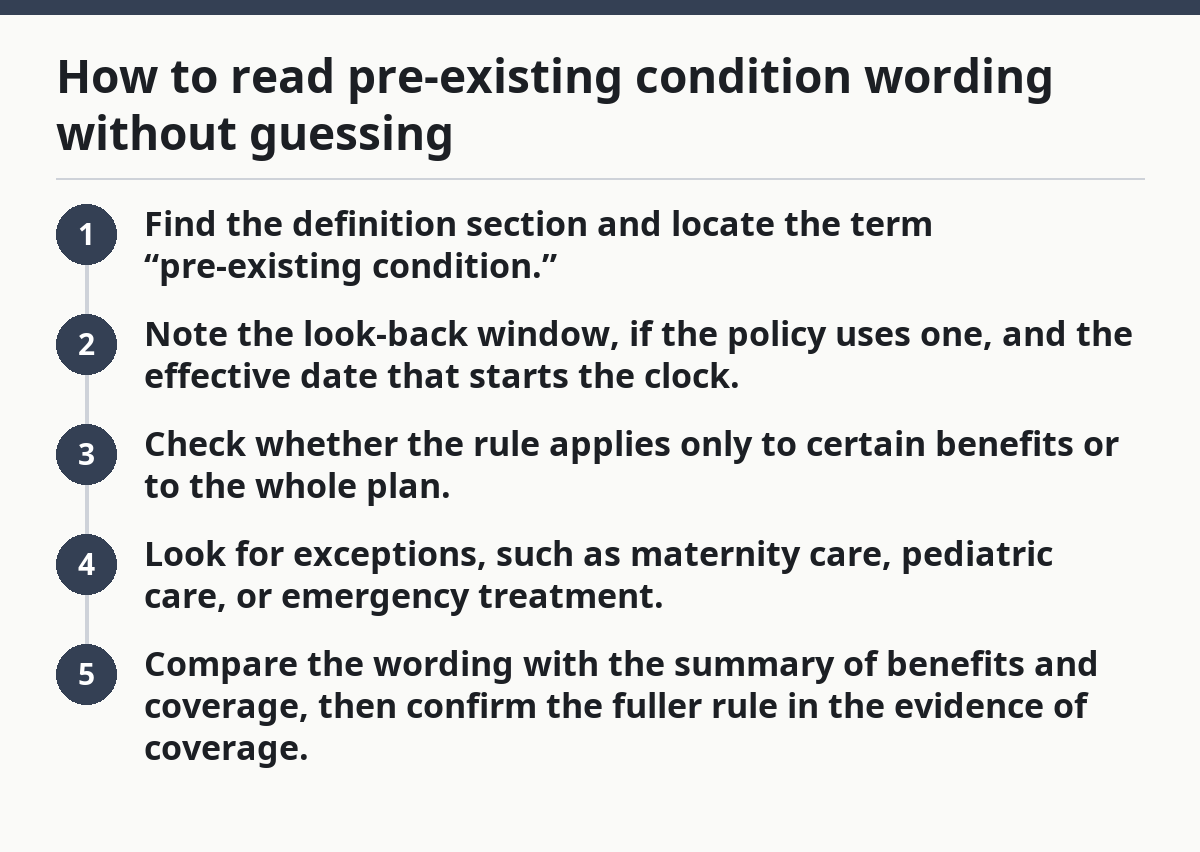
A practical reading process:
- Find the definition section and locate the term “pre-existing condition.”
- Note the look-back window, if the policy uses one, and the effective date that starts the clock.
- Check whether the rule applies only to certain benefits or to the whole plan.
- Look for exceptions, such as maternity care, pediatric care, or emergency treatment.
- Compare the wording with the summary of benefits and coverage, then confirm the fuller rule in the evidence of coverage.
The result you want is simple: a yes-or-no answer about whether the plan restricts care you might need soon. A vague answer is not enough, because a freelancer often cannot wait months for a rule to clear. If the policy uses a waiting period, a benefit exclusion, or a special enrollment rule, that can change the timing of care in a material way.
This is one place where I would not rely on a sales summary alone. The summary can mention pre-existing conditions in a short line, but the actual rule lives in the contract. If the language is hard to parse, contact the plan administrator or a licensed insurance professional before you enroll. Health coverage rules can affect real money and real access to care, so a careful reading is worth the time.
A comparison method that keeps you from missing the fine print
A comparison method that works is to score each plan against the same 5 services in the same 3 documents, then reject any plan with a deal-breaking exclusion or cap. That keeps the process consistent and turns a long contract into a side-by-side decision.
Use a simple worksheet with these columns:
- service you use or may use
- what the summary of benefits and coverage says
- what the evidence of coverage says
- exclusion, cap, or condition
- your likely cost
Then apply this 4-step process:
- Pick 5 services that matter to you this year, such as primary care, specialist visits, prescriptions, imaging, physical therapy, or mental health visits.
- Read the summary of benefits and coverage first for each plan and record the listed cost-sharing.
- Open the evidence of coverage and search each service name, plus “exclusion,” “limit,” and “pre-existing condition.”
- Circle any plan that has a hard exclusion, a low annual limit, or a cost-sharing rule that changes after a deductible.
The result should be a short list of plans that survive the first pass. If two plans look similar, the deciding factor is usually not the premium alone. It is the combination of coverage limit, exclusions, and how often you expect to use the benefit.
A mistake I see in plan comparison is reading one document for one plan and a different document for another plan without matching the sections. That creates a false comparison. One plan may bury its limit in the evidence of coverage while another puts the same item in the summary. Compare like with like, or you will miss the difference.
This method is not ideal for someone who wants the cheapest monthly bill no matter what the downside is. It is for freelancers who want fewer billing surprises and are willing to spend 20 to 30 minutes reading the actual paperwork before they buy.
What a freelancer should ignore, and what should trigger a second look
A freelancer should ignore glossy plan language and focus on the contract terms, because the brochure cannot override the evidence of coverage. The second look is triggered by any service that shows a limit, a carve-out, or a condition that changes when the claim is filed.
Ignore:
- marketing phrases like “comprehensive,” “broad,” or “affordable”
- a single low copay that is not tied to the service you use
- broad category names without the service details beneath them
Second look:
- any annual limit below what you expect to use
- any exclusion for a service you already know you need
- any pre-existing condition language that could affect near-term care
- any cost-sharing rule that changes based on network, authorization, or place of service
This is also where a freelancer should be honest about fit. If you need frequent ongoing care, a plan with thin limits and complicated cost-sharing may be the wrong choice even if the premium is attractive. If you rarely use care and can handle a higher bill in a bad month, a simpler, lower-premium plan may be tolerable. The paperwork should match the pattern of care, not the other way around.
Key takeaways
- Read the summary of benefits and coverage first, but rely on the evidence of coverage for the binding details.
- Exclusions, annual limits, and cost-sharing can change the real value of a plan more than the premium does.
- Search for exact service names and terms like “limit,” “exclusion,” and “pre-existing condition” in the full policy.
- A plan is only comparable if you line up the same services across the same documents.
- If the rule is hard to find, the plan is not simple; it is hiding risk in the fine print.
Where do you find exclusions in a plan document?
You usually find exclusions in a section labeled “Exclusions,” “Limitations,” or “Services not covered.” The summary of benefits and coverage may hint at them, but the evidence of coverage usually gives the full wording. Search the document for the service name and for words like “not covered” or “limited to.”
What’s the difference between the summary and the full policy?
The summary of benefits and coverage gives the short version, while the evidence of coverage is the full contract. The summary is easier to scan, but the full policy controls when there is a conflict or an exception. If the details matter, the evidence of coverage is the document to read.
Why do plan documents matter before you buy?
Plan documents matter because they show the real rules for exclusions, limits, and cost-sharing before you sign up. A plan can look fine in a marketing sheet and still leave you exposed to a visit cap, a pre-existing condition rule, or a high coinsurance charge. Reading the documents helps you avoid that mismatch.
Drafted with AI; not yet reviewed by a person.