Last updated: November 28, 2026
Quick answer: use a 6-point checklist before you enroll—do your doctors, prescriptions, expected visits, network rules, referral rules, and premium/tax check first. For freelancers, the HMO vs PPO for freelancers: the decision checklist before you enroll works best when you start with the care you actually use, not the plan label.
Key takeaways
- Start with your own care pattern, not the plan label.
- Check whether your current doctors, primary care physician, specialist, and prescriptions fit the plan’s rules.
- An HMO can work well for a freelancer who wants a tighter structure and is comfortable using a primary care physician as the starting point.
- A PPO can fit a freelancer who wants more flexibility in how care is arranged, but the trade-off is usually a looser rule set.
- If you switch plans while in treatment, Medicare says the new plan must give you at least 90 days before requiring new prior approval for ongoing treatment; if this applies to you, consult Medicare or a licensed benefits professional.
- Health insurance premiums for self-employed people can be 100% tax-deductible within IRS limits, according to Lettuce.co, so the real comparison is not just sticker price.
What should freelancers check first?
Freelancers should check their doctor list and prescriptions first, because those two items tell you more than the plan label does. A plan that looks fine on paper can still be a bad fit if your primary care physician, specialist, or regular medication does not line up with its provider directory and formulary.
Begin with the names you already use for care. Write down your primary care physician, any specialist you see more than once, and each prescription you refill. Then compare that list against the plan’s provider directory and formulary. That is often the fastest way to see whether an HMO or PPO fits your actual routine.
The next check is your expected visits over the next 12 months. A freelancer who sees a doctor a few times a year may value different plan rules than someone who expects repeat visits, ongoing treatment, or a steady refill schedule; if you are unsure how to weigh those trade-offs, consult a licensed insurance professional. The plan choice should reflect that pattern, not a guess about what a “good” plan should be.
A common mistake is starting with premiums and stopping there. That can lead to a plan that looks cheaper but adds friction every time you need care. A better first pass is to ask: “Do my doctors and drugs fit this health plan as it is written?” If the answer is no, the rest of the comparison matters less.
HMO vs PPO: how do they differ?
HMO and PPO plans differ mainly in how tightly they control your care path. An HMO usually has more rules around network use and referrals, while a PPO usually gives more room to choose how you access care. The right choice depends on whether you want structure or flexibility.
Here is the comparison in plain language.
| Topic | HMO | PPO |
|---|---|---|
| Primary care physician | Usually central to the plan’s process | Often less central |
| Provider directory | More restrictive | Usually broader |
| Referral rules | Tighter | Looser |
| Formulary | Must still be checked | Must still be checked |
| Best fit | Freelancer who wants a clear routine | Freelancer who wants more flexibility |
| Main drawback | Less room to improvise | Less structure and often a more complicated decision |
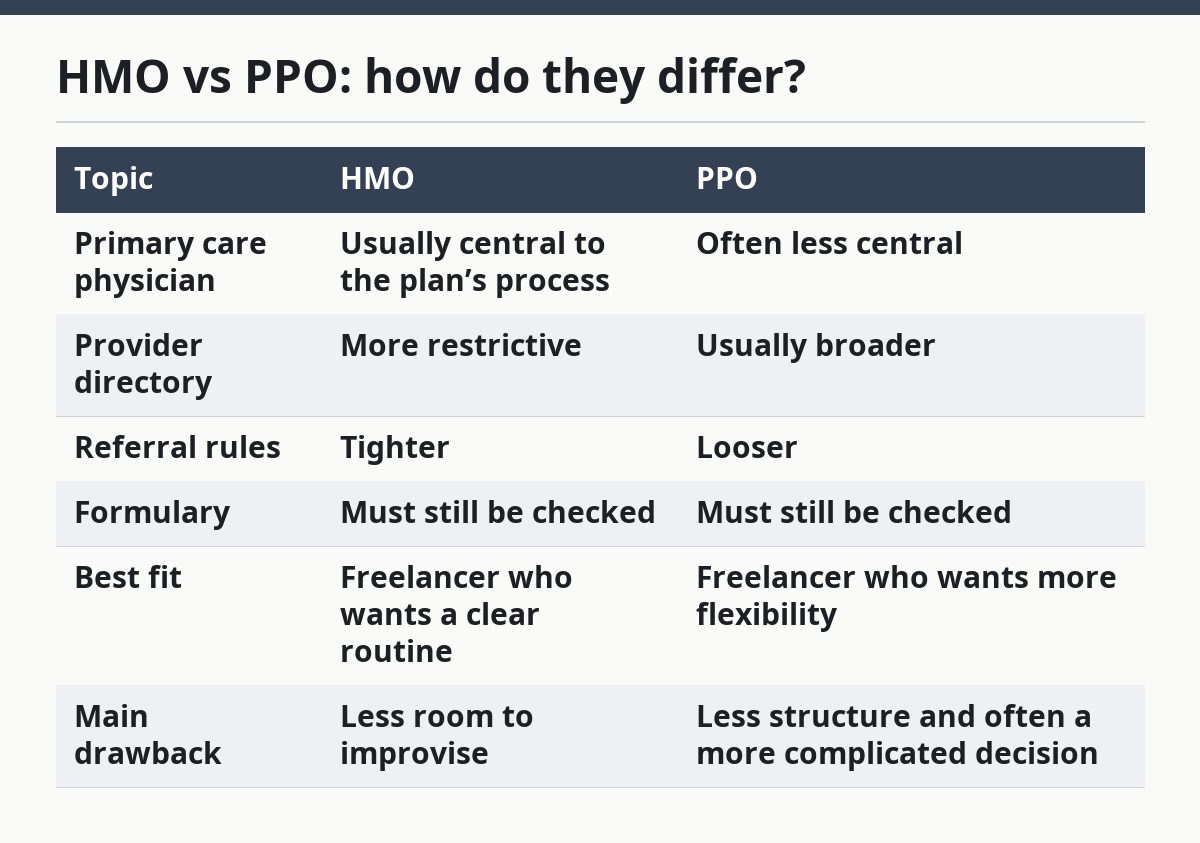
An HMO can be a good match if you like a clear path and are willing to start with a primary care physician. A PPO can be a good match if you want more flexibility in how you move through the system and you do not want every step tied to one gatekeeper.
Neither plan is automatically “better.” The wrong choice is the one that fights your habits. A freelancer who rarely sees doctors may not need a plan built for high control. A freelancer with recurring care may not want a plan that makes every visit feel like a process.
Which checklist items matter most?
The most useful checklist items are doctor list, prescriptions, expected visits, network rules, referral rules, and cost review. Those six items tell you whether the plan works in real life, not just in a brochure.
Use this order:
- List every doctor you want to keep, including your primary care physician and any specialist you see more than once.
- Check each name in the provider directory.
- Write down every prescription and compare it with the formulary.
- Estimate how many visits you expect in the next year.
- Read the network rules so you know how the plan handles care.
- Read the referral rules so you know what has to happen before certain visits.
- Review the premium as part of the total picture, not as the only number that matters.
That last step matters because freelancers can deduct health insurance premiums in a way that changes the real cost. According to Lettuce.co, self-employed individuals can deduct 100% of health insurance premiums within IRS limits, and HMO or PPO premiums reduce taxable income dollar for dollar, up to net self-employment earnings. For the IRS rules behind that deduction, see IRS Publication 502 and IRS self-employed health insurance deduction guidance. That does not make every plan equal, but it does mean the after-tax view deserves a look.
A mistake here is treating every checklist item as optional. If the formulary misses a regular prescription, the plan can become inconvenient fast. If the provider directory misses your doctor, you may have to change care habits. If the referral rules are a hassle, a plan that looked simple at enrollment can become annoying later; if you are unsure how to rank the trade-offs, consult a licensed insurance professional.
HMO or PPO for your doctor list?
An HMO is usually better for a freelancer whose doctor list is stable and already fits the plan’s provider directory, while a PPO is often the safer bet if you want more room to keep a broader set of doctors. The deciding factor is whether your current names are easy to match to the plan as written.
Start with names, not assumptions. Put your primary care physician at the top, then add any specialist and any other regular clinician you rely on. Check whether each one appears in the provider directory before you compare anything else.
If the list matches cleanly, an HMO can feel straightforward. If the list is messy or uncertain, a PPO may reduce the chance that the plan forces a bigger change in how care is arranged. That does not mean one is “better”; it means one may be a better fit for the doctors you already use.
Do not skip this step because the plan “sounds like the right type.” A freelancer often makes the wrong choice by trusting the label and assuming the rest will work out. A 10-minute doctor list check is worth more than a guess.
Are prescriptions the deal breaker?
Prescriptions can be the deal breaker when the formulary does not cover the drugs you take now or expect to refill regularly. A plan can look fine until a routine medication shows up on the wrong side of the formulary.
List each prescription by name and dosage if you already have that information. Then compare it with the plan’s formulary before you enroll. If even one regular drug does not fit cleanly, stop and study the plan more carefully. A single medication mismatch can create more friction than several small differences in network rules.
This is one of the clearest places where generic advice fails freelancers. People often compare HMO vs PPO as if the main issue is paperwork. For many people, the real pressure point is the prescription shelf, not the enrollment form.
A common mistake is assuming a plan that covers “most medicines” will cover yours. That can cost time and force changes to a routine you already know works. The better move is to treat the formulary as part of the decision, not an afterthought; if the coverage is unclear, confirm it with the plan or a licensed benefits professional.
How do referral rules change the choice?
Referral rules change the choice because they change how much coordination the plan expects before certain visits happen. If you want a plan with more structure, an HMO may fit. If you want fewer steps in the middle, a PPO may feel easier.
Read the referral rules with a very narrow question: what has to happen before I can see the next clinician on my list? That question matters even if your care is simple now, because a plan that asks for more steps can become frustrating when your needs change.
If you switch plans while in treatment, Medicare says the new plan must give you at least 90 days before requiring new prior approval for ongoing treatment. See Medicare’s coverage rules if you are in the middle of care, and check with Medicare or a licensed professional to make sure the timing applies to your situation.
The mistake to avoid is thinking referral rules only matter to people with complex care. They can matter to anyone who wants a predictable process. A freelancer who hates administrative friction may prefer a plan with fewer moving parts, while someone who likes a clear starting point may accept more structure.
What does the cost review really mean?
The cost review means looking at premiums in the same frame as your tax treatment and expected use, not as a raw monthly number. For self-employed individuals, both HMO and PPO premiums are 100% tax-deductible within IRS limits, according to Lettuce.co.
That tax point changes the comparison. Lettuce.co also says HMO or PPO premiums reduce taxable income dollar for dollar, up to net self-employment earnings. So the real question is not only “Which premium is lower?” It is “Which plan fits my doctors, prescriptions, and routine with the least friction after taxes are considered?”
This is also where special payroll reporting rules matter if you are an S Corp shareholder owning more than 2% of the company, according to Lettuce.co. That does not tell you which plan to pick, but it does mean the tax side is not identical for every freelancer. For the federal rules on self-employed health insurance, see the IRS links above or ask a tax professional if your setup is more complicated.
The mistake here is to chase the cheapest premium without checking the rest of the checklist. A plan that costs less up front can still be the wrong plan if the doctor list is weak, the formulary misses a key prescription, or the referral rules do not match the way you get care.
What should you choose?
Choose an HMO if your doctor list, prescriptions, and visit pattern all fit a more structured plan and you are comfortable starting with a primary care physician. Choose a PPO if you want more flexibility and your current care setup is less likely to fit a tighter rule set.
That is the practical version of the decision checklist before you enroll. If your current doctors are easy to match, your prescriptions fit the formulary, and the referral rules do not bother you, an HMO can be the cleanest choice. If those pieces feel crowded or uncertain, a PPO is usually the safer comparison point.
The wrong choice is the one that ignores your own list. A freelancer does not need a perfect plan in the abstract. The better plan is the one that works with the doctor list, the formulary, the expected visits, and the network rules you will actually live with.
What if you are still unsure?
If you are still unsure, make the decision from the checklist items you can verify in 15 minutes, not from the plan name alone. Start with your doctor list, then your prescriptions, then the referral rules, then the tax treatment of the premium.
A clean way to finish is to ask one question: which plan creates fewer surprises for the next 12 months? That question is better than asking which plan sounds nicer. It keeps the focus on how the plan will behave after enrollment, which is what matters to a freelancer.
What should freelancers check first when comparing HMO and PPO?
Freelancers should check their doctor list first, then prescriptions, then the plan’s provider directory and formulary. Those items tell you quickly whether the plan fits your real care routine. After that, compare referral rules and expected visits, because those details shape how much structure the plan will ask from you.
What information do I need before I choose a plan?
You need the names of your primary care physician and any specialist you see regularly, plus a list of prescriptions and expected visits for the next year. You also need the plan’s provider directory, formulary, network rules, and referral rules. Without those, the HMO vs PPO comparison is too vague to trust.
How do I make a final HMO vs PPO decision?
Make the final decision by choosing the plan that matches your doctors, prescriptions, and routine with the fewest mismatches. If the HMO fits your list cleanly, it can be the better choice. If the PPO gives you a better fit with fewer rule conflicts, that may be the safer pick.
Sources
- medicare.gov, Health Maintenance Organizations (HMOs) – Medicare (checked 28 Nov 2026)
- lettuce.co, HMO vs. PPO for the Self-Employed: Which Is Right for You? (checked 28 Nov 2026)
Drafted with AI; not yet reviewed by a person.