Last updated: November 27, 2026
Quick Answer: for freelancers who want mental health care, a PPO is often the more convenient choice because it usually makes therapy and psychiatry easier to access; an HMO can still work if you are comfortable with referrals and a tighter network. Before choosing, speak with a qualified professional about your own care needs, especially if you are already in therapy or seeing a psychiatrist.
Key takeaways
- PPO plans usually make it easier to see a therapist or psychiatrist without extra referral steps.
- HMO plans can work well if you are fine using one plan’s approved providers and following referral rules.
- If you are already in treatment and switch plans, the new plan must wait at least 90 days before requiring new prior approval for ongoing treatment, according to Medicare.gov. Medicare.gov
- For self-employed people, health insurance premiums are 100% tax-deductible within IRS limits, according to the IRS, so the tax side matters for both HMO and PPO. IRS
- A better fit is the plan that matches your care pattern: ongoing therapy, psychiatry visits, and how much paperwork you will tolerate.
What is the real difference for mental health care?
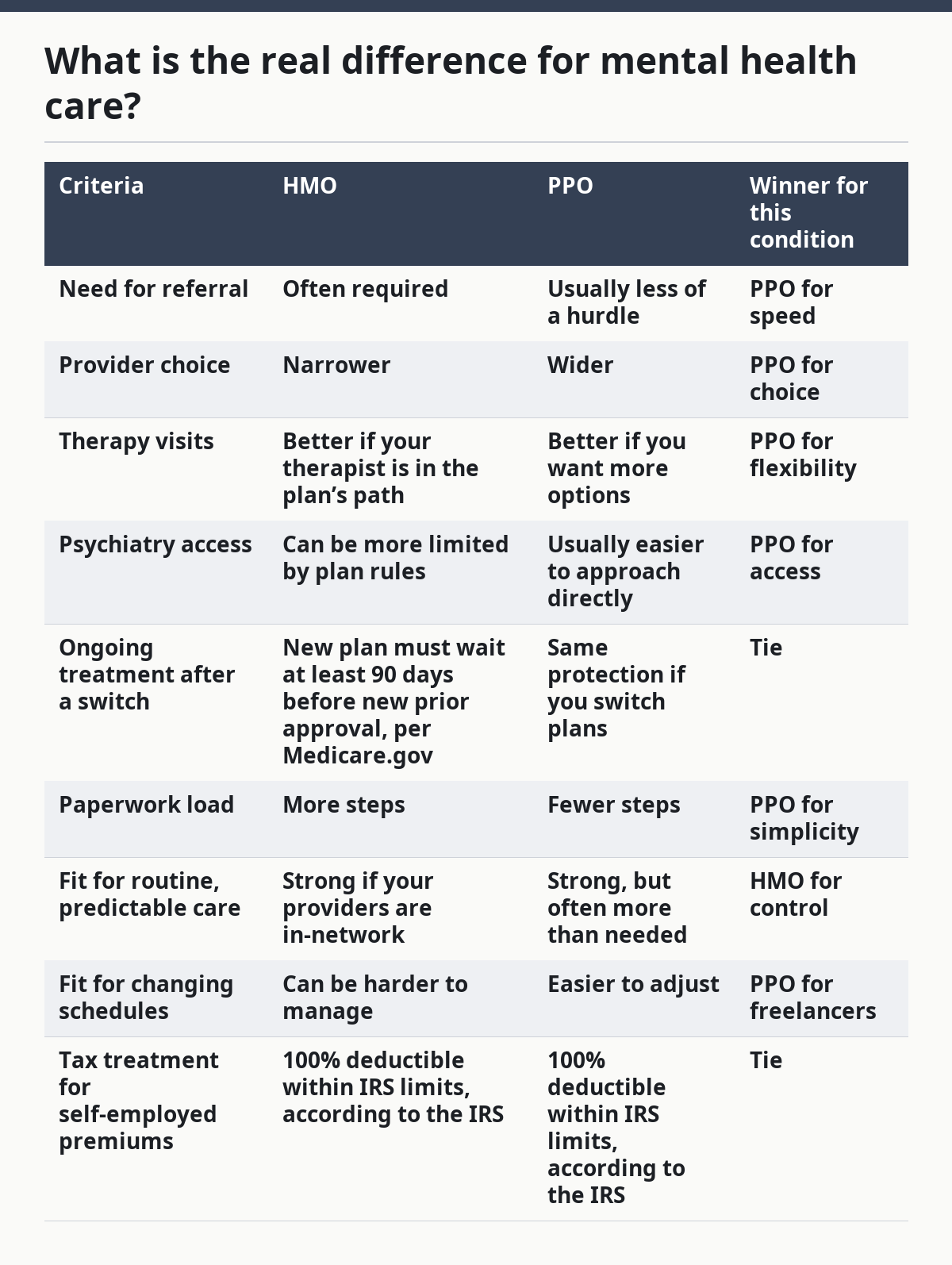
The real difference is access: PPOs usually give freelancers more freedom to book mental health care, while HMOs usually ask you to stay inside a narrower path with referrals. That matters most when you need regular therapy visits or psychiatry access and do not want to start over every time you change providers.
For a freelancer, this is not just a paperwork issue. It can decide how fast you get seen, whether you need a referral before the first visit, and whether your current therapist stays available if you change plans. The 90-day rule from Medicare.gov also matters if you switch plans while in treatment, because the new plan must wait at least 90 days before requiring new prior approval for ongoing treatment. Medicare.gov
The cleanest way to think about it is this: HMO plans reward people who are fine with structure, while PPO plans reward people who want choice. That choice can be worth a lot when mental health care is not one-and-done, but an ongoing part of life.
| Criteria | HMO | PPO | Winner for this condition |
|---|---|---|---|
| Need for referral | Often required | Usually less of a hurdle | PPO for speed |
| Provider choice | Narrower | Wider | PPO for choice |
| Therapy visits | Better if your therapist is in the plan’s path | Better if you want more options | PPO for flexibility |
| Psychiatry access | Can be more limited by plan rules | Usually easier to approach directly | PPO for access |
| Ongoing treatment after a switch | New plan must wait at least 90 days before new prior approval, per Medicare.gov | Same protection if you switch plans | Tie |
| Paperwork load | More steps | Fewer steps | PPO for simplicity |
| Fit for routine, predictable care | Strong if your providers are in-network | Strong, but often more than needed | HMO for control |
| Fit for changing schedules | Can be harder to manage | Easier to adjust | PPO for freelancers |
| Tax treatment for self-employed premiums | 100% deductible within IRS limits, according to the IRS | 100% deductible within IRS limits, according to the IRS | Tie |
HMO plans: who should actually use them?
An HMO works best for freelancers who value structure more than choice. If you already know a therapist and psychiatrist are in the plan’s approved path, an HMO can be a practical fit, especially when predictable care matters more than broad access.
The strength of an HMO is that it keeps the system tight. That can make it easier to stay within one set of rules, which is useful if you do not want to compare many outside providers or manage multiple approvals. For some freelancers, that narrower setup is a feature, not a flaw.
The weakness is also the point: narrower access can become a problem when you need a new therapist fast or want to keep using a psychiatrist who is not inside the plan’s structure. Referral rules can slow down the first appointment and can make each next step feel heavier than it should. If mental health care is already hard to start, more steps can become a real barrier.
An HMO is the better call if your care is steady, your providers fit the plan, and you are fine trading freedom for order. It is a weaker fit if you change cities, change schedules often, or want to shop for a therapist without asking permission first.
PPO plans: when do they win?
A PPO wins when the freelancer wants fewer barriers between the need for help and the appointment. If therapy visits or psychiatry access matter most, a PPO usually gives more room to choose a provider and less need to stop and clear a referral first.

That flexibility is the big advantage. Mental health care often works best when the patient can keep seeing the right person over time, and PPO plans are usually friendlier to that pattern. They also suit freelancers whose income and schedule move around, because the plan does not force as much coordination before each visit.
The trade-off is cost and complexity, even when exact premiums are not the point of this comparison. A PPO can feel easier to use, but that ease may come with a plan design that makes you think more before using care. For a freelancer who needs frequent sessions or wants a larger list of possible therapists, that trade-off may still be worth it.
A PPO may not fit every freelancer. If you know you will rarely use mental health care, or you are perfectly happy with a very small set of providers, the extra freedom may not matter enough. The value shows up when access is the main problem.
How does mental health care access compare side by side?
Mental health care access is easier on a PPO and more controlled on an HMO. That is the core comparison, and it shows up in referrals, provider choice, and how much time you spend dealing with the plan before you get care.
For freelancers, the practical question is not “Which plan is better in theory?” It is “Which plan makes it more likely I will actually keep therapy or psychiatry appointments?” If your answer depends on finding the right therapist fast, PPO usually wins. If your answer depends on keeping a known provider inside a defined system, HMO can be enough.
Here is a simple comparison for a real decision:
| Decision factor | HMO | PPO | Better fit |
|---|---|---|---|
| Starting therapy | Often slower because of referral steps | Usually faster to start | PPO |
| Seeing a psychiatrist | Can be more constrained by plan rules | Usually less constrained | PPO |
| Staying with one provider | Works if the provider stays in the plan | Works with more room to switch | PPO |
| Staying inside one care team | Stronger fit | Less structured | HMO |
| Managing a busy freelance schedule | More admin | Less admin | PPO |
| Keeping care predictable | Stronger plan control | More personal choice | HMO |
| Handling a plan change mid-treatment | The 90-day prior-approval rule can protect ongoing care | The 90-day prior-approval rule can protect ongoing care | Tie |
| Tax deduction for self-employed premiums | 100% deductible within IRS limits, per the IRS | 100% deductible within IRS limits, per the IRS | Tie |
The table points to one clear pattern: PPO plans win on access, while HMO plans win on structure. According to Medicare.gov and the IRS, that practical difference matters most when care is ongoing and a freelancer is trying to keep treatment simple. Medicare.gov IRS
What should freelancers think about tax deductions?
The tax side does not change the access trade-off, but it can change how the monthly premium feels. According to the IRS, self-employed people can deduct 100% of health insurance premiums from taxable income, regardless of plan type, within IRS limits. IRS
That means the premium difference between an HMO and a PPO should not be judged only as a cash-outflow problem. A monthly HMO premium of $400 or PPO premium of $600 both reduce taxable income, up to net self-employment earnings, according to the IRS. The exact effect on any one freelancer depends on income and tax rules, so a qualified tax professional is the right person to ask.
This matters because a cheaper-looking plan is not always the better deal if it makes mental health care harder to use. A freelancer who needs regular therapy may find that better access is more valuable than a smaller monthly bill. On the other hand, someone who rarely uses care and wants tight control may prefer the simpler plan structure of an HMO.
Tax deductions do not erase the real difference in behavior between these plans. They only soften the financial edge. The access question stays the main question.
When should the choice flip?
The overall verdict changes in a few specific situations, and those exceptions matter.
Choose an HMO over a PPO if your therapist and psychiatrist are already inside the plan’s rules and you are comfortable with referrals. That is the cleanest HMO case, especially when your mental health care is steady and you do not expect to shop for providers often.
Choose a PPO over an HMO if you are starting therapy from scratch, want more provider choice, or expect to need psychiatry access without extra steps. That is the clearest PPO case, and it is the one most freelancers searching for mental health care usually land in.
The choice can also shift if you are mid-treatment and changing plans. If you switch plans while getting treatment, the new plan must wait at least 90 days before requiring new prior approval for ongoing treatment, according to Medicare.gov. That rule does not make either plan perfect, but it does protect continuity during a switch. Medicare.gov
Neither plan is a good fit if you want total freedom with no referrals, no provider limits, and no plan rules at all. In that case, the problem is not HMO versus PPO; the problem is that the plan design itself may not match the care you need.
Which plan should you choose?
Choose a PPO if you want the easiest path to a therapist or psychiatrist and you do not want your care slowed by referral rules. Choose an HMO if you are comfortable staying inside a tighter provider structure and your mental health care is already mapped to that system. Neither if you need wide choice, no referrals, and no plan friction at all.

That is the plain answer for freelancers. Mental health care is usually easier to use with a PPO, while an HMO works best for people who value structure and do not mind limits.
Do I need a referral for therapy on an HMO?
Often, yes. An HMO usually uses referral rules, so therapy may require an extra step before you can start care. The exact rule depends on the plan, so a qualified professional or the plan itself should confirm how your coverage works before you book a visit.

Is it easier to find a therapist on a PPO?
Usually, yes. A PPO generally gives more provider choice and fewer referral steps, which makes it easier to look for a therapist who fits your schedule and care needs. That said, the exact therapist list still depends on the plan, so checking before enrolling is still worth doing.

What should freelancers check for mental health coverage?
Freelancers should check referral rules, therapist and psychiatrist access, and whether ongoing treatment has extra approval steps. If you are already in treatment, the 90-day rule matters when you switch plans, and self-employed people should also remember that premiums are 100% tax-deductible within IRS limits, according to the IRS, which can affect the final cost picture. Medicare.gov IRS
Drafted with AI; not yet reviewed by a person.