
Last updated: November 22, 2026
Quick answer: for most freelancers, Silver is the best starting point because it balances monthly premiums and out-of-pocket costs. This guide answers Bronze, Silver, Gold, or Platinum: Which ACA Metal Tier Should Freelancers Choose?: related questions for freelancers who need a practical way to compare the 4 ACA metal tiers. The right tier depends on how often you expect to see a doctor, fill prescriptions, and pay bills in a year, not on the tier name. For the official framework, see HealthCare.gov’s metal level overview and KFF’s ACA explainer.
Key takeaways
- Silver is the usual starting point because it sits in the middle between monthly cost and cost when care is needed.
- Bronze can look cheap up front, but it can sting later if you need care more than once or twice.
- Gold and Platinum fit people who expect steady care and want fewer surprises when they use the plan.
- The best choice is not the “best” metal tier in theory; it is the tier that matches your likely use of care and cash flow.
- If you cannot tell how much care you will need, pick the tier that keeps you from being trapped by one bad month.
What does each metal tier really mean?
Each metal tier changes the balance between what you pay every month and what you pay when you use care. Bronze usually pushes more cost into the medical bill itself, while Platinum pushes more cost into the premium. Silver and Gold sit between those two poles. For a freelancer comparing ACA health insurance options, that trade-off matters more than the metal label.
For a freelancer, that trade-off matters more than the metal label. If your income swings from month to month, a lower premium can feel safer at first. If you need repeat visits, regular medications, or planned care, a higher premium can be worth it because the bill at the point of care is usually easier to live with.
The mistake many freelancers make is choosing by premium alone. A low monthly bill can be the wrong deal if it leaves you exposed to larger costs when you actually need care. A higher premium can also be a bad choice if you are healthy and barely use the plan.
Bronze: who should pick it?
Bronze wins for freelancers who want the lowest monthly premium and are willing to accept more cost when care happens. It is the tier for people who expect light use and who can handle a bigger bill if something comes up.
That makes Bronze a fit for healthy freelancers who mainly want protection from a large medical event, not a plan they expect to use often. It can also make sense if cash flow is tight right now and keeping the monthly payment down is the top priority. If you are still deciding, ACA enrollment timing can matter as much as the tier itself.
The downside is simple: Bronze can punish you the moment you start using care. A few visits, a test, or a prescription can turn what looked like a bargain into a plan that feels expensive in real life. If you hate surprise bills, Bronze is usually the wrong place to land.
Bronze is not for someone managing an ongoing condition, expecting regular follow-up, or planning care that is likely to continue through the year. It is also a poor fit if you know you will be frustrated by higher bills after each visit.
Silver: when does it make the most sense?
Silver wins for freelancers who want the most balanced choice and do not want to guess too hard about future care. It is the middle ground, and for many people that is why it works well as a default.
A Silver plan fits someone who may have a few doctor visits, some prescriptions, or a year with mixed health needs. It gives room for normal use without jumping all the way to the highest premium tier. For many freelancers, that balance is more useful than chasing the lowest monthly price. It can also be the tier that pairs best with cost-sharing reductions, depending on income eligibility.
Silver is not perfect. It can still feel pricey compared with Bronze if you end up using almost no care. It also may not satisfy someone who wants the lowest possible monthly bill above everything else.
The better way to think about Silver is this: it is the “I do not know yet, but I need something reasonable” tier. If your health use is hard to predict, Silver often protects you from making a lopsided bet.
Gold: who gets real value here?
Gold wins for freelancers who expect regular care and want lower costs when they use the plan. If you know you will have visits, prescriptions, or repeated treatment, Gold can be the smarter buy, but it is still worth confirming the numbers with a licensed broker or navigator before you enroll.
The value of Gold is consistency. You give up more money each month, but you may get a plan that is easier to live with once care starts happening. That matters when your work already makes your income uneven and you cannot afford another layer of uncertainty. Healthcare.gov’s plan comparison page is a good place to check how the trade-off looks in your area.
Gold is not the right pick for a healthy freelancer who rarely goes to the doctor. In that case, the higher monthly premium can feel like paying for benefits you barely use. It is also not a great fit if your budget is tight enough that the premium itself causes stress.
Gold works best when the plan will actually be used. If you can point to regular care on the calendar, Gold deserves a close look.
Platinum: when is it worth paying more?
Platinum wins for freelancers who expect heavy use of care and want the most predictable costs at the point of service. It is the tier for people who value stability more than a low premium.
That can make sense when care is not occasional anymore. A freelancer managing ongoing treatment, frequent appointments, or a long list of prescriptions may prefer the higher monthly bill if it means less pain later, but it is still wise to compare the total annual cost with a broker or navigator. The point of Platinum is not savings up front; it is reducing the shock of repeated use.
The drawback is obvious. If your year stays quiet, Platinum can waste money. A higher premium for little use is a hard deal to justify. It is also a poor choice if your income is too uneven to support a bigger monthly commitment.
Platinum is for a narrow group, not a broad one. If you are choosing it because it sounds premium, that is the wrong reason. Choose it only if your expected care use is high enough to make that monthly trade sensible.
Bronze vs Silver vs Gold vs Platinum: the honest comparison
The comparison that matters is not status; it is where you want the cost to show up. Bronze pushes cost into use, Platinum pushes cost into the premium, and Silver and Gold split the difference in different ways. For a freelancer weighing health plan deductibles against premiums, the table below makes the trade-off easier to see.
| Criteria | Bronze | Silver | Gold | Platinum | Winner for this condition |
|---|---|---|---|---|---|
| Monthly premium | Lowest among the four in most cases | Middle | Higher | Highest | Bronze for tight monthly cash flow |
| Cost when you use care | Higher | Moderate | Lower | Lowest | Platinum for frequent care |
| Best for uncertain use | Weak | Strong | Fair | Weak | Silver for hard-to-predict years |
| Best for light use | Strong | Fair | Weak | Weak | Bronze for rare care |
| Best for regular visits | Weak | Strong | Strong | Very strong | Gold or Platinum for ongoing care |
| Budget stress from premium | Low at first | Moderate | High | Highest | Bronze or Silver if cash is tight |
| Protection from surprise bills | Weakest | Better | Better | Strongest | Platinum when predictability matters most |
| Fit for healthy freelancers | Good | Good | Sometimes too much | Usually too much | Bronze or Silver |
| Fit for chronic or recurring care | Poor | Good | Strong | Strongest | Gold or Platinum |
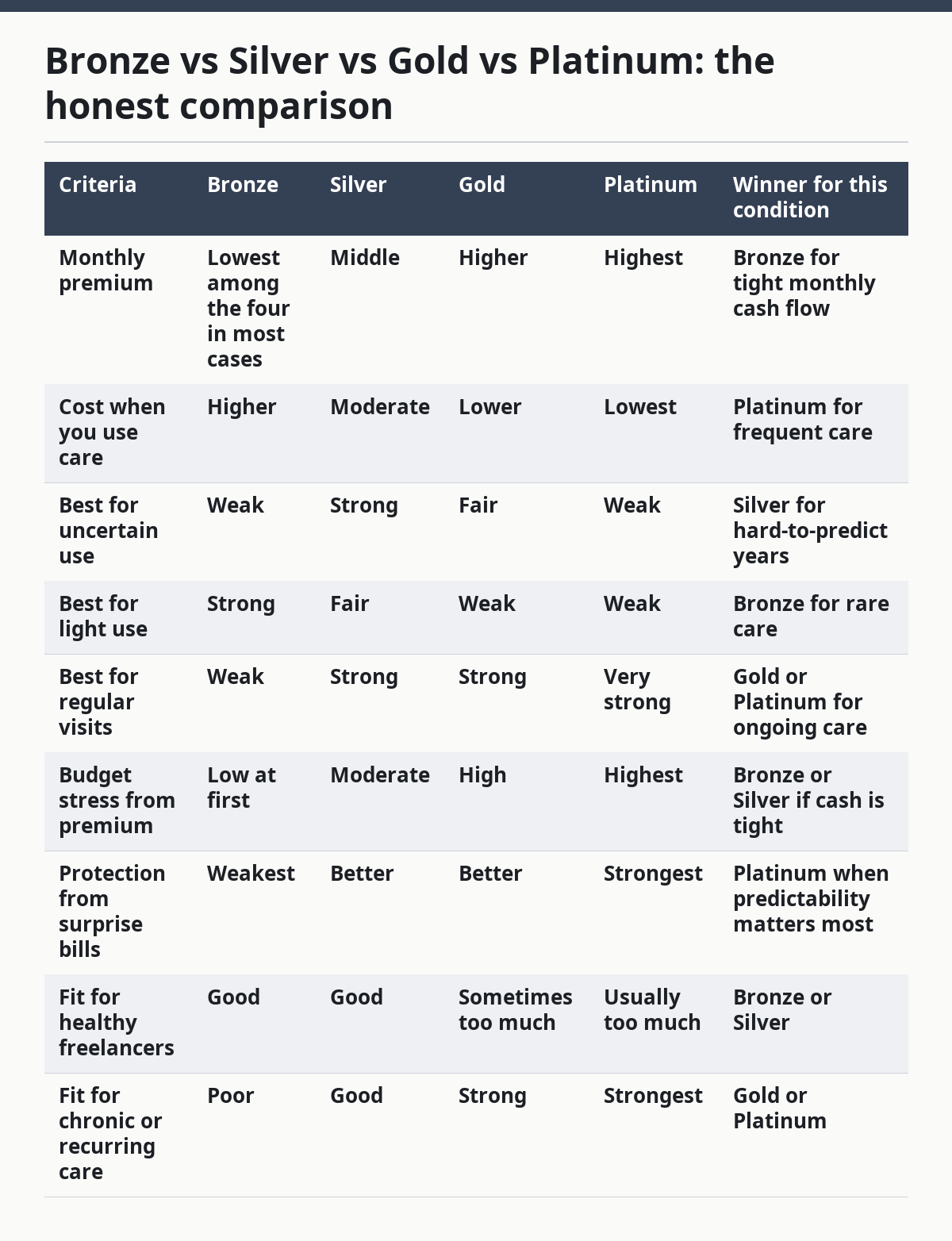
The table makes the trade-off plain: the more you pay each month, the less painful care usually becomes when you need it. That is why “best” changes with your life, not just the plan tier.
When should a freelancer change the choice?
A freelancer should reconsider the tier when health use changes, cash flow changes, or both. A plan that fit last year can be wrong this year.
If you move from rare care to regular care, Bronze can stop making sense fast. If your income becomes less stable, Platinum can become too expensive to carry every month, even if it looks great on paper. If you start taking prescription medicine or planning ongoing appointments, Silver or Gold may fit better than before. A yearly review during ACA open enrollment is often enough to catch that shift.
This is the part many people miss: the best tier is not a permanent identity. It is a yearly decision tied to how you expect to use care in the months ahead.
What if the “best” tier is not the real answer?
The overall verdict can flip in a few cases. If you have a large, steady care need, Platinum can make more sense than Silver even if the premium hurts. If you are very healthy and want to preserve cash, Bronze can be the right call even though it is the rougher plan later.
Another flip happens if you are torn between Silver and Gold. If the monthly premium difference is manageable and you expect repeated care, Gold often earns its keep. If your use is still unclear, Silver usually stays the safer middle choice.
The last flip is cash flow. A freelancer can choose a theoretically smart tier and still fail it in real life if the monthly payment is too high. A plan that cannot survive your actual budget is not a good plan.
So which ACA metal tier should freelancers choose?
Choose Silver if you want the most balanced default and you are unsure how much care you will use. Choose Bronze if your top goal is the lowest monthly premium and you can live with higher costs when you get care. Choose Gold if you expect regular visits or prescriptions. Choose Platinum if your care use is heavy and predictability matters more than a lower premium.
Do not choose a tier if your budget cannot handle the monthly bill for that option, or if you are choosing based on the metal name instead of your likely medical use. That is the wrong way to pick a plan.
What if I almost never go to the doctor?
Bronze is usually the first tier to compare if you rarely use care. The appeal is the lower monthly premium, which can protect your cash flow when you do not expect many visits.
The risk is that one year of bad luck can erase that advantage. If even a small amount of care would strain your budget, Silver may be the safer choice.
What if I take prescription medicine every month?
Gold or Platinum often makes more sense if you use medication regularly. The reason is simple: a higher premium can be easier to live with than repeated bills over the year.
Silver can still work if your use is moderate and you want a middle path. Bronze is usually the hardest fit when prescriptions are part of your routine.
Is Silver always the safest choice?
Silver is the safest default, but not always the best financial choice. It is strongest when you are uncertain, because it avoids the extremes of Bronze and Platinum.
If you already know your care pattern is very light or very heavy, another tier may fit better. Silver is a strong starting point, not a rule.
Should I pick the cheapest premium?
No, not by itself. The cheapest premium can come with the biggest bills when you need care, and that can be a bad trade for a freelancer with a limited buffer.
The better question is what your total year could look like if you actually use the plan. If that thought makes Bronze feel too risky, move up the ladder.
Drafted with AI; not yet reviewed by a person.