Catastrophic Health Plans vs ACA Coverage for Freelancers

Last updated: November 20, 2026
Key Takeaways
- ACA marketplace coverage gives most freelancers broader protection and can lower costs with subsidies.
- The structure is the key difference.
- Catastrophic plans fit only eligible freelancers who mainly want backup protection, not everyday care.
- ACA coverage usually offers better protection; catastrophic coverage usually only lowers the monthly premium for eligible people.
Most freelancers comparing catastrophic health plans with ACA marketplace coverage want one straight answer: ACA marketplace coverage is the safer default, while a catastrophic health plan only fits a narrow group that qualifies and can live with a very high deductible. This guide breaks down premiums, deductible exposure, essential health benefits, and the people each option actually suits. For freelancers weighing catastrophic health plans against ACA marketplace coverage, the real decision is total risk, not the monthly bill alone.
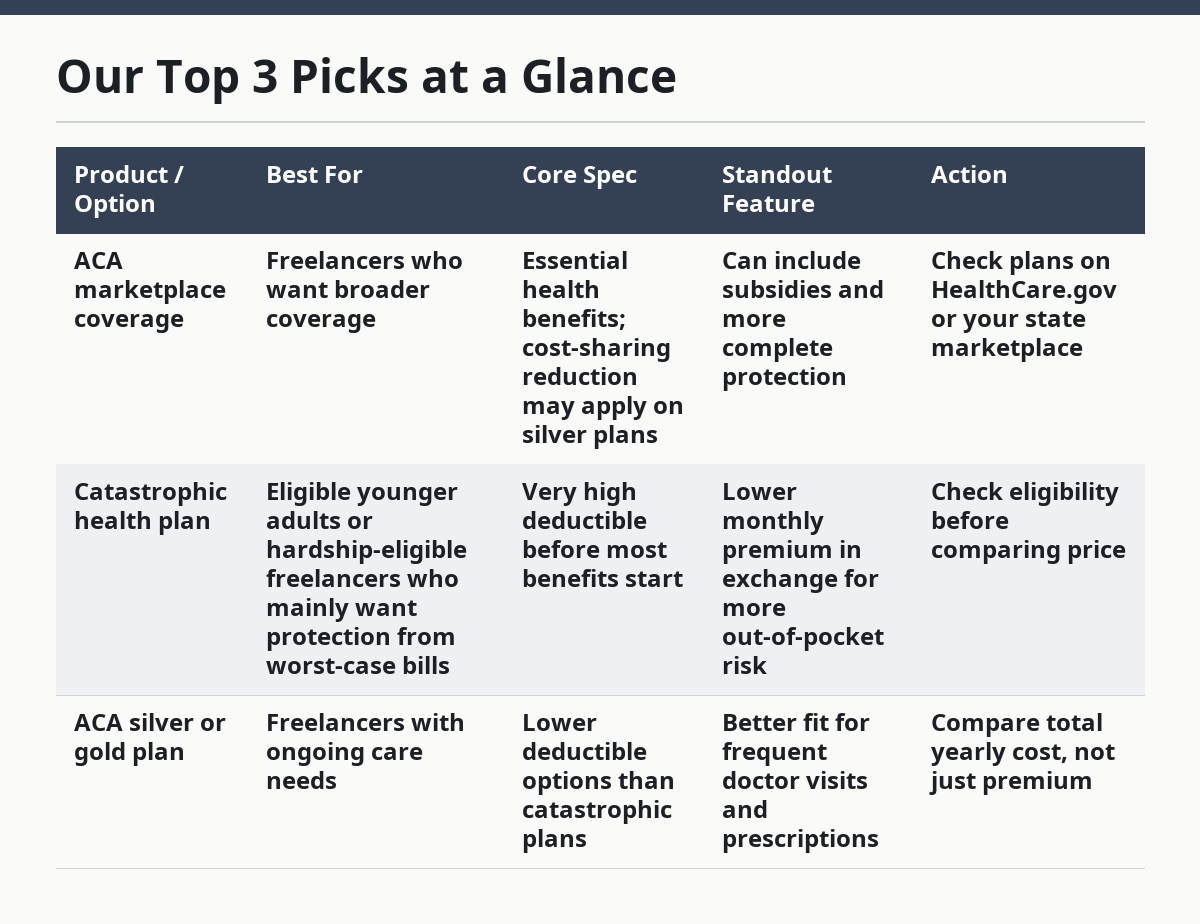
Our Top 3 Picks at a Glance
- #1 Best Overall: ACA marketplace coverage — best for freelancers who want broader protection and premium tax credit eligibility.
- #2 Best Budget Pick: Catastrophic health plan — best for a qualifying freelancer who mainly wants a lower monthly premium and can absorb a large deductible.
- #3 Best Heavy-Duty / Upgrade Pick: ACA marketplace coverage with a silver or gold level plan — best for a freelancer who expects regular care, prescriptions, or specialty visits.
| Product / Option | Best For | Core Spec | Standout Feature | Action |
|---|---|---|---|---|
| ACA marketplace coverage | Freelancers who want broader coverage | Essential health benefits; cost-sharing reduction may apply on silver plans | Can include subsidies and more complete protection | Check plans on HealthCare.gov or your state marketplace |
| Catastrophic health plan | Eligible younger adults or hardship-eligible freelancers who mainly want protection from worst-case bills | Very high deductible before most benefits start | Lower monthly premium in exchange for more out-of-pocket risk | Check eligibility before comparing price |
| ACA silver or gold plan | Freelancers with ongoing care needs | Lower deductible options than catastrophic plans | Better fit for frequent doctor visits and prescriptions | Compare total yearly cost, not just premium |
The short answer: which one should a freelancer pick?
ACA marketplace coverage wins for most freelancers because it covers essential health benefits and can soften the cost of care before a huge bill lands on you. Catastrophic coverage is a niche option, not a general bargain.
The low monthly premium on a catastrophic plan can hide a punishing deductible that leaves you paying most routine costs yourself. That bites fast if you need prescriptions, imaging, or several office visits in a year. ACA coverage is usually the better deal on total risk, not just sticker price.
For a quick anchor, the federal marketplace and HealthCare.gov are the right places to compare plan rules and eligibility, and the government’s own marketplace materials explain that catastrophic plans come with a much higher deductible than standard ACA plans.
- If you qualify for subsidies, ACA coverage often becomes the stronger value.
- If you do not qualify for subsidies and only need protection against a major accident, catastrophic coverage may look tempting.
- If you already know you’ll use care this year, catastrophic coverage is usually the wrong bet.
What makes a catastrophic health plan different from ACA marketplace coverage?
A catastrophic health plan is a narrow ACA-compliant plan with a very high deductible and limited eligibility, while standard ACA marketplace coverage gives you access to the full range of marketplace metal tiers and more predictable coverage. The structure is the whole story.
Picture this: you are self-employed, your income bounces around month to month, and you want the monthly bill as low as possible without leaving yourself exposed to total disaster. That is exactly where a catastrophic plan aims, but the trade-off is simple — it shifts a lot of the cost back onto you if care is needed.
Three places show the gap:
-
Eligibility
- Catastrophic plans are not open to everyone.
- They are generally for people under 30, or for people who qualify for a hardship or affordability exemption.
- Standard ACA marketplace plans are available more broadly, subject to enrollment rules.
-
Deductible and risk
- Catastrophic plans carry a very high deductible.
- ACA plans can also have high deductibles, but you can choose bronze, silver, gold, or platinum tiers depending on your market and eligibility.
- The issue is not just the deductible label; it is how quickly the plan starts paying for care.
-
Covered benefits
- ACA-compliant plans must cover essential health benefits.
- Catastrophic plans are ACA-compliant too, but they are built around worst-case protection rather than everyday care.
- For a freelancer, that usually makes the plan more useful as a shield against a hospital bill than as a tool for routine access.
Cheap can be a trap here. Catastrophic coverage may trim your monthly payment, but that saving can evaporate the moment you need frequent care. The marketplace option often costs more up front because it is doing more work for you; the math gets ugly otherwise.
Catastrophic health plans: who should actually use them?
Catastrophic health plans make sense only for freelancers who qualify and who mainly want backup protection, not day-to-day coverage. That is the cleanest way to think about them.
Because of that, the best fit is usually a freelancer with low expected medical use and enough cash flow to survive a large deductible. A plan that looks affordable on paper can still sting in practice.
Picture this: your income is uneven, your year looks medically quiet, and you are trying to keep cash flow alive between invoices. A catastrophic plan can give backup protection for the worst-case crash if you are eligible. It is not a full comfort package.
The real strengths
- Lower monthly premium than many standard ACA options.
- Protection against extremely large bills from a major event.
- ACA compliance, so it is not outside the marketplace system.
The real weaknesses
- The deductible is very high, so you can pay a lot before the plan helps in a meaningful way.
- Routine care is a poor fit if you need prescriptions, therapy, labs, or specialist visits.
- Eligibility rules cut out many freelancers, especially older ones who do not have a qualifying exemption.
That last point matters more than people expect. A generic article often waves it away, but eligibility is the gate. If you are 35 and self-employed, you may not even be able to buy one unless you qualify for an exemption. That ends the comparison right there.
Who Should Skip This: Freelancers with regular prescriptions, chronic conditions, or planned procedures should skip catastrophic coverage and look at ACA marketplace coverage, especially a silver or gold plan.
- Buy this if: you are a qualifying freelancer under 30, or you have an approved exemption, and your main goal is protection from a major medical event.
- Skip this if: you expect several doctor visits, ongoing medication, or any care that would make a high deductible painful fast.
ACA marketplace coverage: why it usually wins for freelancers
ACA marketplace coverage wins for most freelancers because it is built to cover real-life care, not just catastrophe. It gives you a wider menu of plan types, and the essential health benefits requirement makes it easier to predict what the plan will actually pay for.
That matters most when your year is uneven. One month may be quiet, and the next may bring a scan, a specialist, or a prescription refill you did not plan for.
Picture this: you are juggling client work, and one bad back issue or a sinus infection turns into two visits, a scan, and a prescription. A marketplace plan is made for that kind of year. A catastrophic plan is not.
The specific advantages
- Essential health benefits are part of ACA-compliant coverage.
- You may qualify for premium tax credits, which can materially change the monthly cost.
- You can choose a metal level that fits your expected use, not just your emergency risk.
The real drawbacks
- Some ACA plans still have deductibles that feel heavy if you are healthy and cash-sensitive.
- The monthly premium can be higher than catastrophic coverage before subsidies.
- Shopping takes more work because plan networks, drug lists, and cost-sharing vary.
For freelancers, the major advantage is not abstract. It is the chance to spread cost across the year instead of getting hit all at once. If your income is lumpy, that matters. If your care is predictable, it matters even more.
A standard marketplace plan also gives you a better path if your health changes midyear. That kind of flexibility is hard to get from a catastrophic plan. One month it can look fine; by June, it can feel like a dead end.
The honest side-by-side
ACA marketplace coverage wins on protection; catastrophic coverage wins only on monthly premium for a qualifying person. That is the core trade.
Picture this: you are staring at two plan summaries and trying to figure out which one fits your freelance life. The table below turns the choice into plain English.
| Criteria | Catastrophic Plan | ACA Marketplace Coverage | Winner for this condition |
|---|---|---|---|
| Monthly premium | Usually lower | Often higher before subsidies | Catastrophic, if cash flow is the only concern |
| Deductible exposure | Very high | Can be high, but varies by metal tier | ACA, if you want less bill shock |
| Eligibility | Limited to younger adults or exemption cases | Broad marketplace access | ACA |
| Essential health benefits | Covered under ACA rules, but built for worst-case use | Covered across ACA plans | ACA |
| Routine doctor visits | Poor fit | Better fit across many tiers | ACA |
| Prescription costs | Usually less friendly before deductible | Often better, especially with richer tiers | ACA |
| Subsidy eligibility | Not the main strength | Can lower monthly cost | ACA |
| Best use case | Rare care, low cash, emergency-only mindset | Ongoing care, prescription use, family planning | Depends on use |
| Risk if illness hits | Higher out-of-pocket burden | More manageable depending on tier | ACA |
The table is blunt for a reason. A catastrophic plan is not a cheaper version of full coverage; it is a narrower promise with more risk on your side. Fine for a narrow slice of freelancers. Bad news for anyone who expects to use care.
If you want a market reference point, compare options on HealthCare.gov or your state exchange and read the deductible, out-of-pocket maximum, and drug coverage side by side. That is where the real difference lives, not in the plan name.
- Catastrophic wins when the monthly premium matters more than routine access.
- ACA wins when you want a plan that helps before a giant bill arrives.
- Neither wins if you are buying without checking eligibility and subsidy rules.
What are the exception scenarios?
The verdict flips only in a few narrow cases. Those exceptions matter because they are the difference between a smart low-cost move and a bad gap in coverage.
Because of that, it helps to test the plan against your actual year, not a theoretical one. Low use and low income can make catastrophic coverage look attractive, but that does not make it right for everyone.
Picture this: your freelance income is low, your health is quiet, and your budget is under pressure. A catastrophic plan can be the least-bad fit if you are eligible. But that is not the usual freelancer case.
The main exceptions
-
You are under 30 and healthy
- Catastrophic coverage may be worth a look because eligibility is simpler and the low premium can preserve cash.
- Even then, read the deductible before you sign.
-
You qualify for a hardship or affordability exemption
- That can open the door to a catastrophic plan.
- It does not change the fact that routine care may still be expensive.
-
You expect almost no care this year
- If your medical use is truly near zero, the lower premium can make sense.
- One ER visit can erase that advantage fast.
-
You qualify for strong ACA subsidies
- This often flips the answer back to ACA marketplace coverage.
- Subsidies can shrink the premium gap enough that the better coverage becomes the better value.
That last case is the one many freelancers miss. They compare the full sticker price of an ACA plan to a catastrophic premium and stop there. Wrong comparison. If you qualify for help, compare the subsidized ACA premium against the catastrophic premium and then factor in the deductible.
The verdict: which one to choose and why
Choose catastrophic health plan if you are eligible, you are mainly trying to protect against a rare medical disaster, and a very high deductible will not wreck your budget. Choose ACA marketplace coverage if you want broader day-to-day protection, expect to use care, or qualify for subsidies. Neither if you are comparing plans without checking eligibility, because catastrophic coverage may not even be available to you.
That is the clean answer.
For most freelancers, ACA marketplace coverage is the better choice because it reduces out-of-pocket exposure and covers the kind of care self-employed people actually use. Catastrophic coverage is a niche backstop, not a default plan. If you want a deeper framework for plan types, the hub on comparing plan types and coverage options for freelancers is the better next stop.
Quick decision rule
- Pick catastrophic only when you are eligible and the premium savings are worth the risk.
- Pick ACA when you want a plan that can handle regular care without a brutal deductible wall.
- Walk away from both if you have not checked the current marketplace rules for your state and income.
Drafted with AI; not yet reviewed by a person.