
Last updated: November 28, 2026
Quick answer: for HMO vs PPO for freelancers who use urgent care often, a PPO is usually the safer choice for flexibility, while an HMO can be the smarter pick if you are comfortable staying inside one network and keeping your primary care physician in the loop. The right answer comes down to how often you need same-day, non-emergency care after hours, and how tightly you want your visits managed.
Key takeaways
- A PPO gives you more room to choose where you go for urgent care, which helps if you change routines or need care outside normal office hours.
- An HMO can work well for repeat urgent care users if the plan’s network is convenient and you do not mind using a primary care physician for more of your care path.
- Urgent care is not the same as emergency room care, so the plan question here is about copay patterns, network rules, and how easy it is to get seen fast.
- If you switch plans while already in treatment, Medicare says you may have at least 90 days before the new plan can demand new prior approval for ongoing treatment; confirm the details with the plan or a Medicare counselor. Medicare
- A freelancer who needs the broadest day-to-day choice should lean PPO; a freelancer who wants a tighter, simpler care structure should lean HMO.
Which plan is better if I use urgent care often?
A PPO is usually better for frequent urgent care use because it gives a freelancer more room to pick a clinic without fitting every visit through a primary care physician first. That matters when you need same-day care after hours and do not want your plan design to slow you down.
An HMO can still be the better value if your urgent care visits are predictable and you already know the clinics in the plan’s network. The trade-off is control: HMOs are built around a more structured care path, while PPOs are built around wider choice. For a plan-by-plan comparison, check your Medicare plan options and the plan’s own provider directory before you enroll.
That difference matters more than the label on the card. A freelancer who only goes to urgent care a few times a year may not care much either way, but someone who uses it often feels every extra rule. If you want the shortest path from “I need care tonight” to “I’m seen,” PPO is the cleaner fit.
The catch is that PPO freedom is not free of friction. A broader choice can still mean different copay patterns from one visit to the next, and it can tempt people to treat urgent care like their default home base; check the summary of benefits and ask the plan or a licensed broker to explain the copays before you rely on that pattern. That is not what urgent care is for, and no plan fixes that problem.
How do HMO and PPO handle urgent care visits?
HMO and PPO plans both cover urgent care, but they tend to handle the visit differently because the plan rules are built around different ideas. An HMO usually asks you to stay inside the plan’s network and keep your primary care physician central. A PPO is looser, so a freelancer often has more options for same-day, non-emergency care. Medicare’s urgent care coverage rules are a useful baseline, but the plan still controls the details.
That difference shows up in real life when you are sick on a Friday night. With an HMO, the plan structure can make the right clinic choice feel more conditional. With a PPO, you usually have fewer steps between deciding to go and getting care.
Therefore, urgent care is usually about speed and simplicity, not complexity. The plan that adds fewer hoops often feels better when you are tired, coughing, or dealing with a minor injury after hours. A network-based plan can still be a fine fit, but only if it matches your habits.
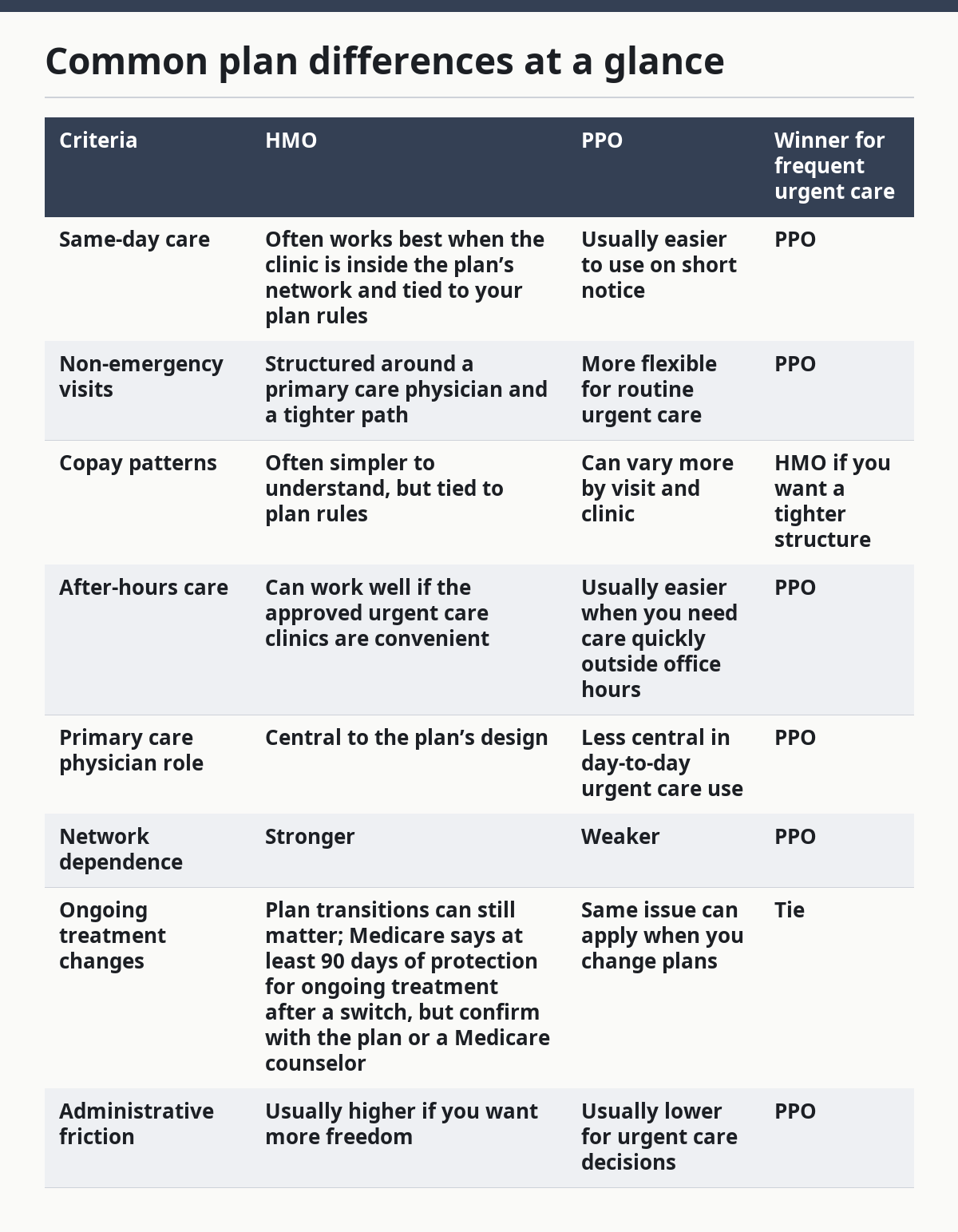
Common plan differences at a glance
| Criteria | HMO | PPO | Winner for frequent urgent care |
|---|---|---|---|
| Same-day care | Often works best when the clinic is inside the plan’s network and tied to your plan rules | Usually easier to use on short notice | PPO |
| Non-emergency visits | Structured around a primary care physician and a tighter path | More flexible for routine urgent care | PPO |
| Copay patterns | Often simpler to understand, but tied to plan rules | Can vary more by visit and clinic | HMO if you want a tighter structure |
| After-hours care | Can work well if the approved urgent care clinics are convenient | Usually easier when you need care quickly outside office hours | PPO |
| Primary care physician role | Central to the plan’s design | Less central in day-to-day urgent care use | PPO |
| Network dependence | Stronger | Weaker | PPO |
| Ongoing treatment changes | Plan transitions can still matter; Medicare says at least 90 days of protection for ongoing treatment after a switch, but confirm with the plan or a Medicare counselor | Same issue can apply when you change plans | Tie |
| Administrative friction | Usually higher if you want more freedom | Usually lower for urgent care decisions | PPO |
When does an HMO fit a freelancer better?
An HMO wins when a freelancer wants a tighter care path and is fine using a primary care physician as the starting point. If you already know where your urgent care clinic is, and you are not trying to shop the whole city every time you need care, an HMO can be a clean fit.
That is especially true if your urgent care use is repeat but routine. Some people use urgent care because they want fast treatment for the same kinds of problems over and over, and a licensed benefits counselor can help you confirm whether an HMO’s network and copays match that pattern. If that sounds like you, the HMO’s structure may feel less like a burden and more like a guardrail.
The weak spot is choice. If you need to decide on the fly, a plan that asks you to stay in one network can become annoying fast. A freelancer who works odd hours, changes locations a lot during the week, or likes to make quick decisions may feel boxed in by the HMO model.
So if you switch plans while already getting treatment, Medicare says you may have at least 90 days before the new plan can require new prior approval for ongoing treatment, but you should verify the timeline with Medicare or the plan itself. That matters for freelancers who are in the middle of care and thinking about changing coverage at the same time. It does not make an HMO bad; it just means the timing of a switch can matter as much as the plan itself.
HMO pros and cons for urgent care users
Pros
- Can fit a freelancer who likes a clear care path.
- Often works well when a primary care physician is part of the routine.
- Can feel straightforward if your urgent care visits stay inside the plan’s network.
Cons
- Less flexible when you need a visit on short notice.
- Can be awkward if you do not want to route care through a primary care physician.
- Not ideal for freelancers who want the widest choice after hours.
Who should skip it: freelancers who use urgent care often and want the easiest possible same-day choice, especially if they dislike plan rules that shape where they can go.
When does a PPO win for urgent care?
A PPO wins when a freelancer values convenience more than structure. If urgent care is part of your life because you work late, travel between jobs, or simply do not want to think hard when you are sick, the PPO’s looser design usually matches that reality better.
The biggest strength is practical: you can usually move faster from symptom to clinic without worrying as much about whether the plan path is perfect. That matters for after-hours care, when the last thing you want is to decode a plan booklet. For a quick check on how a plan works, compare its provider directory and benefits summary before you need care.
The downside is that more freedom can make the plan feel less tidy. Copay patterns may be less simple, and the plan may not feel as easy to predict at a glance. For some freelancers, that trade-off is worth it. For others, it creates more uncertainty than they want.
A PPO is also the better fit if you do not want your primary care physician to sit at the center of every decision. That does not mean you ignore primary care. It means your plan does not make urgent care feel like a detour through a gatekeeper every time.
PPO pros and cons for urgent care users
Pros
- Better fit for frequent same-day care.
- Easier to use when you need a visit after hours.
- Less likely to feel restrictive when you are choosing a clinic fast.
Cons
- Copay patterns may be less simple.
- More choice can mean more decisions at the worst time.
- Can tempt you to use urgent care as your default instead of your backup.
Who should skip it: freelancers who want a more controlled setup, already know they will stick to one care path, and prefer the feeling of a tighter plan structure.
What does the side-by-side look like?
The side-by-side answer is simple: PPO wins on flexibility, HMO wins on structure. For a freelancer who uses urgent care often, flexibility usually matters more because the whole point of urgent care is getting seen quickly for a non-emergency problem.
That said, the better plan is not always the broader one. If you already have a primary care physician you trust and you do not mind following the plan’s path, an HMO can be enough. The real question is not “Which plan is better on paper?” It is “Which plan will feel easier on a Tuesday night when you need care now?”
Because the federal framework for HMOs and PPOs still shapes how these plans operate, the practical difference is not just historical. It is built into network rules, referral habits, and how quickly you can act when something comes up. CMS and Medicare both publish plan guidance that helps with the comparison.
Comparison table
| Criteria | HMO | PPO | Winner for frequent urgent care |
|—|—|—|—|
| Fast access for same-day care | Can be fast if the approved clinic is a good fit | Usually easier to use with less planning | PPO |
| Need for a primary care physician | More central | Less central | PPO |
| After-hours convenience | Depends more on the plan’s clinic setup | Usually better for quick decisions | PPO |
| Copay clarity | Often easier to understand | Can be less uniform | HMO if simple structure matters |
| Network reliance | Stronger | Looser | PPO |
| Non-emergency visits | More managed | More flexible | PPO |
| Fit for repeat urgent care use | Good if you like rules and a stable clinic | Better if you want fewer steps | PPO |
| Fit for a structured care routine | Strong | Moderate | HMO |
| Protection during plan changes | Medicare says at least 90 days for ongoing treatment after switching, but confirm the details with the plan or a Medicare counselor | Same rule framework matters | Tie |
When should I reconsider the choice entirely?
A freelancer should reconsider both plans when urgent care is no longer the main issue and the care path itself has changed. If your visits are becoming part of ongoing treatment instead of one-off same-day care, the urgent care question stops being the whole story.
That is where the Medicare 90-day rule matters again. If you switch plans while you are already getting treatment, you may have at least 90 days before the new plan can require new prior approval for ongoing treatment. If that situation applies, plan timing deserves as much attention as plan type. Check with Medicare or the plan administrator before you rely on the rule.
You should also rethink the choice if your urgent care use is really a sign that you need a better primary care setup. A plan with a nicer urgent care copay does not fix poor follow-up care. If the same issue keeps coming back, the plan should not be chosen only for the after-hours visit you hope will happen next.
Another reason to pause: if you almost never use urgent care, the whole comparison matters less. In that case, choosing a plan just because one visit feels easier is not enough. But for frequent users, the difference is real, and the wrong structure gets annoying quickly.
The verdict: which one to choose and why?
Choose PPO if you use urgent care often, want quicker same-day decisions, and do not want a primary care physician to sit in the middle of every minor illness. Choose HMO if you are happy staying inside a tighter network, prefer a more managed care path, and already know your urgent care routine.
Neither if you need a plan mainly for ongoing treatment and are choosing only around urgent care convenience. In that case, the plan should be judged on the whole care path, not just the clinic you visit after hours.
For the hub page on HMO vs PPO for freelancers, this urgent-care question is the practical one that matters most: if speed and flexibility drive your real-world use, PPO usually wins.
Do HMO and PPO plans treat urgent care differently?
Yes, they do, because the rules around where you go and how you get there are usually different. An HMO is more structured and usually keeps your primary care physician in the center. A PPO is looser, which usually makes urgent care easier to use when you need same-day, non-emergency care.

Is urgent care in network on both HMO and PPO plans?
Usually urgent care is handled through the plan’s network rules, but the plan type changes how tightly those rules are applied. An HMO is typically more dependent on staying inside the network, while a PPO is usually more flexible. The exact clinic list matters, so the plan details matter too.
Should a freelancer use urgent care as a tie-breaker?
Yes, if urgent care is a regular part of life for you. A freelancer who uses it often should usually lean PPO because convenience matters more when you need after-hours care fast. If you almost never go and like a more managed setup, an HMO can still be the better fit.
Drafted with AI; not yet reviewed by a person.