
Last updated: November 27, 2026
Quick answer: an HMO usually uses 1 primary care step before specialist care, while a PPO often lets you book a specialist directly. For How HMO and PPO referrals work when a freelancer needs specialist care, that difference changes how fast you get an appointment, how many calls you make, and whether a visit becomes a bill you did not expect.
Key takeaways
- HMOs usually put the primary care physician in the middle of the process.
- PPOs usually cut out one step, so you can often book a specialist sooner.
- The referral rule matters most when you need care from more than 1 specialist or the specialist is out of network.
- A freelancer should check the plan’s referral rule before the first appointment, not after the claim is denied.
- The right plan is the one that matches how often specialist care shows up in your year, not just the size of the list of doctors.
What changes between HMO and PPO referrals?
An HMO usually requires a referral from a primary care physician before you see a specialist, while a PPO often does not. That one rule changes the whole workflow: one plan turns specialist care into a 2-step process, and the other often makes it a 1-step process.
Here is the practical difference for a freelancer who needs specialist care.
| Item | HMO | PPO |
|---|---|---|
| First step | See primary care physician first | Often book specialist directly |
| Referral requirement | Common | Less common |
| Role of primary care physician | Gatekeeper | Usually less central |
| Out-of-network specialist care | Often limited and harder to use | Often more available, but usually costs more |
| Best fit | People okay with a managed route | People who want faster direct access |
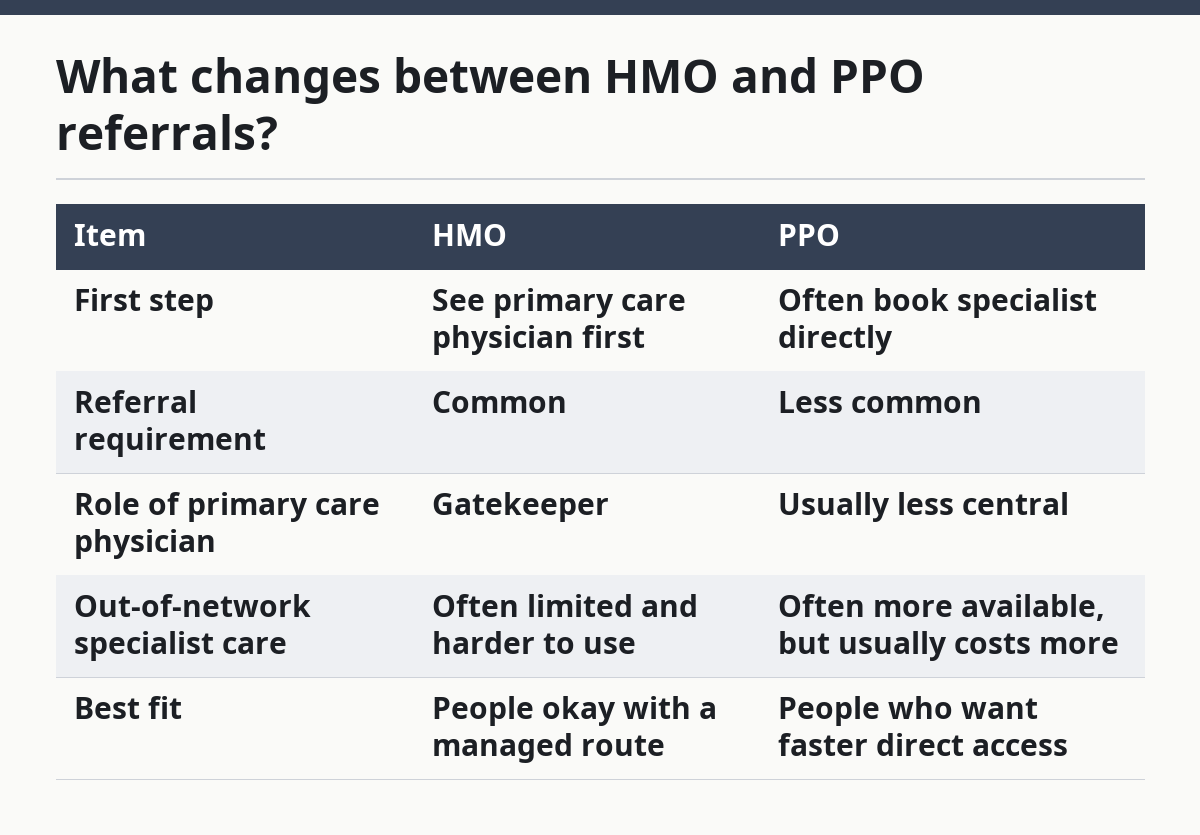
The trade-off is simple. An HMO can mean more control and fewer off-plan detours, but it can also mean 2 appointments before you reach the doctor you really need. A PPO can feel quicker because it removes one barrier, but that freedom does not erase cost-sharing or the plan’s rules for outside specialists.
For a freelancer, the choice is not abstract. A missed workday for one extra appointment matters more when your income is tied to billable hours, contracts, or project deadlines. If specialist care tends to come up in a rush, a PPO-style referral setup is usually easier to live with. If you rarely need specialist care and you want a tighter process, an HMO may fit better.
How does an HMO referral work?
An HMO referral works by routing you through the primary care physician before the specialist visit. In plain terms, you book the first appointment, explain the problem, and the primary care physician decides whether a specialist should see you.

The usual sequence looks like this:
- Book with the primary care physician first. This is the starting point for the plan, not the specialist’s office. The result is that the plan has a record of why you need the next step.
- Describe the symptom or condition clearly. Bring a timeline, test results, or prior records if you have them. That can shorten the visit from a vague conversation into a focused decision.
- Ask whether the specialist visit needs a referral. Some care needs 1 referral, some needs a separate approval path, and the office staff often knows the plan’s routine. The result should be a clear next move, not a guess.
- Wait for the referral to be sent. The primary care physician’s office usually sends it to the specialist or to the plan. If it is not sent, check with a professional, because the specialist may otherwise treat the visit as self-referred. A plan brochure or member services line can help confirm the rule.
- Book the specialist visit only after the referral is in place. This lowers the risk of a claim being handled as non-covered or out of process.
The biggest HMO mistake is assuming “I have a specialist appointment” means “I am covered.” On an HMO, the referral is often part of the coverage path, not just paperwork. If you skip it, the cost can land on you instead of the plan.
A second mistake is waiting until the specialist office asks for the referral. By then, you may already have spent time on a visit that needs to be rescheduled. That costs more than the office call you wanted to avoid, especially if your schedule is built around 1 or 2 client meetings that day.
If you are on an HMO, the primary care physician is not just a general doctor. In referral flow, that office is the traffic controller.
How does a PPO referral work?
A PPO referral usually does not block you from seeing a specialist first, so the specialist visit can start with a direct appointment. That is the main reason many freelancers prefer PPOs when they expect occasional specialist care.

The workflow is usually shorter:
- Check whether the specialist is in network. This matters because PPOs often still reward in-network care with lower cost-sharing. The result is a cleaner bill.
- Call the specialist office directly. Many PPO members can do this without first seeing a primary care physician.
- Ask whether the plan still wants a referral for that service. Even when the plan allows direct access, certain visits or services may still have plan-specific rules.
- Schedule the visit if the office confirms your plan will accept it. This keeps the appointment from turning into a back-and-forth between offices.
- Use the primary care physician when it helps, not because the plan forces it. Some freelancers still want a primary care physician to coordinate records, but the PPO often does not make that step mandatory.
The main benefit is speed. You can often skip a whole appointment before the real appointment. That matters when the specialist is for a short, specific issue, such as a skin concern, a joint problem, or a one-time evaluation.
The drawback is easy to miss: direct access is not the same as unlimited freedom. A PPO can still cost more for out-of-network care, and a specialist office may still ask for chart notes, test results, or plan details before booking. The process is lighter, not friction-free.
PPOs are usually the better fit for a freelancer who values direct access and does not want to turn every specialist visit into a referral chain. They are not the right choice for someone who wants the lowest-cost structure at the expense of flexibility.
What happens if the specialist is out of network?
If the specialist is out of network, the bill and the booking rules can change fast, and the difference between an HMO and a PPO becomes obvious. An HMO often makes outside specialist care harder to use, while a PPO may allow it, but usually with higher cost-sharing.

For an HMO, out-of-network specialist care is often the most difficult path. The plan may not cover it in the usual way, or it may require a narrow exception. That means a freelancer can face delays before the appointment even happens.
For a PPO, out-of-network access is often more open, but the open door can still be expensive. The specialist may bill at a higher rate, and the plan may cover less of it. That is where many freelancers get caught: they see the word “PPO” and assume any specialist will work the same way.
The practical rule is simple. If the specialist is out of network, ask 3 questions before booking: will the plan cover the visit, will the specialist bill you directly, and does the referral change anything. Those 3 questions can save you from a surprise later.
This is also where a freelancer should slow down and read the office script carefully. A receptionist saying “we take your plan” does not always mean the specialist is in network or that the visit follows your plan’s referral rules. Those are 2 different things.
Which plan is easier for a freelancer?
A PPO is usually easier for a freelancer who wants faster specialist access, while an HMO is usually easier for someone who is fine with a primary care physician first. The “easier” plan depends on how much control the freelancer wants over the first appointment.
Here is the comparison that matters most at the point of care:
| Situation | HMO | PPO |
|---|---|---|
| Need to see specialist quickly | Slower because of referral step | Often faster because direct booking is possible |
| Want one doctor to coordinate care | Strong fit | Possible, but not built around it |
| Expect rare specialist visits | Can work well | Can also work well |
| Expect repeated specialist visits | Referral step can get old fast | Usually less friction |
| Want fewer surprises from process | Clear, but controlled | Flexible, but you must check more details |
The HMO is a better fit when the freelancer wants structure and does not mind the primary care physician acting as a gatekeeper. It can also fit people who are comfortable with a 2-step process for most specialist care.
The PPO is a better fit when the freelancer wants more direct control over appointments and does not want to ask permission every time a specialist is needed. It is not automatically cheaper or easier in every case, but it usually reduces the referral hassle.
The wrong choice is the one that conflicts with how you actually use care. A freelancer who needs specialist visits only once in a long while may tolerate HMO rules without much trouble. A freelancer with recurring specialist needs may find the referral loop draining, especially if every visit means another call, another message, and another delay.
If you want the broader freelancer comparison, this article sits under the hub on HMO vs PPO for freelancers, which is the right place to judge the bigger plan fit before looking at one referral rule.
What should I do before I book?
Before you book, confirm the referral rule, the specialist’s network status, and whether the first visit needs the primary care physician at all. This 3-point check can help you avoid a wasted appointment.
Use this order:
- Check the plan type. HMO and PPO do not handle referrals the same way.
- Find the specialist’s network status. In-network care is usually simpler than out-of-network care.
- Ask whether a referral is required for this exact service. Not every visit follows the same rule.
- Call the specialist office. The office can often tell you what the plan usually wants.
- Keep the referral record. If the office sends a note or the plan shows it in your file, save it.
The common mistake here is assuming the front desk and the insurance rule are the same thing. They are not. A scheduler may know how to book the visit, but not how the plan will process the claim. That difference can cost you a rescheduled appointment or a denied claim.
For a freelancer, the time cost matters as much as the money cost. A 15-minute call now is cheaper than a canceled specialist visit later. It also keeps you from losing a work block to a problem that should have been checked before booking.
How do I choose between them?
Choose the HMO if you want a primary care physician to direct specialist care and you are fine with a referral step. Choose the PPO if you want more direct specialist access and less gatekeeping.
I would steer a freelancer toward the PPO when specialist access is likely to matter on short notice, because the direct-booking path is usually simpler to live with. I would steer a freelancer toward the HMO when specialist care is occasional and the person prefers a more managed setup.
The main drawback of a PPO is that flexibility can hide higher costs, especially out of network. The main drawback of an HMO is that the referral step can slow you down when you need care quickly. Neither plan is “better” in the abstract. The better one is the one whose referral rules match the way you actually get medical care.
For more on the broader HMO vs PPO choice for freelancers, the hub article is the next place to go.
What do the referral rules mean in real life?
Referral rules mean the difference between calling 1 office and calling 2, between booking today and waiting for a primary care physician’s sign-off, and between a straightforward claim and one that needs extra review. For a freelancer, that difference can shape an entire workweek.

A simple example: if you need specialist care on a Tuesday and your HMO requires a referral, the earliest path may start with the primary care physician first. If you have a PPO and the specialist is in network, you may be able to skip that first stop. That does not guarantee a faster appointment, but it often makes the process shorter. CMS and plan documents both describe network and referral rules as plan-specific, so the exact outcome depends on the policy.
The best way to think about it is this: HMO referral rules create a guided path; PPO referral rules often leave the door open sooner. If the freelancer wants the simplest route to specialist care, the PPO usually wins on access. If the freelancer wants the plan to keep the process tightly managed, the HMO can make sense. HealthCare.gov notes that HMOs commonly require members to use in-network doctors and may require referrals, while PPOs usually allow more choice, though often at a higher cost.
What should I do if my specialist visit is urgent?
If the visit is urgent, call the specialist office and the plan right away, because the referral rule does not always pause for your schedule. The first answer should be whether the visit can be seen without the usual referral step or whether the primary care physician must send something first. Medicare and other plan guidance recommend checking urgent-care rules with the plan or provider as soon as possible.
Can I use an old referral?
An old referral may not be usable, since referral rules can be tied to a specific visit, problem, or time window. Ask the primary care physician’s office whether that referral still matches the specialist visit you want to book, and confirm with the plan if the office is unsure.
What if the office says no referral is needed but the plan says yes?
The plan wins if the claim is processed under its rules, so a mismatch can still cost you. Ask the specialist office to confirm the exact service and ask the plan to confirm whether the referral is required before you go in.
Drafted with AI; not yet reviewed by a person.