
Last updated: November 27, 2026
Quick Answer: a PPO is usually easier to use in an emergency, while an HMO can still cover emergency room care when you need it most. For a freelancer comparing HMO vs PPO for freelancers: which plan is easier to use in an emergency?, the real difference is not “Can I go to the ER?” but “How much hassle will I face before and after stabilization?” A PPO usually gives more room to act fast, especially out of area; an HMO can work fine if the emergency is true emergency care and you follow up with the plan’s rules. For a closer look at plan terms, see HealthCare.gov’s HMO and PPO glossaries: https://www.healthcare.gov/glossary/health-maintenance-organization-hmo/ and https://www.healthcare.gov/glossary/preferred-provider-organization-ppo/
Key takeaways
- A real emergency is treated first, then insurance rules matter more during follow-up than during stabilization; if you are unsure how your plan handles the bill, check the plan documents or a licensed insurance professional, and see HealthCare.gov’s emergency coverage guidance: https://www.healthcare.gov/glossary/health-emergency-services/
- A PPO is usually simpler for freelancers who travel, work in different cities, or want fewer referral steps after an ER visit.
- An HMO can still be a good choice if you mainly stay local and want lower-friction primary care, but it can be stricter after the crisis passes.
- The biggest trap is not the ER bill itself; it is the surprise you get when the plan starts asking about out-of-network care, referrals, or follow-up visits.
- If you often work far from home, a PPO is usually the safer pick for emergency use.
What matters in an emergency?
Therefore, a PPO is easier to use in an emergency because it usually creates fewer barriers when time is tight. In a true emergency, the question is not which plan sounds better on paper; it is which plan lets you get to the emergency room, get stabilized, and deal with the claim later without extra paperwork. If you need plan-specific guidance, a licensed insurance professional can help you interpret the rules.
The key term is stabilization. Federal guidance on emergency services generally says plans must cover emergency care in a way that protects life or health, and the patient can be treated before the insurance dispute gets sorted out; if you need the exact application of those rules, verify your plan or ask a licensed professional. HealthCare.gov explains this emergency-care rule in its coverage guidance, and the Centers for Medicare & Medicaid Services also treats emergency services as urgent, immediate care. See: https://www.healthcare.gov/glossary/health-emergency-services/ and https://www.cms.gov/
For freelancers, the setting matters. If you are at a client site, on a train, or halfway across the state, a PPO is usually easier because it is more forgiving when the nearest ER is not in your usual care circle. An HMO can still cover the ER visit, but the plan may be less forgiving once you leave the emergency room and need follow-up care.
Here is the practical rule: if the situation is life-threatening, both plans should generally get out of the way long enough for treatment, but you should still confirm the details with your insurer or a licensed professional. The difference shows up after stabilization, when the plan decides how the rest of the care is handled.
For reference, HealthCare.gov has a plain-language explanation of emergency coverage, and its HMO and PPO glossary pages are useful background:
https://www.healthcare.gov/glossary/health-emergency-services/
https://www.healthcare.gov/glossary/health-maintenance-organization-hmo/
https://www.healthcare.gov/glossary/preferred-provider-organization-ppo/
HMO vs PPO for emergency care: the honest comparison
However, an HMO is usually more restrictive, and a PPO is usually more flexible. That is the whole emergency story in one line. For a freelancer, flexibility is the thing that buys peace of mind when you are away from home or do not know which doctor is in your local directory.
| Criteria | HMO | PPO | Winner for emergency use |
|---|---|---|---|
| Getting to the ER fast | You can usually go in a real emergency, but the plan may be stricter later. | You can usually go in a real emergency with fewer concerns about where the ER is located. | PPO when you are away from home |
| Out-of-area emergencies | Can be workable, but the rules may tighten after stabilization. | Usually easier when the emergency happens outside your normal area. | PPO |
| Stabilization | Emergency stabilization is the priority, then the plan may steer what happens next. | Emergency stabilization is still the priority, with more room to continue care. | Both, with less friction on PPO |
| Post-ER follow-up | More likely to require you to stay within the plan’s rules and usual care route. | Usually easier to see a follow-up specialist without as many gatekeeping steps. | PPO |
| Need for referrals | Often more structured and referral-driven. | Usually less dependent on referrals. | PPO |
| Paperwork after the visit | Can be more rule-heavy, especially if any part of care falls outside the network. | Usually simpler if you need care outside your main provider list. | PPO |
| Routine care after the emergency | Good if you want a fixed local doctor to coordinate everything. | Better if you want more choice in who handles the follow-up. | Depends on your setup |
| Best fit for freelancers who travel | Less ideal unless travel is rare and local care is easy to reach. | Better fit for people who work in multiple cities or change locations often. | PPO |
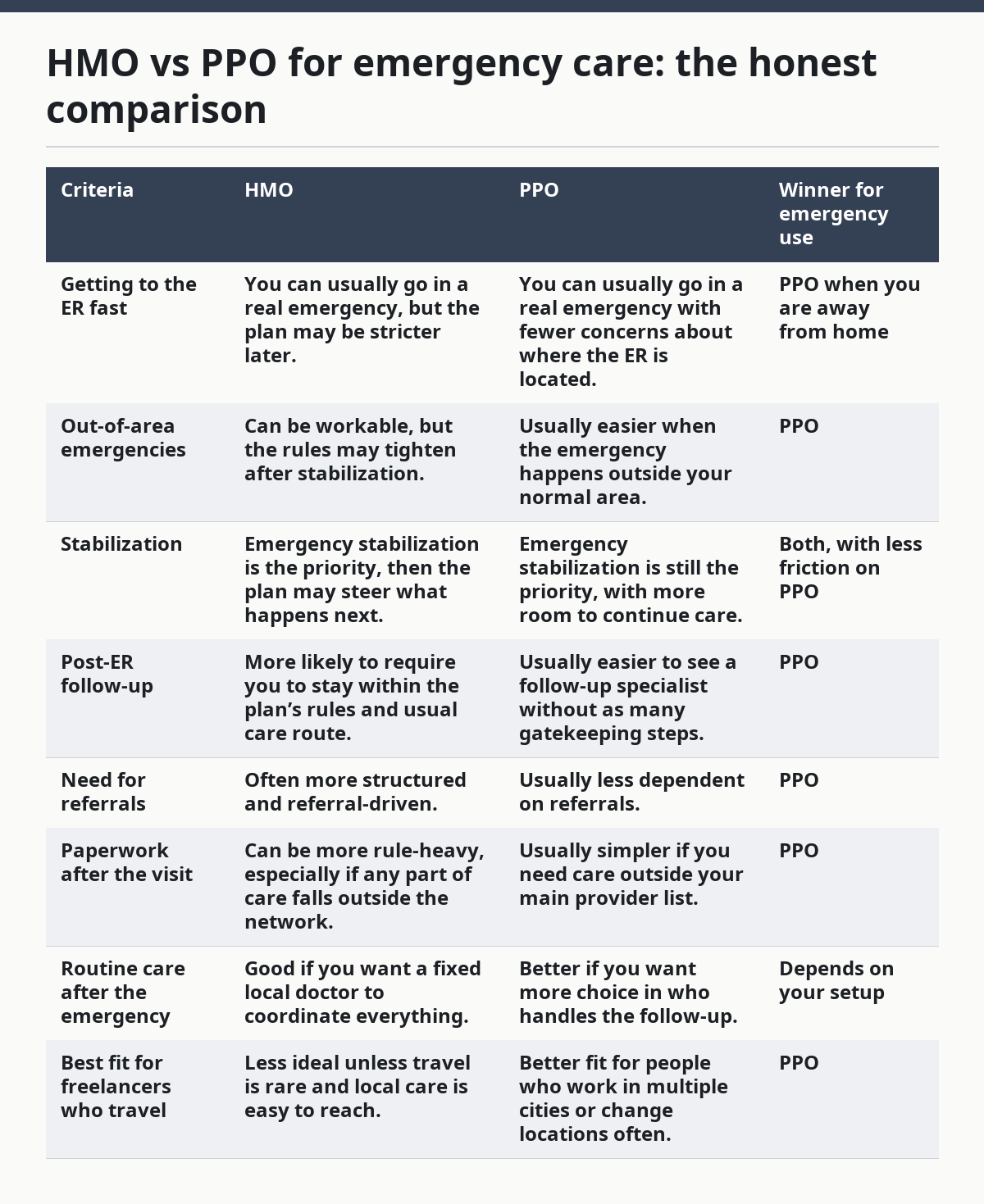
So the table points to the same conclusion: a PPO is easier to use in an emergency because it is less likely to punish you for being in the wrong place at the wrong time. An HMO is not a bad emergency plan by default, but it asks more of you once the immediate danger has passed.
The real trade-off is not abstract. It is the difference between a plan that fits a narrow care path and a plan that gives you more room when your day goes off script. Freelancers tend to live with more schedule swings, more travel, and fewer chances to predict where care will happen.
Why an HMO can still work
Therefore, an HMO can still be a sensible choice if your life is mostly local and your emergency risk is straightforward. If you live and work in one city, already have a primary doctor, and do not want a plan that feels loose, an HMO can keep your care more organized.
The strength of an HMO is structure. That structure can help after the ER visit, because you know which doctor is supposed to manage the next step. If your emergency leads to a short follow-up run of visits, a single local system can be easier to keep track of than a wider, looser setup.
That said, the same structure can become a drawback in a hurry. If you are out of town when the emergency hits, or if you need a specialist fast after stabilization, an HMO may feel less convenient. A freelancer who works in a few locations, takes last-minute trips, or relocates every year should think hard before choosing an HMO for emergency use.
The right HMO user is someone whose day-to-day life is stable and local. The wrong HMO user is someone who expects to need care far from home and wants the least possible friction after an ER trip. A plan that is tidy on paper can feel narrow when the clock is running.
Why a PPO is easier after the crisis starts
Meanwhile, a PPO is the better emergency-use plan for most freelancers because it is built for less rigid decision-making. That matters when you are not at home, do not know the local doctors, or need to move from the ER to follow-up care without delay.

The main advantage is flexibility. A PPO usually gives you more ways to get care without making every step depend on one primary path. That is useful after stabilization, when you may need imaging, a specialist, or a recheck visit and do not have time to sort through a maze of rules.
This does not mean a PPO is carefree. Out-of-network care can still create problems, and the plan still has rules. A freelancer should not read “PPO” as “anything goes.” It means the plan is usually less likely to trap you if the emergency happens in the wrong place or at an inconvenient time.
The person who should choose a PPO is the freelancer whose work life is messy in the calendar sense: travel, client visits, temporary moves, and changing cities. The person who should skip it is the freelancer who never leaves one area and would rather accept more structure in exchange for a simpler doctor relationship.
The honest side-by-side
Overall, a PPO wins on emergency convenience, while an HMO wins on structure. That is the cleanest way to think about it, and it is especially true for freelancers who may not know where they will be when something goes wrong.
Pros and cons help here more than slogans.
HMO pros
- Clearer care path if you stay local.
- Better fit for a freelancer who wants one main doctor to coordinate care.
- Can keep follow-up organized after the ER visit.
HMO cons
- Less forgiving if the emergency happens away from home.
- More likely to feel restrictive after stabilization.
- Not the easiest choice if you want minimal friction during a chaotic week.
PPO pros
- Easier to use when the emergency happens in a different city.
- Usually simpler for post-ER care and specialist follow-up.
- Better for freelancers whose work locations change often.
PPO cons
- Can still involve out-of-network problems.
- May not feel worth it if your life is predictable and local.
- Can tempt people to assume every provider choice is equally easy, which is not true.
The table below sums up the decision more tightly.
| Question that decides it | Pick HMO if… | Pick PPO if… |
|---|---|---|
| Do you travel for work? | Rarely | Often |
| Do you want the easiest emergency handoff? | Not your top priority | Yes |
| Is your care mostly local? | Yes | No |
| Do you want a fixed doctor to steer follow-up? | Yes | No, or not always |
| Do you want less friction after an ER visit? | Not essential | Essential |
Who should choose which plan?
Therefore, choose an HMO if your work stays close to home, your doctor is nearby, and you are comfortable trading flexibility for a more controlled care path. An HMO can be fine for emergency care if your main concern is a local system that manages follow-up neatly after the ER visit.
Choose a PPO if you want the easiest emergency setup for a freelance life that can shift without warning. A PPO is the stronger choice if you work in more than one city, travel for client work, or want a plan that is less likely to make a bad day worse.
Neither plan is right if you expect to rely on care across borders or spend long periods far from your usual doctors without checking the fine print first. Emergency care rules help, but they do not erase every network rule, referral rule, or follow-up rule. The wrong plan for your lifestyle can still turn a simple ER trip into a paperwork problem.
If the main website page in this cluster already taught the broad HMO vs PPO basics, this article fills the emergency-care gap that matters when you are deciding under pressure.
When does the answer change?
However, the answer changes in a few specific cases. If your HMO has unusually strong local coverage and you never leave that area, the HMO can be easier to live with because all the follow-up happens in one place. If your PPO has a weak provider setup where you live, the added flexibility may not feel as useful in daily life.
If you are dealing with a planned relocation, the safer choice can change again. A move means you may not want to be locked into a narrow local path before you know where you will receive care. In that case, the flexibility of a PPO is often worth more than the tidy structure of an HMO.
A final case is a freelancer who almost never needs specialist care and only wants emergency protection. If the whole goal is “cover me if something bad happens,” then the easiest emergency access usually wins over the more organized plan.
That said, if you already know you need tightly coordinated care after a major event, the HMO structure can be useful. The emergency room is only the first stop; the next 2 or 3 appointments are where plan design starts to matter again.
The verdict
Finally, choose PPO if you want the easier plan to use in an emergency, especially if you travel, work in more than one place, or want fewer barriers after stabilization. Choose HMO if you stay local, want a more organized follow-up path, and are willing to accept tighter rules. Neither if you expect frequent out-of-area care and have not checked how the plan handles emergency and follow-up visits.

Do HMOs cover emergency room visits?
Yes, HMOs generally cover emergency room care when the situation is a true emergency. The important part is that emergency treatment comes first and stabilization comes before the plan starts sorting out network details, but if you need plan-specific guidance, confirm the rules with your insurer or a licensed professional. The follow-up after the ER visit is where HMO rules can become stricter, so the visit itself is not the whole story. See HealthCare.gov’s emergency coverage page: https://www.healthcare.gov/glossary/health-emergency-services/
Does PPO change emergency care access?
Yes, a PPO usually makes emergency care easier to use because it gives more flexibility about where you get treated and how you handle follow-up. The emergency room still comes first in a real emergency, but the PPO usually creates fewer barriers afterward. That can matter a lot for freelancers who are away from home. If you want to compare plan types directly, see HealthCare.gov’s PPO glossary: https://www.healthcare.gov/glossary/preferred-provider-organization-ppo/
What should freelancers know before a trip or relocation?
For instance, freelancers should check how the plan treats emergency room care, stabilization, and post-emergency follow-up before they travel or move. A plan may be fine for one city and inconvenient in another. If the trip or relocation is coming soon, a PPO is usually the safer choice because it gives more room when care happens away from home.
Drafted with AI; not yet reviewed by a person.