
Last updated: November 20, 2026
Quick Answer: Freelancers comparing deductibles, copays, and coinsurance should start with the out-of-pocket maximum, then check the deductible, then compare copays and coinsurance. This topic is about how freelancers compare deductibles, copays, and coinsurance before choosing a plan.
Key Takeaways
- Compare the out-of-pocket maximum first, then the deductible, copays, and coinsurance.
- A deductible matters most when you expect more than a basic annual checkup.
- Copays are easier to predict for routine care and recurring visits.
- Coinsurance matters most after the deductible on larger claims.
Freelancers comparing a health plan often get stuck on one thing: the plan with the lowest deductible is not always the cheapest to use. The right choice depends on how often you expect to see care, how predictable your visits are, and how much you can pay before the plan starts helping. This guide on how freelancers compare deductibles, copays, and coinsurance before choosing a plan settles that trade-off.
Our Top 3 Picks at a Glance

- #1 Best Overall: A plan with a moderate deductible, clear copays for common visits, and a coinsurance rate you can live with after the deductible.
- #2 Best Budget Pick: A plan with lower monthly premiums and a deductible you can actually afford to meet in a bad month.
- #3 Best Heavy-Duty / Upgrade Pick: A plan with a higher premium but a stronger out-of-pocket maximum for people who expect surgery, imaging, or ongoing treatment. If you are weighing this kind of upgrade, consult a licensed broker or benefits professional and review plan documents carefully.
How freelancers compare deductibles, copays, and coinsurance before choosing a plan
Freelancers should compare the out-of-pocket maximum first, then the deductible, then the copays and coinsurance. That order matters because a plan’s cost-sharing design decides how pain gets spread across the year, not just how much you pay at the doctor’s office. For a 2024 Marketplace plan, the federal out-of-pocket maximum for in-network essential health benefits can be as high as $9,450 for an individual and $18,900 for a family.
Source: HealthCare.gov — https://www.healthcare.gov/glossary/out-of-pocket-maximum-limit/
The truth is, many people shop the monthly premium and miss the part that bites later. A $30 copay feels easy, but a 20% coinsurance bill on a hospital claim can be much rougher. A deductible sits in the middle: it’s the amount you pay before the plan starts sharing most costs on covered services. The Kaiser Family Foundation reports the average employer deductible for single coverage was $1,787 in 2024, up from $1,644 in 2023.
Source: KFF Employer Health Benefits Survey — https://www.kff.org/report-section/ehbs-2024-section-7-worker-and-employer-contributions-for-premiums/
Here’s the catch: freelancers often need a plan that handles both quiet months and ugly ones. The best plan for a solo designer with one annual checkup is not the best plan for a contractor with physical therapy, scans, or a chronic condition. A single annual visit can make a high-deductible plan look fine, while repeated care can shift the balance fast.
The one sentence that matters most
A plan with a lower deductible can still cost more overall if its copays are high and its coinsurance stays steep after the deductible.
- Deductible: what you pay first for many covered services.
- Copay: a fixed amount for a visit or prescription.
- Coinsurance: a percentage of the bill after the deductible.
- Out-of-pocket maximum: the ceiling on your covered spending for the year.
Deductible: the part freelancers feel first

A deductible is the first big hurdle, and it matters most if you expect anything beyond a basic annual checkup. Picture this: you’re self-employed, income is uneven, and one slow month lands right before a specialist visit. The deductible decides whether that visit feels manageable or like a shock.
Lower deductibles help if you expect surgery, imaging, maternity care, or a year full of appointments. Higher deductibles can work if you mainly want protection from disaster and can handle routine costs yourself.
Pros of a lower deductible
- You reach plan help sooner.
- Bigger claims start sharing costs earlier.
- Less risk of paying a lot before coverage kicks in.
Cons of a lower deductible
- Plans with lower deductibles often cost more in monthly premium.
- You may pay for coverage you barely use.
- It can still leave you with copays and coinsurance after the deductible.
Who should skip this focus: A freelancer who almost never uses care and wants the leanest monthly bill may do better studying copays and the out-of-pocket maximum instead.
Copays: the easiest part to predict
A copay is the most readable cost-sharing term, and it wins for freelancers who want predictable bills for routine care. Picture this: you need a primary care visit, a therapy session, or a refill, and you want to know the cost before you book. A copay gives you that number.
Copays usually make everyday care easier to budget. That helps freelancers with recurring appointments, regular prescriptions, or a calendar full of small health expenses. The downside is simple: a plan can advertise friendly copays and still be expensive elsewhere.
Pros of copays
- Easy to predict.
- Good for frequent small visits.
- Better for budgeting month to month.
Cons of copays
- Copays do not protect you from large bills by themselves.
- Some services may still hit the deductible first.
- A plan with low copays can hide a high deductible or weak coinsurance.
Who should skip this focus: A freelancer facing a planned procedure should not pick a plan on copays alone. The better fit is a plan with a stronger deductible and coinsurance story.
Coinsurance: the piece that can turn expensive fast
Coinsurance is the share of the bill you owe after the deductible, and it matters most for big claims. Since a deductible and a hospital bill often show up together, this is where costs can jump quickly. Picture this: you’ve already met part of your deductible, then a scan, outpatient surgery, or hospital stay arrives. That’s where coinsurance decides whether the next bill is tolerable or brutal.
Lower coinsurance is better for expensive care because you keep less of the bill. Higher coinsurance can look harmless on paper, then sting when the service itself is costly. This is why freelancers who expect significant care should look past the monthly premium and read the coinsurance line with care.
Pros of lower coinsurance
- Better for large claims.
- Reduces the damage after you meet the deductible.
- Helps if you expect specialist-heavy care.
Cons of lower coinsurance
- It may come with a higher premium or tighter plan design.
- It still does not help before the deductible.
- A bad out-of-pocket maximum can erase the advantage.
Who should skip this focus: A freelancer with only rare, low-cost visits may not get much value from obsessing over coinsurance if the deductible and copays already fit the budget.
The honest side-by-side
Deductible wins when you need to know how much pain comes before coverage starts. Copays win when routine visits are the main issue. Coinsurance wins when the real fear is a large claim. Picture this: you are comparing two health plans and trying to pick the one that will hurt least in a normal year and a bad year. This table is the shortest path to a real answer.
| Criteria | Deductible | Copay | Winner for this condition |
|---|---|---|---|
| Predicting a routine doctor visit | Harder to forecast | Fixed amount is easier to plan for | Copay |
| Handling a year with one major claim | Sets the first barrier | May matter less on big services | Deductible |
| Cost after the deductible is met | No direct role | May still apply to office visits or drugs | Copay |
| Cost of imaging or surgery | Starts the share of expenses | Often not the main charge | Deductible |
| Exposure to a large bill | Can be high early in the year | More limited on its own | Copay |
| Handling expensive claims after the deductible | Does not control the share rate | Usually less important than coinsurance | Coinsurance |
| Budgeting with uneven freelance income | Can be hard if it is very high | More predictable for small care | Copay |
| Protection in a bad health year | Works only up to the deductible | May not stop large bills | Coinsurance |
| Short-listing plans fast | Needs more math | Easier to scan | Copay |
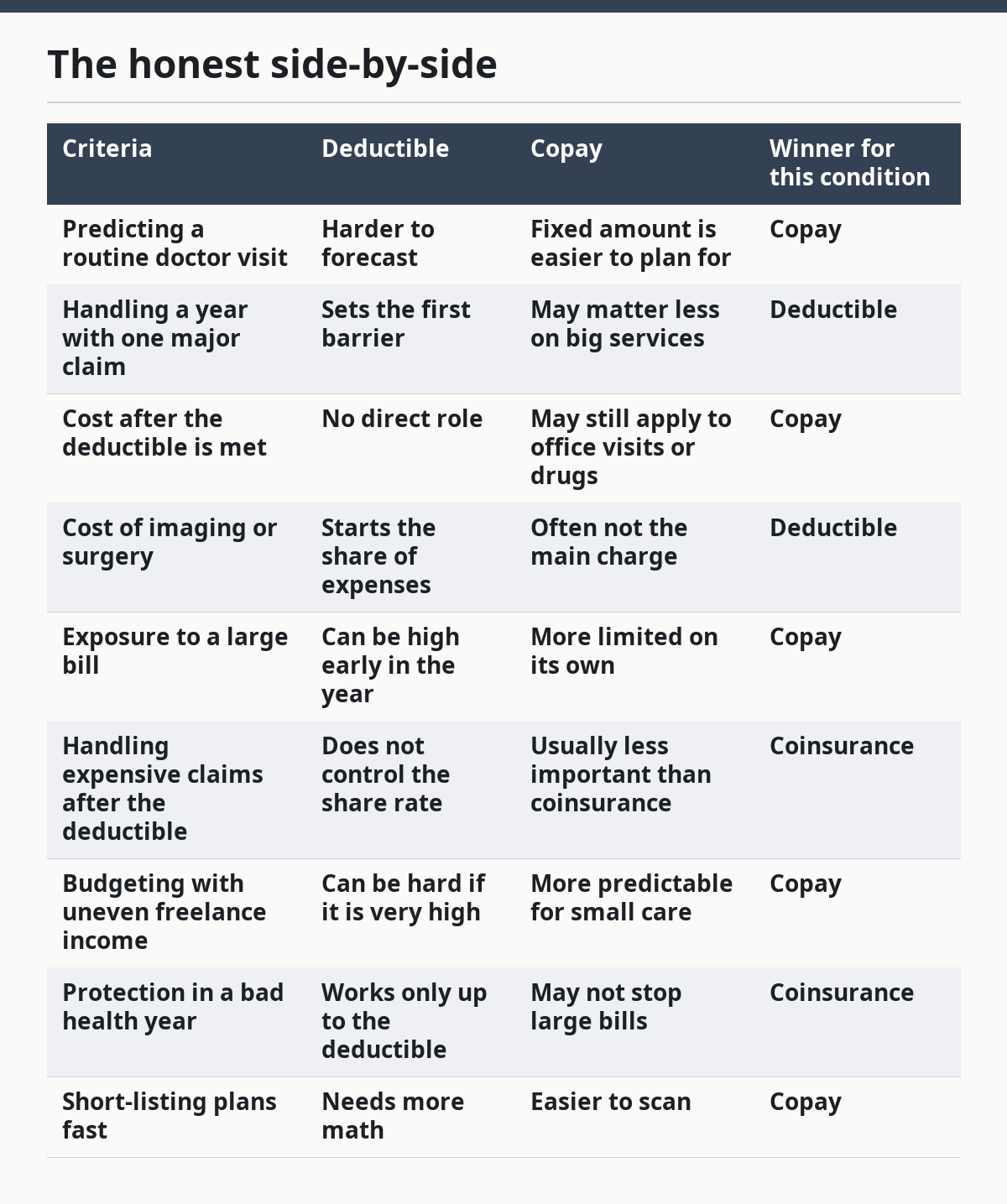
The table gives the pattern: copays simplify routine care, deductibles control the entry point, and coinsurance controls the damage after you cross that point. If one line looks good but the other two look ugly, the plan may still be a poor fit.
Which cost-sharing term matters most when comparing plans?
The out-of-pocket maximum is the safest backstop, but the deductible matters most if you expect to spend moderately, not barely and not heavily. Picture this: you’re not trying to memorize insurance jargon; you’re trying to avoid a bad surprise.
For a freelancer, that usually means comparing the plan’s order of pain. Start with the maximum because it caps the year. Then check the deductible to see how soon help begins. Then look at copays and coinsurance to see how everyday care and big claims are handled. A plan with a friendly copay and ugly coinsurance can still disappoint.
Best part? This order keeps you from overvaluing the easiest number to understand. The easy number is not always the deciding one.
- If you expect routine care: copays deserve more attention.
- If you expect one large event: deductible and coinsurance matter more.
- If you want the safest ceiling: the out-of-pocket maximum leads the list.
When the overall verdict flips
A freelancer should not treat one cost-sharing style as the answer in every case. Picture this: two plans look close on paper, then one detail changes the whole decision. That happens a lot with specialists, prescriptions, and planned care.
The verdict flips in a few cases:
- You expect repeated visits. A plan with better copays can beat a plan with a lower deductible if your care is mostly small and frequent.
- You expect a big event. A plan with lower coinsurance and a stronger out-of-pocket maximum can beat a plan that looks cheaper upfront.
- You rarely use care. A high-deductible plan may make sense if you can absorb a surprise bill and want to keep monthly costs down.
- You take regular prescriptions. Copays on drugs can matter more than the medical deductible if the pharmacy side is where the spending happens.
The truth is, one good-looking number is never enough. A plan can be right for office visits and wrong for surgery. It can be right for prescriptions and wrong for imaging. That’s why freelancers need to compare the whole cost-sharing design, not just the part that sounds friendly.
The verdict: which one should you choose and why
Choose copays if you want predictable spending for routine care and your year is likely to be built around office visits, follow-ups, and refills. Choose deductibles if you want to judge how much the plan asks you to pay before broader coverage kicks in. Choose coinsurance if you’re worried about a large claim, because that is where the bill can grow fast. Neither if you are only comparing monthly premium and ignoring the out-of-pocket maximum.
For most freelancers in consideration mode, the best overall choice is the plan with the most balanced deductible, reasonable copays, and lower coinsurance after the deductible. That mix usually handles both the ordinary month and the ugly one better than a plan that is only cheap in one spot.
If you want the wider framework behind plan fit, the hub on plan selection and coverage fit sits above this decision and can help you place cost-sharing in the full picture.
What freelancers should check before deciding
The best plan choice usually comes from three checks, not one. Picture this: you have two plans left and need to rule one out before the enrollment deadline. A quick checklist can do that.
- Look at the out-of-pocket maximum first.
- Compare the deductible for the services you’re likely to use.
- Scan the copays for doctor visits, urgent care, and prescriptions.
- Read the coinsurance line for specialist care, imaging, and hospital use.
- Check whether the service is subject to the deductible before the copay starts.
If one plan has a low deductible but weak coinsurance, it may be the wrong plan for a freelancer who could face bigger claims. If another plan has nice copays but a huge deductible, it may look better than it behaves. Before the enrollment deadline, review the plan summary rather than guessing from the premium alone.
FAQ
Which cost-sharing term matters most when comparing plans?
The out-of-pocket maximum matters most if you want the hard cap on covered spending, but the deductible matters most if you want to know when the plan starts helping. The best answer depends on your likely use of care and how much risk you can carry.
How do deductibles affect total cost?
A deductible changes how much you pay before the plan starts paying its share for many services. A lower deductible can reduce early-year pain, but it may come with a higher premium or different cost-sharing elsewhere. Always compare the whole design, not one number.
What is the difference between copays and coinsurance?
A copay is a fixed amount, while coinsurance is a percentage of the bill. Copays are easier to predict for routine care, and coinsurance matters more for expensive services after the deductible.
Drafted with AI; not yet reviewed by a person.