Freelancers and Marketplace Coverage After Losing Insurance

Last updated: November 20, 2026
Quick Answer: In many cases, freelancers get a special enrollment period of 60 days after losing employer coverage to enroll in Marketplace coverage outside open enrollment.
Need Marketplace coverage after job-based insurance ends? For how freelancers enroll in Marketplace coverage after losing other insurance outside open enrollment, the proof, timing, and effective-date rules decide whether the application goes through. This guide lays out the documents, dates, and Marketplace rules that matter; it also flags the COBRA and job-based plan details that trip people up.
Key takeaways
- Losing employer-sponsored insurance can open a special enrollment period for Marketplace plans.
- The Marketplace usually asks for proof that coverage ended, not just your word.
- COBRA and job-based plans can create different timing and document rules.
- Your enrollment window and start date depend on the kind of coverage you lost and when it ended.
- This is information, not financial advice; your own situation may need a qualified adviser or Marketplace help.
Who this applies to, and what you need in hand
This applies to freelancers who lost employer-sponsored insurance and now want Marketplace coverage during a special enrollment period. Know the date your old coverage ended. Have basic personal details ready. And be able to upload or mail documents if asked.
Because this is about how freelancers enroll in Marketplace coverage after losing other insurance outside open enrollment, the first checkpoint is the loss date. Proof comes next. Those two details tell the Marketplace whether the special enrollment period applies.
Picture a freelancer who is no longer on a payroll plan, open enrollment has already passed, and the bills still need sorting out. You may still be able to apply, but only if the loss of coverage fits the Marketplace rules and you can show it. Here’s the catch: a freelancing income change by itself does not create this enrollment path.
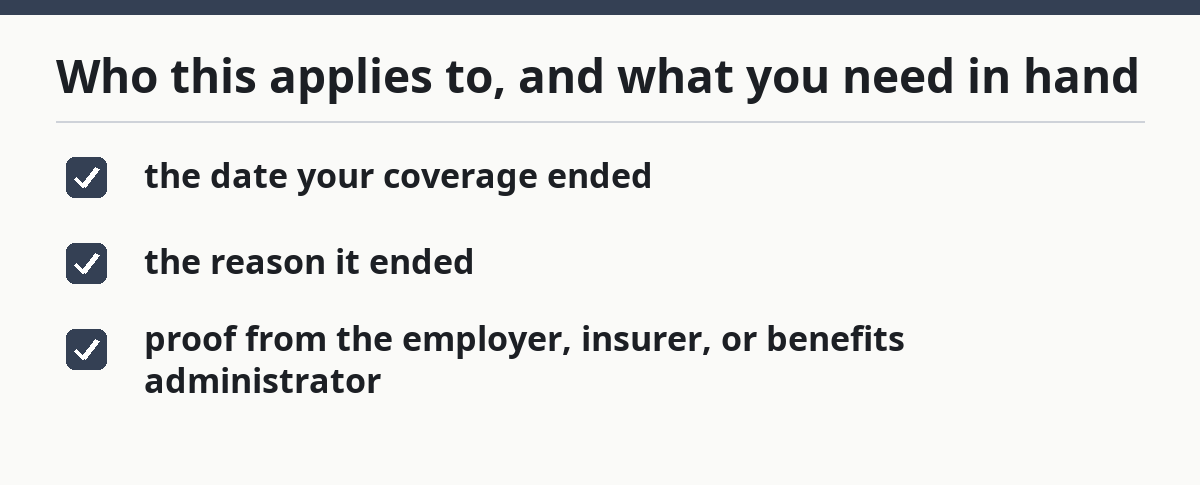
A clean application usually starts with three things:
- the date your coverage ended
- the reason it ended
- proof from the employer, insurer, or benefits administrator
What this page does not do:
- it does not explain every type of special enrollment period
- it does not cover what happens after you submit the application
- it does not replace state-specific Marketplace guidance
For the broader mechanics, the hub on Marketplace enrollment and eligibility mechanics fills in the bigger map. See also special enrollment periods, HealthCare.gov enrollment help, and freelancer health insurance basics.
How freelancers enroll after losing coverage
Report the coverage loss, show proof when asked, and choose a Marketplace plan during the enrollment window tied to that event. The process is easy when the dates line up. It goes sideways when people guess at the end date or wait until the last week.
Because how freelancers enroll in Marketplace coverage after losing other insurance outside open enrollment depends on dates, the application starts with the qualifying event. If the Marketplace accepts the event, it can open a special enrollment period. HealthCare.gov says many qualifying events, including loss of coverage, come with a 60-day window.
Picture this: you’re on HealthCare.gov or your state Marketplace, and the site asks why you qualify now. Pick the loss-of-coverage path, enter the date your old plan ended, and move through the application. Then the Marketplace may ask for documents. Match the details and the proof, and you can finish plan selection.
- Start the Marketplace application and choose the option for a life change tied to loss of coverage. Verify that you are entering a special enrollment reason, not a normal open enrollment application. If the site does not offer that path, the problem is usually the start date or the wrong qualifying event.
- Enter the exact date coverage ended, using the date on your termination letter, insurance notice, or COBRA end notice. Verify that the date is not just the last day you remember paying a premium. If the date is inconsistent across your forms, the Marketplace can flag it for review.
- State the reason coverage ended: job loss, reduction in hours, end of employer-sponsored coverage, or COBRA ending. Verify that the reason matches the document you can upload. If the reason is vague, the application may stall while the Marketplace asks for more proof.
- Gather proof before you submit if you can. Typical proof is a letter from the employer or insurer showing the person covered, the plan name, and the end date. Verify that your name appears exactly as it does on the application. If the document omits the end date, it is often not enough.
- Upload the document or be ready to mail or fax it if the Marketplace requests that route. Verify the file is readable and complete, with all pages included. If the scan cuts off the date or the sender’s name, expect a delay.
- Finish the application and compare the plan’s effective date rules with your coverage gap. Verify whether the new plan starts the first of the next month or later, depending on when you enroll and the Marketplace rules that apply in your state. If you assume same-month coverage, you may end up uninsured for a gap month.
- Pick a plan and submit by the deadline tied to your special enrollment period. Verify that you still have time left after the document request, because a request for proof does not usually extend the clock by itself. If the deadline passes, you may have to wait for open enrollment unless another qualifying event occurs.
- Save screenshots, confirmation numbers, and copies of every document. Verify that you can show the sequence: coverage ended, proof submitted, application filed, plan chosen. If you cannot reconstruct the timeline later, it becomes much harder to resolve a mismatch.
Speed is not the first goal. A matching paper trail is.
What proof of loss of coverage usually works?
Proof usually means a document that ties your name to the old coverage and shows the date it ended. The Marketplace is looking for evidence, not a story. A short letter beats a long explanation every time.
For how freelancers enroll in Marketplace coverage after losing other insurance outside open enrollment, proof is often the part that slows things down. HealthCare.gov and CMS both say you may need to submit documents to confirm the qualifying event.
Picture a termination letter with the coverage end date buried on page 2 or tucked inside a benefits table. That can still work if the document is legible and complete. A pay stub, by itself, often does not show enough. Here are the documents that most often matter:
- employer notice that coverage ended
- insurer notice showing the termination date
- COBRA election or COBRA end notice
- letter from HR or the benefits administrator
- plan cancellation notice that names you and the end date
A few details matter more than people expect:
- your full legal name should match the application
- the date should show the end of coverage, not just the date the letter was written
- the document should show the reason for the loss when possible
Missing the exact end date? The Marketplace may ask again. Wrong name because of a marriage, divorce, or typo? That can mean extra proof.
Does COBRA ending trigger a special enrollment period?
Yes, COBRA ending can trigger a special enrollment period if the loss of coverage fits the Marketplace rules and the timing lines up. The end of COBRA is not the same thing as losing employer coverage on the day you left work, and that difference matters.
Because COBRA can end months after the job does, the later date may be the one that opens the Marketplace window. The clock usually runs from the date coverage actually ends, not from the date you first left the job.
The catch is that COBRA has its own paperwork trail, so the proof has to match the kind of coverage you lost. A COBRA termination notice may be the key document. If you only have the original COBRA election form, that usually is not enough by itself.
What to watch for:
- the coverage end date on COBRA paperwork
- whether the end is tied to nonpayment, expiration, or another event
- whether the Marketplace wants a letter from the insurer instead of the employer
When the COBRA record is murky, the application can stall until the dates are sorted out.
How do job-based plan endings work for freelancers?
Job-based plan endings work when your employer-sponsored insurance ends and that loss opens the enrollment window. The key point is that being a freelancer does not create the right by itself; the loss of the prior plan does.
Because how freelancers enroll in Marketplace coverage after losing other insurance outside open enrollment depends on the coverage ending, the date on the employer notice matters more than the date you started freelancing. If the plan ended in April, April is usually the date that counts.
Picture a person who had a W-2 job with benefits, then moved to freelance work and watched the old plan end. The qualifying event is the coverage loss, not the new freelance status. So the Marketplace will care about the employer plan’s end date, the reason it ended, and whether it falls inside the allowed enrollment period.
Some job-based endings are simple:
- you quit or were let go and the plan ends
- your hours drop and benefits stop
- the employer changes plans and your coverage ends
- you age off a dependent plan tied to employment
Some are messier:
- coverage continues briefly after employment ends
- the insurer and employer show different end dates
- a spouse’s plan ends and the paperwork is filed under the wrong person
Here’s the trap: if the old plan ends on one date but your documents show a different date, the Marketplace may treat the file as incomplete. Keep the employer letter, insurer notice, and any COBRA paperwork together.
The deadlines and effective dates that trip people up
The deadline is the part that makes or breaks the application, and the effective date decides whether you have a gap in coverage. Those two dates are not the same thing. Miss one, and the result can be very different from what you expected.
Because the clock starts with the qualifying loss, not with freelance income, timing matters from day one. HealthCare.gov generally gives people 60 days after losing coverage to enroll, though state-based Marketplaces can have their own process. That is why the proof date matters so much.
Picture this: you lose coverage, wait a few weeks, and assume the Marketplace will still treat you as eligible. Sometimes it will, sometimes it won’t, and the reason is the special enrollment period clock. State rules and federal Marketplace rules can differ, so the exact window can vary. That is why the date on the proof matters so much.
A practical checklist:
- confirm the coverage end date first
- apply within the enrollment window tied to that date
- check whether your state Marketplace uses its own deadlines
- look at the first day your plan can start once you pick it
Effective dates matter most if you are trying to avoid a gap between plans. Depending on when you apply and what rule applies, coverage may start the first day of a later month rather than immediately. If you wait too long in the month, you can slide into the next coverage month.
The safest move is usually to file the application as soon as your proof is ready.
When this approach does not fit
This path does not fit every freelancer, and forcing it is where people waste time. If the qualifying event is wrong, the dates do not match, or the proof is weak, the Marketplace may not open enrollment for you.
Because how freelancers enroll in Marketplace coverage after losing other insurance outside open enrollment only works when coverage actually ended, a job change by itself is not enough. The Marketplace generally needs a qualifying loss of insurance, not just a smaller paycheck or a move into freelance work.
Picture a lost paycheck but no lost health coverage. That is not the same thing. The Marketplace generally needs a qualifying loss of insurance, not just a smaller paycheck or a move into freelance work.
Stop and use a different route when:
Your coverage never actually ended: You still have active employer-sponsored insurance or COBRA — the Marketplace may not grant this enrollment path. Consider waiting for open enrollment or another qualifying event.
The end date is uncertain: You do not know whether coverage ended on the last day of work, the last day of the month, or later — do not guess. Get the insurer or employer notice first.
Your only paper is a premium receipt: A receipt shows payment, not loss of coverage — ask for a termination letter or insurer notice.
The person on the old plan is different from the applicant: A spouse or parent’s plan may need different proof — match the documents to the person applying.
The state Marketplace has asked for more proof and you cannot provide it: The file may stall or close — contact Marketplace help or the employer benefits office before the deadline runs out.
When the dates and documents do not line up, the answer is not to push harder. It is to fix the record.
The mistakes freelancers make, and what they cost
Most mistakes are boring, which is exactly why they are expensive. A wrong date, a missing page, or a late upload can turn a valid special enrollment period into a delay.
Because enrollment mistakes can cost a full month, this is where the paperwork matters most. A simple scan problem can lead to another request. In a 60-day window, that can be enough to lose time.
Picture this: you know you lost coverage, but you uploaded the wrong letter because it was the first file you found. The Marketplace may ask for more proof, and every extra round of back-and-forth burns time. That is how people end up with a gap month they did not expect.
Common errors:
- Using the wrong end date: This can make the special enrollment period look expired. Use the date on the official notice, not memory.
- Uploading incomplete proof: Missing pages or cropped scans lead to document requests. Upload the full notice with the date visible.
- Confusing COBRA with employer coverage: COBRA ending and job-based coverage ending are not always the same event. Match the paperwork to the event.
- Waiting until the end of the window: A late filing leaves no room to correct errors. Apply early enough to fix one round of requests.
- Relying on verbal confirmation: A phone call is not the same as document proof. Save the written notice.
- Mixing up the applicant: If the old plan covered a spouse or child, the proof must match the person applying or show why they qualify through that relationship.
The correct alternative is simple: line up the date, the reason, and the document before you submit.
Can freelancers use this path if their job changed, not their insurance?
No, a job change alone does not usually count unless it changed or ended the coverage itself. That distinction matters because many freelancers think “I left my job” and “I lost coverage” mean the same thing. They do not always.
Because the qualifying event is the coverage ending, the date on the notice matters more than the job end date. If employment ended in March but coverage ran through April, the Marketplace usually looks at April. The application should match the coverage date, not the payroll date.
Picture a salaried job that ended in March, but the plan stayed active until the end of April. The Marketplace usually cares about April, not March, because that is when the coverage actually ended. If your paperwork says April and your application says March, expect a mismatch.
This is where a clean timeline helps:
- employment ended
- coverage ended
- proof was issued
- application was filed
- plan was selected
Each date has to fit the next one. If the dates spread out, the file can still work, but it needs cleaner documents.
Sources and where to verify the rules
The Marketplace rules for special enrollment periods are explained by the federal Marketplace and, in some states, by the state exchange. The details can change, and state rules can differ from federal rules.
Two good places to verify the current process are:
- HealthCare.gov special enrollment period information
- CMS Marketplace guidance on coverage loss and enrollment periods
If you are in a state-based Marketplace, check that site too. The state exchange can ask for different proof or use a different workflow. See also HealthCare.gov special enrollment periods and CMS Marketplace consumer resources.
How long after losing coverage can a freelancer enroll?
The answer depends on the special enrollment period tied to the loss of coverage, and the exact deadline can vary by Marketplace rules. The enrollment window starts from the qualifying loss, not from the date you first began freelancing.
Drafted with AI; not yet reviewed by a person.