Last updated: November 19, 2026
Key Takeaways
- A qualifying life event can reopen enrollment, but not every major life change qualifies.
- The clock usually starts on the event date, not when you notice it matters.
- Loss of qualifying coverage is often the strongest trigger for a new plan.
- Open Enrollment is the annual window; Special Enrollment opens only after a qualifying event.
Enrollment timing decides whether you get coverage, pay a penalty, or have to wait months for the next chance to sign up. Life events can open a special enrollment period, but only if the event fits the rules and you act inside the deadline.
I write about health coverage timing, plan eligibility, and enrollment rules for people who need a clean answer, not a brochure.
The one question that matters most: can this life event open enrollment now?

Yes, if the event is a qualifying life event and you enroll within the deadline; no, if it is just a routine change that does not trigger a special enrollment period. That is the whole problem most people are trying to solve, because “I moved” or “I lost coverage” sounds obvious until the paperwork says otherwise. If you are unsure, consult a licensed benefits professional or the official marketplace guidance before you act; HealthCare.gov explains special enrollment periods here: https://www.healthcare.gov/glossary/special-enrollment-period/
The phrase most people need is special enrollment period, often shortened to SEP. An SEP is a time-limited window outside the regular annual Open Enrollment Period when you can enroll in or change coverage after a qualifying life event. For HealthCare.gov plans, the federal marketplace generally gives 60 days after many qualifying events, though some events use different timing rules depending on the type of coverage involved. The Centers for Medicare & Medicaid Services explains special enrollment periods here: https://www.cms.gov/marketplace/individuals-families/special-enrollment-periods
This guide focuses on the timing traps that most articles skip: when the clock starts, what counts as “loss of coverage,” why a move sometimes does nothing, and which family changes matter. It also separates marketplace plans from employer plans, because the rules are not identical and mixing them up costs people real time.
The practical rule is simple: do not wait for the perfect plan comparison if your deadline is running. Confirm the triggering event, gather proof, and submit the application before the SEP closes. If the event does not qualify, the annual Open Enrollment Period may be your only chance.
What counts as a qualifying life event?
A qualifying life event is a change that the rules treat as serious enough to reopen enrollment, but not every major life change qualifies. The most common triggers are loss of other coverage, marriage, birth or adoption of a child, moving to a new coverage area, and some household changes that alter tax status or dependent eligibility. If you are unsure, consult the plan rules or a benefits expert; HealthCare.gov’s overview of life events is here: https://www.healthcare.gov/glossary/qualifying-life-event/
For the federal marketplace, the most common qualifying events usually include:
- Losing job-based coverage
- Losing Medicaid, CHIP, or other minimum essential coverage
- Getting married
- Having a baby or adopting a child
- Moving to a new ZIP code or county that changes plan options
- Gaining lawful presence or another status that affects eligibility
The catch is that “qualifying” is not the same thing as “important.” A new job may be important, but if the new employer offers coverage and your old plan continues for a short runway, you may not have an immediate SEP. A divorce can matter, but only if it changes your eligibility for your current coverage. A child leaving for college usually does not create a new chance to enroll. The rules care about coverage status, household structure, and enrollment rights, not the emotional weight of the event.
A generic article gets this wrong by treating all life events as equal, so it is worth checking the official rules or asking a professional before you rely on a guess. They are not. A move across town may do nothing if you stay in the same rating area. A move to another state usually changes plan availability and often opens a special enrollment period, but the deadline still matters. The same is true for pregnancy: pregnancy itself does not always trigger marketplace SEP eligibility, while the birth of the child does.
If the event is tied to employer coverage, the employer’s plan rules and the plan document matter too. Some employers require notice within a set number of days. If the company says you had 30 days to report the event and you missed it, the marketplace may still be available in some situations, but the employer plan may not be. The U.S. Department of Labor explains HIPAA special enrollment rights here: https://www.dol.gov/agencies/ebsa/laws-and-regulations/laws/hipaa
When does the enrollment clock start?
The clock usually starts on the date the qualifying life event happens, not the date you realize it matters. That distinction is where people lose coverage. If your old plan ends on June 30 and your special enrollment period is 60 days, the deadline is measured from the loss date, not from the day you find the paperwork in your inbox.
That sounds obvious, but it becomes tricky in three common situations. First, if you are losing coverage at the end of a month, the qualifying date is often the last day of coverage. Second, if your event depends on paperwork, the effective date can lag behind the real-world change. Third, some plans and employers ask for proof before they finalize the enrollment, but the deadline for submitting the application still runs from the event date.
For the federal marketplace, many special enrollment periods run for 60 days after the qualifying event, and the effective date can depend on the event type and when you enroll. CMS and HealthCare.gov explain those timing rules in the marketplace SEP materials, and the exact effective date is not always the same for every event. That is why people should not assume “I have two months” means “I can wait until the last week.” Waiting compresses your ability to fix document problems.
If you are enrolling through an employer, the plan may use a much shorter internal window, often measured in days rather than months. Employer plans commonly require quick notice after birth, marriage, or loss of coverage. The federal government’s Employee Benefits Security Administration has guidance on HIPAA special enrollment rights here: https://www.dol.gov/agencies/ebsa/laws-and-regulations/laws/hipaa
The safest move is to anchor the deadline to the event date, not to a payday, not to the end of the month, and not to the day you feel ready. If the event happened on the 3rd, the deadline is built from the 3rd.
Which life events open a special enrollment period?
The strongest trigger is loss of qualifying coverage, because it usually gives a direct path into a new plan. If you lose employer coverage, COBRA, individual market coverage, Medicaid, or CHIP, that may open a SEP, but the facts matter. A voluntary cancellation without another qualifying reason is not the same as losing eligibility.
Marriage is another clear trigger, but only if it changes your eligibility for a plan or lets you join a spouse’s coverage. A marriage certificate by itself is not a magic key unless the plan rules recognize the event. Birth, adoption, and placement for adoption are usually among the most flexible events because they can allow retroactive or immediate enrollment rules depending on the coverage source.
A move can help, but only when it changes your service area, county, state, or plan choice in a way the marketplace recognizes. Moving within the same county often does not create a new enrollment right if your plan options stay the same. Because of that, a move tied to school, seasonal work, or temporary housing can be messy if it is not considered permanent.
There are less obvious events too: gaining U.S. citizenship, release from incarceration, leaving AmeriCorps, and changes in household status that affect tax filing or dependent status. The exact list depends on the coverage system. Marketplace rules, employer plans, Medicaid, CHIP, Medicare, and student coverage all have their own trigger sets.
A common mistake is assuming “life event” means “any disruption.” It does not. Ending a lease, changing jobs without losing coverage, or deciding you want a cheaper plan are not enough by themselves. The enrollment rules are specific because insurers need predictable enrollment windows. That can feel rigid, but it also helps prevent people from gaming the system after they need care, so check the official guidance or a professional if you are unsure.
If you are not sure the event qualifies, check the plan’s own special enrollment page and the federal marketplace guidance before you miss the window. A wrong assumption can leave you uninsured until the next Open Enrollment Period.
The real difference between Open Enrollment and Special Enrollment
Open Enrollment is the broad annual window; Special Enrollment is the exception that opens only after a qualifying event. Open Enrollment is where you can plan ahead. Special Enrollment is where you recover from a life change.
Open Enrollment usually lasts for a fixed season each year. On HealthCare.gov, the federal Open Enrollment Period for 2026 coverage runs from November 1, 2025, through January 15, 2026. State-based marketplaces may use different dates. That means your window to shop, compare, and enroll is predictable if you are starting from scratch. Special Enrollment is not predictable; it depends on what happened in your life and when it happened.
Because of that, the trade-off is control versus urgency. Open Enrollment gives you time to compare premiums, deductibles, provider networks, and prescription coverage. Special Enrollment gives you a shorter path to coverage, but the clock can force a choice before you have done deep comparison shopping. For someone who needs coverage after a job loss, that speed is a benefit. For someone trying to optimize a family plan from a dozen choices, the short window can feel cramped.
Here is the practical difference that matters most: Open Enrollment does not require a triggering event. Special Enrollment does. If you miss Open Enrollment and do not have a qualifying life event, you usually wait. If you have a qualifying life event, you may not need to wait for the yearly cycle at all.
| Criteria | Open Enrollment | Special Enrollment | Winner for this condition |
|---|---|---|---|
| Need for a qualifying event | None | Required | Open Enrollment for simple annual shopping |
| Timing flexibility | High | Limited | Open Enrollment if you want time to compare |
| Ability to react after a loss of coverage | No special trigger needed | Designed for this | Special Enrollment after job loss |
| Deadline pressure | Lower | Higher, often 60 days | Open Enrollment for careful decision-making |
| Plan choice changes | Broad annual reset | Event-linked changes only | Open Enrollment for major switching |
| Effective date predictability | More standard | Varies by event and filing date | Open Enrollment for planning ahead |
| Best use case | Annual review | Life-change recovery | Depends on your situation |
| Risk of missing the window | Lower | Higher | Open Enrollment if you are disorganized |
| Proof requirements | Standard application info | Often requires event documentation | Open Enrollment for fewer admin hurdles |
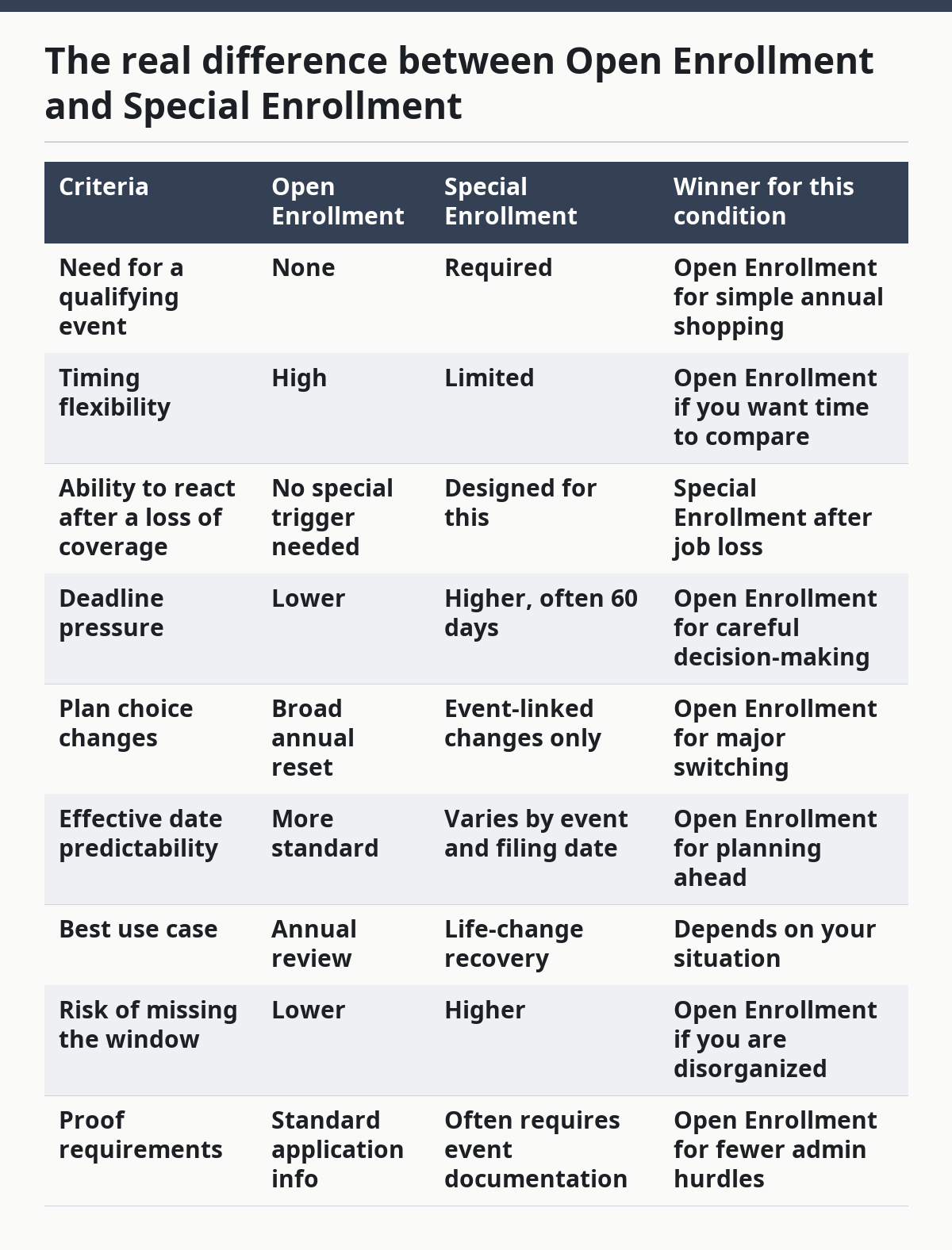
The right answer is not that one is better in general. It is that Open Enrollment is the safer planning window, while Special Enrollment is the rescue path when life changes midyear.
How employer coverage timing differs from marketplace timing
Employer coverage is usually stricter and faster than marketplace coverage. That is the part most people learn too late. If you are getting insurance through a job, the employer can require faster notice, tighter documentation, and an election deadline that is shorter than the marketplace’s 60-day window.
Employer plans operate under a framework that includes HIPAA special enrollment rights, and the Department of Labor explains these rights for job-based coverage. In plain English, certain events can let you enroll outside the normal enrollment window, but the plan can still demand quick action and proof. If you have a new baby, lose other coverage, or gain a spouse, the employer may give you a short period to request enrollment. Miss that period and the plan may wait until the next annual enrollment.
The strengths of employer coverage timing are straightforward. If your employer offers a plan with strong contributions, payroll deduction, and a network that includes your doctors, getting in through a life event can be efficient. You often join without needing to shop the individual market, and the administrative steps are familiar to HR.
The weakness is rigidity. Employer plans can be unforgiving about paperwork. A missing marriage certificate, a late notice, or a misunderstanding about when coverage starts can delay enrollment. Some plans also have waiting periods for new hires, which are separate from special enrollment rights. A new employee may have to wait 30, 60, or 90 days for regular eligibility, and that is not the same thing as a life-event trigger.
This section matters because many people mistakenly assume the marketplace and employer plans run on the same clock. They do not. A person leaving a job may be eligible for a marketplace SEP even if the new employer has not processed their enrollment yet. A person marrying may be able to join a spouse’s employer plan even if the marketplace window looks closed. The two systems overlap, but the rules are not interchangeable.
If you are dealing with a job-based plan, read the summary plan description and contact HR immediately. If you are dealing with the marketplace, use the federal or state exchange rules and do not wait for your employer to sort it out.
The honest side-by-side on timing, proof, and consequences
The right choice depends on whether you have a clean qualifying event and whether you can document it quickly. Special enrollment is the right tool for a real life event, but it is a poor tool for casual plan shopping. Open enrollment is the right tool for comparison, but it is useless if the calendar is closed and you need coverage now.
| Criteria | Open Enrollment | Special Enrollment | Winner for this condition |
|---|---|---|---|
| Requires proof of life event | No | Usually yes | Open Enrollment |
| Lets you plan around a calendar | Yes | No | Open Enrollment |
| Helps after involuntary loss of coverage | No | Yes | Special Enrollment |
| Works for routine plan upgrades | Yes | No | Open Enrollment |
| Protects you from missed deadlines | Better | Worse | Open Enrollment |
| Can start coverage midyear | Sometimes, but not event-driven | Yes | Special Enrollment |
| Best for family changes like birth or marriage | Sometimes, during annual window | Usually yes | Special Enrollment |
| Best for first-time shoppers | Yes | Only if life event qualifies | Open Enrollment |
| Administrative friction | Lower | Higher | Open Enrollment |
Special enrollment wins when the event is real, documented, and time-sensitive. Open enrollment wins when the goal is to compare options without pressure. The hidden cost of Special Enrollment is paperwork risk; the hidden cost of Open Enrollment is waiting if you miss it.
A generic article often says “just enroll as soon as possible.” That is too vague to help. The real advice is sharper: enroll as soon as your event qualifies, because the paperwork burden rises after the deadline, not before it. If you wait and then discover the event does not fit, you may have lost both the special window and the annual one.
For people who are moving, changing family status, or losing coverage, the decision point is not premium first. It is eligibility first. Coverage that looks affordable is worthless if you cannot enroll in time.
Exception scenarios where the rule flips
The overall rule flips when the life event changes your plan access, but the usual choice between Open Enrollment and Special Enrollment is not always the answer. A few situations deserve special caution.
-
You moved, but your network did not change. If you moved within the same service area and the same plans are still offered, you may not get a special enrollment right. In that case, Open Enrollment remains the real opportunity to switch.
-
You gained access to another plan, but not because of a qualifying event. Starting a new job is not the same as losing coverage or becoming eligible for a spouse’s plan. If the employer has a waiting period, you may have to wait for that window rather than use a marketplace SEP.
-
You missed the SEP deadline by a few days. Once the deadline passes, most systems do not care that the delay was small. The rule is blunt. The next opportunity may be the annual Open Enrollment Period, unless another qualifying event occurs.
-
You are eligible for COBRA and a marketplace SEP at the same time. COBRA can preserve employer coverage, but it can also be expensive relative to a marketplace plan, and the deadline math is separate. The better choice depends on your doctors, prescriptions, and whether you need continuity immediately. If the cost of COBRA is too high, a marketplace plan may be the better path, but you still need to watch the SEP clock.
These exceptions are why people should not rely on a single “life event” checklist copied from a blog. The label matters less than the coverage consequence. If the event does not change your eligibility, it may not change your enrollment rights.
So which enrollment path should you choose?
Choose Special Enrollment if you have a qualifying life event, can document it, and need coverage before the next annual window. Choose Open Enrollment if you are shopping by choice, your event does not qualify, or you need time to compare plans without deadline pressure. Neither if you are counting on a vague life change that does not alter your coverage eligibility.
That is the clearest answer because it follows the actual rules, not the emotional logic of the moment. A marriage, birth, loss of coverage, or move can open the door; a job change, lease change, or generic “life disruption” often does not. If you are unsure, assume the deadline is shorter than you want and verify it immediately.
The best next step is not to browse plans endlessly. It is to identify the event date, find the exact enrollment rule for your coverage type, and submit the application with proof before the window closes. A correct decision made late can still fail. A fast decision made on the wrong basis can too.
How do I know if my move qualifies?
Your move qualifies only if it changes your coverage options in a way the marketplace or plan recognizes. A move to another state, county, or service area usually matters more than a change of address within the same area.
Can I enroll after I lose my job?
Yes, if the job loss also means you lose qualifying health coverage. The qualifying event is usually the loss of coverage, not the employment change by itself, and the deadline is commonly measured from that loss date.
Does having a baby open a special enrollment period?
Yes, in most coverage systems, birth triggers a special enrollment opportunity for the parent and the new child. The exact effective date and paperwork rules depend on whether the plan is through the marketplace, an employer, Medicaid, or CHIP.
What if I miss the deadline?
You usually wait for the next Open Enrollment Period unless another qualifying life event happens. Some employer plans have their own rules, but a missed SEP deadline is often hard to fix.
Where should I check the official rules?
Start with HealthCare.gov for marketplace coverage and the U.S. Department of Labor for employer-plan special enrollment rights. Those two sources cover the most common timing problems and explain the core deadlines clearly.
Drafted with AI; not yet reviewed by a person.