
Last updated: November 19, 2026
Key Takeaways
- Marketplace coverage is ACA-compliant insurance sold through HealthCare.gov or a state exchange, and it is often a strong starting point for a freelancer who needs individual health insurance.
- Marketplace coverage is often a good fit for freelancers with uneven income, no employer plan, and a need for subsidy eligibility.
- Premium tax credits are a big reason Marketplace coverage often works for freelancers at all, because they can lower the monthly premium based on projected household income.
- Marketplace coverage often offers subsidy access and consumer protections, while private off-exchange coverage can offer more network flexibility.
Marketplace coverage for freelancers means buying health insurance through the federal or state Marketplace instead of through an employer. For the Marketplace Coverage for Freelancers — The Complete Guide, the real question is not “Is Marketplace coverage available?” It is “Will a Marketplace plan actually fit my income, tax setup, and medical needs better than a private plan or going uninsured?”
I write on health coverage and benefits with a focus on how plans work on the ground: premiums, deductibles, subsidies, provider networks, and the trade-offs that matter when your income changes month to month. The guidance below is built for freelancers who need a plan they can afford to keep, not a brochure answer.
What Marketplace coverage actually is for freelancers
Marketplace coverage is the ACA-compliant insurance sold through HealthCare.gov or a state exchange, and it is often a strong starting point for a freelancer who needs individual health insurance. The key advantage is access to plans that cover essential health benefits and cannot reject you for preexisting conditions.
That matters more for freelancers than for many W-2 workers because your income can swing across the year. Marketplace plans are designed to pair with income-based help: premium tax credits, and in some cases cost-sharing reductions if you buy a Silver plan and your household income qualifies. The American Academy of Actuaries and HealthCare.gov both explain that these subsidies are tied to projected household income, not to whether you are “full-time” or “part-time” in the ordinary sense.
A freelancer should think of Marketplace coverage as a regulated retail market, not a discount club. Every plan has a metal tier — Bronze, Silver, Gold, or Platinum — and the tier tells you how costs are split between monthly premiums and care you pay at the doctor’s office. A Bronze plan usually means a lower premium and a higher deductible. A Gold plan usually means a higher premium and lower cost sharing. That trade-off is not abstract; it determines whether a $40 telehealth visit or a $3,000 imaging bill is tolerable.
The catch is that Marketplace coverage is not always “cheap.” It is often the best value when subsidies apply, but without subsidies a narrow-network Marketplace plan can still cost a lot. It is also not the right answer for someone who wants any doctor, any hospital, and no network restrictions. If that is the priority, a private off-exchange plan or a very different employment setup may be more suitable.
For the official rules on enrollment and subsidies, HealthCare.gov is the primary source to read: https://www.healthcare.gov/get-coverage/ and https://www.healthcare.gov/lower-costs/save-on-monthly-premiums/. The IRS explains premium tax credit reconciliation in Form 8962 and its instructions, which matters because freelancers often have variable income and can end up repaying part of an advance credit if income rises during the year. For tax questions, it is smart to review the instructions and, if needed, consult a tax professional. See https://www.irs.gov/forms-pubs/about-form-8962 and https://www.irs.gov/pub/irs-pdf/i8962.pdf.
Who should use Marketplace coverage — and who should skip it
Marketplace coverage wins for freelancers with uneven income, no employer plan, and a need for subsidy eligibility. It is especially strong for solo self-employed people, independent contractors, gig workers, and seasonal freelancers who can estimate annual household income reasonably well and want a plan that is legal to buy during Open Enrollment or a Special Enrollment Period.
It is also a sensible choice for freelancers who have predictable medical use. If you see a primary care doctor regularly, take ongoing prescriptions, or want maternity coverage, a Marketplace plan can be a better deal than a short-term policy or bare-bones private coverage because those alternatives often exclude key benefits or impose exclusions. ACA Marketplace plans must cover prescription drugs, emergency care, mental health and substance use disorder services, outpatient care, and maternity care as essential health benefits.
This route is less attractive for freelancers who expect very high income and qualify for no subsidy, yet still want top-tier provider choice. In that case, the market may push you toward a plan with a deductible large enough to make the monthly premium feel like the only bill that is predictable. It can also be a bad fit if you live in an area where the Marketplace options are dominated by a single insurer or a narrow HMO network. A plan can be ACA-compliant and still be awkward if your preferred specialist or hospital is out of network.
Freelancers who are eligible for other coverage should usually pause before buying here. If you can join a spouse’s employer plan, qualify for Medicare, or have access to affordable employer-sponsored coverage through your own business structure, Marketplace coverage may not be the best first move. The ACA’s “family glitch” fix changed some eligibility calculations for employer coverage, so checking whether you can get affordable employer coverage through a spouse is worth doing before you shop on the exchange.
The blunt takeaway: Marketplace coverage is right for freelancers who need a legal, subsidy-capable, ACA-compliant plan. It is not always the best option for someone who values open provider choice above all else or who has a more favorable coverage path already available.
How premium tax credits change the real price
Premium tax credits are the reason Marketplace coverage often works for freelancers at all, because they can lower the monthly premium based on projected household income. Without that credit, many freelancers would find the sticker price too high to keep year-round. With it, a Silver or Bronze plan can become realistic.
The amount of the credit depends on your household size, household income, and benchmark plan pricing in your area. The exact formula is tied to federal rules, and the income limits and subsidy rules can change by year, so this is not a place to guess. HealthCare.gov’s subsidy pages explain the basics, and the IRS explains how the advance credit is reconciled when you file taxes. A freelancer who gets too much advance credit may owe some back. A freelancer who underestimates income may get a larger credit or refund at tax time.
This is where many generic articles get the advice wrong: they say “estimate carefully” and stop there. The practical version is more specific. If your freelance income is volatile, use a conservative annual estimate, but do not sandbag so hard that you risk missing a better plan. The goal is to project your taxable household income across the whole year, not your best month or worst month. If your income comes from multiple streams — client invoices, platform work, rental income, spouse income, or a side W-2 — all of it can affect subsidy eligibility.
One more wrinkle matters: if your income lands below the subsidy floor in a state that did not expand Medicaid, you may fall into a coverage gap rather than qualifying for Marketplace help. That is one of the biggest structural limitations of the system, and it is not a freelancer problem alone. It is a state-policy problem that can make Marketplace coverage less useful for low-income self-employed people in some states.
Before enrolling, compare your projected annual income with a premium tax credit calculator from a reputable source such as HealthCare.gov and, if needed, a tax professional. For tax treatment and reconciliation, the IRS instructions for Form 8962 are the document to read, and you should consult a professional if your income is variable or your situation is complex.
The honest side-by-side: Marketplace plans versus private alternatives
Marketplace coverage wins on subsidy access and consumer protections; private off-exchange coverage can win on network flexibility. That is the core trade. The right choice depends on whether you care more about help paying the premium or about broader plan design.
| Criteria | Marketplace coverage | Private off-exchange coverage | Winner for this condition |
|---|---|---|---|
| Premium help | May qualify for premium tax credits and, for eligible Silver plans, cost-sharing reductions | No federal Marketplace premium tax credits | Marketplace coverage if income is subsidy-eligible |
| Preexisting conditions | Must cover them | ACA-compliant private plans must also cover them; short-term plans may not | Marketplace coverage for certainty and simpler comparison |
| Provider choice | Often narrower networks | Sometimes broader, depending on insurer and plan type | Private off-exchange if you need a specific doctor or hospital |
| Plan comparison transparency | Standardized tiers and public comparison tools on HealthCare.gov | Varies by insurer and broker; harder to compare apples to apples | Marketplace coverage for clear comparison |
| Essential benefits | Must include ACA essential health benefits | ACA-compliant plans do too; short-term plans often do not | Marketplace coverage if completeness matters |
| Enrollment timing | Open Enrollment or Special Enrollment Period, unless you qualify for a change-triggered SEP | Varies; some private products can be sold year-round | Private off-exchange if you need a date outside Marketplace windows |
| Cost-sharing reductions | Available only with eligible Silver plans and qualifying income | Not available | Marketplace coverage for lower out-of-pocket cost at moderate income |
| Network and referral restrictions | Can be restrictive, especially HMOs | May be broader, but not guaranteed | Private off-exchange if network flexibility is the main issue |
| Risk if income changes | Credit must be reconciled at tax time | No advance subsidy reconciliation | Private off-exchange if you want less tax-year adjustment complexity |
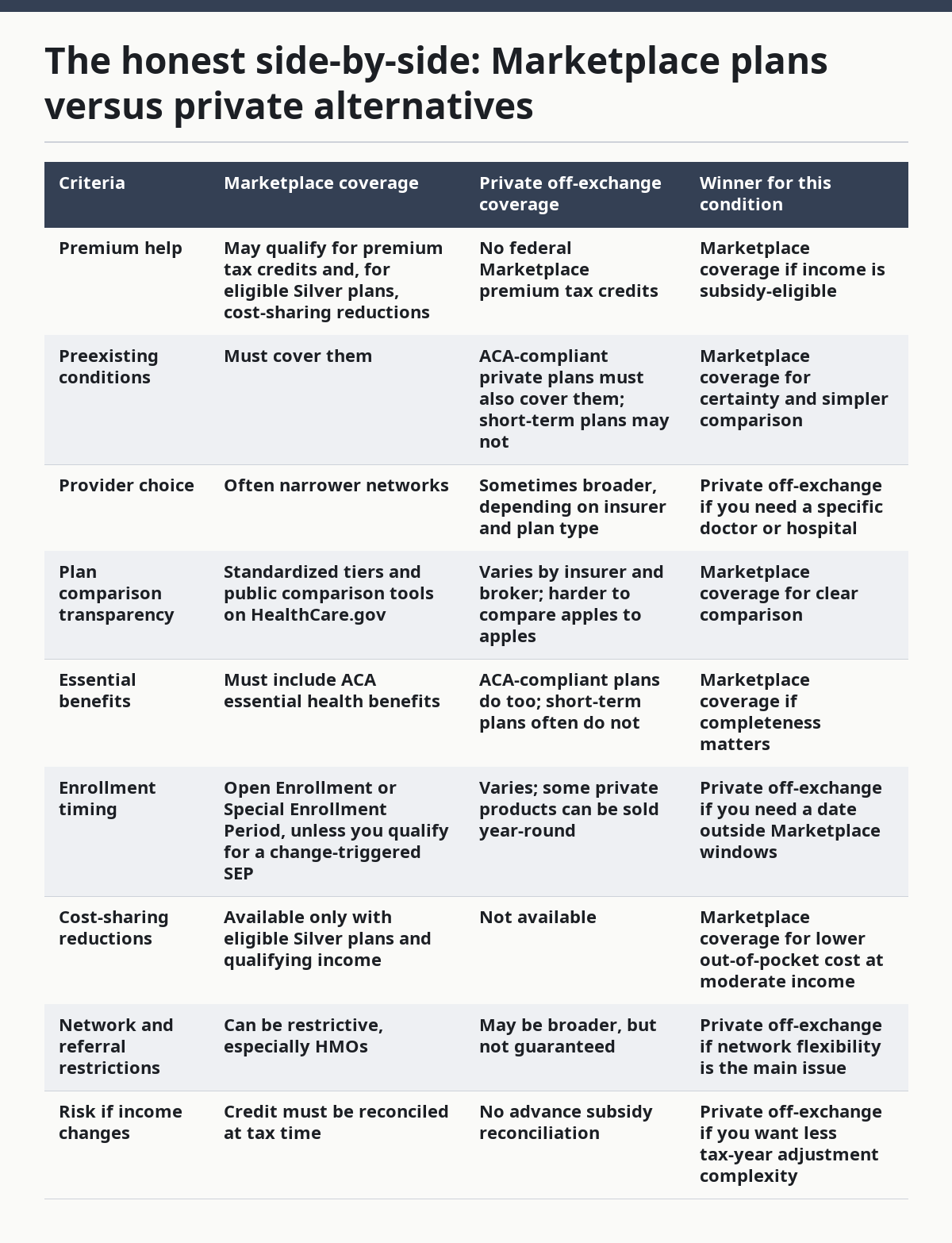
The table’s real lesson is this: Marketplace coverage is the better system if you need affordability help and consumer protections. Private coverage is the better system if you have no subsidy, your doctor list is nonnegotiable, and you are willing to trade some standardized comparison for more network control.
The weak spot in Marketplace coverage is usually not the law; it is the local plan menu. A freelancer in one ZIP code may see three decent PPO options, while another sees one HMO and a deductible that feels punishing. That is why “Marketplace” is not a full answer by itself. The local carrier lineup matters just as much as the federal rules.
How to choose the right metal tier without guessing
The right tier depends on how often you use care, not on how much you dislike monthly premiums. Bronze wins for freelancers who want the lowest regular bill and can tolerate a high deductible. Silver wins for many income-qualified buyers because it is the only tier that can carry cost-sharing reductions. Gold wins for freelancers who expect more routine use and want lower point-of-service costs. Platinum is usually too expensive for most freelancers unless the local pricing is unusually favorable.
That tier choice is where too many generic guides go lazy. They say, “Choose Bronze if you’re healthy.” That is too crude. A healthy freelancer with three prescriptions and a specialist visit every quarter may be better off with Silver or Gold. A freelancer with no regular care, an emergency fund, and a strong preference for low monthly spending may prefer Bronze, even if the deductible is high.
Here is the practical test. If a $6,000 deductible would derail your budget, do not buy a plan only because the premium looks easy. If a higher monthly premium would strain your cash flow more than a possible hospital bill, then a lower-premium plan may still be the safer play. This is not about liking risk in the abstract; it is about which fixed expense your business can carry.
For many freelancers, Silver deserves extra attention because of cost-sharing reductions. Those reductions can materially lower deductibles, copays, and out-of-pocket maximums for eligible enrollees. The exact eligibility band depends on current federal rules, so check the current HealthCare.gov guidance before you buy. If you qualify, Silver is often the smartest middle ground, not because it is “average,” but because it can behave like a richer plan at a midrange premium.
Bronze is wrong for someone with frequent appointments and no cushion. Gold is wrong for someone who is mostly buying peace of mind and has little cash for monthly premiums. Platinum is usually wrong for freelancers unless the premium spread in your county is unusually small or you know your medical use will be heavy.
Which freelancers should choose Marketplace coverage?
Marketplace coverage is the best default for freelancers who want ACA protection, income-based help, and a plan they can keep even when clients disappear for a month. It is also the best fit for someone building a business and needing predictable, legally recognized coverage before taxes and cash flow are perfectly stable.
This route is especially good for freelancers who are self-employed full-time, earn a mix of 1099 income, or are married to a spouse whose employer coverage is not affordable enough to use. It is also a strong option for families, because Marketplace family coverage can be easier to coordinate than a patchwork of short-term or private policies. If your household income changes, the Marketplace is built to handle that change, provided you update the exchange when it happens.
There is a real downside: network restrictions can frustrate people who want a favorite specialist, a particular hospital system, or nationwide access. If you travel constantly for work, plan to get care in multiple states, or have a rare-condition specialist you must keep, Marketplace coverage may be too confining. It can still work, but only if the local network fits your actual medical geography.
The best use case is a freelancer who values protection over customization. The worst use case is a freelancer who treats every plan like a national PPO and then discovers the network is local, the deductible is high, and the tax credit must be reconciled later. That mismatch is where disappointment starts.
If you want the shortest answer, this is it: Marketplace coverage is the right baseline for most freelancers who need real insurance, but it is not always the right answer for someone who demands broad provider choice or already has a better affordable option.
When does Marketplace coverage stop being the best move?
Marketplace coverage stops being the best move when one of four things changes: you get another affordable coverage source, your income makes subsidies disappear, your medical providers are out of network, or your state situation leaves you in a coverage gap.
First, if a spouse’s employer plan becomes affordable and usable, that can beat a Marketplace plan on simplicity and sometimes on total household cost. Second, if your income rises enough that you no longer qualify for meaningful premium assistance, a private plan or employer arrangement may look more attractive. Third, if your doctors are tied to one health system and the Marketplace network excludes it, the plan may be cheap only on paper. Fourth, if you are in a non-expansion state and your income is too low for Marketplace subsidies but too high for Medicaid, the whole structure can fail you.
There is also a timing issue. Marketplace enrollment is not always open. Most freelancers need a qualifying event or the annual Open Enrollment window. That matters because “good plan, wrong month” is still a bad outcome. If you are leaving a job, losing coverage, or adding a dependent, the date of the change can trigger a Special Enrollment Period, but you need to act quickly and document it.
A generic article would end here by saying “review your options annually.” That is too weak. The better rule is to revisit coverage any time one of these changes occurs: household income shifts, marital status changes, a dependent is added or removed, your doctor list changes, or your state of residence changes. Those are the moments when a Marketplace plan can stop being the best fit.
If none of those triggers apply and the current plan still covers your doctors, prescriptions, and budget, staying put is often smarter than chasing a theoretical upgrade.
What should you do before you enroll?
You should build a plan around your annual income, your actual doctor list, and your likely medical use before you pick a metal tier. That is the only way to avoid buying the wrong kind of affordability.
Start with your projected household income for the year, not a monthly guess. Then list your prescriptions, ongoing treatments, and the providers you want to keep. Then compare the plan’s deductible, out-of-pocket maximum, referral rules, and network. Those are the four facts that matter most once the plan is live. If a plan’s Summary of Benefits and Coverage does not clearly answer those questions, treat that as a warning sign.
Use official sources when you verify the details. HealthCare.gov explains how to shop and compare plans, and the IRS explains how premium tax credits are reconciled. If you need help deciding how subsidies affect your taxes, a licensed tax professional can help, especially if you are self-employed, have estimated quarterly taxes, or receive both freelance and W-2 income in the same year.
Marketplace coverage is not perfect. It can be narrow, annoying, and dependent on the county you live in. But for a freelancer who needs real insurance and an income-sensitive price structure, it is usually the most practical starting point.
The verdict: which one to choose and why
Choose Marketplace coverage if you are a freelancer who needs ACA-compliant insurance, expects income-based premium help, and can live with a plan network that may be narrower than a private option. Choose private off-exchange coverage if you do not qualify for subsidies, need a specific doctor or hospital, and value network flexibility more than standardized comparison. Neither if you already have affordable employer coverage, Medicare, or another coverage source that is clearly better for your situation.
Quick answers for freelancers comparing plans
Can freelancers get Marketplace coverage if income changes during the year?
Yes. Freelancers can enroll based on projected annual household income, and they should update the Marketplace if income changes enough to affect premium tax credits. The IRS uses Form 8962 to reconcile advance credits at tax time, so year-end income accuracy matters.
Is Silver always the best tier for freelancers?
No. Silver is often the best value only if you qualify for cost-sharing reductions or want a balanced premium-and-care trade-off. A freelancer with very low expected use may prefer Bronze, while one with frequent visits may prefer Gold.
Do Marketplace plans cover preexisting conditions?
Yes. ACA Marketplace plans must cover preexisting conditions and cannot charge more because of them. That protection is one of the main reasons freelancers choose the Marketplace over non-ACA alternatives.
What if my doctor is not in the network?
Then the plan may still be usable, but it is a weaker choice. Out-of-network care can be much more expensive or not covered except in emergencies, so a freelancer who must keep a specific doctor should treat network verification as a top priority before enrolling.
Drafted with AI; not yet reviewed by a person.