How freelancers request out-of-pocket reimbursement

Last updated: November 19, 2026
A freelancer files a member reimbursement request by paying the provider first, gathering a receipt, itemized bill, and claim form, then sending the full packet to the insurer or plan administrator before the deadline on the form. If the bill is missing one of those pieces, the request often stalls or comes back for more information.
Key takeaways
- Pay the provider first, then build the reimbursement packet from the bill, receipt, and claim form.
- The itemized bill matters more than a simple total because it shows what was billed line by line.
- Keep one copy for your records and send one complete copy for the request.
- Missing documents usually slow the process more than a small clerical error.
- This process is for getting money back after you already paid; it is not the same as appealing a denied claim.
What is a member reimbursement request?
A member reimbursement request is the form packet a freelancer sends when a provider billed them directly and they want money back for an eligible service. It usually asks for the provider’s name, date of service, amount paid, and proof that payment happened, often with a receipt and an itemized bill.
For a freelancer, this is the right path when the office did not bill the insurer first or when the provider’s checkout desk asked for full payment up front. It is not the same as asking the provider to fix a coding error, and it is not the same as filing an appeal after a denial. Those are different problems, and mixing them up wastes time.
The simplest way to think about it is this: the provider treated the bill like a direct purchase, and the member reimbursement request asks the plan to pay the covered share back to the member. If you are using Marketplace coverage after enrollment, this page fits inside that bigger process and can sit beside the hub article on how freelancers use Marketplace coverage after enrollment.
The biggest mistake is sending only a card slip or bank record. That shows payment, but it does not show what the service was. A reimbursement team usually needs the line-item bill too, because one total amount does not explain the charge.
Which papers do I need?
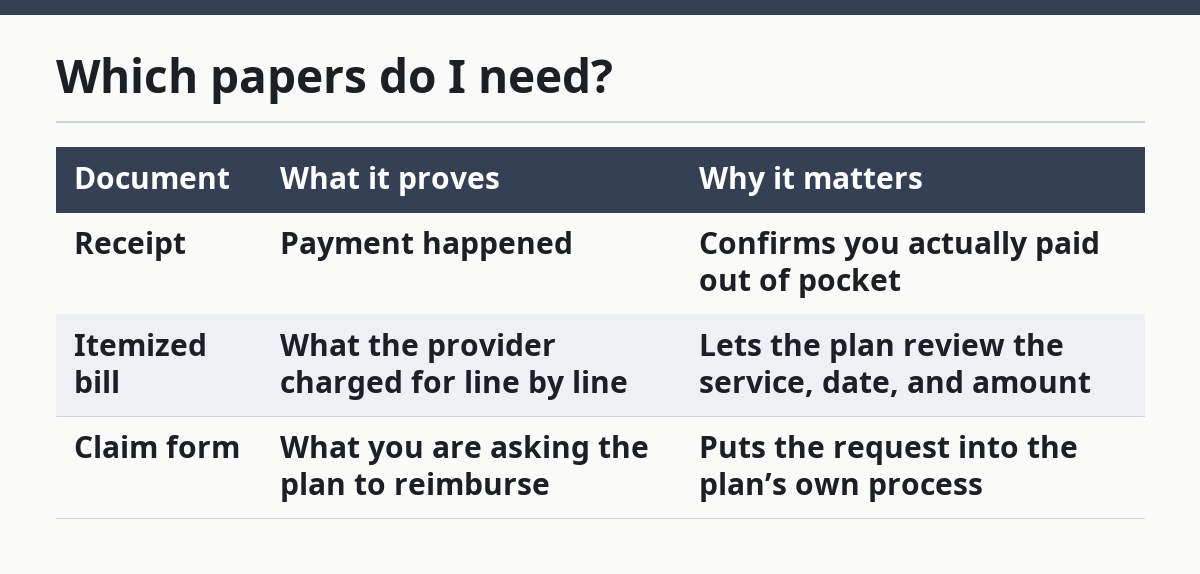
You need three core documents in most cases: a receipt, an itemized bill, and the insurance claim form. A receipt proves you paid. An itemized bill shows what was billed. The claim form gives the plan the member details and the service details in the format it expects.
Here is the difference at a glance:
| Document | What it proves | Why it matters |
|---|---|---|
| Receipt | Payment happened | Confirms you actually paid out of pocket |
| Itemized bill | What the provider charged for line by line | Lets the plan review the service, date, and amount |
| Claim form | What you are asking the plan to reimburse | Puts the request into the plan’s own process |
A good packet often also includes any supporting document the form asks for, such as a diagnosis note, referral, or provider statement if the service type requires it. Use the exact labels the plan uses, because a claim team may sort by those fields before a person reads it.
If the provider gave you a simple one-line invoice, ask for an itemized bill. A one-line invoice may show the total, but not the details that match the claim form. If the provider uses a standard claim form such as a CMS-1500 for medical services, ask whether they can also give you a copy of the billing summary they sent or would have sent.
For a plain-English source on member claims and how plans handle them, HealthCare.gov has consumer guidance on claims and appeals, and your plan’s own member materials should show the submission rules. The claim packet must match the plan’s instructions, not the provider’s office habits.
How do I fill out the reimbursement form?
You fill out the reimbursement form by matching each line on the form to the bill, then attaching proof of payment and any extra document the form asks for. Start with the member name, policy number, and date of service, then copy the provider’s name and the billed amount exactly as they appear on the itemized bill.
A clean way to do it is this:
- Download or request the current claim form. Use the form your plan gives you, not an old copy from a different year. That avoids a mismatch in address, fax number, or required fields.
- Fill in member and provider details first. Put the insured member’s name, policy or ID number, provider name, and service date in the spaces provided. This helps the plan match the request to the right account.
- Copy the billing details from the itemized bill. Use the exact charge amount, service description, and date of service as shown on the bill. A mismatch of even one line can trigger a delay.
- Attach proof of payment. Add the receipt or other proof that the provider actually collected the money. This shows the amount you are asking to have reimbursed.
- Add supporting documents. Include any referral, medical note, or provider statement the form requests. If the form asks for a diagnosis code or procedure code, leave that work to the provider’s billing office if possible.
- Review every page before sending. Make sure the form is signed if needed, the dates line up, and the total on the form matches the bill. A missing signature can stop the request at the first review.
- Send it by the method the plan allows. That may be upload, mail, or fax, depending on the plan. Keep a copy of everything you sent.
The safest habit is to build one complete packet and then make a second copy for your records. That way, if the plan asks for a follow-up, you can resend the same set without rebuilding it from scratch.
When should I ask the provider for a better bill?
You should ask the provider for a better bill when the paper you got does not show what the plan needs to see. A reimbursement team may reject a document that has only a total charge, no service date, or no provider information, even if you clearly paid the bill.
This is common when a front desk prints a simple payment receipt instead of a true itemized bill. The receipt might show $200 paid on a date, but the reimbursement team still needs to know what the $200 covered. Ask for a line-by-line bill with the provider name, service date, service description, and amount charged for each line.
This is also the right move when the provider billed you directly but did not include enough detail for the insurer’s claim form. A provider office can often reprint the bill in a more complete format, and that is usually faster than sending a weak packet and waiting for a request for more information.
Do not wait until the last minute if you can avoid it. If your plan uses a submission deadline, a missing bill can turn a straightforward request into a timing problem. The deadline language belongs on the plan’s form or member materials, so check that before you send anything.
What mistakes slow reimbursement?
The biggest mistakes are incomplete documents, mismatched dates, and sending the wrong form. Each one can push the request into a manual review queue or bounce it back for correction.
| Mistake | What it costs you | Better move |
|---|---|---|
| Sending only a receipt | The plan may not know what service was billed | Add the itemized bill |
| Using an old claim form | The request may go to the wrong address or fail format checks | Use the current form from the plan |
| Leaving out a signature | The packet may be treated as incomplete | Sign before you send |
| Dates that do not match | The claim can look inconsistent | Match the bill, receipt, and form line by line |
| Missing supporting documents | The plan may ask for another round of paperwork | Attach everything the form requests at once |
A second mistake is assuming the provider’s office already sent the right paperwork because you paid them. Payment does not guarantee billing accuracy. The plan still needs the documents in its own format, and the burden falls on the member to submit a complete request.
A third mistake is treating a reimbursement request like an appeal. If the plan has denied the service, that is a separate process with different rules. This page is for the out-of-pocket refund request itself, not for a denial fight.
The better habit is simple: compare the receipt, the itemized bill, and the claim form before sending. If one number, one date, or one name does not line up, fix it first.
What should I keep after I send it?
You should keep a full copy of the packet, plus proof of how and when you sent it. That means the completed claim form, the receipt, the itemized bill, any supporting documents, and a screenshot, mail receipt, or fax confirmation showing the date sent.
Keep this file for at least as long as your plan says it may ask for follow-up, and longer if the bill is large or the service date is close to a plan year change. Even if the plan later reimburses you, the copy helps if a second question comes up about the same charge.
If the plan gives you a reference number, write it on the packet copy. If you sent the request online, save the confirmation page or email. If you mailed it, save the tracking slip. Those records matter more than a memory of what you sent.
This is also the place to check the reimbursement status if the plan gives you a portal. A missing page can be corrected faster when you can reopen your own copy instead of asking the provider to rebuild the same bill.
For general consumer guidance on claim processing and member rights, HealthCare.gov and your plan’s member handbook are the best starting points. The exact upload, mail, or fax route depends on the plan, so use the route named on the claim form rather than guessing.
What proof do I need to request reimbursement?
You need proof that you paid and proof of what you paid for. In practice, that usually means a receipt plus an itemized bill, and often the claim form itself. If the form asks for an extra supporting document, include that too rather than sending a thin packet.
Do I have to pay the provider first?
Yes, if you are using an out-of-pocket reimbursement request, you usually pay the provider first and then ask for money back. That is the point of the process. If you want the provider billed directly from the start, that is a different billing setup and follows different paperwork.
How long does reimbursement take?
The timing depends on the plan’s processing rules and whether the packet is complete. A clean request usually moves faster than one with missing pages or mismatched dates. If the plan gives a status tool or reference number, check that instead of guessing from the calendar.
Drafted with AI; not yet reviewed by a person.