How Freelancers Compare Telehealth, Urgent Care, And Er Benefits In A Plan

Last updated: November 19, 2026
Telehealth vs Urgent Care vs ER for Freelancers
Quick answer: In the telehealth vs urgent care vs ER for freelancers decision, the fastest practical rule is to match the setting to the problem: telehealth for simple issues, urgent care for same-day in-person needs, and the ER for emergencies. If you are comparing a plan, start with the 3 care settings and the 3 cost lines that matter most: telehealth, urgent care, and emergency care. If symptoms are unclear, consult a professional.
I write on plan comparison and coverage fit for people who buy health coverage on their own, so I focus on the part that actually changes your bill in telehealth vs urgent care vs ER for freelancers: the care setting.
Key takeaways

- Telehealth is best for quick, low-complexity problems when a video or phone visit is enough.
- Urgent care fits problems that need same-day hands-on care but are not life-threatening.
- The ER is for emergencies, not convenience, even if the plan covers it.
- Copays and cost-sharing often differ by setting, so the “best” option depends on symptoms, time of day, and what the plan treats as urgent; if you are unsure, consult a professional.
- A plan that looks generous on paper can still be frustrating if its virtual care has limits or if urgent care is hard to reach after hours.
What are you really comparing in a health plan?
You are comparing three access paths, not just three prices. Telehealth, urgent care, and the ER all give you medical help, but they do it at different speeds, in different places, and with different cost rules in most health plans.
Telehealth is virtual care by phone or video. Urgent care is walk-in in-person care for issues that need attention soon but are not severe enough for the emergency room. The ER handles severe or possibly life-threatening problems and usually runs under the strictest cost-sharing rules in a plan.
That matters because a freelancer does not have office-hours coverage from an employer clinic or nurse line built into a workplace system. The plan has to do more of the work, especially after hours. A plan that includes telehealth access, nearby urgent care, and clear emergency coverage gives you three different ways to get care without guessing as much.
The cleanest way to think about it is this: telehealth is for triage and straightforward treatment, urgent care is for in-person same-day needs, and the ER is for danger signs; if symptoms are unclear, consult a professional. Medicare’s telehealth page and MedlinePlus’s emergency guidance both support that basic split: virtual care for some routine issues, emergency care for serious symptoms.
CMS telehealth
MedlinePlus emergency guidance
How does telehealth fit into the plan?

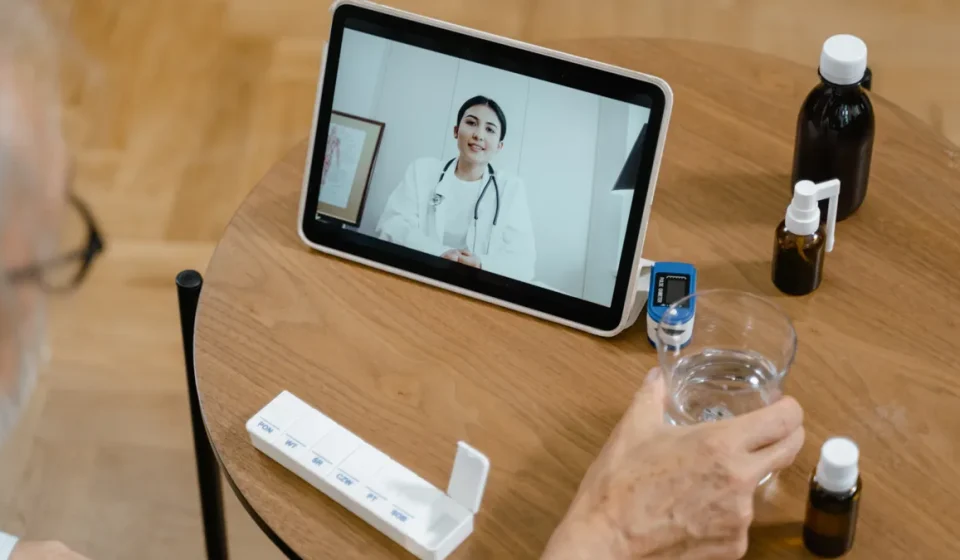
Telehealth wins for convenience, but it is the narrowest tool in the box. A plan with telehealth benefits can be a strong fit for freelancers who need fast access for minor symptoms, refill questions, rash checks, mental health follow-ups, or a quick screening before deciding whether to go somewhere in person.
The strength is obvious: you can often get help without driving, sitting in a waiting room, or losing half a day of work. That is especially useful if your schedule changes week to week or you work nights, weekends, or short deadlines. If the plan makes telehealth easy to access after hours, that can reduce unnecessary urgent care trips.
The drawback is just as important. Telehealth cannot listen to your lungs, stitch a cut, drain an abscess, check blood pressure in person, or do a hands-on exam. Some symptoms just do not fit a screen. A plan that overpromises virtual care can leave you paying for a second visit anyway.
Telehealth is also the wrong first stop if symptoms look serious, if you need imaging or labs right away, or if the plan limits what the virtual visit can handle. A freelancer should treat telehealth as the fastest filter, not the final answer for every symptom.
When does urgent care beat telehealth?
Urgent care wins when the problem needs an exam, not just advice. If you need a strep test, a sprain check, a cut cleaned, or a same-day look at symptoms that are not emergencies, urgent care is usually the better fit.
That is because urgent care fills the gap between virtual visits and the ER. It is a real clinic, so it can do the hands-on work telehealth cannot. For a freelancer, that can mean less time wasted trying to decide whether to “wait and see” or go all the way to the emergency room.
The trade-off is cost and access. Plans often use a separate urgent care copay, and that copay may be different from telehealth. If you live far from an urgent care center or need care late at night, the benefit can look good on paper and still be awkward to use in practice.
Urgent care is not the right choice for chest pain, trouble breathing, stroke symptoms, major bleeding, or other emergency signs. It is also not a substitute for ongoing primary care. If your plan pushes every problem toward urgent care, that can mean repeated copays and fragmented care instead of one clear medical home.
Why does the ER cost more even when it is covered?
The ER usually costs more because it is designed for immediate, high-acuity care and the plan expects that level of resource use. Coverage is not the same thing as a low bill, and that distinction matters a lot for freelancers who pay attention to every claim.
The ER is the right choice when symptoms are severe enough that waiting could cause serious harm. Think chest pain, trouble breathing, confusion, stroke signs, major injury, or uncontrolled bleeding. In those cases, the plan’s emergency coverage matters more than the copay comparison.
The weakness of the ER is that it is the least efficient setting for non-emergencies. If the plan has emergency coverage but the problem is minor, the bill can be much higher than telehealth or urgent care. That is the downside a lot of people miss when they scan the benefits summary too quickly.
The other issue is uncertainty. Many freelancers do not want to “get it wrong” and choose the wrong setting. A plan that explains emergency coverage clearly, including what counts as a true emergency, is easier to live with than one that only lists emergency room benefits in fine print.
The honest side-by-side
Telehealth wins on convenience, urgent care wins on hands-on same-day treatment, and the ER wins only when the risk is high enough that speed matters more than cost. If you are weighing telehealth vs urgent care vs ER for freelancers, the table below shows the practical differences that actually affect a freelancer’s choice.
| Criteria | Telehealth | Urgent care | Winner for [condition] |
|---|---|---|---|
| Speed of access | Often fastest for minor issues | Same-day if a nearby clinic has room | Telehealth for simple questions |
| Hands-on exam | No | Yes | Urgent care when an exam matters |
| Best use case | Low-risk symptoms, follow-up, triage | Sprains, cuts, infections, tests | Depends on symptom type |
| After-hours access | Often strong | Sometimes available | Telehealth for late nights |
| Copay pattern | Often lower than in-person care | Usually a separate urgent care copay | Telehealth for cost control |
| Virtual limits | Cannot do physical procedures | Can do procedures and testing | Urgent care for in-person needs |
| Emergency symptoms | Not appropriate | Not appropriate | ER for true emergencies |
| Risk of a second visit | Higher if symptoms are more serious | Lower than telehealth for physical issues | Urgent care for uncertain symptoms |
| Travel burden | Lowest | Medium | Telehealth when leaving home is hard |
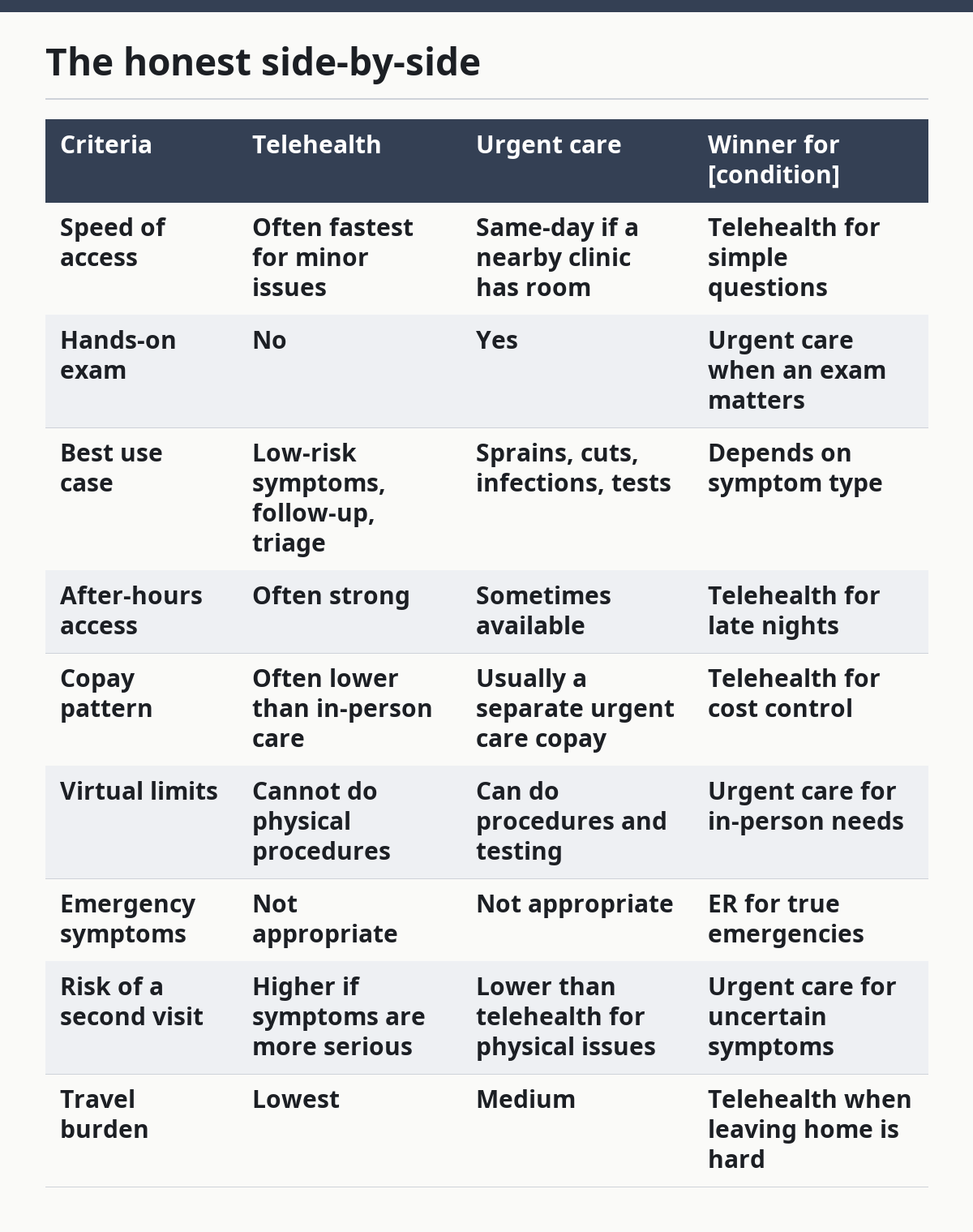
The comparison is not really about which setting is “better” in the abstract. It is about matching the problem to the setting the first time, so you do not pay twice or delay care. For freelancers, that matters because every extra stop can turn into lost work time. Related reading: health plan basics, copays and deductibles, and urgent care coverage.
Which one should a freelancer pick first?
Choose telehealth if the problem is mild, you mainly need guidance, and you want the lowest-friction first step. Choose urgent care if you need an in-person exam, a test, or a minor procedure that cannot wait for a regular appointment. Neither if the symptoms point to an emergency, because the ER is the correct setting then.
That is the cleanest rule. A freelancer should not try to “save money” by forcing every problem into telehealth, and should not use urgent care as a default for issues that are really just quick questions. The right choice is the one that matches the care level, not the one that feels easiest in the moment.
The best plan for this use pattern is the one that makes all three options easy to understand: telehealth benefits for simple care, urgent care copays that are not confusing, and emergency room coverage that is clear in plain language. A plan that does not explain those three together is harder to use when you are sick and short on time.
When should the choice flip?
The choice flips when the setting no longer matches the need. If you have a symptom that looks minor but keeps getting worse, telehealth should give way to urgent care or the ER. If you need a procedure, imaging, or a hands-on exam, urgent care beats telehealth even if the virtual visit is cheaper.
The other flip is after hours. A plan with weak telehealth access and no practical urgent care option can leave you with the ER as the only realistic path. That is not ideal, but it is better than waiting too long when symptoms worsen.
A third flip happens when the plan’s rules are unusually strict. If the plan treats telehealth as limited or the urgent care copay is high enough to make repeat visits painful, the “best” option on paper may not be the best one in real life. Cost-sharing can change behavior fast.
The fourth flip is simple: if you already know the problem is serious, skip the comparison. The ER is for emergencies, and the insurance question comes second.
What should you look for in the benefits summary?
You should look for the three separate lines that tell you how the plan treats telehealth, urgent care, and emergency care. If those lines are buried in different sections, that is a sign the plan may be harder to use than it first appears.
Start with telehealth benefits. Check whether virtual care is listed as covered, whether it has a separate copay, and whether it works for after-hours use. Then check urgent care copays and see whether they differ from primary care or virtual care. Finally, check emergency room coverage and see how the plan describes emergency care versus non-emergency use.
The goal is not to memorize the whole policy. The goal is to know, in advance, which door to use first. For freelancers, that cuts down on delay, and delay is often the most expensive part of getting sick.
FAQ
Does telehealth count as covered care?
Telehealth can count as covered care if the plan includes it, but the details matter. Some plans treat virtual care as a separate benefit with its own copay or rules. Check whether the plan covers phone and video visits, and whether there are limits on what a virtual visit can handle.
When should a freelancer use urgent care instead of the ER?
Urgent care is the better choice when the problem needs same-day attention but does not look life-threatening. A cut, sprain, rash, or infection often fits that lane better than the ER. If symptoms suggest chest pain, trouble breathing, stroke signs, or severe bleeding, the ER is the right setting.
How do copays differ for urgent care and emergency care?
Urgent care copays and emergency room copays are often different, and the ER is usually the more expensive setting. The exact amount depends on the plan, so the benefits summary matters more than a general rule. A freelancer should check each line separately before assuming one visit will cost the same as another.
Drafted with AI; not yet reviewed by a person.