Last updated: November 29, 2026
A hospital can be in-network while some of the doctors, labs, or anesthesia providers are not. The fastest check is to verify the hospital’s network status and then verify every separate billing entity tied to the visit, because a single stay can create 2 or more bills.
Key takeaways
- A hospital’s network status does not automatically cover every clinician who bills you.
- Look for 2 separate pieces: the facility bill and the professional bill.
- Elective care gives you time to check each name before the date of service.
- Emergency care can work differently, so the billing path may not match a planned visit.
- If a bill looks off, the name of the billing entity matters more than the name on the building.
How do I check both parts of the visit?
You check both parts by verifying the hospital, then verifying each doctor or physician group that may bill separately for the same visit. Start with the facility, because that answer is not enough on its own. Then ask for the names of the surgeon, anesthesiologist, radiologist, pathologist, and any physician group tied to the service, since those are common separate billers.
-
Use the insurer directory to search the hospital or facility name first, then confirm the result says the facility itself is in-network for your exact plan. A general network search is not enough if your plan has different tiers or a narrow network.
-
Use the hospital’s billing office to request the names of all billing entities connected to the procedure, visit, or delivery. Ask for the physician group names in writing, because a hospital can bill under one name while doctors bill under another.
-
Use the same insurer directory to search each physician group, not just the individual doctor’s name. If the directory has separate entries for professional services, use those entries too, because the bill may come from a group practice rather than the doctor personally.
-
Use the estimate or pre-service paperwork to look for clues such as “facility fee,” “professional fee,” “anesthesia,” or “labor and delivery.” Those labels tell you the visit may generate more than 1 claim, which means 1 in-network check is not enough.
-
Use the insurer phone line to confirm the exact billing entity names before the date of service. Say the full hospital name, the date, and the expected department, then ask, “Is the facility in-network, and are all doctors and groups likely to bill me also in-network?” Keep the reference number if you get one.
This is the safest route before elective care, imaging, surgery, or childbirth, where 1 missed name can change the bill. It is not a guarantee against every billing surprise, but it closes the biggest gap: the split between the building and the people who bill from it.
What does in-network mean for a hospital?
In-network means the hospital has a contract with your health plan for covered services under that facility agreement. That contract can lower your share of the bill, but it does not automatically control what every clinician charges under a separate agreement.
A hospital visit often has at least 2 billing layers. The facility bills for the room, equipment, nursing, and use of the building. A physician group bills for medical work such as reading a scan, delivering a baby, or performing surgery.
That split is why a reader can see one in-network result and still get a bill from a doctor who is outside the network. The hospital may be in-network on paper while the anesthesia group, emergency physician group, or pathology group is not. The two bills can look linked to the same day, yet they come from different contracts.
The most useful detail is the billing entity name, not the logo on the entrance. If the insurer directory lists “hospital” but the bill comes from a separate physician group, the network answer may not match. For more on the billing side of this issue, the CMS No Surprises Act page and the HHS balance billing overview explain why separate charges matter.
Which people and charges need a separate check?
You need a separate check for any person or charge that can bill independently from the facility. The main names to look for are surgeon, anesthesiologist, radiologist, pathologist, emergency physician, and the physician group that employs or contracts with them.
This is where many people get tripped up. The hospital may be listed correctly in the directory, but the professional fee comes from a different group with its own contract status. That group may not use the same name as the doctor on the appointment card.
| Item to verify | Who bills it | Why it matters |
|---|---|---|
| Facility fee | Hospital or facility | Covers the building and support services |
| Professional fee | Doctor or physician group | Covers the clinician’s work |
| Anesthesia | Anesthesia group | Often billed separately from the hospital |
| Imaging interpretation | Radiology group | The scan and the reading may be separate |
| Lab or pathology | Pathology group | The specimen review can create another bill |
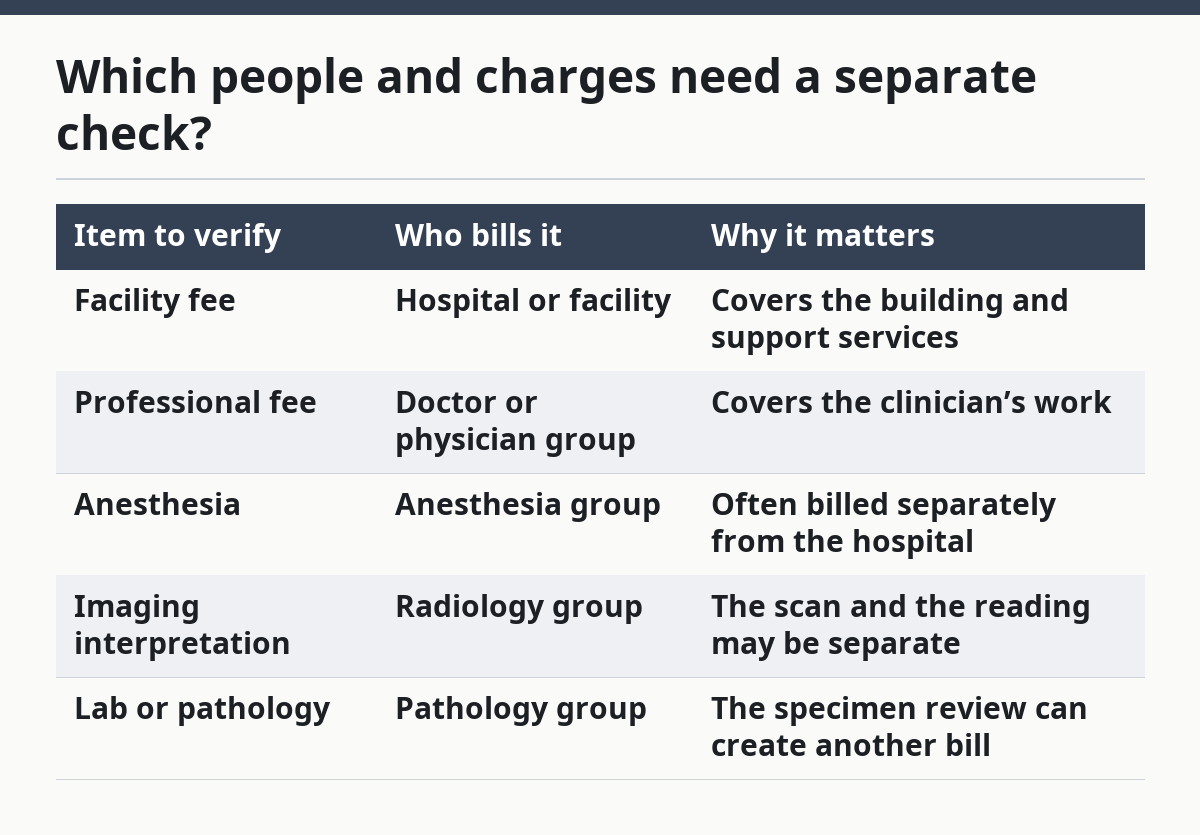
A good rule is simple: if the service could appear as its own line item, check its network status as its own entity. A 1-name search is too thin for a stay that can generate 3 or 4 bills.
What is a facility fee?
A facility fee is the hospital’s charge for using the building and the systems that support care. That can include the room, equipment, supplies, nursing, and other hospital-based services, and it is separate from the doctor’s professional fee.
This matters because a facility fee can exist even when the doctor’s bill is handled elsewhere. A planned procedure in a hospital outpatient department, for example, may produce both a facility bill and a physician bill. If you only check the doctor, you may miss the facility network status; if you only check the hospital, you may miss the doctor.
A plain way to spot this is to look for 2 billing lines instead of 1. One line may say “facility,” “hospital,” or “outpatient department.” Another may say “professional,” “physician,” or a physician group name. If the paperwork shows 2 parts, verify 2 parts.
The cost problem is not just the total amount. It is the source of the charge. A facility fee from an in-network hospital can still be paired with a professional bill from an out-of-network group, and that is where balance billing can start if your plan and the provider do not agree on payment.
When does emergency care work differently?
Emergency care can work differently because you often do not choose the doctors who see you, and the billing path may be handled under rules that differ from elective care. That is why planned care and emergency care should not be checked the same way.
For a planned procedure, you have time to confirm 3 things before you go: the hospital, the facility fee, and each likely billing group. For emergency care, you may only be able to review the hospital afterward and sort out the separate claims as they arrive.
That does not mean you should ignore the network question. It means the check changes shape. In an emergency, the hospital name on the door is only one piece of the bill, and the medical team may include people you never met before arrival. If a bill later lists a doctor or group you do not recognize, compare the name on the bill with the hospital name and the department involved.
This is also where balance billing can show up if a separate entity bills outside the contract rules that apply to the visit. The practical move is to save every explanation of benefits, bill, and discharge paper for at least 1 billing cycle so you can match each charge to a name.
What mistakes cost the most money?
The most expensive mistake is stopping after the hospital search and assuming the whole visit is covered the same way. That can leave you with a bill from a separate physician group, and the surprise often shows up weeks later rather than on the day of care.
Another common mistake is checking the doctor’s name but not the billing group. A physician may practice at an in-network hospital while the group that bills for the service is out of network. If you search only the individual name, you can miss the real payer relationship.
A third mistake is trusting a verbal answer without writing down the exact billing entity. If the hospital says “yes, we’re in-network,” but you do not ask whether that answer covers the anesthesia group, pathology group, and facility fee, you still have a gap. A 2-minute phone call can save a claim appeal later.
The fix is to use the same 3-part checklist every time: facility name, physician group name, and the claim type. If a bill arrives, compare those 3 items to what you confirmed before care. That comparison catches most mismatches faster than rereading the whole chart.
What should I ask before I schedule?
You should ask for the names of every billing entity that may touch the visit, then ask which of those names are in-network for your exact plan. Keep the question short and direct so the answer is harder to dodge.
Use this wording:
- “Is the hospital or facility in-network for my plan?”
- “Which physician group will bill me?”
- “Will anesthesia, radiology, pathology, or other separate groups bill under different names?”
- “Can you put the billing entity names in writing?”
A 1-page pre-service estimate is useful only if it names the separate charges. If it lists just the hospital and leaves out the group practice, the estimate is incomplete for network checking. The point is not to get a perfect forecast; it is to avoid a missing name.
If the staff cannot answer with a billing entity name, ask for the billing office instead of ending the call. The question is not “Is the doctor nice?” or “Is the hospital reputable?” The question is whether the hospital and the doctors are both in-network under the same visit.
Can a hospital be in-network if the doctor is not?
Yes. A hospital can be in-network while a doctor or physician group that bills separately is out of network. That happens because the facility contract and the professional contract are different. A 1-day stay, surgery, or delivery can still create separate charges from 2 or more entities.
What is a facility fee?
A facility fee is the hospital’s charge for the building, equipment, nursing, and related support services. It is separate from the doctor’s professional fee. If the paperwork shows both a facility line and a physician line, each one needs its own network check.
How do I verify both parts of a visit?
Verify the hospital first, then verify every separate billing entity tied to the visit. Use the insurer directory, the hospital billing office, and the pre-service estimate together, then compare the names on the bill with the names you confirmed. If the names do not match, call before paying.
Drafted with AI; not yet reviewed by a person.