
Last updated: November 21, 2026
Quick answer: start with the Summary of Benefits and Coverage document on page 1, where the deductible, copayments, and out-of-pocket maximum usually appear, and use that short summary before you enroll. If you freelance, the Summary of Benefits and Coverage document can show what you may pay for a doctor visit, prescription, or hospital stay, and it is often the fastest way to catch a plan that looks cheap but is not.
Key takeaways
- The Summary of Benefits and Coverage, or SBC, is the first document to open because it puts the main cost rules in one place.
- Focus on the deductible, copayment, and out-of-pocket maximum before you get lost in brand names or broad plan labels.
- Check the coverage examples, since they show how the plan handles common care rather than just listing covered services.
- The SBC is not the whole contract. The evidence of coverage holds the longer rules, exclusions, and definitions.
- A plan can look affordable at the premium level and still cost more if one service you use is priced high or covered in a narrow way.
What is the Summary of Benefits and Coverage?

The Summary of Benefits and Coverage is a standardized health plan summary that shows core costs and coverage terms in a short format. For freelancers, that matters because you usually do not have an HR team to translate plan paperwork, so the SBC becomes the first filter before enrollment.
The SBC usually gives the same kinds of facts for each plan: what you pay for office visits, what the deductible is, what the out-of-pocket maximum is, and where the plan puts limits on care. That standard format makes it easier to compare plans without hunting through a full policy first.
The federal government describes this document on Healthcare.gov’s SBC page, and that page is worth opening once so the layout makes sense: https://www.healthcare.gov/health-care-law-protections/summary-of-benefits-and-coverage/. A second useful source is the Department of Labor’s consumer page on health plans and benefits, which explains where plan documents fit in the bigger picture: https://www.dol.gov/general/topic/health-plans/consumer.
The trap for freelancers is treating the SBC like a full contract, so consult a professional if a line item could affect your coverage, and use the plan documents and the Department of Labor’s consumer guidance as your source for the full terms: https://www.dol.gov/general/topic/health-plans/consumer. It is not. It is a map, not the terrain, and it leaves out long definitions, exceptions, and some plan-specific fine print that live in the evidence of coverage.
Where do I start on page 1?
You start with the plan’s cost-sharing boxes, then move to the examples. Page 1 is often the quickest place to find the numbers that can change your budget, especially if you need care during the year and cannot absorb a surprise bill.
Use this order when you read it:
- Find the deductible. Look for the dollar amount you must pay before the plan starts sharing some costs. If you expect regular care, this tells you how much spending sits on your shoulders first.
- Find the copayment lines. A copayment is a fixed dollar amount for a service, such as a doctor visit or a prescription. This matters because a $0 premium plan can still have a high copayment for routine care.
- Find the out-of-pocket maximum. This is the most you may pay for covered services in a plan year before the plan pays 100% for covered care, subject to the plan’s rules. It helps you understand your worst-case in-network cost.
- Look for service-level costs. Check the lines for primary care, specialist care, urgent care, emergency room care, and prescription drugs. The same plan can be cheap for one service and expensive for another.
- Scan the coverage examples. These examples show how the plan handles a real set of care visits, tests, and drugs. They make the numbers feel concrete instead of abstract.
The reason to read in this order is simple: the premium alone does not tell you what a year of care will cost. For a freelancer, that is the difference between a plan you can carry and a plan that turns into a cash drain.
How do I read the coverage examples?
The coverage examples show what the plan might cost in common situations, and they are the closest thing to a worked example inside the SBC. They usually make the cost structure easier to understand than a list of benefit lines with no context.
Read the examples as a stress test. If the plan shows a routine office visit, a few lab tests, or a childbirth example, you can see whether the deductible hits early, whether the copayment stays fixed, or whether the out-of-pocket maximum becomes relevant. That tells you more than a headline premium ever can.
Do not treat the examples as a promise about your own bill, and if the example conflicts with a service you expect to use, consult a licensed broker, benefits adviser, or other qualified professional before you enroll, using the SBC and the evidence of coverage as your source documents. They are model cases, not your exact claim pattern. A freelancer with a chronic condition, a planned procedure, or a steady need for prescriptions can see very different spending than the example shows.
The best way to use the examples is to match them against your own likely use. If you know you will see a specialist several times a year, those visits matter more than a low-cost example based on a single checkup. If you expect no care at all, the examples still matter because they reveal what a bad year could cost.
What plan limitations should I look for?
The main limitations are the rules that shrink coverage after the headline benefits look generous. These often hide in the SBC and become clearer in the evidence of coverage, so you want both documents before you enroll.
Watch for these items:
- Service limits. A plan may cover a service but only under certain conditions or only a limited number of times.
- Prior approval rules. Some services need approval before the plan pays.
- Network rules. Care outside the network can cost more or be covered differently.
- Excluded services. Some care may be listed as not covered at all.
- Separate cost buckets. A plan may treat prescriptions, mental health, urgent care, and hospital care as different cost categories.
A freelancer can get tripped up here because the plan title sounds broad, while the actual coverage is narrow in one area that matters. A plan that looks good for office visits may still be a poor fit if it puts tight rules on imaging, specialist care, or drugs you use regularly.
This is also where the evidence of coverage starts to matter more than the SBC. The SBC gives the warning sign; the evidence of coverage gives the longer rulebook. If the SBC says a service is limited, do not assume the fuller document will soften that rule.
How is the SBC different from the evidence of coverage?
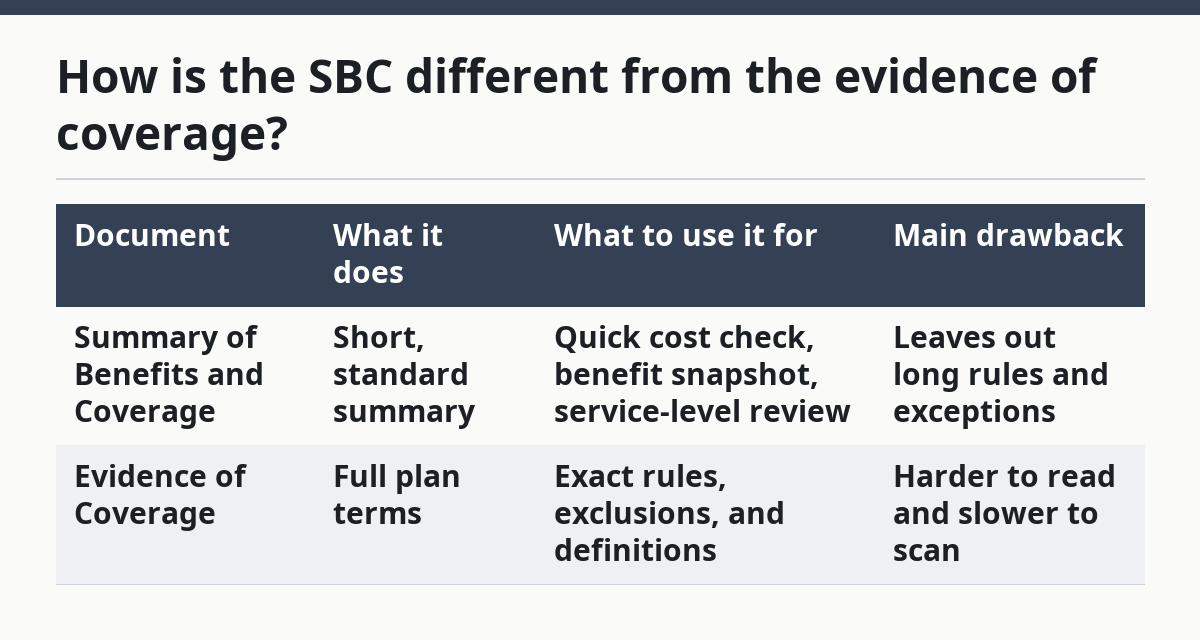
The SBC is the short summary, while the evidence of coverage is the longer contract that spells out the full rules. That difference matters because freelancers often stop after the summary and miss the pages that explain exclusions, definitions, and claim rules.
A simple way to think about it is this: the SBC tells you what the plan looks like at a glance, and the evidence of coverage tells you how the plan works when a claim happens. The first document is usually easier to scan in 10 minutes. The second may take much longer, but it is where the details live.
| Document | What it does | What to use it for | Main drawback |
|---|---|---|---|
| Summary of Benefits and Coverage | Short, standard summary | Quick cost check, benefit snapshot, service-level review | Leaves out long rules and exceptions |
| Evidence of Coverage | Full plan terms | Exact rules, exclusions, and definitions | Harder to read and slower to scan |
If you only have time for one pass before enrollment, read the SBC first. If one item in the SBC affects a service you actually use, then go to the evidence of coverage and read the related section before you enroll. That is especially true for people who expect care in the next plan year, not just in theory.
Which page should I check first?
You should check the SBC first, then the evidence of coverage if any line in the SBC affects your likely care. That order saves time and keeps you from reading a long contract before you know which parts matter.
A practical read-through for a freelancer looks like this: open the SBC, find the deductible and out-of-pocket maximum, check the copayment for the services you use most, then read the coverage examples. If any part looks restrictive, switch to the evidence of coverage and search for that exact service or term.
The main mistake is starting with the plan name, not the numbers. “PPO,” “HMO,” or a marketing label can sound familiar, but the SBC shows whether the plan actually fits your cash flow and care pattern. A second mistake is reading only the premium. That can lead you to pick the cheapest monthly payment and miss a high deductible or steep visit cost.
This page is part of the broader self-employed coverage shopping and plan selection guide, and it also connects to the health insurance deductible guide, out-of-pocket maximum explainer, and self-employed health insurance overview, but the job here is narrower: read the document before you enroll, not compare every plan feature at once.
What mistakes do freelancers make most often?
Freelancers most often skip the service lines they think they will never use, and that can cost them later. A plan can look fine on paper and still punish you on specialist visits, prescriptions, imaging, or urgent care.
The other common mistake is confusing “covered” with “cheap.” Covered care can still come with a deductible, a copayment, or a large share of cost before the out-of-pocket maximum helps. If you only check the premium, you may miss the part of the bill that lands on you during the year.
A third mistake is ignoring the wording around limits and exclusions. That mistake costs time, because you may discover the problem only after you enroll and try to use the plan. The fix is plain: read the coverage examples, then check the related section in the evidence of coverage before you commit.
For freelancers, the goal is not to memorize every line. It is to catch the few lines that change the math. If those lines do not fit your budget or your likely care, the plan is wrong for you even if the premium looks attractive.
FAQ
What is the Summary of Benefits and Coverage?
The Summary of Benefits and Coverage is a standard health plan document that condenses the main costs and covered services into a short format. It helps a freelancer see the deductible, copayment, and out-of-pocket maximum without digging through the full policy first.
How is it different from the evidence of coverage?
The Summary of Benefits and Coverage gives the short version, while the evidence of coverage gives the full contract terms. The SBC is better for quick screening, but the evidence of coverage is where the detailed rules, exclusions, and definitions usually live.
Which page should i check first?
Check the Summary of Benefits and Coverage first. If any line affects a service you expect to use, then open the evidence of coverage and read that section before enrolling. That order keeps the first pass fast and keeps you from missing a costly rule hidden in the longer document.
How do I know whether the out-of-pocket maximum matters?
If you expect frequent care, the out-of-pocket maximum matters because it caps your covered in-network spending for the plan year. If you only expect one or two visits, it still matters, but the deductible and copayments may affect your budget sooner.
What should I compare across plans first?
Compare the deductible, copayments, out-of-pocket maximum, and the service lines for the care you use most. Those numbers usually tell you more than the plan name or the monthly premium alone.
Drafted with AI; not yet reviewed by a person.