How freelancers make a first premium payment to activate Marketplace

Last updated: November 20, 2026
Quick Answer: In most cases, the first premium payment is the step that turns an approved Marketplace plan into active coverage, and the bill usually has to reach the insurance company through the insurer’s payment system, not just sit in your inbox. If the first bill is late or sent to the wrong place, the plan may not start when you expect.
For a freelancer, this is the part that matters most after enrollment: find the premium invoice, pay the first month the right way, and confirm the coverage effective date. HealthCare.gov explains the payment process on its premium payment pages, and the Marketplace rules on premium payment and coverage start are also summarized by CMS. For more background on the enrollment sequence, see our guide to Marketplace enrollment and the related page on Marketplace coverage for freelancers. A plan may show an effective date, but the first premium still has to be posted correctly before coverage starts. HealthCare.gov and CMS both say the insurer’s billing process controls that step.
Source: HealthCare.gov premium payments; CMS premium payment guidance.
Key takeaways
- The first premium payment is what activates the plan after enrollment.
- The premium invoice comes from the insurance company, not from the Marketplace application itself.
- Payment method matters because some options post faster than others.
- Coverage can start only after the first premium is handled the way the insurer requires.
- If the first bill is missed, the plan may not activate on time and the grace period rules become important.
What does the first premium payment do?
The first premium payment activates the Marketplace plan by telling the insurance company that the policy should go live. The plan can be selected and approved, but coverage usually does not become active until the first month’s premium is paid in full and matched to the right policy.
For freelancers, this matters because income can change from month to month and the bill may not feel urgent until the effective date is close. The payment is not a deposit or a processing fee. It is the premium for the first month of coverage, and it must go to the insurer’s billing system, often through a payment portal linked to the premium invoice. CMS says the issuer, not the Marketplace application, is the entity that receives and posts the payment.
A common mistake is assuming the Marketplace itself handles the money. In most cases, the insurer sends the premium invoice, and the insurance company is the one that records the payment. If the invoice lists one policy number and the payment goes under another, the plan may stay inactive even though money left the bank account.
This is why the first bill deserves close attention. A freelancer who is switching from uninsured to covered often expects the plan to “start automatically,” but that only happens after the premium is paid and posted correctly. The practical goal is simple: pay the right bill, for the right month, through the right channel.
For a broader look at how the enrollment side fits into this step, the hub page on how freelancers use Marketplace coverage after enrollment sits one level up from this guide. For the official rule set, see CMS’s page on premium payment and effectuating coverage.
Where do you find the premium invoice?
You find the premium invoice in the place the insurance company uses for billing, not in the Marketplace application screen. That invoice usually shows the amount due, the due date, the policy number, and the payment portal or mailing instructions.
Freelancers should look for the invoice as soon as the plan selection is complete, because the billing clock can move faster than expected. If the insurer offers email alerts, paper mail, or an online member account, the first invoice may appear in any of those places. The important detail is that the invoice comes from the insurance company, while the application and plan choice came from the Marketplace.
A careful read of the invoice solves most early problems. The due date may be tied to the plan’s effective month, and the billing page may separate the premium from any past-due amount or partial payment. If the invoice says the payment must be received by a certain date, do not wait until the last day to start the process. Mail and bank processing can take more than 1 business day.
Here is the simple rule: if the invoice does not show the right plan name, policy number, or month, stop and check it before paying. A payment sent to the wrong account can be a slow fix, even if the amount is correct. The first bill is less about convenience and more about matching the insurer’s records on the first try.
How do you make the first premium payment?
You make the first premium payment by following the invoice, entering the payment details in the insurer’s payment portal, and keeping proof that the payment was submitted. The cleanest way to do it is to work straight from the premium invoice and confirm the policy number before you click submit.
- Open the premium invoice from the insurance company and find the policy number, amount due, and due date. That gives you the exact bill tied to your Marketplace plan.
- Go to the payment portal listed on the invoice or by the insurer. This is the place where the payment is recorded for activation.
- Choose the payment method shown as accepted for that account. Some insurers support card or bank transfer in the portal, while others also accept phone or mail payments.
- Enter the payment details exactly as requested, including the policy number if the portal asks for it. This helps the insurer match the payment to the correct plan.
- Save the confirmation page, receipt number, or email confirmation. That record matters if the payment posts later than expected.
- Check the insurer’s account or invoice history after the payment clears. The result you want is a posted premium that matches the first month of coverage.
Do not assume that a submitted payment is the same as a posted payment. A payment can be started on time but still fail to post if the bank information is wrong, the card is declined, or the insurer cannot match the invoice number. That is why the receipt matters as much as the payment itself.
If the invoice offers more than one way to pay, choose the method that gives the clearest confirmation. For the first premium, clarity is worth more than convenience.
Which payment method is best for a first bill?
The most practical payment method for a first bill is usually the one the insurance company can post quickly and match to your policy without confusion. For a first premium payment, a method that gives immediate confirmation is often easier to track than one that depends on mail delivery.
| Payment method | What it gives you | Main drawback |
|---|---|---|
| Payment portal | Immediate confirmation or a receipt page | Requires correct login and policy details |
| Phone payment | Direct handling through the insurer | Can take time if the line is busy |
| Mail payment | Paper record and a check or money order trail | Slower posting and more room for delay |
| Autopay setup | Less chance of forgetting later bills | May not help with the very first bill if it is not active yet |
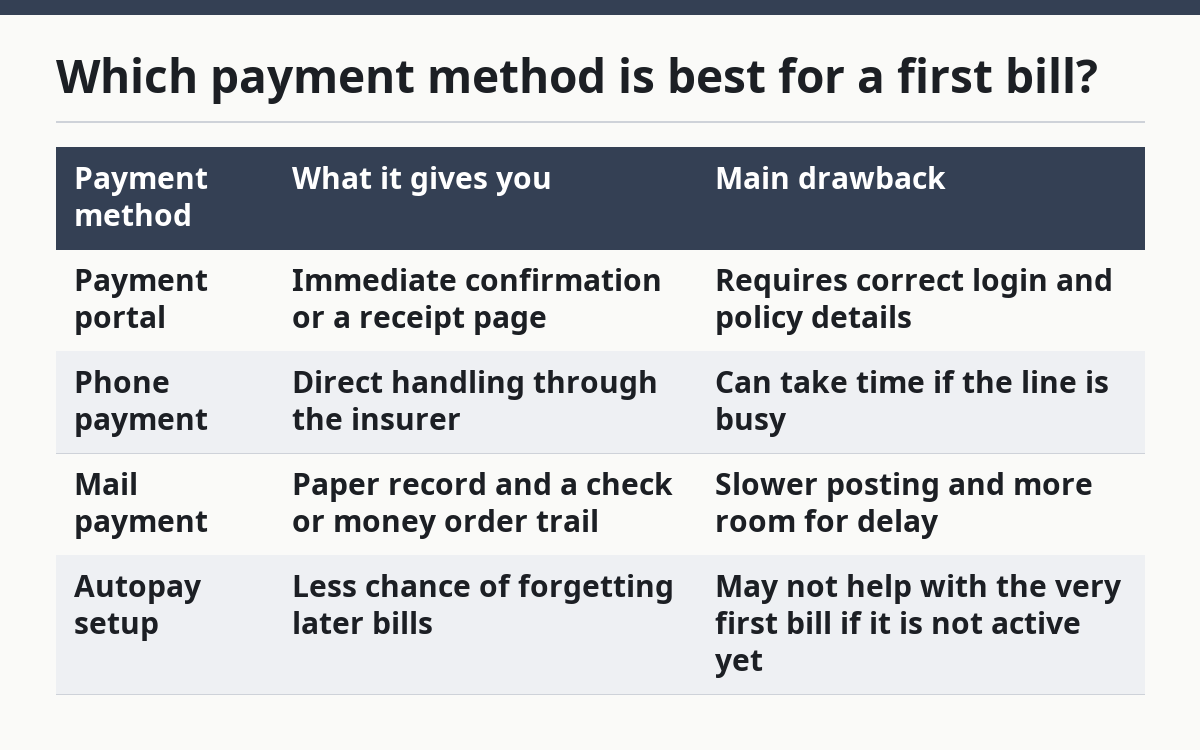
The table shows the trade-off plainly: faster methods reduce the chance of a first-month delay, while slower methods can leave you waiting for posting. For a freelancer who needs coverage active on a specific date, the payment portal or phone option often gives the best control over the first bill.
That does not mean mail is wrong. It means mail can be a poor fit when the deadline is near. A check in the mail can take several days to reach the insurer, and the policy may still sit inactive while you wait. If the invoice gives a due date and you are close to it, use a method that posts the payment sooner.
One more detail matters: if autopay is available, check whether it begins with the first premium or only after the first payment clears. Some accounts treat the first bill differently from later ones, so it is worth confirming that point with the insurer or a licensed professional before you rely on autopay for month 2. HealthCare.gov also advises checking how the issuer wants the first premium paid.
Source: HealthCare.gov premium payments.
When does coverage start?
Coverage starts on the effective date only after the first premium payment is handled the way the insurer requires. The plan can have an effective date on paper, but the policy may not be active if the first bill has not been paid and posted.
That is the key timing issue for freelancers. A plan can be selected for a month, yet the actual start of coverage depends on the insurer matching the premium invoice to the policy. If the payment is late, the effective date may no longer line up with your expected start date.
Grace period basics also matter here. A grace period is the extra time some plans allow after a bill is late, but that is not the same as being active on day 1. It is a backstop, not a replacement for the first payment. If you need care right away, do not plan around the grace period. CMS explains that payment and effectuation are separate steps.
Source: CMS premium payment guidance.
The safest approach is to treat the invoice date as an important deadline and the coverage effective date as the date you are trying to protect. Those are not the same thing. When they are close together, the first premium payment should be made early enough that the insurer has time to post it before the start date.
If you are unsure whether the payment posted in time, check the insurer’s account or call the number on the invoice. That is often the quickest way to learn whether the policy is active or still waiting on payment.
What mistakes delay activation?
The most common mistakes delay activation by making the insurer’s system unable to match the payment to the plan. The fix is usually simple, but the delay can still push the coverage start date off track.
One mistake is paying the wrong bill. Freelancers sometimes see a Marketplace message and assume it is the premium invoice, but the actual invoice comes from the insurance company. If the money goes to the wrong account, the plan may not activate even though payment was sent.
Another mistake is missing the due date by a day or two. That can matter a lot on a first premium, because the insurer may wait for the payment to clear before turning on coverage. A late payment can also force the person to deal with grace period rules, which are not what you want when you are trying to start coverage cleanly.
A third mistake is using the wrong payment portal or wrong policy number. That can leave the payment unlinked from the plan. The money may eventually be found, but not fast enough to protect the original effective date.
A fourth mistake is trusting a submission before it is confirmed. If a card payment fails or a bank transfer does not go through, the bill is still unpaid. Saving the confirmation page takes less than a minute and can save days of confusion later.
Here is the short version: check the invoice, check the due date, and check the confirmation. Those three checks are worth more than any guess about whether the plan is “probably active.”
Is this the right next step for every freelancer?
This is the right next step for freelancers who have already selected a Marketplace plan and now need to turn that selection into active coverage. It is not the right page for choosing between plan types, and it is not the right page for figuring out what comes after a Marketplace application is submitted.
It is also not the right page for someone who has not yet received a premium invoice. Without the invoice, there is nothing to pay yet, and the first job is to find the billing notice from the insurance company. The payment step starts only when the insurer issues the bill for the first month.
That is the trade-off of Marketplace coverage for freelancers: the process is clear once you have the invoice, but the billing step has to be done carefully. If you want to avoid a gap, the first premium is the bill that matters most.
FAQ
When is the first payment due?
The first payment is due by the date shown on the premium invoice from the insurance company. That date is the one to follow, not the date you applied or the date you chose the plan. If the invoice and the payment portal show different dates, contact the insurer using the number on the bill.
Does coverage start before payment is made?
No, coverage usually does not start before the first premium payment is made and posted. The plan may have an effective date, but the insurer still needs the first bill paid correctly. Until that happens, the coverage can stay inactive or pending.
What happens if I miss the first bill?
Missing the first bill can delay activation, and the plan may not start on the date you expected. The insurer may apply grace period rules if the account is eligible, but that is not the same as active coverage. If the first bill is missed, contact the insurance company right away and check the invoice status.
Drafted with AI; not yet reviewed by a person.