How freelancers use a SEP after a move, marriage, or baby

Last updated: November 20, 2026
Quick answer: How freelancers use special enrollment periods after a move, marriage, or baby usually comes down to three steps and one deadline: report the event, upload proof, and choose a plan before the special enrollment period closes. A move, marriage, or new baby can open a special enrollment period that lets a freelancer change Marketplace coverage outside open enrollment. The deadline is short, the proof matters, and the coverage start date depends on the event. This guide settles when to act, what documents to gather, and how the Marketplace usually handles the switch.
Key takeaways
- A special enrollment period is time-limited, so the event date controls the clock.
- Moves, marriage, and a baby can each create a different coverage path and start date.
- The Marketplace may ask for proof, and missing it can stall enrollment.
- The fastest route is usually to report the event, pick a plan, and upload documents right away.
- If the move is across state lines, the old plan may not carry over even if the SEP is approved.
How freelancers use a special enrollment period after a life event
How freelancers use special enrollment periods after a move, marriage, or baby is by reporting the event, proving it, and selecting a new Marketplace plan before the window closes. The special enrollment period is time-limited, and the details differ by event. Move rules, marriage rules, and baby rules do not work the same way, and the coverage start date can shift with each one.
Picture this: you’re juggling invoices, a lease change, and a half-finished plan comparison on your laptop. You need one clean path through the Marketplace, not a pile of tabs and guesses. The steps below show the order that keeps people from missing the deadline.
- Log in to your Marketplace account or start a new application. Use the same household details you would use on tax forms, because the Marketplace matches the SEP to your application record.
- Choose the life event type. Select move, marriage, birth, or adoption so the system opens the right SEP rules and asks for the right proof.
- Enter the event date exactly. The date of the move, wedding, birth, or adoption starts the clock for the enrollment window and can affect when coverage begins.
- Upload proof documents if the Marketplace asks for them. A lease, marriage certificate, birth record, or adoption record may be needed, and a clear file usually moves faster than a blurry phone shot.
- Compare plans and submit your choice before the window ends. Once the SEP closes, you may have to wait for the next open enrollment period unless another qualifying life event happens.
The truth is, freelancers often trip over one small detail: they wait to shop until after they have documents in hand. That can burn through part of the window. Start the process first, then finish the paperwork.
Which move rules matter most for freelancers?
A move can qualify for a special enrollment period if it changes the insurance options tied to your address, and the Marketplace usually wants the move date and your new ZIP code. For freelancers, that matters because your health plan is not tied to an employer office. It is tied to your household and location.
Picture this: you’re packing for a state line move or even a move across town, and your current plan suddenly looks wrong for your new ZIP code. The move is not just a mailing change. It can change your network, your premium, and whether your current plan still fits.
The details that matter most are the kind of move and the date you can document. A move into a new state is often treated differently from a move within the same state, but you should consult a professional or check Marketplace guidance before assuming the rule applies the same way in every case. The HealthCare.gov coverage pages explain that moving can qualify only in certain situations, and the details depend on your new location and eligibility.
- Keep a dated lease, utility bill, mortgage record, or other address proof.
- Save the date you moved in, not the date you signed the lease.
- Be ready to show that the new address is your real residence, not a short stay.
- Check whether your current plan still covers the new area before you assume it will carry over.
Here’s the catch: the Marketplace does not care about your packing date. It cares about the effective move date and the address you use on the application. If those do not match, the SEP can stall.
On the flip side, a move can be the cleanest SEP to document if your paper trail is tidy. A lease with a start date, a utility bill, and a forwarded mail notice can give the Marketplace a straight story. That is the kind of file that gets processed without drama.
How marriage changes the Marketplace timeline
Marriage can trigger a special enrollment period, but the coverage start date depends on when you report the change and when the Marketplace processes it. A wedding is not just a personal milestone. It can also change your household size, tax filing, and the plan choices you can make together.
Picture this: you’re newly married and trying to figure out if you should stay on separate plans or move to one household application. The Marketplace wants the marriage date, the updated household info, and proof that the marriage happened. That is the basic frame.
The Marriage SEP often comes down to three things: the exact date of the wedding, whether you and your spouse file together or separately, and whether both of you need coverage. The Marketplace may ask for a marriage certificate or another legal record.
- Report the marriage as soon as you can after the ceremony.
- Update household size and income if your tax setup changes.
- Decide whether one or both spouses need new coverage.
- Compare premium tax credit effects before selecting a plan, since household changes can change subsidies.
Marriage often gives a cleaner paperwork trail than a move because the legal record is usually straightforward. The downside is the tax side. A new household can change eligibility for savings, and freelancers feel that shift fast because their income can move month to month.
If you and your spouse already had separate plans, do not assume both policies stay right after the wedding. Some couples keep separate coverage. Others switch to one household application. The right move depends on the plans, the doctors you want, and the tax filing setup you expect for the year.
What happens after a baby is born or adopted?
A birth or adoption can create an SEP quickly, and the new coverage often starts right away or from the event date depending on the Marketplace rules and when you enroll. For freelancers, this event often demands fast action because the household changed overnight.
Picture this: you’re in the middle of newborn sleep deprivation or adoption paperwork and the last thing you want is a health plan problem. The Marketplace still needs the update soon, and it will usually ask for proof of the child’s arrival or placement. That proof can be a birth record, discharge paperwork, or adoption documents.
Birth and adoption cases usually matter for more than one person. You may need to add the child, update the household, and decide whether another parent also needs a plan change. That can affect the coverage start date and the size of any advance premium tax credit.
- Report the event as soon as possible. The clock starts from the birth or adoption date, not when you get around to the paperwork.
- Add the child to the application. The Marketplace needs the new household size to determine plan and savings eligibility.
- Upload the proof it asks for. A hospital record, birth certificate, or adoption record can confirm the event.
- Pick a plan that fits the new household. A child means more doctors, more visits, and usually a different cost picture than before.
- Confirm the start date in writing. The date matters because you do not want a gap between the event and the policy change.
A common mistake is waiting for the final birth certificate before starting the SEP request. That can waste days. Start the process with the evidence you already have, then send final documents if the Marketplace asks for more.
What proof documents should freelancers keep ready?
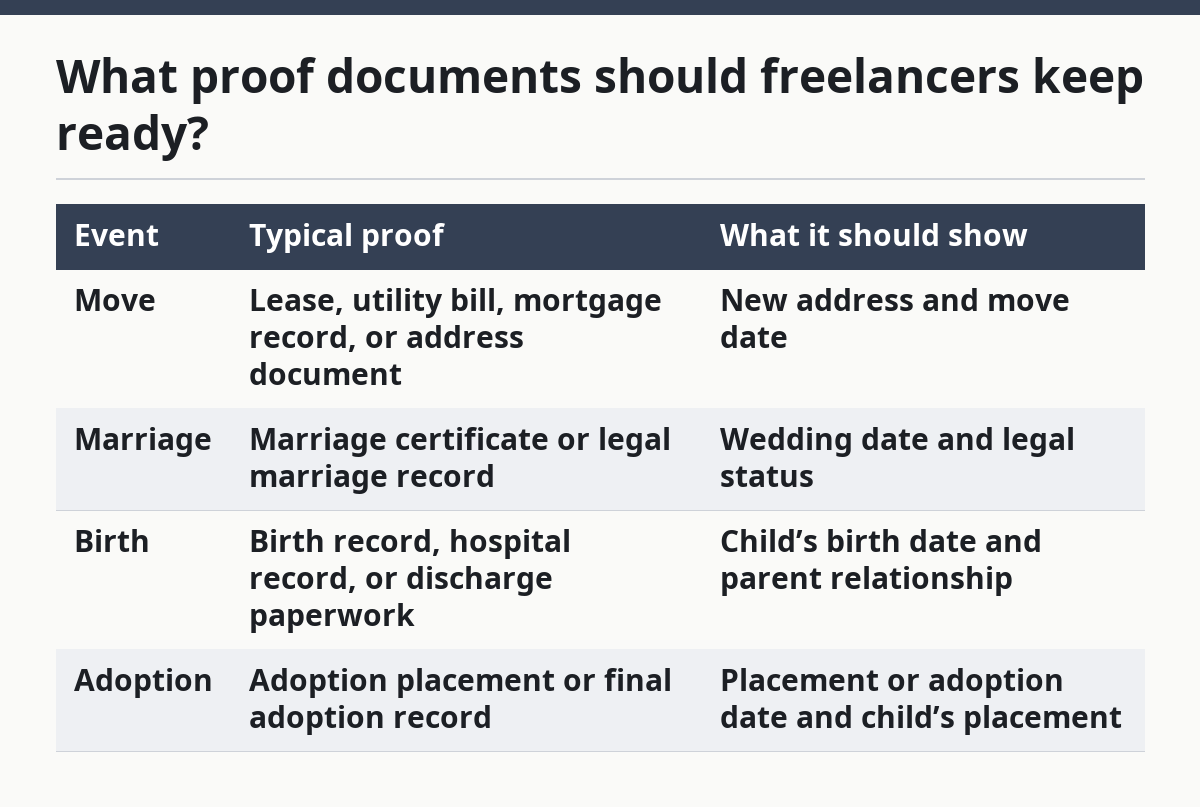
Freelancers should keep proof that matches the life event, because the Marketplace may request documents before it finishes the special enrollment period. No proof, no clean approval in many cases. That is the part people miss when they think the event itself is enough.
Picture this: you’re halfway through the application and the system asks for documents. If your files are named badly or stored in three different places, the process slows down. A simple folder on your phone and laptop can save you real time.
The exact document depends on the event, but the goal is to show the Marketplace that the event happened and when it happened. If you are unsure which record fits, consult Marketplace guidance or a benefits professional. Clean scans beat crooked screenshots. Clear dates beat vague notes.
| Event | Typical proof | What it should show |
|---|---|---|
| Move | Lease, utility bill, mortgage record, or address document | New address and move date |
| Marriage | Marriage certificate or legal marriage record | Wedding date and legal status |
| Birth | Birth record, hospital record, or discharge paperwork | Child’s birth date and parent relationship |
| Adoption | Adoption placement or final adoption record | Placement or adoption date and child’s placement |
The truth is, proof delays are often self-inflicted. Files with no date, files with the wrong name, or files that do not match the application can trigger extra review.
Two things help most:
- Save documents as PDFs if you can.
- Make sure the name on the file matches the name on the Marketplace application.
How does the coverage start date work after a SEP?
The coverage start date depends on the event type, the date you report it, and the Marketplace’s rules for that SEP. That is the part freelancers care about most, because a one-month gap can turn into a real bill.
Picture this: you’re trying to line up your old plan, the new plan, and a move date that landed in the middle of the month. The coverage start date can prevent a gap or create one, depending on when you enroll. It is not something you want to guess at.
For a move, marriage, or baby, the Marketplace may set the new plan to start on a date tied to the event or the next available start date after you enroll. The exact result can vary by the event and by how quickly you complete the steps.
A few practical rules help:
- Report the event early in the SEP window.
- Finish the plan selection before the window closes.
- Check the first premium bill so the plan is actually active.
- Keep your old coverage until you see the new start date confirmed, if your old policy still applies.
Here’s the catch: “approved for an SEP” does not always mean “covered tomorrow.” Approval and effective date are two different things. That gap is where freelancers get surprised.
If you are moving, the start date can matter even more because the old plan may not work in the new area. If you are marrying or adding a baby, the family change may affect the household application and the first month of coverage. Read the date the Marketplace gives you. Do not infer it.
Where freelancers go wrong, and how to avoid it
Freelancers usually miss the SEP by filing late, using the wrong event date, or uploading weak proof. Those mistakes can cost a coverage gap, a delayed plan switch, or a denied request. None of that is rare.
Picture this: you’re busy with client work, so the health plan change sits for a week. Then you realize the window may be nearly gone. That is the classic freelancer mistake. The fix is not complicated, but it has to happen fast.
The most common errors are:
- Waiting too long. The deadline can close before the paperwork is done.
- Using the wrong date. The Marketplace needs the actual event date, not the date you remembered it.
- Sending unreadable documents. Blurry files slow the review.
- Assuming every move qualifies the same way. It does not.
- Skipping the confirmation page. Without confirmation, you do not know if the SEP was accepted.
Who this is not for: anyone who wants to wait until the next open enrollment period and still expect immediate coverage. That is not how a special enrollment period works.
The better move is simple. Gather the proof first, report the event, choose the plan, and save every confirmation screen. If the Marketplace asks for more documents, answer the request the same day.
Special enrollment period questions freelancers ask most
A special enrollment period works best when you treat it like a deadline, not a casual update. Freelancers who move, marry, or add a baby need to act on the event date, not on the date they finally have time to think about insurance.
The better next step is to keep the event record, the proof document, and the plan choice in one place. That turns a messy life change into a straightforward Marketplace update. It also makes it easier to compare options if the new household or address changes what you can buy.
For more on the larger process, see the Marketplace enrollment and eligibility mechanics hub.
What life events trigger a special enrollment period?
A qualifying life event can trigger a special enrollment period if it changes your coverage situation, and move, marriage, birth, and adoption are among the most common examples tied to Marketplace enrollment. The event has to be real, dateable, and connected to your household or address. The Marketplace may still ask for proof before it finalizes the change.
How long is the enrollment window after a qualifying event?
The enrollment window is limited, and the exact timing depends on the event and the Marketplace rule that applies. The key point is that the clock starts on the event date, not when you remember to act. If you wait too long, you may have to wait for the next open enrollment period unless another qualifying event happens.
What proof is needed for a special enrollment period?
The Marketplace usually wants a document that matches the event type and shows the date. For a move, that might be a lease or utility bill; for marriage, a marriage certificate; for birth or adoption, a birth or adoption record. Clear dates and readable files make the request much easier to process.
Drafted with AI; not yet reviewed by a person.