How freelancers cover a domestic partner on health insurance

Last updated: November 20, 2026
Quick Answer: In most cases, a freelancer can add a domestic partner to a health plan if the plan allows it, but the real check is 1 plan document and 1 tax review before enrollment. In the topic of How freelancers cover a domestic partner on health insurance, the coverage question and the tax question are usually separate, so it is wise to consult a qualified tax or benefits professional for your own situation. In many cases, the coverage is possible; the tax treatment is the part that surprises people, because domestic partner benefits are often handled differently from spouse coverage. This is information, not financial advice, and a qualified adviser should be consulted for your own situation. For federal tax guidance, see the IRS on Publication 15-B and Publication 502.
Key takeaways
- A domestic partner can sometimes be added to a health insurance plan, but the plan itself decides the eligibility rules.
- Coverage and tax treatment are not the same question; a partner may be covered yet still trigger taxable income.
- Employer coverage, marketplace coverage, and household reporting use different rules, so the paperwork can change the result.
- A practical first step is to check the plan document, the enrollment window, and the tax form setup before you submit anything.
- A “yes” on coverage does not always mean a “yes” on tax-free treatment.
What does domestic partner coverage mean for a freelancer?
Domestic partner coverage means the plan may let you enroll a partner who is not a spouse, and not always a tax dependent, under your health insurance plan. For freelancers, that usually means a marketplace plan, an employer plan tied to a side job, or an individual plan bought outside work. The exact rules change by insurer, employer, and country, so there is no single universal standard.
The core issue is simple: a health plan can cover a person even when tax law treats that person differently. That split is why one form may ask about household members while another asks about dependents or tax status. If you mix those up, the plan may accept the enrollment but the tax side can still be wrong, so it is best to confirm the result with a qualified adviser and the plan’s written rules. For U.S. marketplace rules, see HealthCare.gov.
This topic is not for someone who needs advice on marriage, divorce, or changing coverage after a legal status change; those are separate questions. It is also not for someone trying to compare which family plan is cheapest for different care needs. Those cases turn on different rules and belong on a different page.
For the tax side, the IRS explains that the treatment of employer-provided benefits depends on who the covered person is and whether the value counts as taxable wages; the details are in IRS guidance such as Publication 15-B and Publication 502. For marketplace coverage and household reporting, the relevant rules are on HealthCare.gov and on your local marketplace if you are outside the U.S.
Who can usually add a domestic partner?
A freelancer can usually add a domestic partner only if the plan’s eligibility rules allow it. Some plans accept a domestic partner, some ask for proof of a shared household or financial commitment, and some do not offer the option at all. The plan document, not the label “partner,” decides the answer.
A common mistake is assuming that “domestic partner” means the same thing everywhere. It does not. A plan may define it using a sworn affidavit, shared address, shared bills, or another standard. If the plan says the partner must meet a 12-month cohabitation rule, for example, the insurer can ask for that proof even when the household thinks the relationship is obvious.
Here is the practical difference between the main paths a freelancer may face:
| Coverage path | What it usually depends on | Main risk | Why it matters |
|---|---|---|---|
| Employer coverage through a job | Employer plan rules and enrollment window | Missing the deadline or lacking required proof | The employer can allow or deny the add-on |
| Marketplace coverage | Household reporting and eligibility rules | Reporting the wrong household size or status | The premium tax credit side can be affected |
| Individual private plan | Insurer policy language | Assuming the plan follows employer-style rules | The definition of partner may be narrower or broader |
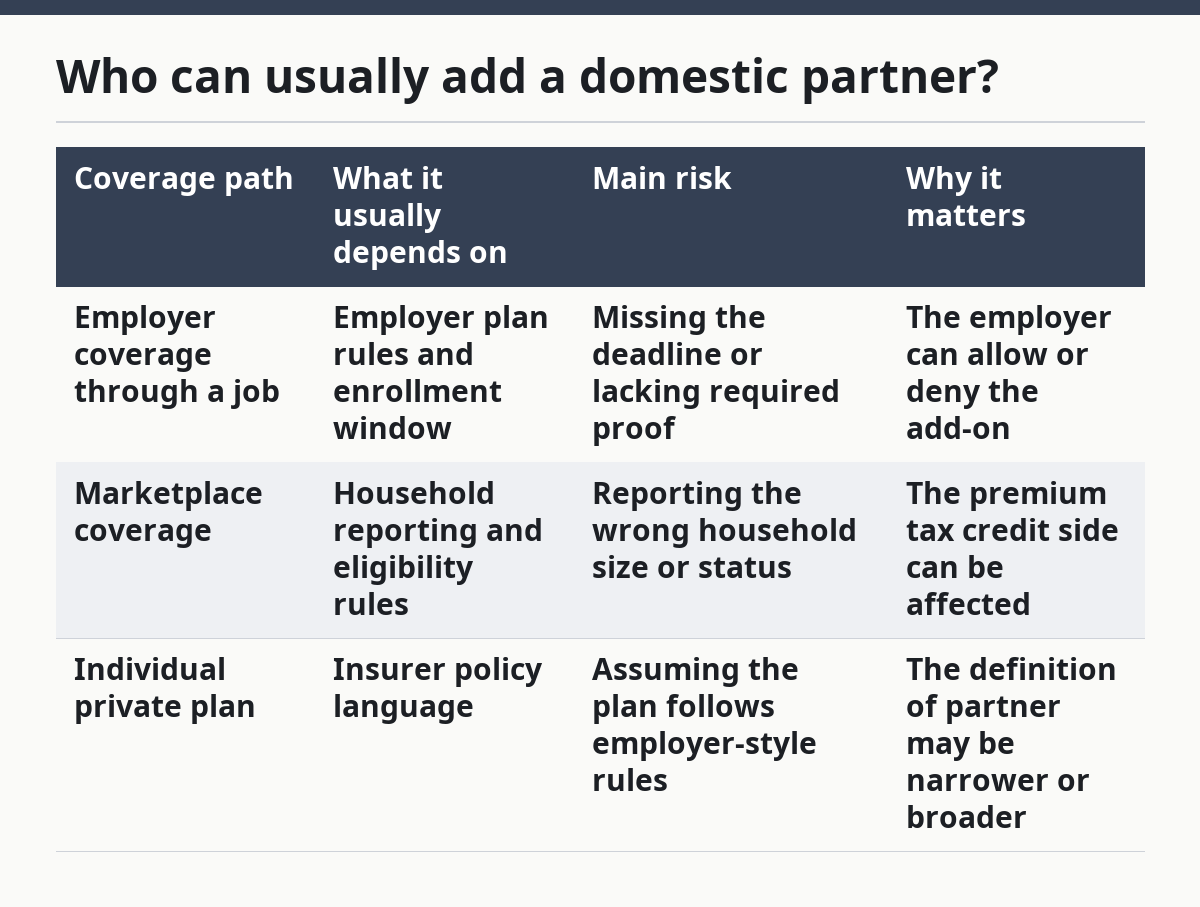
The comparison matters because the same domestic partner can be eligible in one setting and not in another. A freelancer who relies on one rule set for all three settings can end up with a rejected application or a tax form that does not match the coverage record.
How do you add a domestic partner to a health insurance plan?
You add a domestic partner by following the plan’s enrollment rules, submitting proof if required, and checking how the plan handles taxes before the effective date. The process usually takes place during open enrollment or after a qualifying event, and the paperwork often asks for exact names, dates, and household details. The goal is to make the coverage record and the tax record say the same thing.
- Get the plan document first. Read the summary plan description or policy booklet, which often runs 10 to 30 pages, and find the section on eligible dependents or domestic partners. If the plan does not mention domestic partners at all, that is a warning sign.
- Check whether the plan uses an affidavit or proof form. Many plans ask for a signed statement, a shared address, or evidence of a household tie. If the form is missing or incomplete, the enrollment can stall before the partner is added.
- Confirm the enrollment window. Open enrollment is the standard path, and many plans also allow a midyear change after a qualifying event. If the deadline has passed, the request may wait until the next annual window.
- Match the coverage start date to the plan rule. Some plans start coverage at the first of the month after enrollment, while others use a different effective date rule. If the date on the confirmation notice does not match what you expected, stop and ask for correction before paying anything.
- Check how premiums are collected. If the partner’s coverage changes the monthly cost, make sure the deduction or autopay amount is updated. A wrong deduction amount can lead to a bill or a gap in coverage.
- Ask how the plan treats pre-tax and after-tax amounts. If the plan is tied to an employer, the tax treatment may depend on whether the partner is a tax dependent. If the plan treats the value as taxable, the payroll or reporting setup should show it clearly.
- Save every confirmation page and notice. Keep the submission receipt, the approval letter, and the first billing statement for at least one plan year. If the coverage is questioned later, those records are the fastest proof.
- Verify the insurer record within 7 to 10 days. The partner should appear on the member roster and the ID card process should match the approved coverage. If the partner is missing, the request may have been entered incorrectly or stopped for review.
The most important check is not whether the form was sent. It is whether the insurer, employer, or marketplace now shows the partner as active with the correct effective date. A submission without a matching record is not finished.
Can a domestic partner be added during open enrollment?
Yes, a domestic partner can often be added during open enrollment if the plan allows partner coverage and the paperwork is complete. Open enrollment is the main annual window for changing coverage, and it is the safest time to make the change because the rules are usually predictable. If the plan does not allow domestic partner coverage, open enrollment will not change that.
The catch is that open enrollment does not erase tax questions. A plan may accept the partner for coverage, but the cost of that coverage may still be treated differently from spouse coverage. The tax result can change the take-home cost even when the medical benefits look identical on paper.
If you are using a marketplace plan, open enrollment can also trigger a review of the household report. That matters because household size and relationship status can affect eligibility for advance premium help and the amounts shown on the application. If the household report is stale, the enrollment may go through with the wrong numbers attached. For more on marketplace timing, see HealthCare.gov open enrollment.
What should freelancers check before they add a partner?
A freelancer should check the plan definition, the household report, and the tax treatment before submitting the change. Those three pieces often decide whether the coverage is approved, how much it costs, and whether the value is treated as taxable income. If one of them is wrong, the whole setup can be off.
Use this checklist before you send anything:
- Plan definition: Does the policy actually allow a domestic partner, or only a spouse or dependent?
- Proof standard: Does the plan want an affidavit, shared address, or another document?
- Household reporting: Does the marketplace application need the partner listed in the tax household even if the partner is not a tax dependent?
- Tax status: Will the value of the partner’s coverage be taxable under the plan’s rules?
- Effective date: What date does the coverage start, and does that date match the notice?
- Documentation: Do you have the confirmation number, PDF, or letter in one place?
One useful rule is to treat the coverage question and the tax question as separate tasks. A plan can answer “yes” to one and “no” to the other. That split is common enough that it should be checked every time, not assumed.
When should you stop and get help?
You should stop and get qualified help when the plan, tax treatment, or household status is unclear. In a money-and-health setting, guessing can create a coverage gap, a tax mismatch, or a billing problem that takes months to unwind. If the issue is simple paperwork, you can often fix it yourself; if the rule itself is unclear, do not force a decision.
The plan says “spouse” only: That means a domestic partner may not qualify under the benefit rules — contact the insurer or HR before submitting the form.
You need to change household reporting on a marketplace application: That can affect eligibility and tax help — check the marketplace instructions or a qualified adviser before filing.
The partner’s coverage may be taxable: That changes payroll or self-employment reporting — ask a tax professional how the value should be handled.
The plan asks for an affidavit you cannot truthfully sign: That is a documentation problem, not a minor delay — do not submit inaccurate statements.
The coverage start date is unclear or disputed: A bad date can leave a gap in claims — pause and get the insurer or plan administrator to confirm it in writing.
If the situation involves employer coverage plus freelance income, the tax side can get messy fast. That is the point at which a payroll specialist, tax adviser, or benefits administrator is worth the call, because the rules can turn on a single line in the plan document.
What mistakes do freelancers make most often?
Freelancers most often make the same 4 mistakes, and each one has a clean fix. The mistake is rarely “not enough effort”; it is usually using the wrong rule set for the wrong form. A domestic partner is the kind of benefit that looks simple until the paperwork starts.
-
They assume a domestic partner is automatically covered like a spouse.
The result can be a rejected enrollment or a taxable benefit they did not expect. The fix is to read the plan’s definition before filing. -
They treat marketplace reporting like employer plan enrollment.
The result can be a household application that does not match the tax record. The fix is to follow the marketplace’s own household rules, not the employer’s terminology. -
They skip the tax question because the coverage was approved.
The result can be surprise taxable income or a year-end reporting issue. The fix is to ask how the coverage is treated before the first billing cycle. -
They rely on old proof from a prior year.
The result can be a request for fresh documents or a stalled effective date. The fix is to use current forms and confirm the date on the approval letter. -
They do not keep the confirmation notice.
The result can be a dispute months later with no paper trail. The fix is to save the approval, the application, and the first invoice in one folder.
A good rule is to assume that if the plan wants proof, it wants proof in its exact format, not a similar-looking document. That small detail often decides whether the enrollment is processed in 1 cycle or held for review.
What if the plan rules do not fit your situation?
If the plan rules do not fit your situation, the standard approach is the wrong tool and you need a different path. Some plans simply do not allow domestic partner coverage, and some allow it but make the tax treatment awkward enough that the monthly cost changes in a way you need to understand first. That is not a paperwork flaw; it is the plan design.
Edge cases usually fall into 4 buckets:
- No domestic partner language in the policy: The plan may exclude the partner outright, even if another plan in the same market would allow it.
- Mixed household status: A partner may live in the same home but not meet the plan’s proof standard.
- Employer and freelancer coverage overlap: The partner may be covered under one plan while the freelancer’s marketplace application still asks about household members.
- Tax treatment differs from coverage treatment: The partner may be eligible for medical coverage, but the value may still be treated as taxable.
The fix is to ask for the written rule that controls the decision. A verbal “yes” is weak compared with the actual plan text or marketplace instruction page. If those do not match, the written rule wins.
A helpful reference point is to compare the insurer’s rule with the federal guidance on taxation and household reporting from organizations such as the IRS and HealthCare.gov. If your country is different, the same idea still applies: use the plan rule, the tax rule, and the household rule, not just one of them.
FAQ
Is a domestic partner considered a dependent?
Not always. A domestic partner can be covered by a health insurance plan without being treated as a dependent for tax purposes. The plan rule, the tax rule, and the household rule may all differ, so the answer depends on the exact form and the governing standard.
Can a domestic partner be added during open enrollment?
Yes, if the plan allows domestic partner coverage and the enrollment window is open. Open enrollment is the usual time to make the change, but the plan may still ask for proof and may set an effective date that is not immediate. Check the approval notice before assuming the change is final.
Do domestic partner benefits count as taxable income?
They can. In many cases, the value of domestic partner benefits is handled differently from spouse benefits, and the taxable result depends on the plan and tax rules that apply to your situation. Because tax rules change and vary by country, a qualified tax adviser is the right person to confirm the treatment for your return.
Drafted with AI; not yet reviewed by a person.