ACA Family vs Individual Tax Filing for Freelancers

Last updated: November 20, 2026
Quick Answer: 1 main rule decides this choice. Freelancers comparing How freelancers compare ACA family and individual plan tax filing choices should start with the tax household, not the plan label. In most cases, the ACA health insurance application, spouse, dependent, and subsidy rules follow the same household facts you will file on the return. The sections below explain how the application changes when one person, a spouse, or a dependent needs coverage.
Key Takeaways
- Your tax filing setup and your marketplace application must line up with the same tax household.
- A spouse or dependent can change the application even if only one person is freelancing.
- A family application is not always required for everyone in the home.
- Filing status can affect premium tax credit math, so the household details have to match the tax return.
- This is information, not financial advice; a qualified tax or benefits adviser should review your situation.
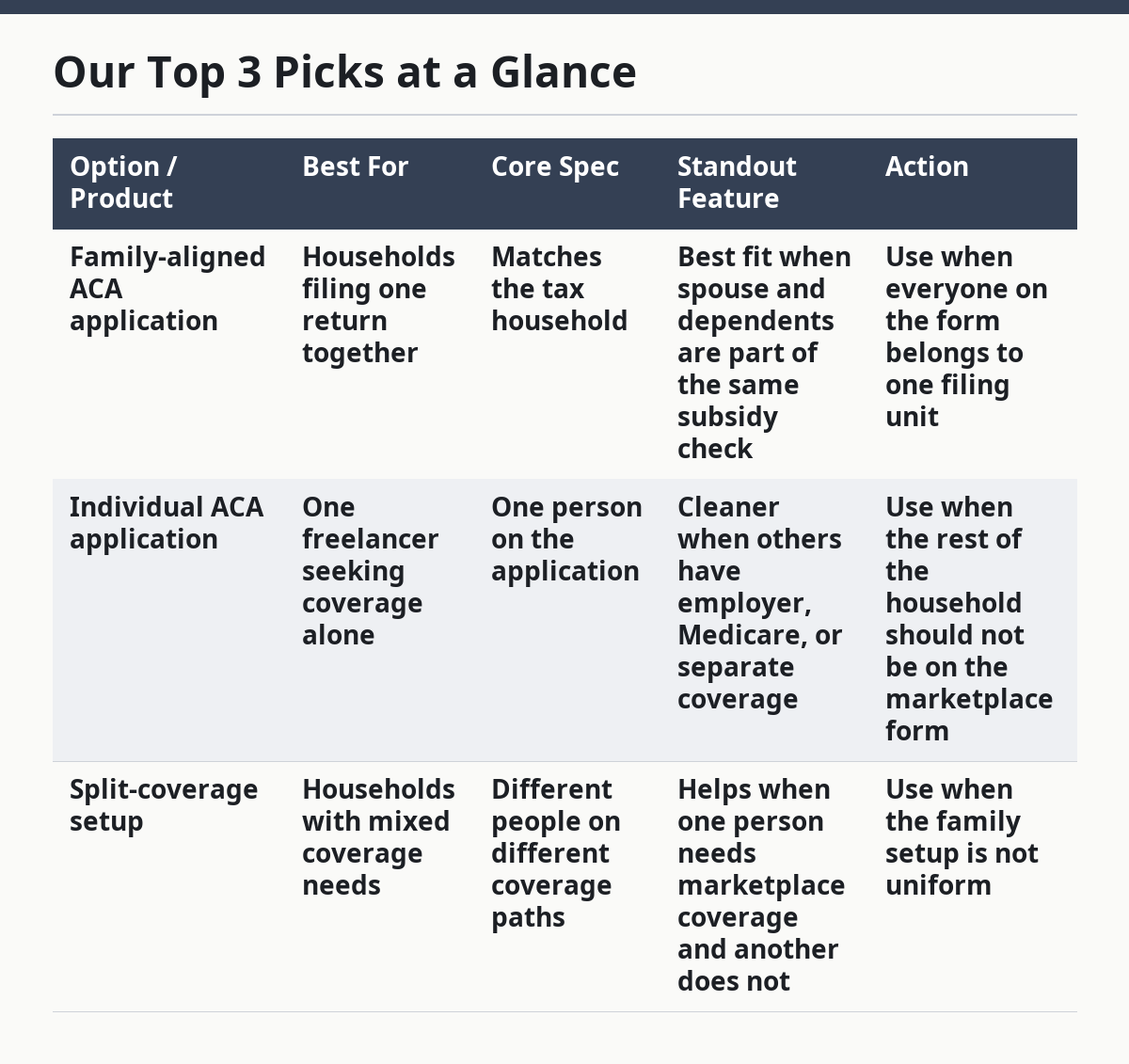
Our Top 3 Picks at a Glance
- #1 Best Overall: Family-aligned ACA application — best when the whole household shares one tax return and one coverage setup.
- #2 Best Budget Pick: Individual ACA application — best when only the freelancer needs marketplace coverage and the rest of the household has other coverage.
- #3 Best Heavy-Duty / Upgrade Pick: Split-coverage setup — best when one spouse or dependent needs a different coverage arrangement than the freelancer.
| Option / Product | Best For | Core Spec | Standout Feature | Action |
|---|---|---|---|---|
| Family-aligned ACA application | Households filing one return together | Matches the tax household | Best fit when spouse and dependents are part of the same subsidy check | Use when everyone on the form belongs to one filing unit |
| Individual ACA application | One freelancer seeking coverage alone | One person on the application | Cleaner when others have employer, Medicare, or separate coverage | Use when the rest of the household should not be on the marketplace form |
| Split-coverage setup | Households with mixed coverage needs | Different people on different coverage paths | Helps when one person needs marketplace coverage and another does not | Use when the family setup is not uniform |
Freelancers spend less time and make fewer tax mistakes when the ACA application follows the tax household, not a guess about who “should” be included. That simple rule drives the rest of the decision.
What the tax filing choice changes on the ACA application
The tax filing choice changes who belongs on the application, what income gets counted, and how subsidies are checked. It does not, by itself, force everyone into one plan. A marketplace plan is built around the tax household, but the enrollment can still be individual or family depending on who needs coverage.
If your spouse and dependents are in your tax household, the application usually asks for the full household picture. If another person in the home files separately, has different coverage, or is not in the same tax household, that changes the setup fast.
Here’s the catch:
- A tax household is the income unit the marketplace uses to decide subsidy eligibility.
- A dependent can belong on the application even if they do not need their own separate policy.
- A spouse can be included or excluded depending on filing status and coverage needs.
- The ACA health insurance application uses the household picture, not just who pays the premium.
For the federal framework, HealthCare.gov explains marketplace enrollment rules, and the IRS explains premium tax credit reporting and reconciliation. Those sources matter because the rules can change, and state marketplaces may add their own wrinkles. See also HealthCare.gov coverage options and IRS Form 8962 guidance.
Should a freelancer use a family ACA application?
A family ACA application fits best when the household files together and the people in the home need one shared subsidy picture. That is the cleanest setup for most married freelancers with a spouse or child on the same return.
Picture this: you’re self-employed, your spouse works part-time, and your child is your dependent. The marketplace will want the whole tax household, not just your freelance income. That means the application usually needs the combined household picture so the premium tax credit check is based on the right numbers.
The strength here is simple. A family application reduces the risk that one person is counted twice, left out, or attached to the wrong subsidy calculation. It also fits households where a spouse and dependent are part of the same return and the same coverage story.
The weakness is just as real. If one person in the household has very different coverage needs, a family application can get clumsy. It may also create confusion when one spouse has employer coverage and the freelancer is the only person actually shopping the marketplace.
Who should skip this: a freelancer with a spouse on separate employer coverage and no dependent who needs marketplace insurance; an individual ACA application is usually the cleaner fit.
- Buy this if: you file with a spouse or dependent and the household income picture belongs together.
- Skip this if: you are the only person seeking marketplace coverage and everyone else has separate insurance.
Is an individual ACA application better for a freelancer alone?
An individual ACA application is better when only the freelancer needs coverage and the rest of the household does not belong on the form. That is common when you are single, when your spouse has separate coverage, or when dependents are insured another way.
Picture this: you’re a freelancer with no spouse on the return and no dependent to include. The marketplace only needs your household information, your income, and the plan you want. That keeps the application short and avoids pulling in unrelated coverage details.
The biggest strength is clarity. A one-person application is easier to keep consistent with the tax return, especially if your freelance income rises and falls during the year. It also reduces the chance that you will include someone who should not be on the marketplace file.
The weak point is that it can be the wrong shape if your household is larger than you think. If your spouse or child belongs on the tax return, leaving them off can break the subsidy match later. That can matter when the IRS compares the application to the return.
The first thing to check is the household structure, then the coverage need:
- Is there a spouse on the tax return?
- Are any dependents part of the same tax household?
- Does anyone else in the home need marketplace coverage?
- Does the application income match the return you plan to file?
If the answer to all four is no, the individual application is usually the better fit. If not, the family setup may be the one that matches reality.
The honest side-by-side
The family application wins on subsidy matching for a shared household, while the individual application wins on simplicity for a solo freelancer. That is the real trade-off.
Picture this: you are comparing two ACA health insurance application setups before open enrollment, and you want the one that fits the tax return you will actually file. The answer depends on the people in the household, not on whether you freelance full time or part time.
| Criteria | Family ACA application | Individual ACA application | Winner for this condition |
|---|---|---|---|
| Matches one tax return | Best when spouse and dependents are in the same filing unit | Best when only one person belongs on the return | Family for shared households; individual for solo filers |
| Subsidy household matching | Usually stronger when everyone’s income belongs together | Cleaner when only the freelancer’s income matters | Depends on tax household |
| Application complexity | More moving parts | Fewer moving parts | Individual |
| Spouse coverage choice | Useful when spouse is in the same household and coverage picture is shared | Useful when spouse has separate coverage or is not on the form | Depends on spouse coverage |
| Dependent coverage choice | Better when dependents belong on the same application | Not a fit if dependents need to be included | Family |
| Risk of mismatch with taxes | Lower when the whole household is included correctly | Lower when the household is truly one person | Depends on filing status |
| Fit for split coverage | Can be awkward if one person needs a different setup | Can work if the other household members are covered elsewhere | Individual in simple split cases |
| Use with marketplace plan | Common when the plan is for the whole family | Common when the marketplace plan is only for the freelancer | Both |
The family form tracks the household as a unit, which helps when several people share one return. By contrast, the individual form stays narrow and avoids bringing in people who do not belong. That is why the better choice depends on the tax household, not on the label alone.
How spouse and dependent coverage change the choice
A spouse and dependent can flip the choice even when the freelancer’s income is the same. That is because the ACA application is built around the tax household, not just the person earning freelance income.
Picture this: you are comparing a marketplace plan for yourself, but your spouse files jointly with you and your child is a dependent. The household setup may require a family application even if only one person needs the plan today. On the flip side, if your spouse has employer coverage and your child is already covered elsewhere, the application may not need to look like a family enrollment at all.
The mechanism is easy to miss. The application does not ask, “Who is self-employed?” It asks, “Who is in the household, who files together, and who needs coverage?” That is why a freelancer can have the same job income and still end up with a different application structure from year to year.
This is where people make expensive paperwork mistakes. They pick the wrong setup because they focus on the word “family” instead of the tax rules underneath it. That can create subsidy discrepancies later when the return is filed.
A practical check:
- If a spouse is on the same return, include them in the household analysis.
- If a dependent belongs on the return, check whether the application needs that dependent listed.
- If a spouse or dependent has other coverage, make sure the marketplace file still matches the tax household.
- If the household situation changed midyear, review the application before the next enrollment step.
The verdict: which one to choose and why
Choose family ACA application if you file a shared tax return and your spouse or dependent belongs in the same household picture. Choose individual ACA application if you are the only person on the marketplace form and the rest of the household has separate coverage. Neither if your filing status is still unsettled or your household setup changed and you have not matched the application to the tax return yet.
Picture this: you want the fastest path through enrollment without creating a tax mismatch later. The right move is the one that mirrors the tax household you will actually file. That is the whole game.
This is a comparison page, not personal financial advice. A qualified tax professional or benefits adviser should review your own return, especially if you file separately, have mixed household coverage, or expect a premium tax credit. One clean application today can save a messy correction later.
When to reconsider the choice entirely
A freelancer should pause and re-check the setup when the household stops being simple. That happens more often than people think, especially around marriage, divorce, new dependents, or a spouse changing jobs.
Picture this: you enrolled in January, then in July your spouse gets employer coverage or your dependent moves to a different coverage arrangement. The ACA health insurance application may still need an update because the household you started with is no longer the household you have.
These are the main exception scenarios where the overall verdict can flip:
- Married filing separately changes the household math. The way income and tax credit eligibility work can shift when a couple does not file jointly.
- A spouse gets employer coverage midyear. The marketplace form may no longer need to treat the spouse the same way.
- A dependent’s coverage changes. A child who once belonged on the application may not need the same setup later.
- The freelancer’s income changes sharply. A big swing in freelance income can change subsidy eligibility and the household numbers that support it.
The number to keep in mind here is not a price; it is the tax year itself. The return and the application must line up for that year. If they do not, the mismatch can become a paperwork problem fast.
What a freelancer should check before filing the ACA application
A freelancer should check the tax household, the filing status, and the people who actually need coverage before sending the application. That three-part check usually prevents the wrong setup.
Picture this: you are about to enroll and you have 10 minutes to sort out the form. Start with the household, then the spouse, then the dependent list. If the people on the form match the people on the return, you are usually in the right lane.
Use this short checklist:
- Confirm whether you file jointly or separately.
- List every spouse and dependent who belongs in the tax household.
- Check whether anyone already has employer coverage, Medicare, or another separate plan.
- Make sure the income on the application matches the household income you expect to report.
- Review the enrollment setup before open enrollment closes, because timing matters.
Drafted with AI; not yet reviewed by a person.