
Last updated: November 21, 2026
In short: freelancer coverage for a child turning 26 usually ends when the plan’s dependent rules say it ends, and the freelancer’s job is to line up the next coverage before that gap starts. The exact date, the special enrollment window, and the next option depend on the plan type, so the first move is to check the coverage end date and the plan’s rules for dependents aging off. For a freelancer handling coverage for a child turning 26, a qualified adviser or benefits specialist can help with the timing.
Key takeaways
- The key date is the coverage end date, not the birthday itself.
- A child turning 26 may qualify for a special enrollment period, but the timing rules depend on the plan.
- The next step can be a new marketplace plan, an employer plan, or bridge coverage for a short gap.
- The cleanest transition starts with the plan documents, not with shopping for a new policy first.
- A mismatch of even a few days can leave a gap, so the effective date matters as much as the application.
What changes at 26?

A child turning 26 usually ages off as a dependent because most plans stop dependent coverage at that age. That does not mean coverage ends on the birthday itself in every case; many plans tie the cutoff to the end of the month or another plan rule, so the coverage end date is the detail that matters.
For a freelancer, this matters because household coverage is often built around one policy that covers the parent and child together. Once the child ages off, the household may split into two coverage tracks: the parent keeps the current plan, and the child needs a new one. The right question is not “Can the child stay forever?” but “What date does the current plan use, and what can start next?”
Therefore, the transition also affects how fast a new plan can start. A child aging off coverage can be treated as a qualifying event that may open a special enrollment period, which is a limited window to apply outside open enrollment; Healthcare.gov explains that loss of coverage can trigger that window, but the exact timing depends on the plan and program rules, so a benefits specialist or plan administrator can confirm the date. For background on the broader household side of this topic, the hub on health insurance rules for freelance households is the right place to start, then come back here for the aging-off transition itself.
How do you line up the dates?
You line up the dates by working backward from the coverage end date and matching it to the start date on the next plan. The goal is simple: no unpaid gap between the old policy and the new one, and no assumption that the birthday alone controls the cutoff.
Start with the plan document or the benefits notice. Look for the section on dependent eligibility and the rule for age 26, then write down the exact end date in a calendar. If the notice is vague, ask for the date in writing; a phone answer without a record is easy to misread later.
Then check whether the child can use a special enrollment period. On Healthcare.gov, a loss of coverage is one of the life events that can trigger a special enrollment period, and the application usually has to be submitted within a limited time after the loss. That timing is the difference between a normal transition and waiting for the next open enrollment.
Next, compare possible effective dates. A marketplace plan, an employer plan, and some other coverage types can start on different schedules, so the start date is not automatic. If the new plan starts on the first of the following month, but the old plan ends on the 15th, that leaves a gap unless another option bridges those 16 days.
Use this order:
- Find the dependent’s exact coverage end date in the plan notice or policy rules.
- Check whether the child’s current coverage ends at the end of the month, the policy month, or another stated date.
- Ask whether the loss of dependent coverage creates a special enrollment period and note the deadline in days or months, as written by the plan or exchange.
- Compare the start date of the next plan, especially if it begins on the first day of a month.
- Confirm whether the new plan needs documents showing the loss of coverage, such as a letter or notice.
- Check for any gap of even 1 day, because that gap is what creates the problem.
- Keep copies of the notice, application confirmation, and effective date in one place.
Because the dates do not line up, the problem is usually not the insurance choice itself. It is the timing. A strong application with the wrong effective date still leaves the family exposed for the gap.
What coverage can replace it?

The next coverage can be a marketplace plan, an employer plan, or a short-term bridge, depending on what the child qualifies for. The right answer depends on what is available, how quickly it can start, and whether the child needs continuous coverage or only a short stopgap.
A marketplace plan is one of the most common next steps because aging off a parent’s plan can trigger a special enrollment period. If the child has an employer offer, that may be another path, and some employer plans can start on a set date after enrollment paperwork clears. Bridge coverage is different: it is meant to cover a short transition, not to solve every long-term need.
Here is the practical trade-off:
| Option | What it does | Main timing issue | Main drawback |
|---|---|---|---|
| Marketplace plan | Gives a new individual policy | Effective date may not match the old plan’s end date | Needs a qualifying event and enrollment window |
| Employer plan | Uses a job-based group plan | Start date depends on employer rules | May not begin immediately |
| Bridge coverage | Covers a short gap | Must start before the old coverage ends | May not be ideal for longer-term needs |
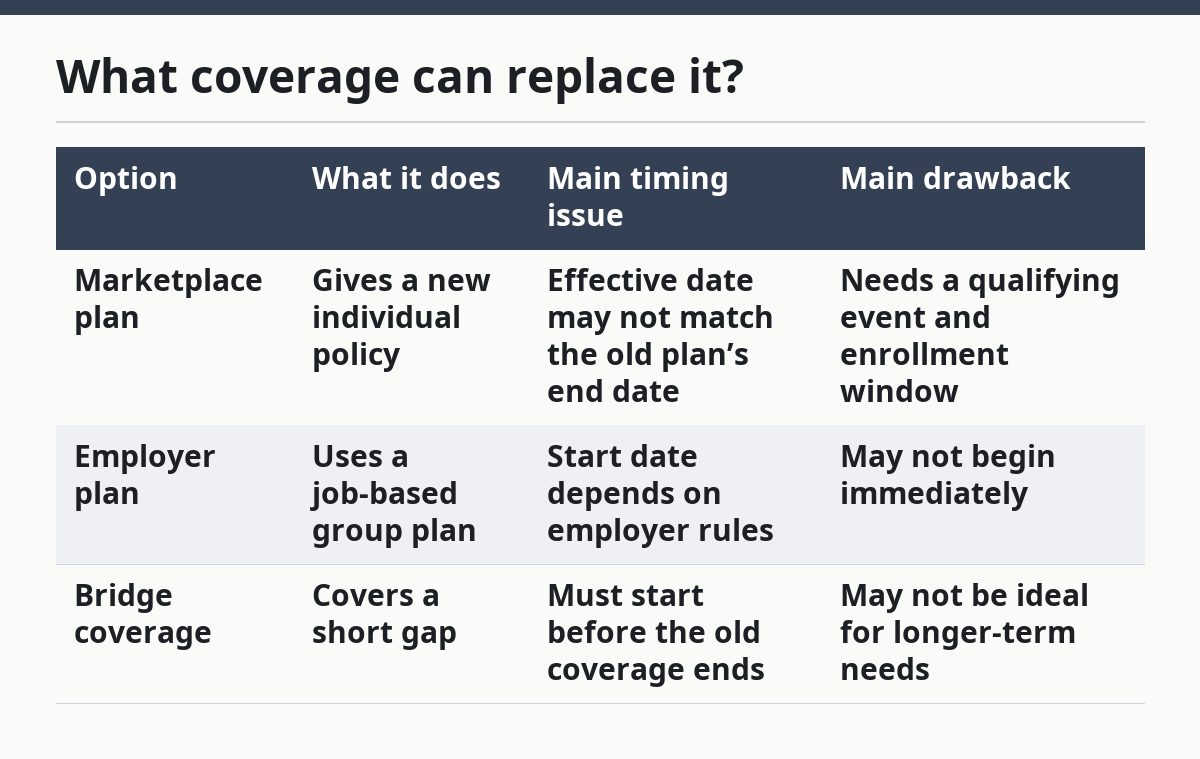
The choice is not about finding the fanciest plan. It is about matching the start date to the loss of coverage, then checking whether the network, prescriptions, and monthly premium fit the child’s situation. Because rates and rules differ by country and change often, a plan that looks right in one year can work differently in the next; CMS and Healthcare.gov both publish plan and enrollment information that can help confirm the current rules.
For example, if the new plan cannot start until the next month and the old plan ends before then, the bridge is the gap-filler, not the long-term answer.
Can the child enroll outside open enrollment?
Yes, an aging-off child can often enroll outside open enrollment if the loss of dependent coverage creates a special enrollment period. That period is the exception that lets someone apply after a life change instead of waiting for the annual window.
The key is to treat the loss of coverage as the trigger, not the birthday. If the plan ends coverage because the child turns 26, the child may have a limited window to choose a new plan. The length of that window is not the same everywhere, and the start date for the new plan may also vary by program, so a benefits specialist or exchange representative can help confirm the timing.
The child usually needs proof that coverage ended or is ending. That can be a notice from the current plan, a letter from the employer plan, or another document that shows the qualifying event. Without proof, the application can stall, and a stalled application can mean a delayed effective date.
This is the point where many people make a wrong assumption: they think any life event automatically creates immediate coverage. It does not. The event opens a door; the plan still has rules for when the new coverage starts.
What mistakes cause the biggest gaps?
The biggest gaps come from missing the cutoff date, assuming the birthday controls everything, and waiting too long to apply. Those mistakes can leave the child uninsured for days or longer, even when the family intended to act quickly.
- Using the birthday instead of the coverage end date: The plan may end coverage at month-end, not on the 26th birthday — check the notice and mark that date.
- Waiting to shop until after coverage ends: The special enrollment window may be limited — start the application before the old plan ends when possible.
- Ignoring the effective date of the new plan: A new policy can still leave a gap if it starts later — compare the first day of coverage before enrolling.
- Assuming every plan treats aging off the same way: Employer plans, marketplace plans, and other policies can use different rules — read the actual policy language and confirm it with the plan administrator if needed.
- Not saving the notice of loss: Without proof, the enrollment process can slow down — keep a copy of the letter or confirmation.
- Picking a plan without checking the child’s needs: A plan with the wrong provider access or prescription setup can create a new problem — verify the child’s doctors and medicines before finalizing.
The cost of these mistakes is usually time, paperwork, and a coverage gap. The fix is rarely complicated, but it does require attention to the exact date and the exact enrollment rule.
When does the standard approach not apply?
The standard approach does not apply when the child already has another qualifying route, when the plan has unusual dependent rules, or when the timing creates a gap that the normal special enrollment window cannot fix. In those cases, the cleanest answer may come from the plan administrator or a qualified benefits adviser, not from a generic checklist.
The child already has employer coverage available: That can change the best timing, so compare the employer start date against the old coverage end date before choosing anything.
The current plan uses an unusual cutoff date: Some plans do not mirror the most common age-26 timing — confirm the rule in writing rather than relying on general advice.
The loss of coverage happens near open enrollment: Two enrollment paths may overlap — check both, because one may start sooner or fit better than the other.
The child needs ongoing treatment or prescriptions: A gap can disrupt access to care, so verify the new plan’s provider list and drug rules before the old coverage ends; a benefits specialist can help if the medication list is hard to compare.
The family is split across states or countries: Local rules can change the available plans and timing — use the rules that apply where the child is enrolling.
The current policy notice is unclear: If the end date is missing or contradictory, the transition is not ready — ask the plan for a written answer before submitting an application.
This is also where a wrong generalization causes trouble. A freelancer’s household can look simple on paper, but age-off timing, plan type, and effective dates can make it messy fast. When the timeline is unclear, pause and get the date pinned down first.
What should you check before the old plan ends?
You should check the end date, the new plan’s start date, the proof needed for special enrollment, and whether there is any gap of 1 day or more. Those checks catch most transition problems before they become expensive or stressful.
Confirm the dependent’s last day of coverage in writing. Then compare that with the start date on the new plan, and do not assume the start date is immediate. If the child is moving to a marketplace plan, verify that the special enrollment period is active and that the application deadline has not passed.
Also check practical details that matter to real families: provider access, prescription coverage, and whether the child will need a new card before a doctor visit. A plan can be technically active and still be a poor fit if the child’s current doctor is out of network or the medication list is not covered the same way.
A final check is administrative: keep the notice, the application confirmation, and any approval letter together. If a problem comes up later, those papers are the trail that shows the loss of dependent coverage and the new effective date.
FAQ
When does coverage end when a child turns 26?
The coverage end date is set by the plan rules, not just by the birthday. Some plans end dependent coverage at the end of the month or on another stated date, so the notice or policy language is the document to trust.
Can an aging-off child enroll outside open enrollment?
Yes, loss of dependent coverage can create a special enrollment period. The child usually has to act within the plan’s deadline and show proof that coverage ended or is ending, so the application timing matters as much as the qualifying event.
What coverage options are available next?
The next option can be a marketplace plan, an employer plan, or short bridge coverage. The best fit depends on when the new coverage can start, whether the child has access to an employer plan, and whether there would be even a short gap between policies.
Drafted with AI; not yet reviewed by a person.