
Last updated: November 19, 2026
Yes, freelancers can usually change Marketplace plans after they enroll, but only during open enrollment or after a qualifying life event that opens a special enrollment period. The answer turns on timing, not on freelance status alone. This article’s answer is simple: most freelancers can change Marketplace plans, but only in the right window.
Key takeaways
- After you enroll, a Marketplace plan usually stays in place for the rest of the coverage year unless a permitted change window opens.
- Open enrollment is the broad annual window for switching plans.
- A special enrollment period is the narrower path that can let you change plans after a life event.
- Plan changes can affect your premium, deductible, network, and drug coverage on the new plan’s effective date.
- The first step is to check the change deadline, then pick the new plan before the window closes.
Can freelancers change Marketplace plans after they enroll?
Freelancers can change Marketplace plans after enrolling, but not whenever they want. In most cases, the Marketplace locks in your choice until open enrollment or until a special enrollment period gives you permission to switch.
That matters because a Marketplace plan is not a month-to-month subscription you can swap on a random Tuesday. If you enrolled in a Silver plan in January and decide in April that you want a different metal level, you usually need a valid path to change it. The two main paths are open enrollment and special enrollment period rules.
The practical question is not “Can I ever change?” but “Which change window applies right now?” A plan change outside those windows usually will not process, even if you are self-employed, freelance full time, or just starting side work. The Marketplace generally uses the same change timing rules for freelance coverage as it does for other individual coverage; if your situation is unclear, it is wise to check with the Marketplace or a licensed insurance professional. HealthCare.gov’s special enrollment period guidance is the best place to start.
If you want the broader overview of how Marketplace coverage works for freelance workers, the hub on freelance Marketplace coverage is the right starting point. This page stays focused on post-enrollment changes: when they are allowed, how to make one, and when the new coverage starts. For background on plan types, the Marketplace glossary and open enrollment basics can help.
What open enrollment lets you change
Open enrollment lets you switch Marketplace plans for the next coverage year, and that is the simplest time to make a change. During this annual window, you can move to a different insurer, different metal level, different premium, or different network before the new year starts.
This is the cleanest route because you do not need to prove a life event. You can compare plans side by side and make a new choice for the coming coverage year, usually before the current year ends. If your current plan is expensive, has a narrow network, or no longer fits your prescriptions, open enrollment is the time to correct that.
The catch is timing. Open enrollment does not stay open all year, and the exact dates can vary by marketplace. If you miss the deadline, you usually keep the plan you already have unless you qualify for a special enrollment period. That is why people who freelance often set a calendar reminder well before the deadline. For date-specific guidance, see the Marketplace enrollment calendar and HealthCare.gov’s open enrollment page.
A good open-enrollment switch is simple:
- pick the new plan before the deadline,
- compare premium, deductible, copays, provider network, and drug list,
- confirm the new plan starts when you need it,
- keep proof of the confirmation in case billing questions come up later.
Open enrollment gives you the broadest choice, but it only comes once a year. If your needs change in March, you may need to wait unless you qualify for a special enrollment period. CMS explains the enrollment window and the special enrollment period rules in its Marketplace materials.
Can freelancers switch Marketplace plans during the year?
Yes, but only if they qualify for a special enrollment period or are changing within the rules of a permitted enrollment window. Outside those rules, a midyear switch usually is not allowed.
This is the part many people get wrong: being self-employed does not automatically create a change right. A freelance income swing, a busier season, or a wish for a different deductible does not, by itself, let you swap plans midyear. The Marketplace looks for a qualifying event, not just a change in preference.
A special enrollment period can open after events such as moving to a new area, losing other coverage, getting married, having a baby, or other qualifying changes recognized by the Marketplace. The exact event matters because each one can come with its own deadline and documentation needs. If the event is valid, you can usually choose a new plan during the special window.
Here is the core process when you think you qualify:
- Log in to your Marketplace account and look for the special enrollment section. That tells you whether the site recognizes a change window and what kind of proof it wants.
- Choose the qualifying event and enter the date it happened. The date controls the window, so an August move and a September move do not lead to the same deadline.
- Upload documents if the Marketplace asks for them, such as a move notice or proof of coverage loss. This step keeps the enrollment from being delayed or denied for lack of evidence.
- Compare plans before you submit the new selection. Once you pick a plan, you may not get a second easy chance before the window closes.
- Submit the change and save the confirmation page or email. That record helps if the new premium or start date does not match what you expected.
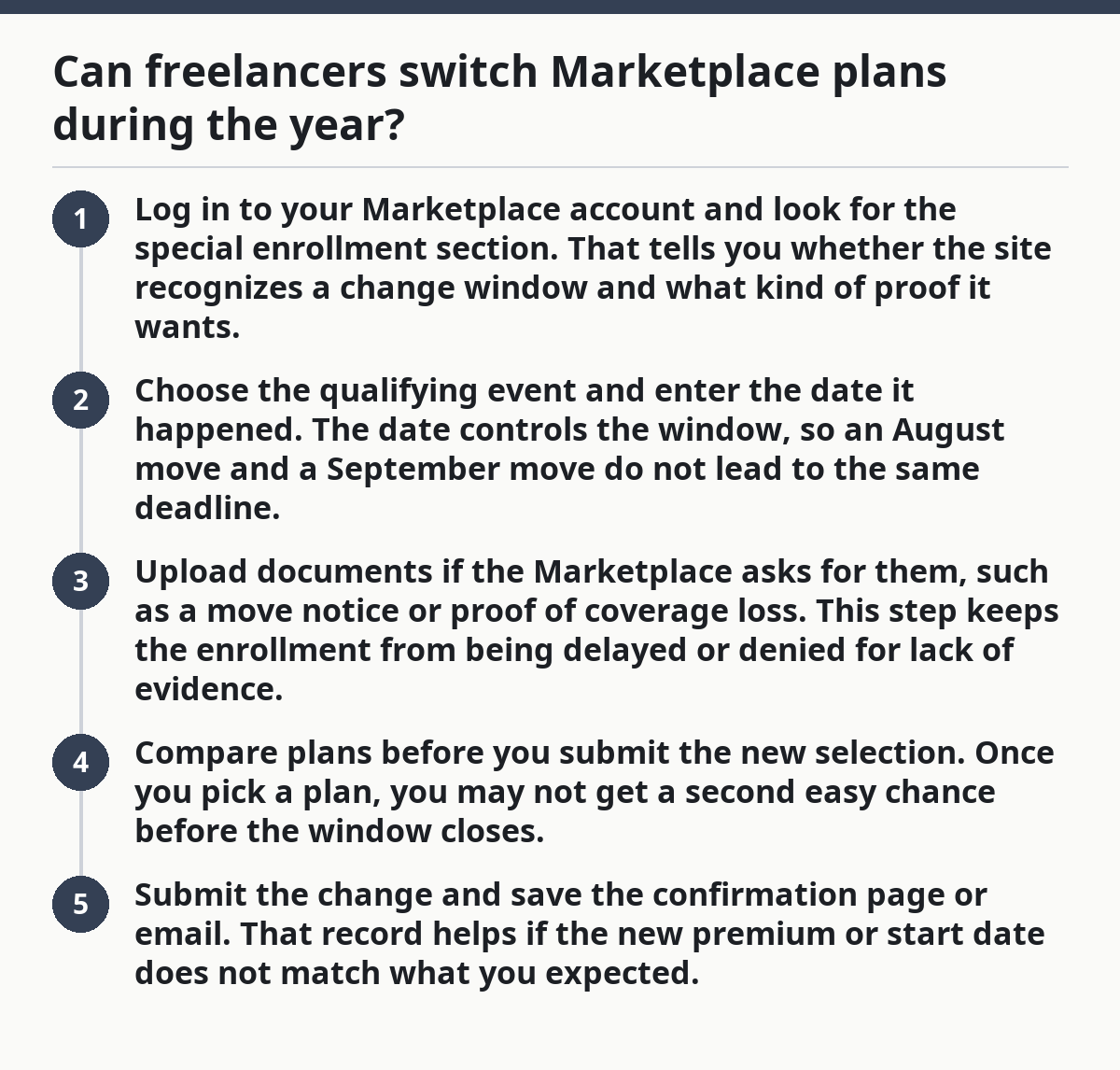
The result you want is a confirmed plan change with a clear effective date. If the Marketplace does not accept the event, the change will not move forward.
For official rules, the HealthCare.gov special enrollment period page and the U.S. Centers for Medicare & Medicaid Services materials on Marketplace enrollment are the most relevant references to check. The HealthCare.gov special enrollment period page is the most direct source.
How the effective date works when you switch plans
The effective date is the date your new Marketplace plan actually starts, and it is usually not the same day you click “submit.” That timing is what trips people up when they switch from one plan to another.
If you change during open enrollment, the new plan commonly starts with the new coverage year. If you change through a special enrollment period, the start date depends on the event and the marketplace’s rules for that event. A move, a loss of coverage, or another qualifying event can each trigger a different effective-date rule.
That means you need to look at two dates, not one:
- the date you make the change,
- the date the new plan takes effect.
If you need a plan active by the first of next month, waiting until the last week of the current month may be too late. A change submitted on the wrong side of the cutoff can push the effective date later than you want. For freelancers who need regular care or prescriptions, that gap matters.
This is also where billing changes show up. Your old plan may end on one date, and the new one may begin on another. If you already paid a premium for a month you will not use, the Marketplace or insurer may handle that through normal billing adjustment rules, but the process depends on the carrier and the timing. Keep the confirmation notice and watch the next invoice closely.
The honest limitation here is simple: switching plans is not just about picking a different premium. It is also about avoiding a coverage gap. If your doctor visits or prescriptions are scheduled around a specific date, check the effective date before you finalize anything. For more on timing, see coverage effective dates and Marketplace billing.
What to check before you switch plans
Before you switch plans, check your network, prescriptions, total cost, and start date, because the lowest premium is not always the best deal. A plan that saves $20 a month can cost more if it drops your doctor or raises your deductible.
The four checks that matter most are:
- provider network: is your doctor in-network?
- drug coverage: are your prescriptions on the formulary?
- deductible and copays: what do you pay before the plan helps?
- effective date: when does the new coverage actually begin?
A freelancer who sees a specialist every 6 weeks has different needs from someone who only wants catastrophic protection. The first person may care more about network breadth and prescription access. The second may care more about a lower premium and a higher deductible. Those are different trade-offs, and the plan choice should match the pattern of care, not just the monthly bill.
The common mistake is switching because a plan looks cheaper on the summary page. That can backfire if the cheaper plan excludes a clinic you use twice a year or charges more for brand-name medicine. The cost shows up later, often at the point of care.
A useful habit is to compare three numbers before changing:
- monthly premium,
- annual deductible,
- expected out-of-pocket cost for your usual care.
If those three do not line up with your budget, hold off or look at another plan. The right plan is the one that fits your actual care pattern for the next 12 months, not the one that only looks good in the comparison table. If you want help comparing options, the and drug formulary check are useful starting points.
What happens if you try to change outside the rules
If you try to change outside open enrollment and without a qualifying special enrollment period, the Marketplace usually will not let the new plan take effect. In practical terms, the request can be denied or left unchanged.
That is frustrating, but it protects the system from constant midyear switching. It also protects your current coverage from being canceled by mistake. The downside is obvious: if your circumstances changed but do not fit the rule set, you may be stuck with your current plan until the next permitted window.
This is where people sometimes make avoidable mistakes:
- they assume freelance status creates a special right to switch,
- they miss the deadline by a few days,
- they submit the wrong event date,
- they choose a new plan before confirming the effective date.
The cost of those mistakes is delay. In some cases, it is a gap between the coverage you wanted and the coverage you actually have. If you need care soon, a delay can be more than an annoyance.
If your situation is borderline, do not guess. Check the Marketplace account notices, read the event requirements carefully, and save screenshots or emails of what you submitted. If the change is denied, the denial notice usually explains what failed, and that is better than waiting and assuming the switch went through.
For official guidance, the HealthCare.gov pages on open enrollment and special enrollment periods are the best starting points. The National Association of Insurance Commissioners also has consumer-facing material on health insurance shopping that can help you understand the trade-offs. HealthCare.gov and CMS are the most authoritative sources for Marketplace timing rules.
The shortest answer for freelancers who need to act now
Freelancers can change Marketplace plans after enrolling, but the change has to fit open enrollment or a special enrollment period. That is the rule that controls almost every post-enrollment switch.
If you want the new plan to start on a certain date, work backward from the effective date and the deadline. If you want to switch because your plan feels wrong, check whether it is open enrollment first. If it is not, look for a qualifying life event before you spend time comparing plans.
The rule that matters most is simple: being freelance does not, by itself, open the door to a midyear plan change. The timing rules do. That is why the first step is to confirm which window you are in before you shop plans. If you need a refresher, revisit open enrollment and special enrollment periods.
Can I switch plans during the year?
Yes, but only if you qualify for a special enrollment period or you are in a permitted open enrollment window. Outside those windows, a midyear switch usually does not go through. The exact effective date depends on the event and the Marketplace rules attached to it.
Do I need a qualifying life event to change plans?
Usually, yes, if you want to change outside open enrollment. A qualifying life event is what typically creates a special enrollment period. If you do not have one, the Marketplace generally expects you to wait for the annual open enrollment window before making a new choice.
Drafted with AI; not yet reviewed by a person.