
How Freelancers Compare Plan Documents Before Choosing Coverage

Last updated: November 20, 2026
Quick Answer: Freelancers should compare the Summary of Benefits and Coverage (SBC) first, then check the Evidence of Coverage (EOC) for the contract details. In practice, this is a two-step process that can take about 20 minutes if you focus on the services you expect to use. The SBC gives the fast comparison view; the EOC shows the rules that can change your bill.
Key Takeaways
- Document order matters: use the SBC first, then the EOC.
- The SBC gives a quick side-by-side format for comparing benefits.
- The EOC spells out exceptions, limits, and edge cases behind the summary.
- Match the same service in each EOC to see what each plan excludes.
Freelancers comparing coverage should read the Summary of Benefits and Coverage (SBC) first, then check the Evidence of Coverage (EOC) for the details that can change your bill. That pair will tell you what the plan says it covers, what it excludes, and how cost-sharing works. The checklist below shows exactly how to compare them. For official definitions and plan language, see the U.S. Department of Labor’s health plan consumer resources and HealthCare.gov’s Summary of Benefits and Coverage.
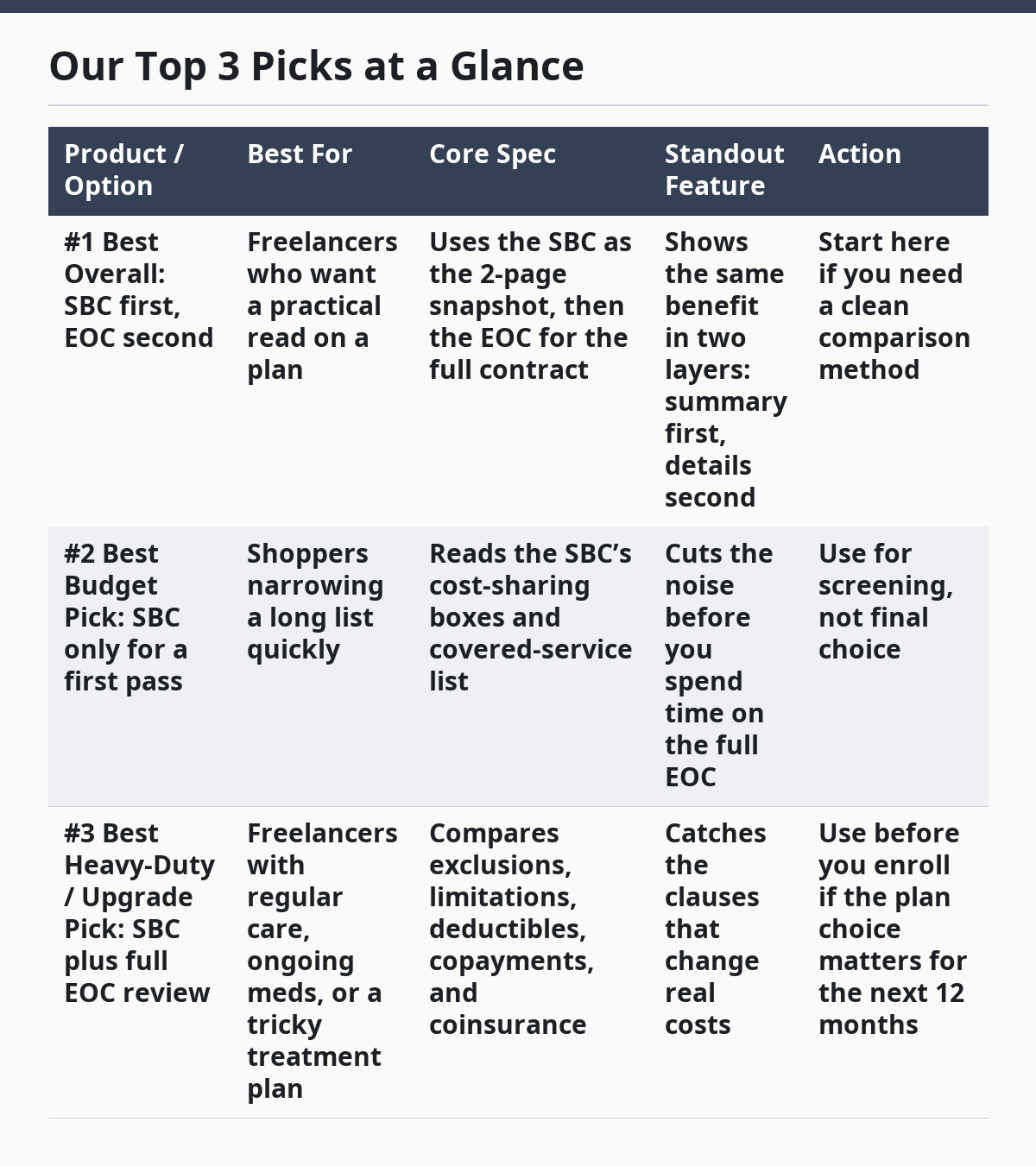
Our Top 3 Picks at a Glance

For document comparison, the “pick” is the document order you should use, not a plan. Start with the SBC, use the EOC to confirm the fine print, then check exclusions and cost-sharing details before you enroll. That sequence helps reduce the common mistake of judging a plan by a neat one-page summary alone; if you are unsure, consult a licensed insurance professional or plan representative.
| Product / Option | Best For | Core Spec | Standout Feature | Action |
|---|---|---|---|---|
| #1 Best Overall: SBC first, EOC second | Freelancers who want a practical read on a plan | Uses the SBC as the 2-page snapshot, then the EOC for the full contract | Shows the same benefit in two layers: summary first, details second | Start here if you need a clean comparison method |
| #2 Best Budget Pick: SBC only for a first pass | Shoppers narrowing a long list quickly | Reads the SBC’s cost-sharing boxes and covered-service list | Cuts the noise before you spend time on the full EOC | Use for screening, not final choice |
| #3 Best Heavy-Duty / Upgrade Pick: SBC plus full EOC review | Freelancers with regular care, ongoing meds, or a tricky treatment plan | Compares exclusions, limitations, deductibles, copayments, and coinsurance | Catches the clauses that change real costs | Use before you enroll if the plan choice matters for the next 12 months |
What the top three options mean in practice
The best approach is the SBC first, EOC second method, because it gives you speed and proof in one pass. The SBC is shorter and easier to scan, while the EOC is the contract that spells out the edges, exceptions, and limits. If you only read one, you can miss a rule that changes the bill.
The middle option works only as a filter.
The full-review option takes longer, but it is the right move when a missed clause could matter for a full year of coverage. A freelance schedule can be messy; your document review shouldn’t be.
Start with the SBC before you read anything else
The SBC is often the quickest way to compare plans because it puts the same benefit lines in the same format. If you want a side-by-side read, this is the page that gives it to you. The catch: it is a summary, not the full contract.
Picture this: you’re staring at three health plans, and each one looks fine until the wording gets slippery. The SBC helps you compare the same items—deductible, copayment, coinsurance, and key covered services—without hunting through 60 pages. That makes it a strong first stop.
Use the SBC to answer these questions:
- What is the deductible?
- What is the copayment for common visits?
- What is the coinsurance after the deductible?
- Which services are listed as covered?
- Is there a separate limit or special rule in the summary?
The SBC usually gives you the same basic structure across plans, which is why it is the right comparison tool. A deductible is the amount you pay before many benefits kick in. A copayment is a fixed amount, like a set fee for a visit. Coinsurance is the percentage you pay after the deductible.
Here’s the catch: the SBC can make two plans look similar when they are not.
How to read the SBC without missing the trap
Read the SBC line by line, then compare one benefit at a time. If a plan lists a lower deductible but a higher coinsurance, that trade-off may be less attractive than it looks at first glance. If the copayment is low but the benefit list is thin, the cheap-looking plan may have a narrow path to real coverage.
- Open the SBC for each plan side by side.
- Match the same service across all documents, such as office visits or emergency care.
- Write down the deductible, copayment, and coinsurance for each one.
- Look for notes beside the benefit, not just the number in the box.
- Flag any wording that says “subject to” or “see EOC.”
That last step matters. Short notes often point to the rules that change the bill.
The SBC is the right place to start because it is built for comparison. It is not the place to stop.
What the EOC tells you that the SBC leaves out

The EOC gives you the contract language that explains the exceptions, limits, and hidden edges in the SBC. If the SBC is the map, the EOC is the roadbook. This is where freelancers find the terms that can turn a good-looking plan into a bad fit.
Picture this: the summary says a service is covered, but the full rules add conditions, caps, or a narrower path to payment. The EOC is where those details live. If you skip it, you are guessing about the part that matters most when you file a claim or use a service.
The EOC usually explains:
- exclusions, or services the plan does not cover
- limitations, such as caps, visit rules, or service restrictions
- cost-sharing details tied to specific services
- definitions that shape how the plan applies a benefit
- the order rules are applied when more than one section seems to fit
A lot of freelancers ignore the EOC because it is long and plain-language light.
The truth is, the EOC is where the plan tells you what it means by the words on the SBC. A one-page summary can tell you a benefit exists. The EOC tells you when that benefit actually applies.
Compare the EOC with a highlighter, not by memory
Read the EOC only after you mark the same benefit in the SBC. That keeps you focused on the places where the plan changes the promise. If a service looks covered in the SBC but the EOC says it has a special limit, you have found a real difference, not a typo.
After that, use this sequence:
- Pick one service, such as a primary care visit or imaging.
- Find that service in the SBC.
- Search the EOC for the exact same service name.
- Check whether the EOC adds an exclusion, limitation, or alternate cost rule.
- Repeat for each service you care about.
That method takes longer than skimming, but it is cleaner than reading the whole contract end to end. If you have only 15 minutes, use the SBC to screen plans, then spot-check the EOC for the services that matter most.
How do I compare exclusions across plans?
You compare exclusions by matching the same service in each EOC and writing down what each plan leaves out. That is the only reliable way to do it because exclusions often hide behind different wording. The section title may not even say “exclusions”; sometimes the rule sits inside a coverage clause or a definition.
Picture this: two plans both say “covered,” but one excludes a setting, a type of provider, or a version of the service you actually need. The exclusions section is where the false match falls apart. This is where many freelancers make their most expensive mistake.
Use a simple four-column note:
- service
- plan A exclusion
- plan B exclusion
- which one fits your use
That sounds basic because it is. Basic works.
When you compare exclusions, look for language tied to:
- setting, such as inpatient vs. outpatient
- provider type
- service version or category
- whether the plan covers only certain conditions or circumstances
- what must happen before the service is covered
A generic comparison misses the part that bites. The question is not “is it covered somewhere in the plan?” The question is “is it covered in the situation I’m likely to have?”
Common mistake: treating an exclusion like a one-off note
That mistake costs you because you may assume the plan covers the service in every form. It often does not. The better move is to compare the exclusion pattern across the full EOC, then check whether the same pattern shows up in more than one place.
One practical check helps: if an exclusion shows up in more than one section, treat it as a hard stop until you understand it. If the wording seems inconsistent, use the more specific rule, not the more generous one.
That is the kind of detail the SBC will never carry on its own.
Which cost-sharing details should freelancers compare first?
Freelancers should compare the deductible, copayment, and coinsurance first because those three items shape the cost path of most plans. If you compare only one number, you can get fooled by a low premium and miss a higher bill later. The numbers must be read together, not one by one.
Picture this: one plan has a lower deductible but a higher copayment, and another has the reverse. The cost-sharing details tell you which trade-off is real for your usage. That is especially important if you expect repeat visits, therapy, imaging, or specialist care.
Compare these items in the SBC, then confirm the wording in the EOC:
- Deductible: how much you pay before many benefits start
- Copayment: fixed fee at the point of service
- Coinsurance: percentage you pay after the deductible
- service-specific cost-sharing rules
- any separate cost-sharing for special care
The trap is that the same service can have a different cost rule in a different setting. A visit may have one copayment in one place and a different rule somewhere else in the contract. That is why the EOC matters even when the SBC looks clean.
A fast comparison rule that works
If one plan has a lower deductible but a much higher coinsurance, it may cost more for someone who uses care often. If another plan has a higher deductible but a lower coinsurance, it may fit someone who expects light use. You are not picking the “cheapest” line item. You are reading the path your bills will follow.
That path is what freelancers need most, because cash flow can swing month to month. A plan that looks cheap up front can be expensive after a few visits. A plan that looks pricier can be easier to live with when care is steady.
A simple document-comparison checklist freelancers can use today
Freelancers can compare coverage in about 20 minutes if they use one checklist and stay on the same service across both documents. The process is simple: read the SBC first, confirm the EOC second, then mark any mismatch in exclusions or cost-sharing. That gives you a real decision tool instead of a stack of PDFs.
Picture this: you have three plan files open and one deadline on the calendar. The 20-minute checklist below keeps the work focused. You do not need to read every line; you need to read the lines that affect your use.
Use this order
- Open the SBC for each plan.
- Write down the deductible, copayment, and coinsurance.
- Mark the services you expect to use most this year.
- Open the EOC for those same services.
- Check exclusions, limitations, and any service-specific cost rule.
- If the EOC contradicts the summary, trust the fuller explanation and flag the plan.
- Keep the plan that matches your likely use, not the one with the prettiest summary.
That order works because it starts broad and gets narrow. It also keeps you from over-reading the whole contract before you know what matters.
Three mistakes that waste time and money
- Comparing plans on premium alone. That hides cost-sharing.
- Reading the SBC without the EOC. That misses exceptions.
- Comparing different services across plans. That makes the notes useless.
You can do this without being an insurance expert. You only need discipline and a pen.
If you want the broader framework that sits above this page, the hub on Comparing Plan Types and Coverage — The Complete Guide is the right next stop.
Which document should decide the final choice?
The EOC should decide the final choice when the SBC and the EOC do not match cleanly. The SBC is your comparison sheet, but the EOC is the contract language that fills in the gaps. For a freelancer, that difference matters because the wrong assumption can follow you for 12 months.
Picture this: one plan looks better on a summary page, but the full contract adds limits that make it a poor fit. The final choice belongs to the document that explains the rule in full. That is usually the EOC, especially when the service you care about is not simple.
Use the SBC to narrow the field. Use the EOC to settle the tie.
The safest rule is this: if the SBC and EOC seem to disagree, do not assume the better-looking number is the one that wins. Read the fuller explanation, look for the specific service, and check whether the plan uses a separate exception or limitation. That is the difference between shopping and guessing.
This page is not about every coverage question you can ask. It is about the document pair that lets freelancers compare plans the right way: summary first, contract second. That is the clearest path to a coverage choice that fits real life, not just a sales page.
Which document tells me what a plan really covers?
The Evidence of Coverage (EOC) tells you what a plan really covers because it contains the full rules, exceptions, and limits. The Summary of Benefits and Coverage gives you the quick view, but the EOC explains the details behind that view. If the two seem to conflict, the EOC is the document to read closely.
How do i compare exclusions across plans?
You compare exclusions by matching the same service in each EOC and writing down what each plan leaves out. The safest method is to compare one service at a time and note the setting, provider type, or condition attached to the exclusion. If the wording is different, the coverage may be different too.
Drafted with AI; not yet reviewed by a person.