
Last updated: November 20, 2026
Key Takeaways
- Freelancers verify ACA household size by matching the Marketplace tax household, not just the number of people at home.
- People go on the Marketplace application when tax rules place them in your household for that year.
- You verify ACA household size by aligning Marketplace answers with your tax filing plan and dependent rules.
- The Marketplace usually asks for tax and family proof, not random paperwork.
Freelancers verify ACA household size by matching the people on the Marketplace application to the people in their tax household—usually the same adults and dependents listed on the federal tax return. This article on how freelancers verify household size for ACA applications shows who to include, what to check, and where the common mistakes happen.
What ACA household size means for a freelancer
Freelancers verify ACA household size by using the same family group the Marketplace uses for tax credit rules, not the number of people in the house. That means the application follows tax filing relationships first, then living arrangements, custody, and marital status where they matter.
If you file a 2024 tax return in 2025, the Marketplace wants the household you expect to use for that tax year. Not the guest list. Not the number of bedrooms.
A freelancer often gets tripped up here because cash flow and family size move on different tracks. The application asks who belongs in the household for subsidy rules, and that can include:
- you,
- a spouse,
- dependents you claim, and
- sometimes a spouse or child even when they do not live with you full time.
This is where the tax household idea does the heavy lifting. The Marketplace application looks for the people tied together by tax rules, then uses that count to judge plan help. The IRS explains household and dependent rules in Publication 501, and the Marketplace uses those tax concepts for eligibility decisions.
A freelancer can live alone, file taxes alone, and still need to count a child or spouse if the tax rules say so. That is why the application asks about the tax return, not just the lease.
- Check your expected filing status first.
- List everyone you expect to claim as a dependent.
- Compare the application’s household count to your last filed return.
- If your tax situation changed, use the new one—not the old one.
Which people belong on the Marketplace application?
People belong on the Marketplace application if they are part of your tax household for the year you’re applying for. That usually means the taxpayer, a spouse, and dependents, but the exact mix follows the federal tax return, not just who shares a kitchen.
A clean way to think about it: the Marketplace asks, “Who will be on the tax return?” before it asks, “Who lives with you?” A freelancer with one child and a spouse may need to count all three, even if one adult works elsewhere or the child splits time between homes.
The application also cares about whether someone is claimed as a dependent by another tax filer. If a parent, ex-partner, or other relative claims that person, the household count can change. Shared custody makes this even more exacting, because the child may live in two homes but usually counts only where the tax rules place the dependent.
Use this quick check:
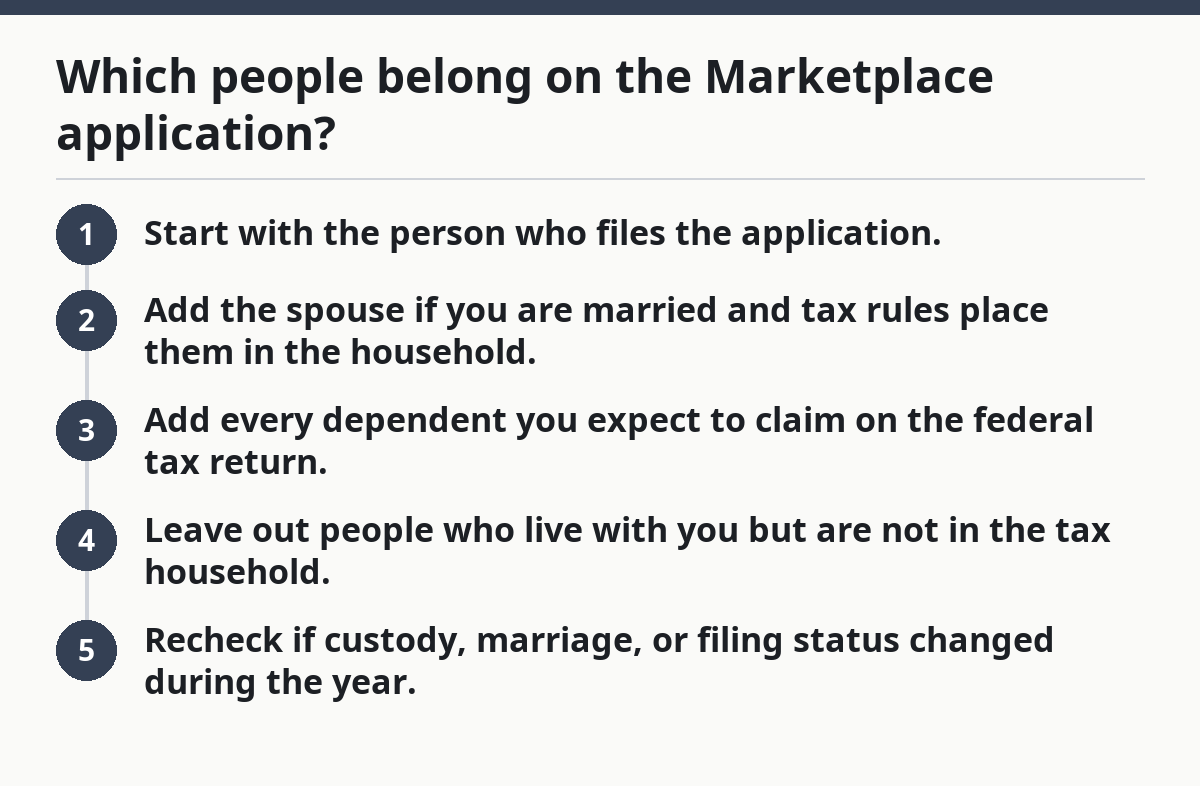
- Start with the person who files the application.
- Add the spouse if you are married and tax rules place them in the household.
- Add every dependent you expect to claim on the federal tax return.
- Leave out people who live with you but are not in the tax household.
- Recheck if custody, marriage, or filing status changed during the year.
HealthCare.gov also explains that household size and income are tied to tax filing status for Marketplace coverage, and IRS Publication 501 covers dependent rules.
How do you verify household size step by step?
You verify ACA household size by matching your Marketplace answers to your tax filing plan and then checking each person against dependent and spouse rules. The process is short, but one wrong answer can change subsidy results for the whole year.
Start with the tax return you expect to file for that coverage year, not the one from 2 years ago. Then move person by person.
- Gather your current tax filing details. Use your expected status for the year—single, married filing jointly, married filing separately, or head of household—and note every dependent you plan to claim.
- Open the Marketplace application and find the household section. Enter the people who belong on the tax return, not every resident at your address.
- Check your spouse rules. If you are married, the spouse may count even when you file separately, depending on tax filing setup and household rules.
- Review each dependent carefully. A child, stepchild, or other qualifying dependent usually belongs if you claim them on the federal tax return.
- Reconcile shared custody. If a child splits time between homes, use the tax claim rules, not the number of nights alone.
- Save your notes. Keep a copy of the filing status, dependent list, and any proof you used in case the Marketplace asks for verification.
Use this as a documentation checklist:
- last federal tax return,
- expected filing status,
- dependent names and dates of birth,
- custody order or parenting plan if applicable,
- Social Security numbers or other requested IDs,
- Marketplace notices you receive.
One practical rule: if you cannot explain why a person is in the household in one sentence, stop and check the tax rule again.
What does the Marketplace usually ask you to show?
The Marketplace usually asks for tax and family proof, not a pile of random paperwork. For household size, the key evidence is the federal tax return, filing status details, and documents that show who you claim or expect to claim.
A lease, a utility bill, and a school form may help show residence, but they do not always settle tax household questions by themselves. The Marketplace wants the link between the people and the return.
Common documents include:
- a signed or prepared federal tax return,
- proof of filing status,
- Social Security numbers or immigration documents when requested,
- birth certificates for dependents,
- custody agreements for shared custody cases,
- marriage records when spouse status is disputed.
If you have not filed the return yet, the Marketplace may still accept a current-year estimate or other tax documents, depending on the request. That is why notices from the Marketplace matter. They say what the caseworker wants and by when.
The question is not always whether someone exists. Often it is whether they belong in the household under tax rules.
Use the notice date and the response deadline. A 30-day request is common in many Marketplace notices, but the exact deadline comes from the letter you got. Miss it, and the application can stall.
What mistakes make freelancers miscount household size?
Freelancers miscount household size by using the home address instead of the tax household, by forgetting a spouse, or by counting a child who is not claimed on the federal tax return. Those errors can change the subsidy result and trigger a request for more proof.
The most common mistake is simple: “Everyone who lives here counts.” That is wrong for ACA purposes. A roommate, adult sibling, or live-in partner does not automatically belong in the Marketplace household.
The second mistake is using the wrong tax year. A freelancer who changed filing status this year may still reach for last year’s return out of habit. That can create a mismatch between the application and the tax filing plan.
The third mistake is ignoring shared custody. A child who spends part of the month in each home still has to be placed according to the tax claim rules. Nights alone do not settle it.
What those mistakes cost:
- extra paperwork,
- a delayed eligibility decision,
- a subsidy mismatch later on,
- a confusing letter asking for correction.
What to do instead:
- use the filing status you expect for the coverage year,
- count only those people in the tax household,
- keep custody rules in mind,
- compare every answer to the federal tax return before you submit.
If you are unsure about a spouse, dependent, or custody setup, the IRS instructions for Form 1040 and Publication 501 are the right place to check the tax rule behind the Marketplace question.
How freelancers handle married filing status and shared custody
Freelancers handle married filing status and shared custody by checking the tax rule first and then mapping that rule onto the application, person by person. That keeps the household count aligned with the Marketplace.
Marriage changes the household count because the spouse may need to be included even when the couple does not live together full time or files in a different way. Shared custody does the same thing for children: the application follows the tax claim, not a simple calendar count.
A practical way to sort it:
- If you are married and file jointly, the spouse belongs in the household.
- If you are married and file separately, the spouse still may affect the application, so do not guess.
- If a child is claimed by one parent, the household count follows that claim.
- If custody shifts during the year, update the application when the tax plan changes.
A July move, an October marriage, or a custody order that starts on January 1 can all change who belongs in the application for that coverage year. The Marketplace cares about the status tied to the tax year, not just the month you fill out the form.
The IRS Publication 501 and the Marketplace eligibility rules are the two anchors here. If they point in different directions from your memory, trust the documents.
Where to check the rule before you submit
The safest place to check ACA household size is the Marketplace application instructions, the IRS dependent rules, and your own federal tax return draft. Those three pieces usually answer the question before the submission button does.
For ACA household questions, two authoritative sources are the best starting points:
- HealthCare.gov’s guidance on household size and income for Marketplace coverage
- IRS Publication 501 on dependents, filing status, and related tax household rules
Use them together. HealthCare.gov tells you how the Marketplace applies the rule. The IRS tells you who belongs in the tax household in the first place. That pairing matters for freelancers because self-employment income often changes during the year, but household rules usually turn on family structure and tax status.
A good filing habit helps here:
- Review your expected federal tax return first.
- Match the Marketplace household list to that return.
- Save the names, dates, and documents you used.
- Submit only after the list makes sense line by line.
If your case involves a dependent claim conflict, split custody, or a spouse with a separate return, a tax preparer or enrollment assister can help you sort the forms. That keeps the application from drifting away from the tax rules.
For the bigger picture on self-employed coverage, the hub guide on self-employed health insurance eligibility and enrollment rules is the right next stop.
Who counts in a marketplace household?
The people in your Marketplace household are the people tied to your tax household for that coverage year. That usually includes the taxpayer, a spouse when tax rules place them there, and dependents you expect to claim on the federal tax return.
It does not include every person who lives at your address. Roommates and other nondependents usually stay out. The Marketplace uses the tax link, not the lease, as the main test.
Does a spouse count if we file separately?
A spouse may still count even if you file separately, depending on how the tax household is set up. That is why filing separately should never be guessed at from memory.
Check the Marketplace prompt and the IRS filing rules before you submit. If your spouse is part of the tax household for the year, leaving them off can distort the household size.
How do dependents affect eligibility?
Dependents usually increase the household size used on the Marketplace application, which can affect the eligibility calculation tied to the tax household. The key point is whether you can claim them on the federal tax return.
If a child or other dependent is claimed elsewhere, do not count them just because they live with you part time. Use the tax claim rule first, then match the application to it.
Drafted with AI; not yet reviewed by a person.