
Last updated: November 19, 2026
Key Takeaways
- The main changes are coverage timing, dependent status, and household size.
- Have the event date, proof, and names and birthdates ready before updating the application.
- Add the dependent through the same enrollment channel during the special enrollment period.
- For freelancers, this usually affects either the premium or the tax credit estimate, if the plan uses one.
Table of Contents
- What actually changes after marriage or a birth
- The first 24 hours: what to gather before you change the plan
- How to add a spouse or baby without breaking the timeline
- What changes about premiums, credits, and household size
- What effective date should you expect after marriage or a baby?
- Common mistakes freelancers make after family-status enrollment changes
- The bottom line for freelancers
- Can I add my spouse to my health plan after marriage?
- Can I add a baby to my marketplace plan right away?
The quick answer is that what changes after a freelancer gets married or has a baby is usually coverage timing, dependent status, household size, and sometimes the premium or tax credit estimate. In this guide to what changes after a freelancer gets married or has a baby, those updates matter because your plan does not adjust itself automatically.
The big change is family-status enrollment changes: marriage or birth can open a special enrollment period, change who counts as a dependent, and affect household size, premiums, and the coverage effective date. If you freelance, those shifts matter because your plan does not update itself just because your life did.
After marriage or a baby, you are not just adding a person to your life. You may be changing the paperwork your insurer uses to decide when coverage starts, how much subsidies can be based on, and which family members belong on the same application. That is why people who ignore the timeline often miss the window and pay for a month they did not need, or leave a new dependent uninsured longer than expected.
What actually changes after marriage or a birth

The practical changes are coverage timing, dependent status, and household size. Those three items drive almost everything else.
Marriage can change the people listed on your health plan application, especially if your spouse will be added as a dependent on a marketplace plan or if the marriage changes the family unit used for tax and subsidy purposes. A baby changes things more immediately: the child becomes a dependent, and the plan may need to be updated to reflect a new household size of 2, 3, or more people.
The part many freelancers miss is that “family event” does not only mean the emotional milestone. It also means the administrative clock starts running. A qualifying life event can trigger a special enrollment period, which is the short window used to make the plan change outside normal open enrollment. For health coverage, that window is often measured in days, not months, so the date on the marriage certificate or birth record matters.
There is a second effect that feels smaller but matters a lot: your premiums and tax credits may shift because household size changed. That does not always mean “more expensive,” but it often means the numbers on your application need to be updated right away, not at tax time. If the application still shows one person when there are now three, the plan may be based on the wrong assumptions.
This page is about those family-status enrollment changes, not the definition of qualifying life event itself. If you need the timing framework, the broader hub on freelance health insurance enrollment timing belongs beside this guide. For official marketplace timing rules, see the Healthcare.gov dates and deadlines page.
The first 24 hours: what to gather before you change the plan
You need three things before you touch the application: the date of the event, proof of the event, and the names and birthdates of everyone affected.
For marriage, that usually means the marriage date and whatever document your insurer or marketplace asks for. For a baby, it means the child’s name, date of birth, and any paperwork requested to show the birth or adoption. If you are adding a spouse or child, have Social Security numbers ready if they have them, because missing one field can stall the update by several days.
Keep the file small and readable. A scan or photo that clearly shows the date is better than a blurry image of a full-page document with shadows on the corners. If the platform accepts uploads, save the file as a PDF or image before you start the application so you are not scrambling when the session times out after 15 or 20 minutes.
Here is the order that usually works best:
- Find the event date.
Use the marriage date or the baby’s birth or adoption date as the anchor. That date is what the enrollment system will compare against the special enrollment period rules. - Gather proof.
Put the certificate, hospital record, or other requested document in one folder so you can upload it in a single pass instead of piecing it together later. - List every person affected.
Include legal names, dates of birth, and Social Security numbers if available. This keeps the household size calculation aligned with the application. - Check your current plan details.
Look at the carrier name, policy number, and the current effective date so you know what is being updated rather than starting from scratch. - Submit the change as soon as the paperwork is ready.
The result you want is an enrollment record that reflects the new dependent and the correct effective date, not a note in your calendar to do it next month.
A generic article often stops at “tell your insurer.” That is not enough. The people who get burned are the ones who know they need to act but have to pause for a document they should have collected on day one.
How to add a spouse or baby without breaking the timeline

You add the dependent through the same enrollment channel you use for the plan, and you do it inside the special enrollment period tied to the event.
The mechanics vary by marketplace, insurer, or employer-sponsored plan, but the sequence is usually the same: log in, choose the life-event change, enter the event date, add the dependent, upload proof, and review the new effective date before you submit. If the system asks whether this is a marriage or birth, answer exactly what happened. Do not guess. A mismatch between the event type and the proof can delay approval.
A baby is usually the simplest case because the dependent is new and the household size changes immediately. The more subtle issue is timing. If the child was born on the 8th and you wait until the next month to file, the plan may not backdate the change the way you expect. The effective date rules matter more than the calendar you keep on your phone.
Marriage can be trickier because it can change more than one person’s status at once. In some cases you may be adding a spouse to your plan; in others, marriage changes how the household is reported even if the spouse keeps separate coverage. The form still needs to match the real family structure.
A few details to watch:
- If the plan asks for proof within 30 days, do not wait for the reminder email.
- If the system gives you a temporary confirmation number, save it.
- If the application shows the wrong household size, stop and fix it before payment is taken.
- If you are switching plans at the same time, read the start date carefully so there is no gap between policies.
This is one of those changes where precision beats speed. It is better to spend 20 minutes verifying the dependent screen than to spend 2 months arguing over why a claim was processed under the old household.
What changes about premiums, credits, and household size
Your household size can change the numbers used to price the plan, which is why a baby or spouse can alter your monthly cost even if nothing else about your work changes.
For freelancers, that usually shows up in one of two places: the premium itself or the tax credit estimate, if the plan uses one. A larger household can change the way your income is measured against the people on the application. That does not automatically mean you will pay less or more. It means the estimate must be recalculated with the new family composition.
This is where people make avoidable mistakes. The first mistake is waiting until tax season to fix the application. That can leave the current-year subsidy estimate wrong for months. The second is assuming a spouse always belongs on the same plan. Sometimes that is true; sometimes it is not the cheapest or cleanest setup, especially if the spouse has separate coverage already. This page does not answer whether you can enroll in a spouse’s plan; that is a separate question and a separate decision.
The third mistake is ignoring how a new dependent affects every other line on the application. One child can change the household size from 1 to 2, or from 2 to 3, and that can alter the subsidy estimate even before the insurer processes the new card.
If you are self-employed, your best move is to treat the event like a data update, not a life story. Recheck:
- the number of people in the household,
- each person’s date of birth,
- the event date,
- and the expected premium before autopay runs again.
The cost of getting this wrong is not abstract. It can mean an incorrect monthly bill, a delayed claim, or a subsidy estimate that no longer matches your family. Fixing the numbers early is cheaper than waiting for a reconciliation later. For official subsidy guidance, see Healthcare.gov lower costs and freelancer health insurance tax credit guide.
What effective date should you expect after marriage or a baby?
You should expect the effective date to be tied to the event date and the enrollment rules, not to the day you finally submit the form.
That is the part most readers care about because it determines whether the new spouse or child is covered immediately, next month, or after a short delay. Coverage effective date is the date the policy change actually starts, and it is not always the same as the date you request the change. For a baby, the effective date often depends on how quickly the plan processes the update after birth or adoption. For marriage, it depends on how the insurer or marketplace applies the enrollment window.
The safe habit is to look for the date in three places before you close the application:
- The event date you entered.
- The start date shown on the confirmation screen.
- The first billing cycle that reflects the new family size.
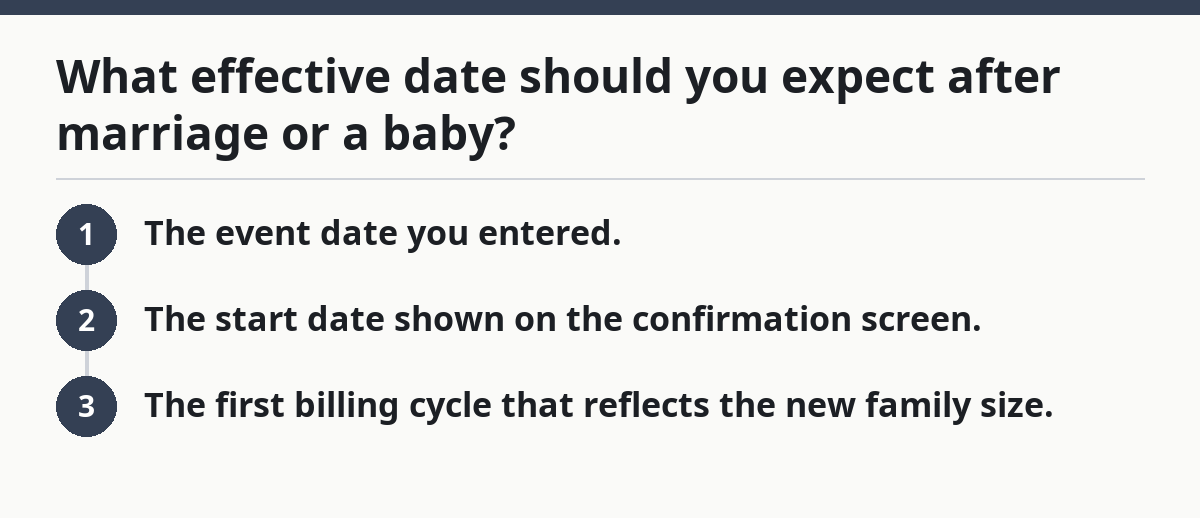
If those do not line up, do not assume they will sort themselves out later. Call the plan or marketplace and ask for the exact effective date in writing. A 1-line confirmation can prevent a month of confusion.
A generic guide often says “coverage starts soon.” That is too vague to be useful. You need the actual start date because it tells you whether to keep the old plan active, whether to delay canceling anything, and whether the new dependent is covered during the gap between birth, marriage, and the plan update.
This is also the point where a professional or plan representative can be worth a short call if the dates are messy. That is not because the process is mysterious. It is because a wrong effective date can create a real coverage gap, and those are expensive to clean up after the fact. The HealthCare.gov eligibility overview explains how these enrollment windows work in practice.
Common mistakes freelancers make after family-status enrollment changes
The biggest mistakes are missing the window, uploading the wrong proof, and assuming the household size will update by itself.
Missing the window costs time. If you wait too long after marriage or birth, you may lose the chance to make the change outside open enrollment. The fix is simple: start the process as soon as you have the date and the paperwork, even if you still need to chase one document.
Uploading the wrong proof costs more time. A certificate that does not clearly show the event date, or a form that does not match the name on the application, can bounce back for correction. Use the document the plan asks for, not the document that happens to be easiest to find.
Assuming household size updates automatically costs money. A plan that still shows the old number of dependents may use the wrong premium or credit estimate. The fix is to review every household field line by line before submitting.
Another mistake is forgetting that one family event can create two separate tasks: adding a dependent and adjusting the existing policy. Those are related but not identical. If the spouse or baby is listed but the effective date is wrong, you still have a problem. If the effective date is correct but the household size is wrong, you still have a billing issue.
For a freelancer, the cleanest approach is boring: keep the event date, proof, application confirmation, and first updated bill in one folder. Four documents, one place, no guessing later.
If there is one thing this process rewards, it is speed with accuracy. A 10-minute review today can save a month of back-and-forth later.
The bottom line for freelancers
After marriage or a baby, the key changes are enrollment timing, dependent status, household size, and the coverage effective date.
If you remember only one thing, remember this: the event itself is not enough. You need to update the plan with the correct date, correct dependent, and correct household count before the window closes. That is what keeps coverage aligned with real life and prevents a small paperwork delay from becoming a month of avoidable expense.
Can I add my spouse to my health plan after marriage?
Yes, if your plan allows a family-status enrollment change after marriage and you file within the special enrollment period.
The important part is the deadline, not the wedding date alone. You will usually need the marriage date, proof of marriage, and the spouse’s details before the update can be processed. If the plan asks for documents within a set number of days, submit them as soon as you can so the effective date is not pushed back.
Can I add a baby to my marketplace plan right away?
Yes, a baby can usually be added as soon as you report the birth and complete the enrollment update.
The baby’s date of birth, name, and any requested proof will drive the change, and the coverage effective date may depend on when the update is filed. Do not wait for a later billing cycle if the plan gives you an earlier enrollment window. The faster you submit the change, the sooner the dependent can be reflected on the policy.
Drafted with AI; not yet reviewed by a person.