
Self-Employed Coverage Shopping and Plan Selection

Last updated: November 20, 2026
Quick Answer: compare 12 months of premiums plus deductible, copays, and prescription costs before you choose. This self-employed coverage shopping and plan selection guide helps freelancers choose a plan that matches the doctors, prescriptions, and budget they will actually use, not just the monthly sticker price. For many buyers, that means an HMO if your doctors are in one local network and you want simpler costs, or a PPO if you travel, split care across specialists, or want out-of-network backup. A plan that looks cheap at enrollment can cost more once you add deductible, copays, and out-of-network rules.
This self-employed coverage shopping and plan selection guide is for the self-employed shopper who needs to make a real HMO vs PPO call, not just read definitions. It uses the plan rules that matter most in everyday U.S. shopping: network size, referrals, out-of-network coverage, deductible structure, and tax forms like Form 1095-A and Form 8962 when you buy through the ACA Marketplace. For a federal starting point, the HealthCare.gov coverage pages and the IRS guidance on premium tax credits are the most useful references: https://www.healthcare.gov/choose-a-plan/plans-categories/ and https://www.irs.gov/affordable-care-act/individuals-and-families/premium-tax-credit
Key takeaways
- Pick the network first. The cheapest premium may not help if your main doctor is out of network.
- HMOs usually work best when your care stays local and you are fine with a gatekeeper-style system.
- PPOs usually fit people who want more provider choice or who may need care in more than one place.
- A deductible only matters if you know what it applies to. Some plans make you pay it before many services; others do not.
- If you buy coverage through the Marketplace, keep your income estimate current so tax credit paperwork does not surprise you later.
What matters most when you shop?

What matters most when you shop is not the plan label; it is how the plan matches your doctors, prescriptions, and expected visits. A plan with a $0 premium can still be expensive if it has a narrow network, a high deductible, or no useful out-of-network help.
For example, start with the people and places you already use. Check your primary care doctor, your main specialist, your local hospital, and each prescription by name. A plan that covers only two of those well is often a poor fit, even if the brochure looks tidy.
Then look at the cost structure. Premium is the monthly bill. Deductible is the amount you pay before many services start to share cost. Copays and coinsurance are what you pay at the visit or after the bill is processed. A freelancer who sees a doctor once a year may care most about premium; a freelancer with ongoing treatment often needs to study the deductible and specialist copays first, and it is wise to consult a licensed insurance professional or tax professional when the choice affects ongoing care or tax credits. HealthCare.gov and the IRS both explain these Marketplace basics in more detail: https://www.healthcare.gov/lower-costs/ and https://www.irs.gov/affordable-care-act/individuals-and-families/premium-tax-credit
There is a tax side too. If you buy through the ACA Marketplace, your premium tax credit depends on estimated income, not hope. The IRS uses Form 8962 to reconcile that credit later, and Form 1095-A documents the Marketplace coverage. If your income changes during the year, update it early instead of waiting until tax season.
For a plain federal overview, the HealthCare.gov pages on Marketplace coverage and plan types are a good reference:
- https://www.healthcare.gov/choose-a-plan/plans-categories/
- https://www.healthcare.gov/lower-costs/
How is an HMO different from a PPO?
Therefore, an HMO is different from a PPO because the HMO usually asks you to stay inside a network and follow a more managed care path, while a PPO usually gives you more choice and more room to go outside the network. That one difference changes almost every shopping decision.
An HMO often has three traits that matter. First, it usually expects you to use in-network doctors and hospitals. Second, it often wants a primary care doctor to coordinate care. Third, it commonly makes out-of-network coverage limited or nonexistent, except for emergencies. That can keep costs more predictable, but it also makes the network list the whole game.
A PPO usually gives broader access. You can often see specialists with less friction, and you may have some out-of-network coverage, though the plan may pay less outside the network. That flexibility helps if you move often, split time between cities, or want to keep long-standing providers. The trade-off is that PPOs often cost more in premium or come with more cost sharing.
In short, the cleanest way to think about it is this: HMO plans usually reward staying inside the box, while PPO plans usually charge you less in convenience and more in monthly cost. That is why the right choice depends less on the insurance category and more on your actual care pattern.
Which plan works better for a freelancer?

Since a freelancer with stable local care usually gets more value from an HMO, while a freelancer who values choice or travels gets more value from a PPO, that is the simplest honest rule, and it covers most shopping decisions.
An HMO fits well if you have one home base, one main doctor, and a short list of in-network specialists. It also fits if you want a simpler claims experience and you do not want to juggle multiple provider systems. The downside is clear: if your favorite specialist is outside the network, you may have to switch or pay most of the bill yourself. That is a real consequence, not a minor inconvenience.
On the other hand, a PPO fits well if you travel for work, live part-time in more than one place, or want the option to see out-of-network clinicians. It also helps when a specialist you trust is not in the lower-cost network tier. The weakness is also clear: the extra choice usually comes with higher monthly cost or more expensive use of care. If you rarely need that extra choice, you may be paying for a feature you never use.
The self-employed shopper should also think about cash flow. Many freelancers care about a plan that makes monthly budgeting easier. A lower premium can look attractive in January and painful in March if the deductible is high. A higher-premium PPO can be the smarter pick if it prevents a large surprise later, but only when that flexibility is real and useful, and it is sensible to consult a licensed insurance professional before you rely on a plan for complex or ongoing care. For consumer background, see HealthCare.gov’s plan category overview: https://www.healthcare.gov/choose-a-plan/plans-categories/
The honest side-by-side
Overall, the honest side-by-side says HMO wins on predictability and PPO wins on freedom. That is the core trade-off, and it shows up in every row that matters.
| Criteria | HMO | PPO | Winner for which condition |
|---|---|---|---|
| Doctor choice | Usually limited to network doctors | Usually broader choice, including some out-of-network options | PPO if provider choice matters |
| Out-of-network coverage | Often little or none except emergencies | Often available, though at a higher cost share | PPO if you may need care outside the network |
| Care coordination | Often centered on a primary care doctor | Usually less managed | HMO if you want a single care hub |
| Predictable costs | Often easier to forecast | Can be less predictable if you go outside the network | HMO if budgeting matters most |
| Flexibility for travel | Usually weaker outside the home network | Usually stronger for multi-city lifestyles | PPO for frequent travel |
| Premium pressure | Often lower | Often higher | HMO if monthly cash flow is tight |
| Specialist access | Can be more controlled | Can be easier to use in practice | PPO if you see specialists often |
| Risk of paying full price for a bad match | Higher if your doctor is out of network | Lower, though still possible | PPO if you are unsure about provider stability |
| Best use case | Stable, local, network-based care | Choice-heavy, travel-heavy, or multi-location care | Depends on your actual provider list |
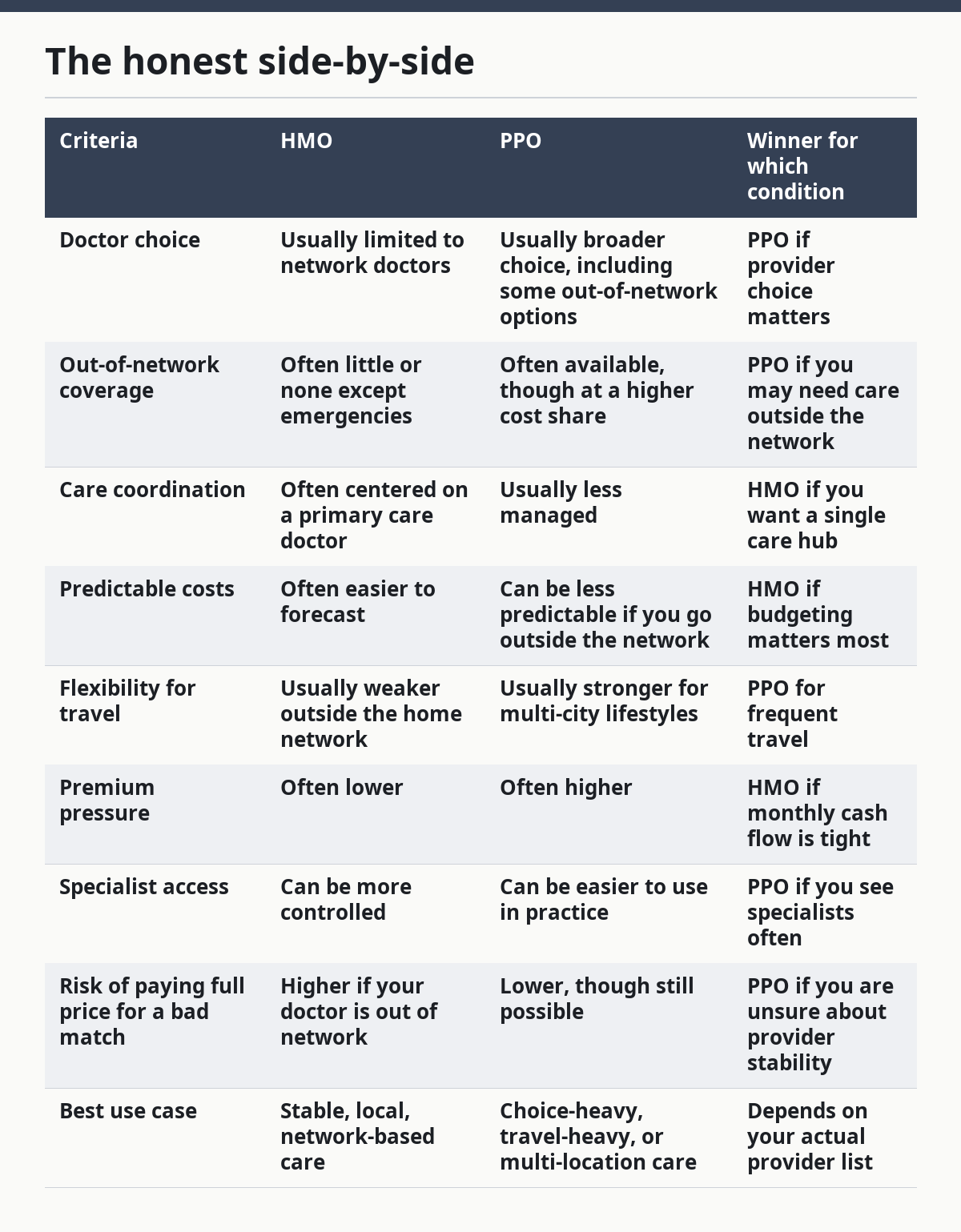
For instance, the table hides one practical detail that matters a lot: the network list changes the real value of the plan. A PPO with a weak local network can be less useful than a strong HMO that includes your doctors. The “better” plan is not the one with the fancier label. It is the one that covers the care you already know you will use.
Because of that, a second detail is that plan documents may present the same cost in different ways. One plan may show a modest copay and a steep deductible. Another may show a higher premium and lower surprise costs. That is why the side-by-side only works if you compare the same service across both plans: primary care, specialist visits, urgent care, prescriptions, and hospital care.
HMO: who should actually choose it?
So an HMO should be your pick if your doctors are in-network, you want simpler bills, and you do not need out-of-network flexibility. That profile describes many freelancers who work from one city and have routine care.
The strongest reason to choose an HMO is fit. If your current primary care doctor, local lab, and nearby hospital are all in network, the HMO can keep your care organized without paying for flexibility you will not use. That can be especially helpful if you dislike surprise billing or do not want to keep track of scattered claims.
The main weakness is also the main risk. If your provider list changes, the plan can become awkward fast. A specialist moving out of network can force you into a new referral chain or a new doctor list. That is not a small issue for someone with ongoing care, because continuity can matter more than saving on the premium.
Likewise, an HMO is usually a poor fit if you live in one place but rely on a provider outside the network, or if you know you will need care in different cities. It is also a weak choice if you want to self-direct specialty care without passing through a primary care gatekeeper. In those cases, the plan can feel cheaper at signup and more restrictive every month after that.
PPO: when does it win?
Therefore, a PPO wins when provider choice, travel, or out-of-network backup is worth paying for. That is the clearest case for freelancers who move around or who already have doctors they want to keep.
The best reason to choose a PPO is control. If you want to keep seeing a specialist who is not in the lower-cost network tier, a PPO may keep that door open. If you split time between two states or travel often for work, the extra reach can keep your care from becoming a logistics problem. That is especially valuable when a health issue is ongoing and the convenience of one network is not enough.
The trade-off is the cost structure. PPOs often ask you to pay more in premium, and out-of-network care can still be expensive. Some buyers assume a PPO means “any doctor, any time, no problem.” That is not how it works. The plan may give you more freedom, but the freedom is not free. You still need to read the rate sheet for specialists, emergency care, and out-of-network services.
Even so, a PPO is a weak choice if your care is simple, local, and mostly preventive. If you use the same few in-network providers every year, you may be paying for flexibility you do not use. In that case, an HMO can be the smarter financial move even if the PPO looks more attractive on paper.
What are the exception scenarios?
Ultimately, the verdict flips in a few specific cases, and those cases matter more than the label on the plan card.
First, if your top doctor is out of network on the HMO but in network on the PPO, the PPO can win even if the premium is higher. The cost of switching doctors or paying full price can dwarf the monthly difference. A single specialist relationship can change the whole plan choice.
Second, if you have a very tight monthly budget and you know your care use will be light, an HMO may beat a PPO even when the PPO offers nicer flexibility. The reason is simple: unused flexibility has no value. For a healthy freelancer with a predictable care pattern, a lower premium and an in-network plan can be the rational choice.
Third, if you are in the middle of a treatment plan, do not assume either category is safe until you check the exact provider and facility list. A plan that looks fine on the summary page can fail you at the hospital, imaging center, or lab level. That detail matters because the bill is often determined by the facility as much as the doctor.
Fourth, if you buy through the Marketplace and your income is hard to forecast, the tax credit side can matter as much as the coverage side. A better subsidy estimate can make a more expensive plan affordable, while a bad estimate can cause trouble at tax time on Form 8962. That is a finance issue, not a plan-label issue, but it belongs in the decision.
How do you pick the right plan step by step?
Next, you pick the right plan by checking three things in order: providers, expected care, and total yearly cost. That order keeps you from choosing based on one number that does not tell the whole story.
Start with providers. Put your primary care doctor, specialist, hospital, and prescriptions into the plan search tool. If the plan cannot cover the people you already use, stop there unless you are willing to switch. A plan with the wrong network is the wrong plan, no matter how tidy the brochure looks.
Then estimate use. Count regular visits, specialist visits, prescriptions, and likely procedures for the year ahead. A person who expects one annual exam and no medication has a very different problem from a person managing a chronic condition. The first shopper may focus on premium; the second should focus on the cost of ongoing use.
After that, compare total cost, not just premium. Add the monthly premium for 12 months, then layer in the deductible, copays, and any expected out-of-pocket use. If you do not have exact numbers, compare the plan documents side by side and look for the service lines you know you will use most. That is the part many shoppers skip, and it is usually where the bad decision starts.
If you buy through the ACA Marketplace, check whether premium tax credits apply and whether the plan fits your projected income. The IRS and HealthCare.gov both make clear that the tax-credit side is part of the plan decision, not a separate issue you can deal with later. For a freelancer, that tax piece can be as important as network size.
What should a self-employed buyer do next?
Finally, a self-employed buyer should make the decision with a provider list in one hand and the plan summary in the other. That is the fastest way to avoid the common mistake of choosing a plan that looks good but does not fit real care.
Choose HMO if your doctors are in network, your care is local, your budget is tight, and you want the simplest path through the system. Choose PPO if you need provider choice, travel often, or want out-of-network backup for a known reason. Neither is right if you are buying only on premium and ignoring the network.
Do not pick a plan that forces you to change doctors unless you are ready for that change. Do not pay for PPO flexibility if you are almost certain you will never use it. The best plan is the one that matches your actual year, not your ideal one.
If the comparison still feels close, use the following rule: when provider access matters most, choose the PPO; when cost predictability matters most, choose the HMO. That is the cleanest decision line for freelancers who need one answer, not another research project.
Can I switch later if I get it wrong?
However, you can sometimes switch later, but you should not count on that as your plan. The timing rules depend on the coverage channel and whether you qualify for a special enrollment event, and those rules are strict enough that “I changed my mind” usually is not enough.
That is why the first selection matters so much. If you pick the wrong network, you may be stuck with the wrong network until the next enrollment period. A freelancer should treat enrollment like a commitment, not a trial run.
If your income, address, or household changes, check whether that creates a new enrollment opportunity or changes your subsidy. The Marketplace and IRS rules can affect both coverage and tax treatment. A quick update can prevent a much larger problem later.
FAQ
Is an HMO always cheaper than a PPO?
No, an HMO is not always cheaper than a PPO. It often has a lower premium, but the real cost depends on deductible, copays, and whether you can stay in network for all your care. A plan with a lower monthly bill can still cost more over the year if you need out-of-network help or frequent specialist visits.
Should a freelancer choose a PPO just for peace of mind?
Not if the PPO flexibility will not get used. Peace of mind has value only when it covers a real risk, such as a doctor you need who is out of network or a work pattern that takes you between cities. If your care is local and stable, the extra cost of a PPO may buy little more than a nicer brochure.
What matters more: premium or deductible?
Neither matters alone; the total cost matters more. A low premium can hide a high deductible, and a higher premium can buy you lower use-costs. If you expect to use care several times a year, the deductible and specialist copays deserve as much attention as the monthly bill.
Do I need to check prescriptions before I choose?
Yes, you should check each prescription before you choose. Drug coverage can change the real cost of a plan as much as the doctor network does. A plan that covers your doctor but not your medication well can still be a bad fit, especially if you take medicine every month.
What if my income changes after I enroll?
Update it as soon as the change is clear, especially if you bought through the Marketplace. Premium tax credits are based on projected income, and the IRS reconciles them later on Form 8962. A stale income estimate can cause a tax surprise that has nothing to do with the plan’s network, so it is worth fixing early.
Drafted with AI; not yet reviewed by a person.