Last updated: November 19, 2026
Key Takeaways
- Urgent care and emergency room bills are different, and freelancers should check both before enrolling.
- Urgent care is often a copay, but some plans apply the deductible first or add coinsurance after the visit.
- Emergency room costs can start with a higher copay and still include deductible charges or coinsurance.
- Out-of-network emergency coverage may still help, but it is not the same as routine out-of-network care.
Quick Answer
A cheap monthly premium can hide a painful surprise at the doctor’s office. Freelancers should verify urgent care and emergency coverage before enrolling because one plan may look affordable and still leave you holding most of the bill after a real medical event. The safest shortcut: check the summary of benefits, the deductible, the emergency room copay, and the out-of-network emergency rule. HealthCare.gov and the NAIC both explain these terms clearly, and the Affordable Care Act requires emergency services coverage in many plans. For general plan selection, see the hub guide to choosing a health insurance plan as a freelancer.
Before you sign up, check urgent care and emergency coverage. A plan can look cheap and still leave you paying most of the bill. This guide on what freelancers should know about urgent care and emergency coverage before enrolling shows what to verify on urgent care, the emergency room, ambulance, out-of-network care, copays, and deductibles before you enroll.
What urgent care and emergency coverage actually protect you from
Urgent care and emergency coverage protect you from two different kinds of bills; mixing them up is where freelancers get burned. Urgent care is for problems that need prompt attention but are not life-threatening. Emergency room care is for chest pain, trouble breathing, major injuries, stroke signs, or anything that could turn serious fast.
The same health plan can treat those two settings very differently, so consult a professional or the plan’s member services if the summary is unclear. A $40 urgent care copay can turn into a deductible charge or a much larger emergency room bill if you go to the wrong place. That surprise lands like a sledgehammer.
- Urgent care usually means one office visit charge, sometimes with a copay.
- Emergency room care can trigger a separate copay, coinsurance, and deductible treatment.
- Ambulance rides may be billed on their own, even when the hospital visit is covered.
- Out-of-network care can change what you owe after the visit if the plan does not treat it as an emergency exception.
If you only skim one part of a brochure, make it the emergency section. The details there tell you more about your real risk than the marketing page ever will. For background on the bigger plan choice, the hub guide to choosing a health insurance plan as a freelancer is the right place to start.
What freelancers should know about urgent care and emergency coverage before enrolling
Four questions matter before you enroll: where the plan sends you for urgent care, how it pays for emergency room visits, what happens out of network, and whether the deductible applies before help kicks in. Those four points decide whether a bad day becomes a manageable bill or a mess.
Urgent care and emergency coverage before enrolling also depends on timing. If you’re sick on a Saturday and the doctor’s office is closed, consult a professional or the plan’s benefits team before assuming the nearest clinic is covered. The answer is often buried in the benefits and exclusions, not the summary page.
A good check takes about 10 minutes per plan if you know where to look.
- Open the plan’s summary of benefits and find the sections for urgent care, emergency room, and ambulance.
- Look for the exact dollar amounts for copays, coinsurance, and any separate emergency room charge.
- Check whether the deductible applies to urgent care, emergency room care, or both.
- Find the out-of-network section and read the emergency exception language.
- Save the member services number so you can ask about a real clinic or hospital before you enroll.
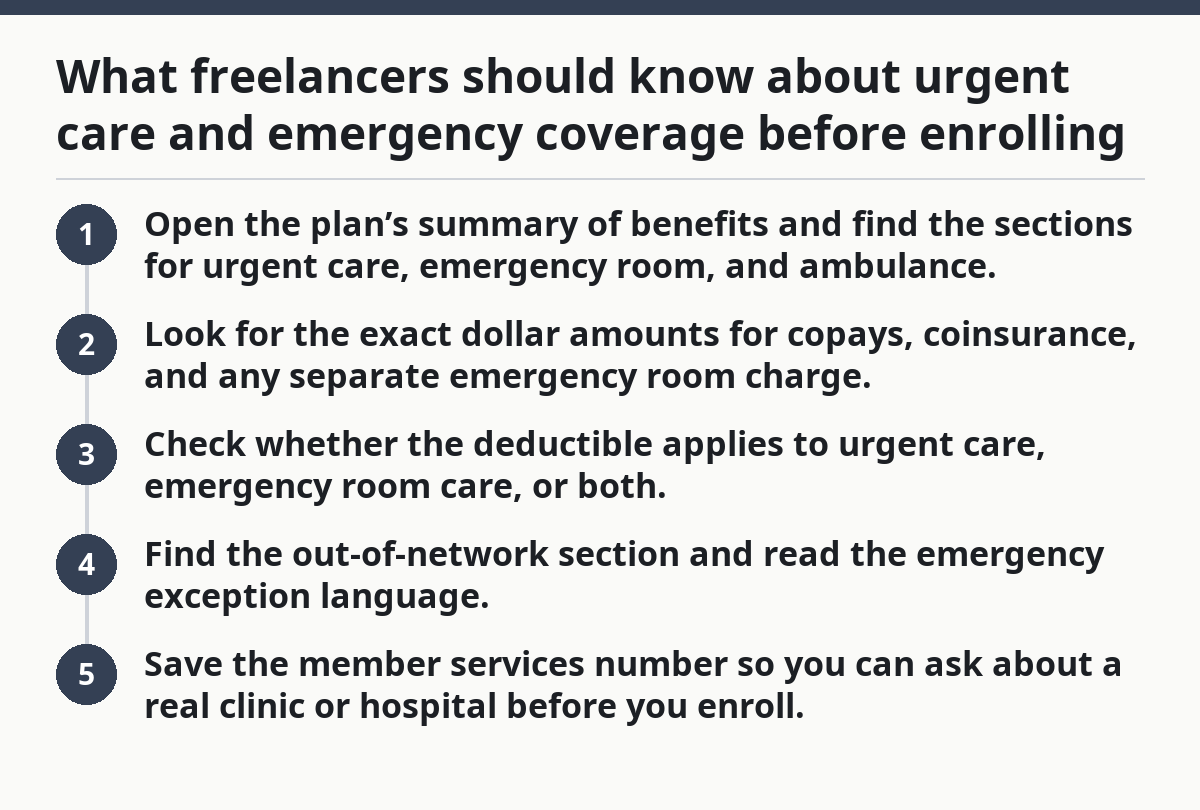
The result you want is plain: you should know what happens if you walk into urgent care, what happens if you land in the ER, and whether the plan changes the math when the provider is outside the network. No guessing.
How urgent care is usually billed
Urgent care is usually billed as a copay, but some health plans apply the deductible first or charge coinsurance after the visit. The same sore throat visit can cost very different amounts depending on the design of the health plan. Pay attention here.
Urgent care and emergency coverage before enrolling gets tricky when a routine visit still becomes expensive because the plan uses the deductible first. Consult a professional if the summary does not spell out the order of charges. HealthCare.gov explains that copays, coinsurance, and deductibles can all apply, depending on the plan.
Picture this: you go in for stitches or a sprained ankle, and the receptionist says the clinic takes your insurance. That still does not tell you the full price. The plan may treat the visit like a simple office call, or it may count it as a higher-cost service tied to the deductible. The bill can snowball quickly.
Watch for these billing patterns:
- Copay only: You pay a fixed amount at the visit.
- Deductible first: You pay the full allowed amount until the deductible is met.
- Copay plus coinsurance: You pay a fixed fee, then a percentage of the rest.
- Separate facility fee: Some clinics and hospital-owned urgent care centers bill more than a stand-alone clinic.
A common mistake is assuming “urgent care” always means “cheap.” A hospital-affiliated clinic can be priced very differently from a small neighborhood center, even under the same health plan. Nice label, rough bill.
How emergency room coverage works when you really need it
Emergency room coverage often starts with a higher copay, then adds deductible treatment or coinsurance if the plan is not fully covering the visit. That is why an ER bill can be much larger than an urgent care bill, even before any scans or labs show up.
Urgent care and emergency coverage before enrolling also means reading the ER rules with a sharp eye. Consult a professional if the plan language is vague. The CMS and HealthCare.gov materials both stress that emergency services rules vary by plan, even though many plans must cover true emergencies.
Picture this: you’re trying to decide between urgent care and the emergency room at 9 p.m. The plan rules matter less in the moment than they do on the bill that arrives later. Still, the plan language tells you whether the ER is treated as a protected service or a cost-heavy one.
Use this simple read of the benefits page:
- Emergency room copay: A fixed charge for using the ER.
- Deductible treatment: The plan may make you meet part or all of the deductible first.
- Coinsurance: You may owe a percentage after the plan allows the claim.
- Separate doctor and facility bills: The ER visit can generate more than one bill.
Do not use the emergency room for something urgent care can handle just because the ER “takes insurance.” That phrase says nothing about the final bill. It only says the claim may be processed under the plan.
What out-of-network emergency rules mean for freelancers
Out-of-network emergency rules can still protect you, but they are not always simple, and they are often different from routine out-of-network care. Most plans handle true emergencies more favorably than a normal doctor visit outside the network, but the claim still needs to fit the plan’s emergency definition.
Urgent care and emergency coverage before enrolling is especially important when you travel or end up far from home. Consult a professional if the plan’s emergency exception is hard to follow. The No Surprises Act and related federal guidance matter here, and HealthCare.gov outlines the emergency coverage basics.
Picture this: you are away from your usual area and end up at the closest hospital. If it is out of network, the plan may still treat the emergency as covered care, then apply the plan’s emergency cost-sharing rules. Better than routine out-of-network coverage, yes, but it can still leave you with deductible and coinsurance charges.
Here’s what to verify before enrolling:
- Whether the plan covers emergency room care in and out of network the same way.
- Whether post-stabilization care changes if the hospital keeps you after the emergency is over.
- Whether ambulance charges follow the same emergency exception.
- Whether the plan can bill you more after an out-of-network emergency visit.
This is the part many freelancers miss. A plan can be fine for routine visits and still become expensive the moment you need care outside its network. The emergency exception helps, but it is not a free pass.
For plan comparison work, the safest source is the actual benefits document, not the sales page. The HealthCare.gov glossary and plan pages on emergency services are useful reference points, and the National Association of Insurance Commissioners explains common insurance terms in plain English.
What to check before you enroll
Check urgent care and emergency coverage before you pay your first premium; the wrong detail can change the bill by hundreds of dollars. You do not need a full spreadsheet. You do need to ask the right questions and read the right line items.
Urgent care and emergency coverage before enrolling can look similar on two plans and behave very differently on one bad day. One may have a lower monthly premium and a tougher deductible; another may cost more each month but soften urgent care and ER charges.
Picture this: you are comparing two health plans that look close on monthly cost. One has a low premium but a harsh emergency room deductible; the other asks for more each month and softens urgent care and ER charges. The cheaper plan is not really cheaper if it punishes the care you are most likely to need.
Use this checklist:
- Urgent care copay: Is it fixed, or does the deductible apply first?
- Emergency room copay: Is there one, and does it stack with coinsurance?
- Ambulance coverage: Is ground ambulance covered, and under what terms?
- Out-of-network emergency care: Does the plan protect you from the worst bill shock?
- Deductible treatment: Which services hit the deductible before the plan helps?
- Hospital-owned urgent care: Is it priced like urgent care or like outpatient hospital care?
A plan that hides these answers is not friendly to a freelancer’s budget. It may still be the right fit, but only if you know how it behaves when the worst day shows up.
Common mistakes freelancers make with urgent care and emergency benefits
Freelancers usually make the same three mistakes: they assume urgent care and the ER cost about the same, they ignore ambulance rules, and they stop reading after the copay line. Each mistake costs money because the real price sits in the deductible, coinsurance, and out-of-network sections.
Urgent care and emergency coverage before enrolling matters most when the deductible applies first and turns a simple visit into something pricier. Consult a professional if the wording is unclear. CMS and HealthCare.gov both note that cost sharing can change based on the service and the plan.
Picture this: you spot a shiny low premium and move on. Later, you find out the plan uses a big deductible before it covers emergency room care, or it prices a hospital-owned urgent care center much higher than the strip-mall clinic across town. That is a painful way to learn.
Common traps to avoid:
- Confusing urgent care with ER care: The bill can be completely different.
- Skipping ambulance language: A covered hospital visit does not mean the ride is cheap.
- Ignoring out-of-network exceptions: Emergency coverage is not always as broad as people assume.
- Reading only the copay: A small copay can sit on top of a big deductible.
The fix is boring, but it works: read the benefits page line by line, then call member services with one real example, like “What would I pay if I went to urgent care at Clinic X?” Boring beats surprise.
How to read the summary of benefits without getting lost
The summary of benefits tells you the emergency rules in plain blocks, and you can usually find the answer in under 5 minutes once you know the headings. The trick is to ignore the marketing copy and read the service categories one by one.
Urgent care and emergency coverage before enrolling is easier to spot in the summary than in the brochure. The summary usually breaks each service into a service name, a cost share, and a note about whether the deductible applies.
Picture this: you have the PDF open and need a fast yes-or-no on urgent care and ER costs. The summary usually breaks each service into a service name, a cost share, and a note about whether the deductible applies. That is the part that matters.
Look for these exact phrases:
- Urgent care
- Emergency room
- Ambulance
- Out-of-network emergency services
- Before deductible
- After deductible
- Coinsurance
If a term appears but the cost is “see plan documents,” keep going. The summary is a map, not the whole terrain. When the summary is vague, the evidence section, evidence of coverage, or member handbook usually has the real rule.
FAQs
Does emergency care have to be in network?
Emergency care does not always have to be in network to be covered. Most health plans treat true emergencies differently from routine out-of-network care, and that is the rule freelancers should look for before enrolling. The plan may still apply a deductible, copay, or coinsurance, so “covered” does not mean “free.”
How is urgent care billed?
Urgent care is usually billed as a copay, but some plans apply the deductible first or add coinsurance. That means the same visit can cost one fixed amount on one plan and a much larger share of the bill on another. Read the urgent care line in the summary of benefits, not just the premium.
What should I check before relying on a plan for emergencies?
Check the emergency room copay, whether the deductible applies, the ambulance rule, and the out-of-network emergency exception. Those four items tell you what the plan does when the situation is serious and you do not get to shop around. If any of them are vague, ask member services for the exact claim rule before enrolling.
Drafted with AI; not yet reviewed by a person.