Freelancer Coverage Use and Provider Fit: The Complete Guide

Last updated: November 19, 2026
Quick Answer: In 3 steps, most freelancers can narrow the choice fast: match the coverage type to the biggest risk, check the claim rules, and compare at least 2 providers. Freelancer coverage is hard to shop because the wrong plan can leave you paying for services you never use or missing the ones you need. The right fit depends on how often you freelance, which services you actually use, and how much provider support you want. The sections below settle that choice for Freelancer coverage use and provider fit — The Complete Guide.
Key Takeaways
- Start with your real work, not the menu of extras.
- Coverage fit is about claim process, service scope, and network access.
- One provider can be right for tax help and wrong for health coverage.
- A low-cost plan can still be a bad fit if it limits claims or support.
- The strongest match is the one you can use without fighting the rules.
I’ve spent years writing about freelancer benefits, insurance, and membership coverage, so I know the gaps readers miss when they compare plans by headline price alone. In this guide to Freelancer coverage use and provider fit — The Complete Guide, the focus stays on use, rules, and provider fit.
What “coverage” means for freelancers
Freelancer coverage is the set of services, protections, or policy benefits you can actually use as an independent worker. Picture this: you’re comparing two plans that both look affordable, but one only helps with invoices while the other includes tax filing help, liability protection, and health access through a partner network. The label matters less than the usable benefit list.
Because of that, the first question is practical, not promotional.
A freelancer may need coverage in several lanes at once: health, liability, income protection, equipment, legal help, or platform-specific support. A provider can be strong in one lane and weak in the rest. A health-first plan with a big network may be useless if you really need contract review. A business support membership may be fine for admin help but irrelevant if you’re trying to protect your income after an injury.
Here’s the catch: many providers bundle services that look similar from the outside but behave very differently when you need them. One may reimburse after a claim. Another may only discount services. One may accept a broad provider network. Another may lock you into a narrow list of vendors.
Use this lens:
- Coverage type: health, liability, income, legal, equipment, or business support
- Access rule: direct use, reimbursement, referral, or network-only
- Claim burden: simple form, receipts, approval, or full documentation
- Service scope: one service or a bundle
- Exclusions: what the plan does not pay for or support
That is the real starting point. Not the brochure.
Which freelancer coverage type fits your work?
The right coverage type is the one that matches your biggest risk, not your loudest worry. Picture this: you work from home, send client work every week, and your biggest fear is a contract dispute, not a broken laptop. A legal or business support package may beat a hardware add-on by a mile.
The main categories work like this:
- Health coverage fits freelancers who need routine care, prescriptions, or emergency protection.
- Liability coverage fits creatives, consultants, and tradespeople who could be blamed for damage, mistakes, or missed work.
- Income protection fits freelancers whose pay stops if they get sick or injured.
- Equipment coverage fits people with expensive gear, like cameras, computers, or tools.
- Legal and admin coverage fits freelancers who need contract help, invoice support, or tax prep.
- Platform or association coverage fits workers who want a bundle through a guild, union, marketplace, or member group.
The strongest fit is often not one product, but the mix that covers your real risk. A designer may need liability coverage for client claims, equipment coverage for a laptop, and tax support for quarterly filings. The mistake is trying to make one product do all three jobs.
A simple rule helps:
- List the one loss that would hurt most.
- Name the service that would cover that loss.
- Check whether the provider actually pays, reimburses, or only advises.
- Look for exclusions tied to freelance work, side gigs, or home offices.
If a provider cannot point to the exact use case in plain language, it is probably not the right fit.
What makes a provider a good fit for freelancers?
A good provider makes the coverage easy to use on a normal Tuesday, not just on a perfect sales call. Picture this: you have a deadline, a stack of receipts, and a policy page full of fine print. The provider that wins is the one whose rules match how freelancers actually work.
Therefore, three things matter most:
- Clarity: Can you tell what is covered in under five minutes?
- Access: Can you use the benefit without jumping through a pile of steps?
- Support quality: Does the provider answer questions clearly and in writing?
A provider with a huge menu can still be a poor fit if it buries limits in policy language. A smaller provider can be a better fit if it says exactly what it covers and how to file a claim. The real test is not feature count. It is whether the rules stay usable when your work gets messy.
Look closely at these details:
- Whether freelancers are eligible at all, or only full-time business owners
- Whether part-time income counts
- Whether you need a registered business entity
- Whether coverage starts immediately or after a waiting period
- Whether claims require invoices, proof of loss, or professional licenses
- Whether the provider works nationally or only in certain regions
The truth is, provider fit often comes down to paperwork tolerance. If you hate admin, choose a provider with fewer steps and clearer claims. If you want the broadest protection, accept that the provider may ask for more documentation.
According to the U.S. Small Business Administration, small-business owners should compare risk, cost, and coverage limits before buying insurance. The National Association of Insurance Commissioners also explains how to compare policies and review complaints before choosing a provider. Both are plain-language starting points for comparing providers and understanding how claims rules work.
How to compare providers without getting fooled by the marketing
The best comparison is not “Which plan has more features?” It is “Which provider is easiest to use for my exact freelance life?” Picture this: two plans both say they support independent workers, but one only covers you after a deductible-style threshold while the other pays a smaller benefit with fewer hoops. Those are not the same product.
So the comparison should stay consistent from provider to provider.
A good comparison starts with five questions:
- What problem does this provider solve first?
- What does it exclude?
- What proof do I need to use the benefit?
- How fast can I get help?
- What happens when my work changes?
To keep the choice honest, compare the provider on the same criteria every time.
| Criteria | Provider with broad coverage | Provider with narrow coverage | Winner for this condition |
|---|---|---|---|
| Service scope | More categories, often with more rules | Fewer categories, usually simpler | Broad coverage if you need multiple protections |
| Claim process | Can require more documents | Often faster and easier | Narrow coverage for low-admin users |
| Freelancer eligibility | May accept more income types | May require a tighter profile | Broad coverage for mixed-income freelancers |
| Support access | More channels, sometimes slower triage | Fewer channels, often more direct | Depends on how often you need help |
| Exclusions | Can still be strict in key areas | Usually easier to read | Narrow coverage for readers who want plain rules |
| Best use case | People who want one provider for several needs | People who want one clear benefit | Broad coverage for multi-risk freelancers |
| Risk of paying for unused benefits | Higher | Lower | Narrow coverage for budget-first buyers |
| Flexibility when work changes | Better if the provider tracks changes well | Better if your needs stay stable | Broad coverage for changing freelance income |
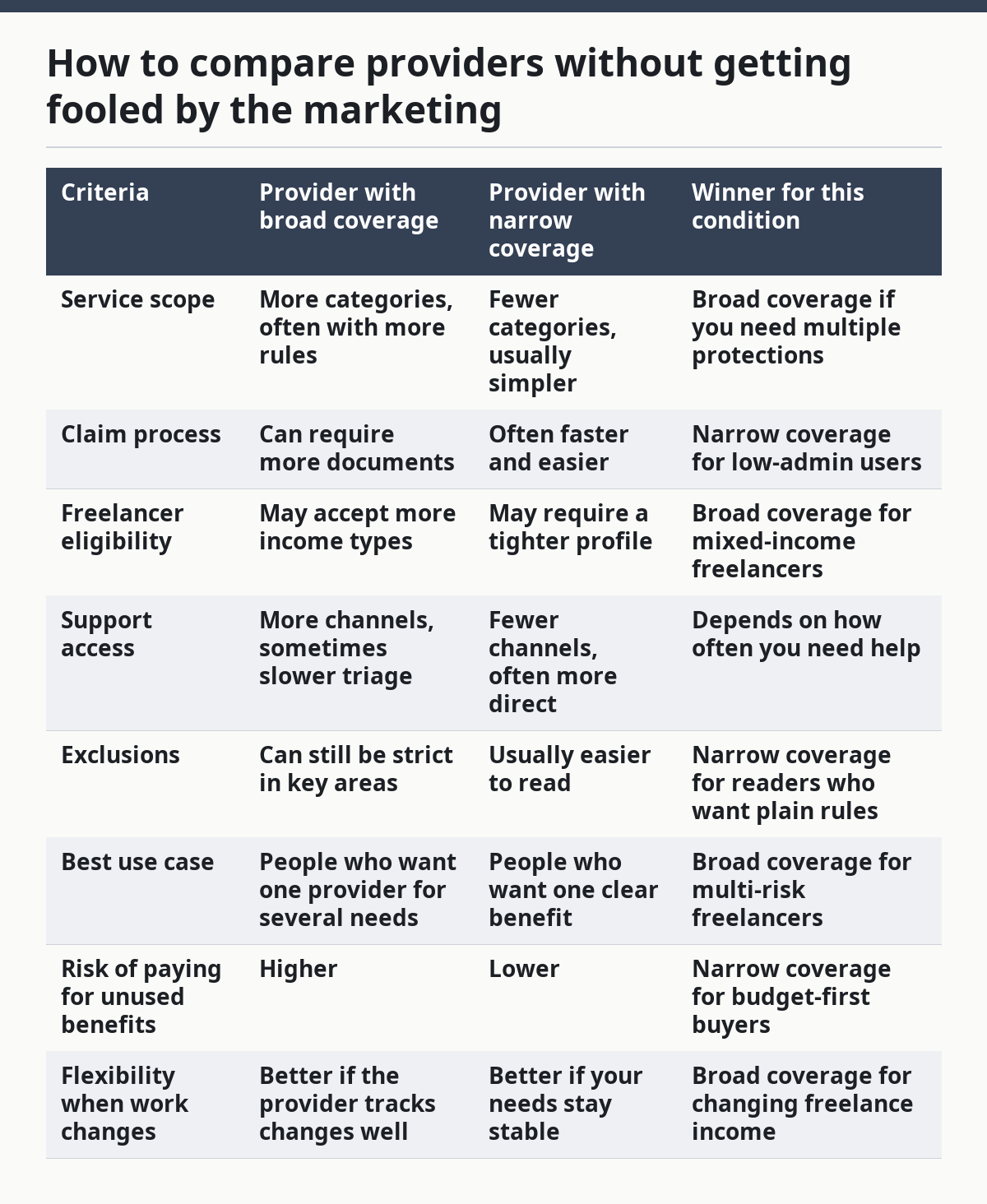
The table says what marketing usually hides: broad coverage buys flexibility, while narrow coverage buys simplicity. Neither is automatically better. One is better when you expect change. The other is better when you want fewer moving parts.
Broad coverage: who should actually use it
Broad coverage wins for freelancers with mixed risks and changing income. Picture this: you work on retainer one month, project-based the next, and you need a provider that can keep up without forcing a brand-new application every time your work changes. That is where a wider bundle helps.
This choice makes sense when you want more than one type of protection from one provider. A freelancer who needs health support, admin help, and liability coverage may save time by keeping everything in one place. If the provider also has clear eligibility rules, the bundle can reduce the chance of a gap between services.
But broad coverage has real downsides.
- You may pay for services you never use.
- The claim process can be longer because the provider handles more benefit types.
- The fine print can be harder to read.
- Some bundles hide narrow caps inside a wide promise.
These weaknesses matter. A broad package is not automatically a good deal just because it sounds complete. If you only need one service, the extra layers can become dead weight.
Who Should Skip This: freelancers who only need one simple benefit should skip broad coverage and look at the narrow option described below, especially if they hate claim paperwork or rarely use support services.
Buy this if: you’re a freelancer with two or more real coverage needs, changing income, and enough patience to read policy rules carefully.
Skip this if: you only need one service and want the shortest path from sign-up to use.
Narrow coverage: the specific situations where it wins
Narrow coverage wins when the need is clear and the use case is simple. Picture this: you want one thing covered well—say, contract help, basic liability, or a single type of work protection—and you do not want a bundle full of extras you’ll never touch. That is the cleanest reason to choose a focused provider.
The strength here is control. Fewer features usually mean fewer exclusions to sort through. The provider can be easier to compare, easier to understand, and easier to use if the benefit is one you plan to claim often. For many freelancers, that is the real win.
Narrow coverage is often the better fit when:
- You are new to freelancing and want a low-complexity start
- Your risk is concentrated in one area
- You already have coverage elsewhere and only need a gap filled
- You dislike broad bundles with multiple claim rules
The trade-off is obvious. If your work changes fast, a narrow provider can age badly. You may outgrow it in a year. You may also discover that the one feature you need is capped too tightly for your line of work.
That is why narrow coverage is not lesser. It is focused. If your real need is one well-defined service, focus beats breadth every time.
Freelancer coverage and provider fit: the honest side-by-side
Broad coverage and narrow coverage solve different problems. Picture this: your work life is stable, but your client base is growing, and your risk profile is changing with it. The right answer turns on how much flexibility you need and how much complexity you can tolerate.
Which one is better for my freelance business?
Broad coverage is better for freelancers whose needs change, while narrow coverage is better for freelancers who want one job done well. That’s the plain answer. If you’re juggling several risks or income streams, broad coverage earns its keep. If you know exactly what gap you’re trying to fill, narrow coverage usually fits better.
| Criteria | Broad coverage | Narrow coverage | Winner for [condition] |
|---|---|---|---|
| Number of needs covered | Usually more than one | Usually one main need | Broad, when you need multiple protections |
| Ease of understanding | Harder at first glance | Easier to scan | Narrow, when clarity matters most |
| Admin burden | Often higher | Often lower | Narrow, for low-paperwork users |
| Flexibility | Better for changing work | Better for stable work | Broad, when income shifts often |
| Risk of unused features | Higher | Lower | Narrow, when budget discipline matters |
| Chance of policy overlap | Higher | Lower | Narrow, if you already have other coverage |
| Ability to bundle services | Better | Limited | Broad, for people who want one provider |
| Speed to use | Can be slower | Often faster | Narrow, when you need quick access |
| Long-term fit | Strong if your work evolves | Strong if your needs stay fixed | Broad, for growing freelance businesses |
The table is blunt for a reason. Broad coverage wins on range. Narrow coverage wins on simplicity. The better fit is the one that matches your calendar, your claim tolerance, and your actual risk.
When to reconsider this choice entirely
Reconsider both options if your freelance work is only part of your income and a separate source already covers the same risk. Picture this: you buy a policy for a problem you already solved through an employer plan, a professional association, or a platform benefit. That is wasted money.
The choice also changes if your work is not steady enough to justify a recurring policy. If you freelance only a few months a year, a pay-as-you-go or temporary option may make more sense than a year-round bundle. If you are using coverage only because it looks safer, pause.
Cases that flip the verdict:
- You already have overlapping protection through another job
- Your freelance work is seasonal, not year-round
- Your income is too low to support a recurring premium or membership
- Your risk is tied to one short project, not ongoing work
- The provider’s claims rules are too strict for your paperwork habits
One more filter helps here: if the provider cannot explain exclusions in plain English, leave it. A freelancer needs a policy that works under stress, not one that reads well in a sales page.
How to choose the right provider without overbuying
Choose the provider by mapping benefit to burden. Picture this: you can get four offers that all sound useful, but only one matches your mix of income, risk, and admin tolerance. That one is the fit.
Use this quick process:
- Write down your top one or two freelance risks.
- Circle the service that would actually help with those risks.
- Check whether the provider’s rules let you use that service easily.
- Read the exclusions before looking at the marketing page again.
- Compare at least two providers on the same terms.
A provider fit is not only about what is included. It is also about what happens when your work changes. If a provider cannot adapt to a second client type, a new region, or a changed income pattern, it may not be built for freelancers at all.
The best provider is the one you can use without second-guessing every step. That does not mean the biggest bundle. It means the cleanest match.
FAQ
How do I know if a freelancer plan is a good fit?
A freelancer plan is a good fit when the main benefit matches your most likely risk and the claim rules are easy enough for you to follow. If the plan needs a stack of documents for every use, it may be a poor fit even if the coverage looks broad.
Is broader coverage always better for freelancers?
Broader coverage is not always better. It helps when you have several risks or changing income, but it can be wasteful if you only need one service. A narrow plan can be the smarter choice when clarity and low admin matter more than bundle size.
What should I check before choosing a provider?
Check eligibility, exclusions, claim steps, and whether the provider supports the kind of freelance work you actually do. Also check whether the plan covers your work type, your region, and any part-time or mixed-income setup you have.
When should I avoid a bundled provider?
Avoid a bundled provider when you only need one service, already have overlapping coverage, or hate complicated claims. A bundle can look efficient and still cost you more in time, money, or confusion than a simpler provider would.
What is the biggest mistake freelancers make with coverage?
The biggest mistake is buying for the headline benefit instead of the actual use case. A plan can look generous and still fail on exclusions, claim rules, or eligibility. The better move is to start with the risk, then find the provider that covers that risk cleanly.
Drafted with AI; not yet reviewed by a person.