Last updated: November 19, 2026
Freelancers using out-of-network care can face larger bills, less predictable reimbursement, and plan rules that change what gets paid at all. Quick answer: out-of-network care can still leave a freelancer paying a gap, sometimes after the plan pays only part of the bill. The sections below sort out what that means, when it matters, and how to avoid a nasty surprise.
Key Takeaways
- Out-of-network care can mean you pay first, then wait for partial repayment.
- A PPO may offer some out-of-network benefits; an HMO often limits them sharply.
- Balance billing is the leftover bill after the plan pays its share.
- Emergency care can be treated differently from routine visits; check your plan or a professional if you are unsure, and see the CMS and CFPB guidance.
- A referral, a preapproval, or a plan exception can change the bill.
What out-of-network care actually means for a freelancer
Out-of-network care means you see a clinician, clinic, or hospital that does not have a contract with your health plan. That can change the price, the claim process, and the amount your plan pays. A routine office visit that feels simple on paper can turn into a separate bill for the provider’s full charge, the allowed amount, and any balance left over.
Picture this: you’re self-employed, need a specialist, and the first available appointment is with an out-of-network provider across town. The visit may still be covered in part, but the bill can arrive in layers. The difference between a PPO and an HMO matters here, because plan rules decide whether out-of-network reimbursement exists at all.
The part many freelancers miss is that “covered” does not mean “paid in full.” A plan can allow the service, pay a portion, and still leave you responsible for the rest. That gap is where cost trouble starts.
- Network contracts set the price the plan will recognize.
- Out-of-network providers can bill more than that allowed amount.
- The patient may owe the difference unless a rule blocks it.
What is balance billing, and why does it hit freelancers hard?
Balance billing is the bill you get for the difference between what an out-of-network provider charges and what your health plan allows. If the provider’s charge is $400 and the plan’s allowed amount is $180, the unpaid gap can land on you unless a protection applies.
Picture this: you got care in a busy month, and the claim looks partly paid. Then the provider sends another statement for the rest. That second bill is the part that stings. Freelancers feel it harder because cash flow is uneven; one large surprise bill can collide with tax payments, software subscriptions, or a slow client cycle.
The risk gets worse when the provider bills you directly before the insurance claim finishes. Some offices ask for the full amount up front, then refund nothing if the plan pays less than expected. A billing desk that sounds casual on the phone can still produce a hard-dollar gap later.
- Ask for the billing code and the expected allowed amount before the visit.
- Get the provider to say, in writing if possible, whether they are out of network.
- Keep every EOB and statement until the final balance is settled.
Balance billing is, at its core, a price mismatch between the provider’s charge and the plan’s allowed amount.
Which plan rules change what you owe?
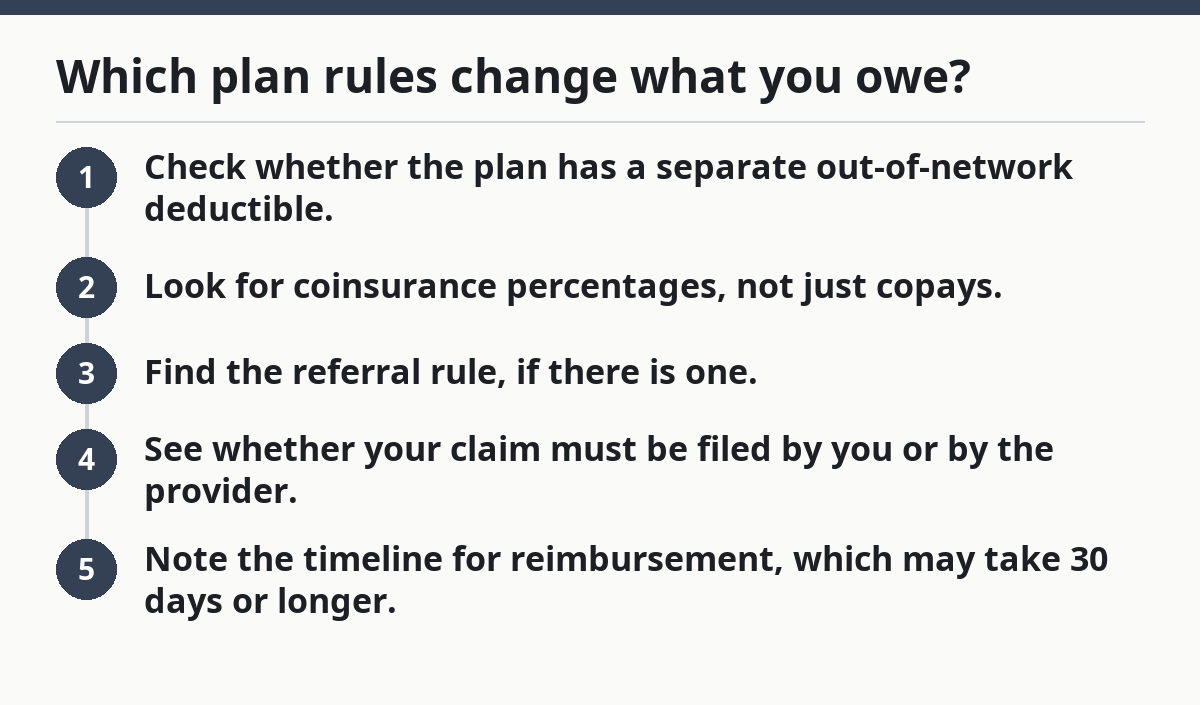
Plan rules decide whether out-of-network care is excluded, partly covered, or paid only after extra steps. A health plan may require a referral, prior approval, or proof that an in-network option was unavailable. Some plans also use separate deductibles and coinsurance for out-of-network services, which makes the math feel like a second policy hiding inside the first.
Picture this: you are trying to book a specialist visit and the office says they are not in the network, but your plan says it has out-of-network benefits. That sounds good until the deductible applies first. You may still owe a large amount before reimbursement starts, and the claim may only pay after a delay of several weeks.
Here is the catch: plan type changes the rulebook. A PPO often gives some room for out-of-network use, while an HMO commonly restricts it unless the situation is an emergency or the plan makes an exception. The exact language in the summary of benefits matters more than the sales pitch.
- Check whether the plan has a separate out-of-network deductible.
- Look for coinsurance percentages, not just copays.
- Find the referral rule, if there is one.
- See whether your claim must be filed by you or by the provider.
- Note the timeline for reimbursement, which may take 30 days or longer.
If you want the basics of choosing a plan in the first place, the hub on how to choose a health insurance plan as a freelancer belongs one level up from this guide.
How to check out-of-network benefits before you book
You should verify out-of-network benefits before the appointment, not after the bill arrives. Start with the plan’s summary of benefits, then call the member services number on the back of the card and ask the same questions in plain language.
Picture this: you are on hold for 12 minutes, but that call can save a $600 mistake. The person on the line may not give perfect legal language, yet you can still collect enough facts to decide whether the visit is worth it. Write down the date, the rep’s name, and the reference number if they give one.
- Ask whether the provider is considered out of network for your exact plan.
- Ask whether out-of-network care is covered at all, or only for emergencies.
- Ask if a referral is required before the visit.
- Ask whether the service needs preapproval and how long approval usually takes.
- Ask how reimbursement works if you pay upfront.
- Ask what document they need, such as an itemized bill or claim form.
The truth is, the answer you need is not “Do you cover this?” It is “What will I owe, when, and to whom?” That is a different question.
Two sources help here: your plan documents, and the plan administrator’s own member-services script. If the two disagree, the written plan terms usually matter more than a phone answer. For broader coverage rules, the Consumer Financial Protection Bureau and the National Association of Insurance Commissioners both publish plain-language consumer material on insurance claims and policy language.
What freelancers should know about out-of-network care before using it in an emergency
Emergency care is often treated differently from a routine visit, and that difference can matter a lot. In a true emergency, coverage rules may change so you are not punished for getting help from the nearest facility. That said, check your plan or ask a professional if you are unsure, because follow-up care after the emergency can still fall back under normal network rules; see CMS and CFPB guidance.
Picture this: you need care fast, there is no time to compare offices, and the nearest ER is not in network. Emergency treatment usually does not follow the same playbook as elective care, but the bill still needs review afterward. The facility, the doctor, and the lab can each send separate claims, which makes the paperwork messy.
The common mistake is assuming the whole episode gets the same protection. It may not. A hospital stay can include an out-of-network anesthesiologist, a separate imaging bill, or a physician group you never chose. That is why the final charge can feel much bigger than the urgent problem that started it.
- Emergency exceptions may protect the initial care.
- Follow-up appointments may not have that protection.
- Ancillary bills can come from different providers.
If you are dealing with a medical emergency, get care first and sort the billing later. For non-emergency care, do not assume an exception will apply just because the office sounded urgent.
Common mistakes that cost freelancers the most
The biggest mistakes are assuming a claim will sort itself out, skipping the network check, and ignoring the fine print on reimbursement timing. Each one can turn a manageable bill into a long, annoying mess.
Picture this: you choose the first available clinician, pay the copay, and think the rest is automatic. Then the claim comes back with a partial payment, a deductible you did not expect, and a balance bill on top. That is a classic out-of-network trap, and it usually starts with one missed question.
- Mistake: booking before checking network status. Cost: surprise full-price billing. Do this instead: confirm the provider’s status with both the office and the plan.
- Mistake: assuming “covered” means “paid in full.” Cost: coinsurance, deductible, and balance billing all stack up. Do this instead: ask for the allowed amount and your share.
- Mistake: forgetting referrals or preapproval. Cost: the plan may deny payment even when the service happened. Do this instead: get permission in writing before the visit if the plan requires it.
- Mistake: throwing away the itemized bill. Cost: you lose the paperwork needed to track reimbursement. Do this instead: save every bill, EOB, and call log for at least one claim cycle.
Most of these errors are preventable with one 10-minute call.
The practical order to follow before you use an out-of-network provider
You should follow a short, fixed order: confirm network status, check referral rules, price the visit, and collect claim paperwork before care happens. That sequence keeps the surprise factor down and gives you a clean record if the bill goes sideways.
Picture this: you have a specialist in mind and the appointment is 3 days away. The clock matters now, because the earlier you ask the right questions, the fewer billing traps you step into. This is the part that turns guesswork into a plan.
- Read the benefits page for out-of-network rules.
- Call the plan and confirm coverage for the exact service.
- Ask the provider for the billing code or a description of the visit.
- Ask for the self-pay price and whether an itemized bill is available.
- Check whether a referral or preapproval is required.
- Save the claim form instructions before the appointment.
- After the visit, compare the bill to the explanation of benefits line by line.
That order matters because claims are easier to challenge when your notes are clean. A missing date, wrong code, or vague phone answer can slow the process by weeks.
For a freelancer, that delay is not abstract. It can mean paying the full bill from business cash, then waiting for repayment later. That is why the question is not just “Will it be covered?” It is “How long can I carry the charge?”
When out-of-network care is a bad fit
Out-of-network care is a bad fit when your cash reserve is thin, your plan has no out-of-network benefits, or the provider refuses to explain the bill upfront. In those cases, the risk is too lopsided for a routine visit.
Picture this: you need care, but you do not have room in the month for a large upfront payment. A provider who bills outside the network may still be the right clinical choice in some cases, yet the money risk can be real and immediate. Freelancers with uneven income feel that squeeze faster than W-2 workers with predictable payroll.
In contrast, when you are making a non-urgent decision and an in-network alternative is available within a reasonable distance or time, out-of-network care is often the harder choice to justify. A 20-minute drive to an in-network office is often easier than a claim fight that lasts 2 billing cycles.
If the office cannot tell you whether a referral, a preapproval, or an itemized bill is needed, treat that as a warning sign. A provider who handles insurance only loosely can make the back end much harder than the front desk sounded.
No care plan is perfect. This one only works when you can carry the billing risk.
When is out-of-network care covered?
Out-of-network care is covered when your health plan has out-of-network benefits, when the service falls under an emergency exception, or when a plan rule or referral allows it. The details depend on the policy language, and some plans cover only a narrow slice of services. Read the summary of benefits and confirm with member services before you go.
What is balance billing?
Balance billing is the amount left after the plan pays its share and the out-of-network provider bills you for the rest. It usually happens when the provider’s charge is higher than the plan’s allowed amount. That leftover bill can be small or very large, so ask about it before the visit.
How do i know if a plan has any out-of-network benefits?
You know a plan has out-of-network benefits if the benefits summary or member handbook lists coverage for out-of-network providers, reimbursement rules, or a separate out-of-network deductible and coinsurance. If the document is unclear, call member services and ask directly whether routine out-of-network care is covered or only emergencies.
Drafted with AI; not yet reviewed by a person.