Choosing and Using Self-Employed Coverage — The Complete Guide

Last updated: November 19, 2026
Quick answer: for many solo workers, the best starting point in Choosing and Using Self-Employed Coverage — The Complete Guide is a marketplace health plan, and the first number to compare is your out-of-pocket maximum, which can be $7,500 or more before you add premiums. The right choice is usually a mix of marketplace health insurance, liability coverage if clients can sue you, and a simple retirement plan you can actually fund.
I write about health coverage, business insurance, and self-employment finance for people who need plain-English decisions, not jargon, and this guide to Choosing and Using Self-Employed Coverage — The Complete Guide keeps the decision order simple.
Key Takeaways
- Start with the risk that can break you: medical bills, client lawsuits, or lost income.
- For most solo workers, the first decision is health insurance; the second is liability; the third is retirement.
- A marketplace plan can be the right answer even if it feels expensive, because tax credits and out-of-pocket caps matter more than the monthly premium alone.
- If your work is advice, design, code, writing, consulting, photography, or other client-facing service work, professional liability coverage deserves serious attention.
- A SEP IRA, Solo 401(k), or SIMPLE IRA changes the game only if your income is stable enough to fund it.
- The wrong setup is usually the one chosen for the premium alone, without checking deductibles, exclusions, and tax effects.
What “self-employed coverage” actually means
Self-employed coverage is not one product. It is a stack of protections that covers different risks, and the right stack depends on whether you are protecting your health, your business, or your retirement.
For a solo freelancer or independent contractor, the common pieces are:
- health insurance, often through the ACA Marketplace or, in some states, directly from an insurer;
- dental and vision, if the medical plan does not include them;
- general liability or professional liability if clients, venues, or contracts require it;
- workers’ compensation only in specific situations, such as hiring employees or state rules that pull you in;
- retirement coverage, meaning a tax-advantaged account such as a SEP IRA or Solo 401(k);
- disability insurance if your income stops when you cannot work.
The biggest beginner mistake is treating all of this as one shopping decision, so it helps to consult a professional if your taxes, benefits, or contract terms are complicated. If you tie the health plan badly, a low premium can hide a $7,500 deductible or worse. If you skip liability coverage, one client dispute can cost far more than a year of premiums. If you ignore retirement, self-employment tax can chew through the money you meant to save.
For health coverage, the official starting point in the U.S. is the HealthCare.gov marketplace or your state exchange, depending on where you live. For retirement rules, the IRS pages on SEP IRAs and Solo 401(k)s are the cleanest starting references. The right order is usually health first, then liability, then retirement — unless a contract requires insurance before you start work.
Which kind of coverage should you choose first?
The first coverage to choose is the one that protects the risk most likely to destroy your cash flow in the next 12 months. For many self-employed people, that is health insurance; for others, it is professional liability or disability coverage.
If you are uninsured or underinsured, start with medical coverage. A marketplace plan can qualify for premium tax credits, and those subsidies can matter more than the sticker price. The trade-off is that bronze and silver plans can come with higher deductibles and narrower provider networks, so the monthly bill is not the whole story. A lower premium can be a bad deal if you see specialists often or take expensive prescriptions.
If your work creates advice, deliverables, or creative output, liability coverage deserves the next look. General liability protects against bodily injury or property damage claims tied to your work or business operations. Professional liability, often called errors and omissions, is the one that matters if a client says your advice, design, code, copy, or strategy caused a loss. A marketing consultant with a typo may not need the same policy as a contractor with tools on site, but both can be exposed in different ways.
If you are healthy, have cash reserves, and already have a family plan through a spouse, retirement coverage may move up the list. A Solo 401(k) or SEP IRA can be powerful because it lets you save with tax advantages, but only if you can fund it consistently. A retirement account is not a substitute for health insurance, and it is not a substitute for liability coverage.
The best first purchase is usually the one that solves the highest-cost problem in your actual life. The wrong move is buying dental add-ons or a flashy retirement account while remaining exposed to a $20,000 medical event or a contract dispute. That is backward risk management.
How do marketplace plans compare with private plans?
Marketplace plans usually win for self-employed people who want subsidy eligibility, standardized plan tiers, and a clear comparison path. Private plans can win if you need a particular network, specific underwriting structure, or a plan that better fits your doctors and prescriptions.
Here is the real difference: the ACA marketplace is built around standardized metal tiers — Bronze, Silver, Gold, and Platinum — plus income-based subsidies for people who qualify. That standardization makes comparison easier. Private off-exchange plans can sometimes look cleaner or offer a preferred network, but they do not come with the same subsidy structure. For many self-employed buyers, that subsidy difference is the whole ballgame.
The marketplace also gives you a formal enrollment path. If you have a qualifying life event or a limited special enrollment period, that process is clearer than trying to piece together coverage on your own. The downside is that plan choice can still be messy. Network size, medication formularies, referral rules, and out-of-pocket exposure vary a lot by insurer and county.
A marketplace plan is the better fit if you:
- want possible premium tax credits;
- need a legal, structured comparison by plan tier;
- care more about financial protection than ultra-flexible plan design;
- can live with the network and formulary that come with the plan.
A private plan can make more sense if you:
- are locked into a doctor or hospital system that the marketplace options do not cover well;
- want a broader menu of off-exchange products;
- are not eligible for subsidies and the off-exchange network is clearly better for your needs.
The drawback of private coverage is simple: it can look customizable while quietly shifting more cost onto you later. A plan with a lower premium but a thin network and expensive out-of-pocket rules is not a bargain. Before choosing, check the summary of benefits and coverage, the provider directory, and prescription formulary. Those three documents matter more than the ad copy.
What about deductibles, copays, and out-of-pocket maximums?
The out-of-pocket maximum is the number that keeps a bad year from becoming an unmanageable one, and it matters more than the premium for people who may actually use care. The deductible and copay structure then decides how painful routine care feels before that ceiling is reached.
A deductible is what you pay before most plan benefits begin. A copay is the fixed amount you pay for a visit or prescription. The out-of-pocket maximum is the ceiling on your spending for covered in-network services in a plan year. On many marketplace plans, that ceiling is the difference between “expensive but survivable” and “financial wreckage.”
This is where generic advice falls apart. A plan with a $350 monthly premium can be a poor choice if it has a high deductible, high specialist copays, and a narrow network. A plan with a higher monthly premium can be smarter if you know you will need ongoing treatment, imaging, therapy, or prescription coverage, but it is wise to consult a professional if you are comparing benefits with a chronic condition. The right answer depends on expected use, not just income.
A self-employed person should compare three numbers side by side:
- monthly premium;
- deductible;
- out-of-pocket maximum.
Then check:
- whether your main doctor is in network;
- whether your prescription is on the formulary;
- whether specialist visits count before or after the deductible;
- whether the plan uses a referral gatekeeper.
If you are healthy and mainly want protection against catastrophe, a higher deductible may be acceptable. If you have a chronic condition, expect pregnancy care, or need recurring specialist visits, the cheaper premium can become false economy. The best plan is often the one that fits your likely year, not the average year in a brochure.
Should a self-employed person buy liability insurance?
Yes, if your work can cause a client loss, a personal injury claim, or damage to someone else’s property, liability insurance is worth serious attention. The exact policy depends on what you do.
General liability usually handles third-party bodily injury and property damage. Professional liability covers mistakes, omissions, negligence claims, and alleged failure to deliver promised professional work. Those are different tools. A photographer with expensive gear at events may need general liability and equipment coverage. A software consultant, bookkeeper, therapist, architect, or designer may care much more about professional liability.
The strongest reason to buy liability coverage is not that a lawsuit is likely every month. It is that the claim cost can be larger than your savings. A contract dispute, alleged missed deadline, data issue, or client accusation can trigger legal fees long before anyone settles anything. That is why many clients ask for proof of coverage before they sign.
The downside is that liability coverage can feel unnecessary until a contract demands it. It also does not cover everything. Policies usually exclude intentional acts, many employment claims, and some specialized risks unless you buy specific endorsements. Read the exclusions before you assume protection exists.
This is not for everyone. If you do side work that never enters a client relationship, never touches client property, and never involves advice or deliverables, you may not need the same liability stack as a full-time consultant. But once you sign contracts, take deposits, or work on-site, the risk profile changes fast. The question is not “Do I feel risky?” The question is “Could my work create a claim?” If the answer is yes, get quotes.
How do retirement options work when you are self-employed?
A Solo 401(k) is often the most flexible retirement choice for one-person businesses, while a SEP IRA is simpler to open and a SIMPLE IRA can work well if you have employees or want an easier administration path. The right one depends on income, payroll structure, and how much you want to save.
The Solo 401(k) is designed for a self-employed person with no full-time employees other than a spouse, in most common setups. It can let you contribute as both employee and employer, subject to IRS rules. That makes it attractive when income is strong and you want higher contribution potential. The trade-off is more administration, especially once balances and reporting requirements grow.
A SEP IRA is simpler. It is easy to understand, easier to set up than a Solo 401(k), and a practical fit for variable income. The trade-off is flexibility: contributions are made by the business, and the structure can be less powerful for some owners than a Solo 401(k). If your income swings wildly, that simplicity can be a virtue.
A SIMPLE IRA can make sense if you have employees and want a plan that is still relatively straightforward. The downside is that employer contributions and employee treatment rules matter more, so it is wise to consult a tax professional before assuming it is the cleanest fit for a solo operator who wants maximum control.
Retirement coverage is where many self-employed people overthink the details and underfund the account. If your income is uneven, a plan that you can use consistently beats a more complex plan you never fund. The IRS has the core rules for these accounts, and a tax professional can help if self-employment tax, business structure, or employee status complicates the picture.
For direct references, the IRS pages on SEP IRAs and retirement plans for small businesses are the right starting points.
The honest side-by-side
Here is the practical comparison if you are deciding between the most common self-employed coverage paths.
| Criteria | Marketplace health plan | Private/off-exchange health plan | Winner for this condition |
|---|---|---|---|
| Subsidy eligibility | Potential premium tax credits if you qualify | Usually no marketplace subsidy | Marketplace plan if income qualifies |
| Plan standardization | Metal tiers and standardized comparisons | More variation by carrier and product | Marketplace plan for easy comparison |
| Doctor/network fit | Depends on county and insurer | Can sometimes offer a better fit | Private plan if one network is clearly better |
| Prescription coverage | Formularies vary, but easy to compare | Also varies, sometimes broader | Tie until you check your meds |
| Out-of-pocket clarity | Summary of benefits is standardized | Can be harder to compare across carriers | Marketplace plan |
| Shopping complexity | Moderate, but structured | Can be more confusing and fragmented | Marketplace plan |
| Suitability for chronic care | Depends on tier and network | Depends on plan design | The plan with the better network and drug coverage |
| Best use case | People who want subsidy access and comparison | People who need a specific doctor or product | Depends on provider access |
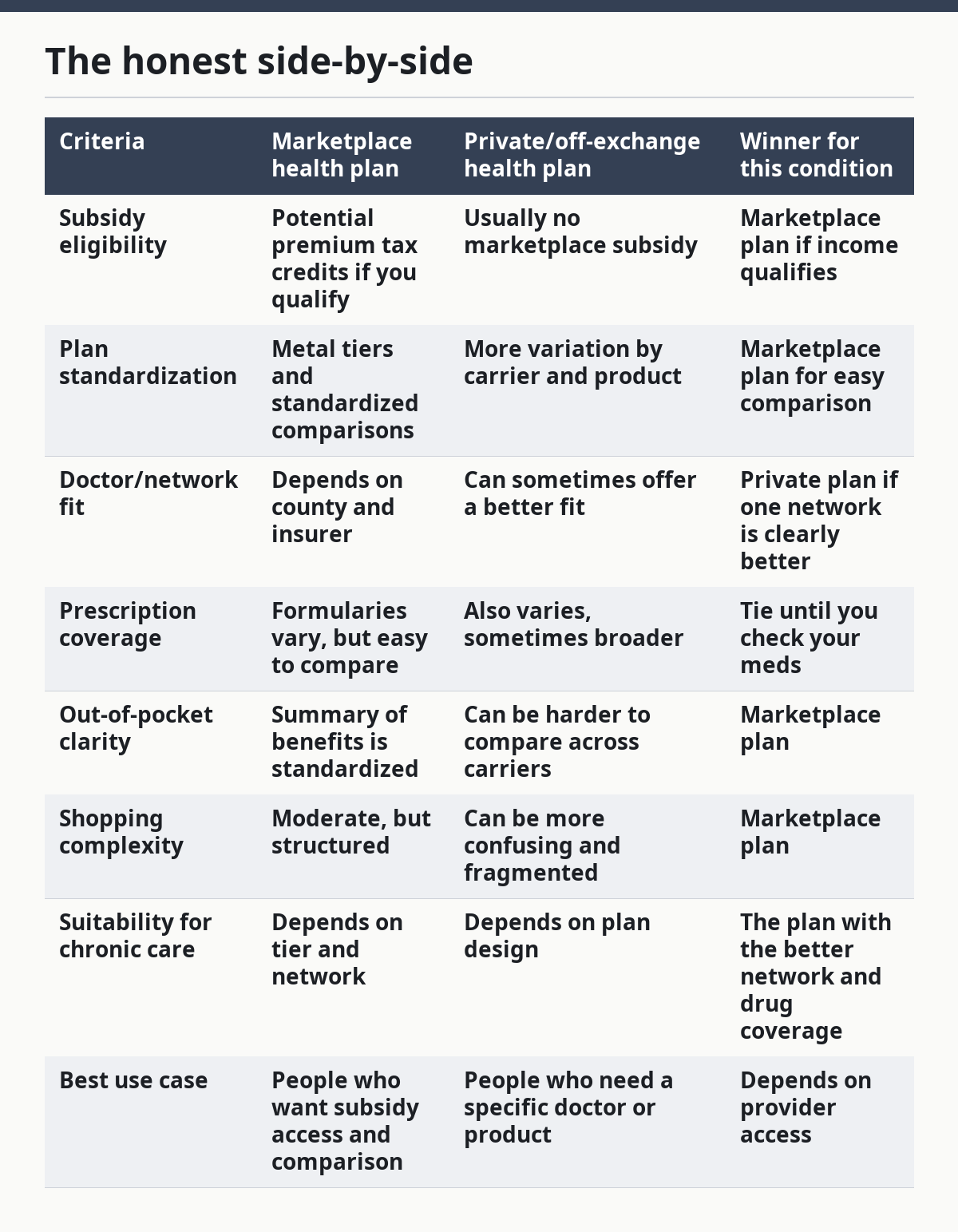
The table is not a verdict by itself. It is a map. If subsidy access matters, the marketplace wins on structure alone. If your current doctor is out of network on every exchange option and in network on one off-exchange plan, the private plan wins despite weaker standardization. The most common mistake is assuming every “private” plan is better because it feels less bureaucratic. Sometimes it is; often it is not.
When does liability coverage beat health coverage in priority?
Liability coverage beats health coverage first only when you already have medical coverage through a spouse, a group plan, or another source and your business exposure is immediate. That is a narrow but real situation.
If you are a consultant with signed contracts, carry client data, or make decisions that can cause measurable financial harm, professional liability can move to the top of the list. The same is true if your contracts require proof of insurance before work starts. A solo designer might need a certificate to land a project even if health insurance is already in place. In that case, waiting to buy liability coverage can cost the job itself.
This priority flip also happens when you work in physical spaces. An event photographer, contractor, or mobile service provider may need general liability quickly because a venue, landlord, or customer may ask for it before access is granted. If the policy is missing, the work stops.
The drawback is that liability coverage does nothing for your own medical bills. That is why this exception only makes sense if health coverage is already handled. If not, the first major illness can overwhelm a solo business faster than a client claim.
A practical rule: if your personal medical exposure is covered and your work creates contractual exposure, buy the liability policy first. If not, start with health. That is the cleanest decision line.
When should you reconsider the whole setup?
You should reconsider the whole setup when your income, family status, work type, or location changes enough that the old policy no longer matches the risk.
The biggest triggers are:
- crossing the income line that changes subsidy eligibility;
- moving to a new state with a different marketplace or insurance network;
- adding a spouse or child to the household;
- taking on employees or changing contractor status;
- signing larger client contracts with insurance requirements;
- developing a chronic condition that changes how often you use care.
A setup that made sense at $45,000 of annual freelance income may not work as well at $110,000, especially if your taxes, subsidy eligibility, or premium level changes. The same is true if your work shifts from low-risk writing or coding into higher-stakes advisory work. One year you may need a basic silver marketplace plan and no liability policy. The next year you may need a better network, stronger out-of-pocket protection, and errors-and-omissions coverage with a contract rider.
The biggest warning sign is a plan that no longer matches your calendar. If you are skipping care because the deductible is too high, the plan is too lean. If you are paying for rich coverage you never use and cannot afford retirement contributions, the plan is too heavy. If you are carrying a retirement account but no basic protection against medical or legal costs, the order is wrong.
Recheck the entire stack during open enrollment, after a tax year with unusual income, and whenever your work adds a new type of risk. Coverage is not something to set once and forget.
The verdict: which coverage to choose and why
Choose a marketplace health plan if you need subsidy eligibility, a structured comparison, and a clear out-of-pocket cap. Choose a private/off-exchange plan if your doctors, prescriptions, or network needs are clearly better there and you do not need marketplace tax credits. Neither if you are buying on premium alone while ignoring deductibles, exclusions, or the fact that you still have no liability coverage for your business.
That is the clean answer for most self-employed people. The marketplace wins for most buyers because it is easier to compare and can be financially better once tax credits enter the picture. A private plan only wins when the network fit is real and measurable, not just implied by a sales pitch.
If your business exposes you to client claims, add liability coverage before you treat retirement as the priority. If your medical coverage is unstable or missing, fix that first. If your retirement plan is the only thing you can fund this year, keep it simple and choose the account structure you can actually maintain.
The wrong choice is the one that looks cheapest this month and expensive everywhere else.
What should I buy first if I am just starting out?
Start with health insurance unless you already have it through a spouse, another job, or a group plan. If that is covered, then buy liability insurance if clients can sue you or require proof of coverage. After that, put retirement into the mix through a SEP IRA or Solo 401(k) if your cash flow can handle it.
Is the cheapest plan usually the best plan?
No, the cheapest plan is often the most expensive once you use it. A low monthly premium can hide a high deductible, a narrow network, and expensive specialist care. The better comparison is total likely cost: premium plus expected copays plus deductible exposure.
Do I need liability insurance if I work from home?
Often yes, if your work involves advice, deliverables, client data, or contracts. Working from home does not remove professional risk, and it does not stop a client from making a claim. If your work never creates third-party exposure, you may not need it, but many solo businesses do.
Can I change coverage in the middle of the year?
Sometimes yes, but it depends on the type of coverage and whether you have a qualifying life event. Marketplace health plans have special enrollment rules, while liability and retirement changes depend on the policy or account rules. If your income or household changed, check the enrollment window and the IRS rules before assuming you must wait.
Which retirement account is best for a self-employed person?
A Solo 401(k) is often the strongest fit for one-person businesses that want flexibility and the potential for higher contributions, while a SEP IRA is simpler to start and maintain. The better choice depends on your income pattern, whether you have employees, and how much administration you want to manage. If the rules are unclear, a tax professional can help.
Drafted with AI; not yet reviewed by a person.