How freelancers choose ACA marketplace plans, private plans

Last updated: November 19, 2026
Quick Answer: for most freelancers, ACA marketplace plans are the best first place to look, private plans are the next option if the exchange is a poor fit, and short-term coverage is only for a brief gap. Freelancers choosing between ACA marketplace plans, private plans, and short-term coverage usually need to think about eligibility, renewal rules, and how long the coverage has to last. I’ll settle which one fits which kind of freelancer.
Key Takeaways
- ACA marketplace plans are usually the strongest default for freelancers, especially if subsidies may help.
- ACA marketplace plans are built for ongoing coverage, not just a brief gap.
- Private health plans are a direct off-exchange option for shoppers who do not want marketplace routing.
- Short-term coverage is a temporary bridge only; it is not meant to replace a full health plan.
Our Top 3 Picks at a Glance
- #1 Best Overall: ACA marketplace plans — best for freelancers who want year-round coverage and may qualify for premium help.
- #2 Best Budget Pick: Short-term coverage — best for a gap between jobs, if you accept weaker protection and limited renewal rules.
- #3 Best Heavy-Duty / Upgrade Pick: Private health plans — best for freelancers who are over the ACA income rules and want more plan choice through a carrier or broker.
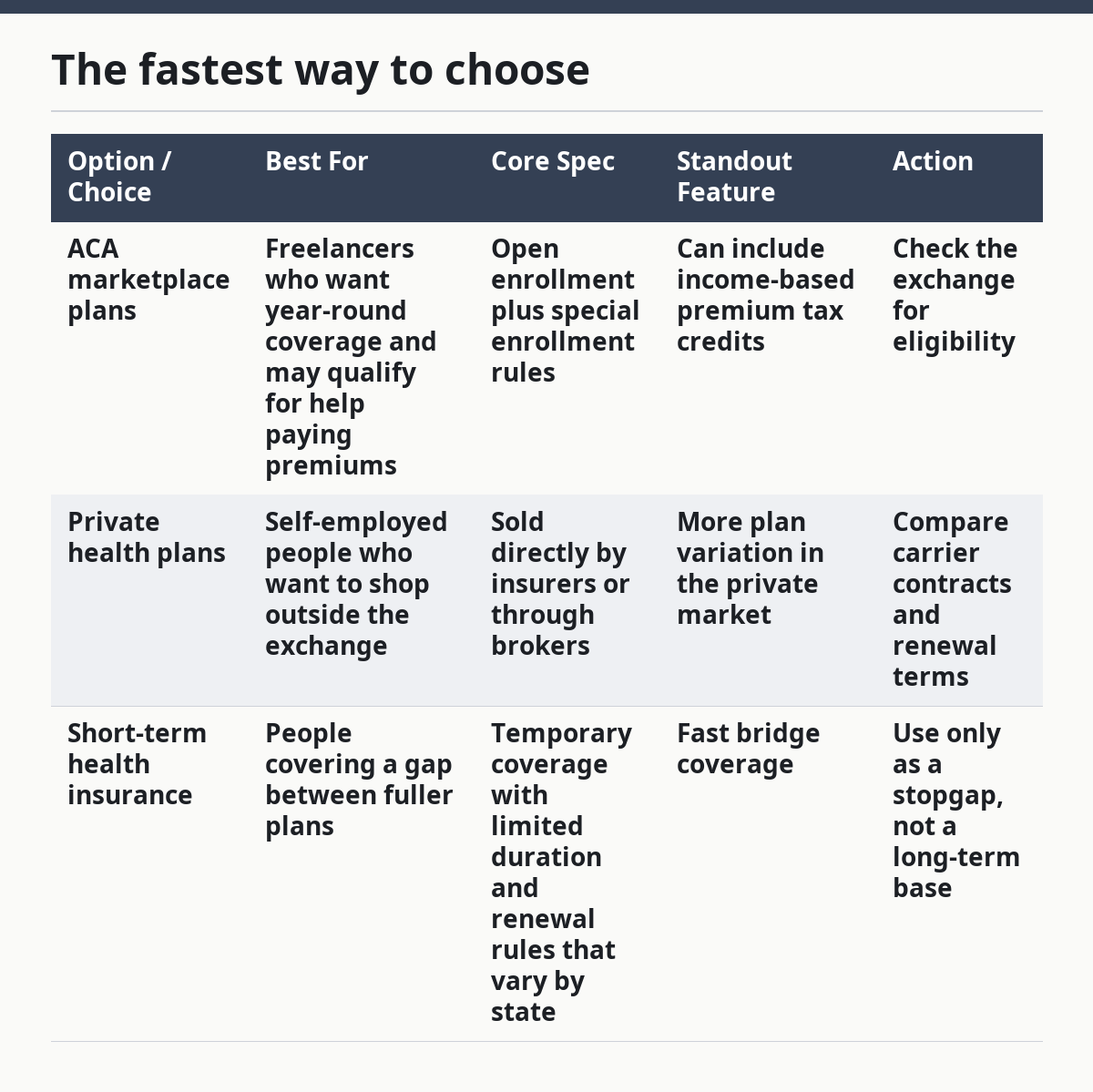
The fastest way to choose
Freelancers usually do best with ACA marketplace coverage unless they have a very short gap to cover or they’ve been priced out of the marketplace and want a private contract instead. That’s the cleanest reading of the three options.
The real choice is not “Which plan sounds nicer?” It’s how long you need coverage, whether you need guaranteed renewal, and whether you qualify for subsidies on HealthCare.gov or a state exchange. Short-term coverage is the outlier because it is built for temporary gaps, not long-term stability. More on that below.
| Option / Choice | Best For | Core Spec | Standout Feature | Action |
|---|---|---|---|---|
| ACA marketplace plans | Freelancers who want year-round coverage and may qualify for help paying premiums | Open enrollment plus special enrollment rules | Can include income-based premium tax credits | Check the exchange for eligibility |
| Private health plans | Self-employed people who want to shop outside the exchange | Sold directly by insurers or through brokers | More plan variation in the private market | Compare carrier contracts and renewal terms |
| Short-term health insurance | People covering a gap between fuller plans | Temporary coverage with limited duration and renewal rules that vary by state | Fast bridge coverage | Use only as a stopgap, not a long-term base |
The truth is, most freelancers should start with the ACA exchange and only move away from it if they have a clear reason. A private plan can still be the right answer, but it should beat the marketplace on fit — not just on marketing.
ACA marketplace plans are the default choice for most freelancers
Since freelancers often need coverage that won’t disappear when a contract ends, ACA marketplace plans win here because they’re designed for ongoing coverage, not just a temporary patch.
They also give you a path to income-based savings if you qualify, which is the feature that makes the marketplace matter to freelancers more than to many W-2 workers. The government exchange at HealthCare.gov explains plan categories and enrollment rules, and state marketplaces follow the same basic structure even when the site looks different. For 2024, the federal marketplace counted about 21 million enrollees, according to HHS.
Here’s the catch: ACA plans usually make you work inside the exchange calendar unless you qualify for a special enrollment period. That can feel restrictive if you need to switch quickly. Still, the upside is stability. You’re buying a real health plan for the long haul, not a temporary fix with a hard stop.
Who should lean this way:
- Freelancers with uneven income
- People who want help paying premiums if eligible
- Anyone who wants a plan built for year-round use
- People who want a clear path to renewal and standardized coverage rules
Who should skip it:
- Freelancers who need only a short bridge for a few weeks
- People who know they won’t qualify for exchange enrollment without a special event
- Anyone who wants the broadest private-market shopping outside exchange timing
The ACA route is usually wrong for someone who only wants a stopgap. It’s also the better fit for a freelancer whose income changes enough that subsidy eligibility matters from year to year. That’s the real reason it usually wins.
Private health plans can fit freelancers who want more room to shop
Since the marketplace is not always the right fit, private health plans can work for freelancers who want more room to shop. Picture this: you make too much for meaningful exchange help, you dislike the plans on the marketplace, and you want to shop through an insurer or broker instead. Private health plans win here when you’re looking for a direct purchase outside the exchange structure.
Private plans are real health insurance, but they live outside the ACA marketplace shopping flow. You might buy them directly from a carrier or through a broker, and the draw is often more choice in how the plan is sold. The downside is that the private market does not automatically mean better coverage. It just means different routing.
The main weakness is simple: you can lose the marketplace’s built-in subsidy path. That matters a lot if your freelance income dips. Private plans can also have more variation in contract terms, which means the fine print matters more than the sales pitch. If the plan is being pitched as “better” but nobody can explain renewal terms in plain English, keep walking.
Private plans fit best for:
- Freelancers who are not getting useful subsidy help
- People who want to shop more broadly than the exchange allows
- Self-employed workers who prefer carrier-direct sales or broker help
- Anyone who has a specific insurance relationship already in place
Private plans are a poor fit for:
- Freelancers who rely on exchange premium tax credits
- People who need a quick short-term fix
- Anyone who wants the simplest enrollment path
A private plan can still be a sound choice if you understand exactly what it gives up. It is not automatically superior. It is better only when the broader private market offers a more useful match than the exchange does.
Short-term coverage is only for a narrow gap
Since the last paragraph focused on longer-run coverage, short-term coverage is the temporary exception. Picture this: your last job’s coverage ended, the next contract starts in six weeks, and you need something to hold you over. Short-term coverage wins only in that gap scenario because it is temporary by design and not meant to behave like a normal long-term health plan.
That temporary nature is the whole point. Short-term policies are meant to bridge time, not solve the whole insurance problem. They can be useful if you need a fast answer and understand that the plan’s renewal rules and coverage length can be limited and state-dependent. The National Association of Insurance Commissioners has a helpful consumer explainer on short-term health insurance, and state insurance departments often spell out local limits more clearly than the sales page does.
Here’s the catch: short-term coverage is the easiest option to regret later. If you develop a health issue while on it, you may discover the plan was never built to carry you through a longer stretch. That is why I do not treat it as a substitute for ACA coverage without checking the rules for your state and talking to a licensed insurance professional. The NAIC consumer guide is a good place to start.
Short-term coverage makes sense when:
- You need a bridge between two fuller plans
- You missed an enrollment window and need temporary protection
- You expect to move to ACA or private coverage soon
Short-term coverage is a bad idea when:
- You need a long-term home for your insurance
- Your income is unstable and you may need subsidy help
- You want the same kind of renewal stability you’d expect from an ACA plan
The truth is, short-term coverage is the least forgiving of the three. It can solve a timing problem. It does not solve a life problem.
The honest side-by-side for freelancers
Since the three paths can sound similar on a sales page, the side-by-side matters. Picture this: you’re comparing three paths on a laptop screen and every sales page sounds fine until you ask the hard questions. ACA marketplace plans win on stability, private plans win on shopping flexibility, and short-term coverage wins on temporary timing only.
That is the cleanest way to see them. If you want the most dependable long-term answer, the marketplace usually comes first. If the exchange no longer fits your situation, a private plan can be the better route. If you need a bridge for a short gap, short-term coverage is the stopgap — not the destination.
| Criteria | ACA marketplace plans | Private health plans | Winner for [condition] |
|---|---|---|---|
| Enrollment timing | Tied to open enrollment or special enrollment | Often sold outside the exchange structure | Private plans if timing is the issue |
| Subsidy access | May include premium tax credits | Usually no marketplace subsidy route | ACA for lower taxable income |
| Coverage duration | Built for ongoing coverage | Built for ongoing coverage | ACA for long-term use |
| Renewal predictability | More standardized rules | Varies by insurer and contract | ACA for stability |
| Temporary-gap use | Not the point of the product | Not the point of the product | Neither |
| Ease of replacement | Can be replaced at next enrollment window | Can be replaced through carrier shopping | Private if you want more off-exchange shopping |
| Fit for irregular income | Stronger fit if subsidy rules help | Depends on the carrier and price | ACA for variable income |
| Bridge between jobs | Possible, but not ideal | Possible, but not ideal | Short-term for a brief gap |
| Risk of ending up uninsured | Lower when enrolled properly | Lower when enrolled properly | ACA and private tie |
| Best use case | Year-round freelancer coverage | Off-exchange shopping preference | ACA for most freelancers |
If you want one sentence that decides it: Choose ACA marketplace coverage if you need a year-round health plan and may qualify for financial help. Choose private coverage if you want to shop outside the exchange and do not need the marketplace subsidy path. Neither if you only need coverage for a few weeks and haven’t checked your next enrollment option.
That call is blunt for a reason. Freelancers lose money when they buy the wrong kind of coverage for the wrong time horizon.
When the choice flips
Since the usual answer is not universal, one detail can change the outcome. Picture this: you thought the answer was obvious, then one detail changes and the best option changes with it. The verdict flips when timing, subsidy eligibility, or state rules change the value of each plan type.
A few cases can override the usual recommendation:
-
You qualify for meaningful marketplace help.
ACA plans usually move ahead fast because the subsidy can change the real cost of staying insured. -
You missed enrollment but need a short bridge.
Short-term coverage can make sense here, but only if you treat it as temporary and you understand the renewal limits. -
You’re no longer a good marketplace fit.
If your income or situation makes exchange coverage a poor match, a private plan can become the better long-term route. -
Your state limits short-term coverage heavily.
State rules can shrink the usefulness of that option, which pushes the choice back toward ACA or private coverage.
The value of these exceptions is that you don’t have to treat every year the same. Freelance income changes, and so can the best health plan choice. That is normal.
What a freelancer should do next
Since the decision comes down to timing and fit, the next step should be simple. Picture this: you’ve narrowed it to one of the three and still want a clean next step. Start with ACA, check private only if the exchange is a bad fit, and use short-term coverage only as a bridge.
That sequence is efficient because it matches how the options work. First, check whether the marketplace gives you a usable plan and any help with premiums. Then look at private health plans if you want off-exchange shopping or your situation points that way. Only reach for short-term coverage if the calendar is the problem and the gap is short.
One practical note: if you need a broader overview of the coverage landscape, the main hub on what health insurance options freelancers have is the right place to start. This page is about choosing between the three routes, not rehashing every insurance type under the sun.
The core question is not which option sounds best in a vacuum. It is which option can hold up through a freelance year that may change from month to month. ACA usually does that best. Private plans can do it too, but they need a closer look. Short-term coverage only does one job, and it does that job briefly.
Which health plan type is best for a freelancer?
ACA marketplace plans are the best default for most freelancers. They usually offer the strongest mix of long-term coverage and possible premium help if you qualify. Private plans can be better when exchange coverage is a poor fit, while short-term coverage should stay in the “temporary bridge” category.
When does short-term coverage make sense?
Short-term coverage makes sense when you need a brief stopgap. It can fill a gap between jobs or between fuller plans, especially if you need something quickly. It is not a good long-term base because it is built for temporary use and has weaker renewal stability than a normal health plan.
What is the main difference between ACA and private coverage?
The main difference is access and structure. ACA marketplace plans run through the exchange system and may include premium tax credits, while private plans are sold outside that marketplace channel. For a freelancer, that usually means the ACA route is better for subsidy access, while private coverage is better when you want to shop off-exchange.
Drafted with AI; not yet reviewed by a person.