
Last updated: November 19, 2026
Key Takeaways
- Marketplace coverage is the safer default when savings might matter.
- The Marketplace often fits best when income is uneven, uncertain, or low enough for subsidy checks.
- Marketplace coverage helps freelancers compare plans and check subsidies when income may change.
- Off-Marketplace coverage fits best when subsidies are settled and a direct search is faster.
If you’re a freelancer trying to answer the question “How do freelancers know if they should use the Marketplace or off-Marketplace coverage?”, the short answer is this: use the Marketplace when you might qualify for savings and want comparison help; use off-Marketplace coverage when you already know the plan you want and your income makes subsidies unlikely. In 2026, a broker can help with either path, but the right channel depends on whether subsidy eligibility is part of the decision.
For freelancers, this is not really a “which insurance is better” question. It is a “where should I shop” question, and the channel can change both the plans you see and whether premium tax credits are in play. For background on the broader shopping landscape, see the hub on freelance Marketplace coverage. For federal guidance, the HealthCare.gov Marketplace page and the IRS premium tax credit rules are the key references.
The real difference between Marketplace and off-Marketplace coverage

Marketplace coverage wins when the possibility of savings matters. Off-Marketplace coverage wins when you are shopping for a plan on its own terms and subsidies are not driving the choice.
The Marketplace is the exchange where health plans are organized for comparison and where subsidy screening happens. Off-Marketplace coverage means buying a health plan directly from an insurer or through a broker outside the exchange. The same insurer may sell similar plan types in both places, but the shopping rules are different.
That difference matters because freelancers rarely have a simple salary picture. Your yearly income can move, your household size can affect eligibility, and one estimate can change what the Marketplace shows you. Off-Marketplace plans do not run through that same subsidy gate. That makes them simpler on one axis and less useful on another.
Here is the cleanest way to think about it: if you want every path to financial help checked first, start on the Marketplace. If you are sure you will not qualify for subsidies, or you already care more about a specific off-exchange plan than about comparing assistance, off-Marketplace can be the faster route.
A broker can sit in the middle of this decision and help compare both channels. That is especially useful if you know you need individual coverage but do not want to decode metal tiers, networks, or formularies by yourself. The broker does not remove the trade-off; the broker just makes the trade-off legible.
Which channel usually fits a freelancer best?
The Marketplace usually fits best when your income is uneven, uncertain, or low enough that subsidy eligibility could matter. That is the channel to check first if you are self-employed and do not want to miss financial assistance because you shopped in the wrong place.
Why? Because the Marketplace is the place where subsidy screening happens. If you shop off-Marketplace first, you are effectively assuming that savings do not matter or that you already know enough to rule them out. That is a risky assumption for freelancers, whose income often changes across the year. Even if your earnings end up too high for help, the Marketplace gives you a clean way to confirm that.
Off-Marketplace coverage fits better when the subsidy question is already settled. Maybe you know your income is too high for premium tax credits. Maybe you want a plan an insurer sells directly and you are comparing provider networks, prescription coverage, or referral rules rather than assistance. In that case, buying off-exchange can be a direct, less bureaucratic route.
The catch is simple: off-Marketplace shopping can hide the most valuable question too early. A plan may look good on premium alone and still be the wrong choice if a Marketplace version would have made subsidies possible. That is why the “I’ll just compare plans myself” approach can cost freelancers real money, even if the plan details look familiar.
One practical rule holds up well: if you have not checked whether your income estimate could open the door to savings, start with the Marketplace. If you have already ruled that out, off-Marketplace becomes a valid shortcut rather than a blind spot. For people who want a broker’s help, the broker should be able to show both channels before anyone commits.
Marketplace coverage: who should actually use it

Marketplace coverage wins for freelancers who need a subsidy check, want a broad comparison starting point, or expect their income to move during the year. It is also the safer default if you are buying coverage for the first time and do not want to miss a benefit just because you skipped a channel.
The biggest strength is process, not glamour. The Marketplace forces the financial question onto the table before you get lost in plan names. That is valuable if you are a sole proprietor, a contractor with irregular invoices, or someone whose annual income will not be obvious on January 1. A single estimate may not be perfect, but it is still better than ignoring the subsidy question entirely.
Another strength is comparison. The Marketplace is built for side-by-side shopping. That matters when a freelancer needs to compare networks, deductibles, and out-of-pocket structures without bouncing between insurer websites. It is easier to spot when one plan is cheaper only because it cuts the doctor network down to size.
The weakness is that the Marketplace can feel slower and more constrained. Not every off-exchange option will be sitting there, and some people do not want the extra income-estimate step. If your finances are clear and subsidies are off the table, the Marketplace can feel like a detour. It may also be less appealing if you already have a broker and want a very specific insurer or plan design outside the exchange.
This channel is wrong for one kind of shopper: the freelancer who has already determined that subsidies are irrelevant and only wants a direct purchase experience. That person may still need a broker, but the broker does not have to start on the Marketplace. For everyone else, especially anyone whose 2026 income estimate is still moving, the Marketplace is the better first stop.
For authoritative background on the public exchange structure, the Centers for Medicare & Medicaid Services explains Marketplace coverage options on HealthCare.gov, and the Internal Revenue Service has the rules that govern premium tax credits. See also the Kaiser Family Foundation for broader context on marketplace enrollment and subsidies.
Off-Marketplace plans: the specific situations where they win
Off-Marketplace coverage wins when you want to buy outside the exchange because the subsidy question is already settled and a direct plan or broker-led search is more efficient.
Its main advantage is choice of route. Some freelancers prefer to work directly with an insurer or through a broker who can shop off-exchange plans without the Marketplace workflow. That can be attractive if you are comparing a few plans with the same network or want to follow a doctor or facility relationship that already points you toward a specific carrier.
Off-exchange shopping can also make sense when you are not chasing subsidies and you want to stay focused on plan features rather than eligibility screens. For a freelancer with a stable, high enough income and a clear preference for a particular insurer, that is a practical advantage. The conversation stays about premiums, deductibles, copays, referrals, and network access.
The weakness is the one that matters most: off-Marketplace shopping does not give you the same built-in subsidy check. If there is even a decent chance that your income estimate would qualify you for help, skipping the Marketplace can be an expensive mistake. You might also lose the clean side-by-side structure that helps expose trade-offs between a lower premium and a narrower network.
Off-Marketplace is not the right choice for a freelancer who is unsure about income, has volatile earnings, or is comparing plans for the first time and wants the system to surface savings automatically. It is also a weaker fit if you want the simplest way to verify whether you are leaving money on the table.
This channel is for the freelancer who says, in effect, “I know what I need, I do not need subsidy screening to drive the decision, and I want to shop directly.” If that is not you, start elsewhere.
The honest side-by-side
The Marketplace wins on subsidy visibility and structured comparison; off-Marketplace wins on directness and, sometimes, access to the exact plan search you want.
| Criteria | Marketplace | Off-Marketplace | Winner for this condition |
|---|---|---|---|
| Subsidy screening | Built into the shopping flow | Not built into the exchange flow | Marketplace, if savings could matter |
| Best for irregular freelancer income | Strong fit | Weaker fit | Marketplace, if income changes year to year |
| Direct buying experience | More steps | Fewer steps | Off-Marketplace, if you already ruled out subsidies |
| Side-by-side comparison | Designed for it | Depends on insurer or broker | Marketplace, for first-time shoppers |
| Broker help | Common and useful | Common and useful | Tie, if the broker can show both paths |
| Plan availability | Exchange-listed plans only | May include off-exchange options | Off-Marketplace, if a specific carrier matters |
| Risk of missing financial help | Lower | Higher | Marketplace |
| Shopping speed | Often slower | Often faster | Off-Marketplace |
| Best first stop for a freelancer | Usually yes | Only in narrow cases | Marketplace |
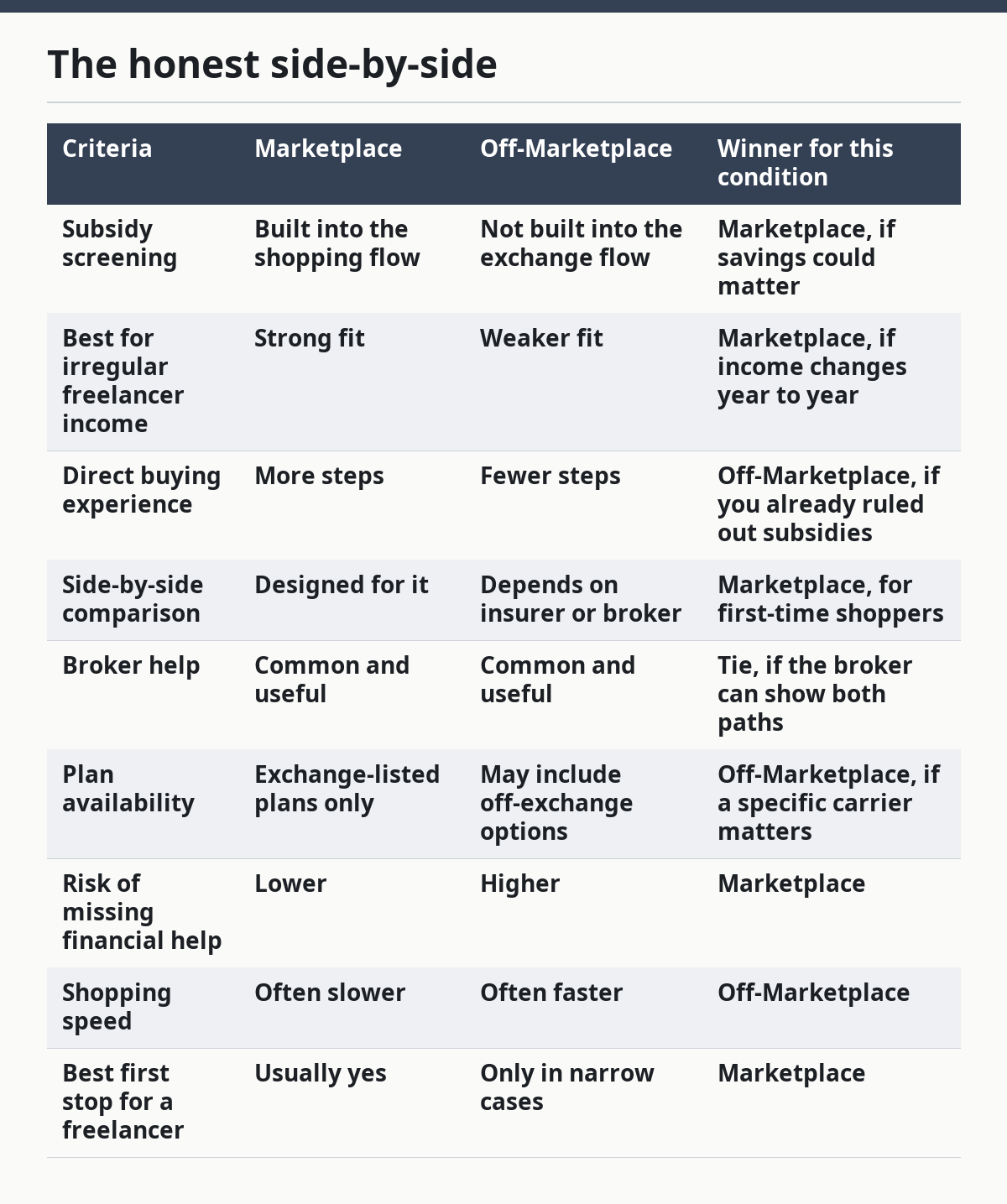
The table points to the same conclusion the long answer does: if subsidy eligibility is even part of the picture, the Marketplace is the safer default. Off-Marketplace is not “worse”; it is narrower. That narrower lane is useful only when the freelancer already knows the savings question will not change the decision.
A broker can reduce friction in both lanes, but the broker cannot turn an off-exchange search into a subsidy check. That is why the channel matters before the broker does. If your decision is mostly about plan design and not about financial help, the off-exchange route becomes more attractive.
What a broker should do for you in either channel
A broker should help you compare both Marketplace and off-Marketplace options, not push you into one channel without explaining the trade-off.
That matters because the channel choice is not just administrative. It changes what you see and what you may miss. A good broker can explain whether a Marketplace plan and an off-exchange plan from the same insurer differ in network, cost-sharing, or eligibility for savings. The broker can also help you estimate whether your freelance income is close enough to subsidy thresholds that you should not skip the Marketplace.
The broker is especially useful when the plan language starts to blur together. EPO, HMO, preferred providers, drug tiers, referrals, prior authorization — those terms change the real value of a plan more than the label on the front page. A broker can translate that without pretending the channels are equivalent.
The drawback is that brokers vary. Some are excellent at comparison and weak on channel neutrality. Some will default to the route that is easiest to sell or the one they know best. That is a real reason to ask one plain question: “Will you show me both Marketplace and off-Marketplace options before I decide?” If the answer is no, the help is not as useful as it should be.
For a freelancer with a 1099 income, a changing client load, or a household that may affect subsidy rules, broker help is most valuable when it begins with the channel question, not after it. If the broker starts by naming one channel as the answer, the comparison is already compromised.
When the choice flips
The overall recommendation flips in three specific situations: your income is clearly too high for subsidies, you already know the exact plan design you want, or the Marketplace does not show the carrier or plan structure you are trying to buy.
If you are confident that subsidy eligibility is off the table, the Marketplace loses one of its main advantages. In that case, off-Marketplace can be the cleaner route because you are no longer paying the mental cost of a subsidy check you do not need.
If a broker has identified a specific off-exchange option that matches your doctor network or prescription needs, the direct route may be more efficient. That is not because the plan is inherently better; it is because the search problem has already narrowed to one target.
If the Marketplace is missing the plan family you want to compare, off-Marketplace can become the only practical route. That is a channel limitation, not a quality judgment.
The flips do not change the default. They only define the exceptions. For most freelancers, especially anyone with variable annual income, the Marketplace remains the safer first stop because it checks the question that most often gets skipped: “Am I leaving savings on the table?”
The verdict: which one to choose and why
Choose Marketplace coverage if you are a freelancer whose income is uncertain, uneven, or low enough that subsidies could matter. Choose off-Marketplace coverage if you have already ruled out subsidy eligibility and want a direct purchase path or a plan that fits a specific network need. Neither if you have not yet estimated your yearly income well enough to know whether savings are in play.
That is the decision line. Start with the Marketplace when the subsidy question is alive. Go off-Marketplace when it is dead. Use a broker in either case if you want help comparing networks, deductibles, and prescription coverage, but do not let the broker blur the channel choice.
Can off-marketplace plans get subsidies?
Usually no, not through the Marketplace subsidy process. Off-Marketplace plans are bought outside the exchange, so they do not use the same eligibility screening for premium tax credits. If savings are a possibility for a freelancer, the Marketplace is the channel to check first. For tax or coverage implications, a licensed health insurance professional or tax adviser can help.
Is the Marketplace always better for freelancers?
No, but it is usually the better first stop. The Marketplace is best when subsidy eligibility might matter or income is hard to predict. Off-Marketplace can be the better fit when you already know subsidies will not change the choice and you want a direct route to a specific plan. The right answer depends on whether savings are part of the decision.
Drafted with AI; not yet reviewed by a person.