How Freelancers Use Marketplace Coverage After Enrollment

Last updated: November 20, 2026
After enrollment, freelancers use Marketplace coverage by paying the first premium on time, picking a primary care doctor if the plan requires one, using in-network care, and checking referrals, deductibles, and prior authorization before they book anything. The real choice for most freelancers is not “do I have coverage?” but “how much freedom do I want when I actually use it?”
Key takeaways
- Marketplace coverage is only useful after the first bill is paid and the plan is active.
- HMO plans usually ask you to stay in-network and work through a primary care doctor.
- PPO plans usually cost more in flexibility because they allow out-of-network care more often.
- The best plan for a freelancer depends on how often they travel, how often they see specialists, and how much surprise billing they can tolerate.
- A freelancer who wants low admin work and local care often fits an HMO better than a PPO.
What changes after enrollment?
After enrollment, the job shifts from shopping to using the plan. Once a Marketplace plan is active, the freelancer has to follow the plan’s rules every time care is needed, from a routine visit to a specialist appointment to a prescription refill. The important parts are the network, the deductible, the copay or coinsurance, and any referral rule tied to the plan type.
A Marketplace plan does not work like a generic discount card. If the plan is an HMO, care usually has to stay inside the plan’s network except for emergencies. If it is a PPO, some out-of-network care may still be covered, but the share paid by the member is often worse. That difference matters more after enrollment than it does during the shopping stage, because the bill arrives later.
For a freelancer, the first post-enrollment tasks are practical. Confirm the effective date, pay the first premium, save the member ID card, and log in to the insurer portal. Then check whether the plan needs a primary care physician, a referral for specialists, or prior authorization for imaging, surgery, or other higher-cost care. These steps sound small, but skipping one can turn a covered visit into a denied claim.
The cleanest rule is simple: the plan type decides how much freedom the freelancer gets, but the network and authorization rules decide how smooth the claims process will be. A freelancer who ignores those rules can end up with a plan that looked right on paper and feels wrong the first time a real bill shows up.
For plain definitions and federal rules, the official starting points are the HealthCare.gov page on plan categories and the CMS consumer pages on Marketplace coverage. Those pages spell out the basic structure of ACA coverage and how plan types differ.
How does a freelancer use an HMO after enrollment?
An HMO works best when the freelancer is willing to trade flexibility for a narrower, more controlled path to care. The plan usually centers on a primary care doctor, and that doctor becomes the front door for non-emergency care. That setup can cut down on confusion, but it also adds steps.
The main habit with an HMO is to check the network before every appointment. A freelancer who books a specialist first and asks questions later can get stuck paying the full bill if the provider is out of network and the plan does not make an exception. The same caution applies to labs, imaging centers, and urgent care sites. The doctor may be in network while the facility is not.
HMO coverage after enrollment often feels simplest for people who mostly get care in one city and do not mind using the plan’s system. The primary care doctor can coordinate referrals, which can reduce the chance of duplicate tests or random specialist visits. For a freelancer with a steady local routine, that can be a real benefit. It also helps keep choices narrower, which can make the bill easier to predict.
The weakness is just as clear. An HMO can feel tight if the freelancer wants direct access to specialists, has a child with care in another state, or spends long periods traveling. If the plan’s network is thin, the freelancer may spend time calling offices to confirm whether the provider is actually in network, whether a referral is required, and whether a location counts as part of the same network. That is not a small hassle when the visit is urgent.
An HMO is usually the better fit for a freelancer who values lower friction inside a local system and can handle the referral step. It is a poor fit for someone who wants broad choice or expects to need care in several places during the year.
How does a freelancer use a PPO after enrollment?
A PPO works best when the freelancer wants more provider choice and is willing to pay for it. The plan usually lets the member see specialists without a referral and may cover some out-of-network care, though the member often pays more for that freedom. That makes the PPO the more flexible plan type, but also the one that can create a bigger bill if the freelancer is not careful.
After enrollment, the key PPO habit is not “go anywhere.” It is “check the rate before going anywhere.” Even with a PPO, in-network care usually costs less than out-of-network care, and the difference can be large once the deductible and coinsurance are applied. A freelancer who uses out-of-network care casually can burn through the budget fast.
The PPO wins when the freelancer wants flexibility across cities, sees a specialist who is hard to replace, or wants fewer gatekeeping steps. It can also work better for people who already have a doctor they trust and want to keep seeing. That said, the plan’s broader access does not remove the need to read the fine print. Prior authorization, higher out-of-network cost sharing, and separate provider billing can still show up.
The drawback is price and complexity. A PPO often asks the member to manage more variables: in-network versus out-of-network, allowed amount versus billed amount, deductible status, and whether a service needs approval. For a freelancer who wants simple rules and fewer claim surprises, that complexity is real. A PPO can be the right tool, but only for a person who will actually use the extra choice.
This plan type is usually wrong for the freelancer who never goes out of network, rarely sees specialists, and wants the simplest possible claims path. In that case, paying for extra flexibility can buy little more than extra paperwork.
HMO vs PPO for freelancers after enrollment
The HMO wins on control, while the PPO wins on flexibility. That is the real split after enrollment, and it matters more than the brand name on the insurance card.
| Criteria | HMO | PPO | Winner for [condition] |
|---|---|---|---|
| Need for a referral | Usually required for specialist care | Usually not required | PPO for direct specialist access |
| Out-of-network coverage | Often very limited or none except emergencies | Often available, usually at a higher cost | PPO for travelers or hard-to-reach specialists |
| Primary care doctor | Usually part of the structure | Often optional | HMO for people who want a guided path |
| Network discipline | Stronger network rules | More room to move outside the network | HMO for people who want predictable rules |
| Claim complexity | Usually simpler if care stays in network | More moving parts if out-of-network care is used | HMO for low-admin users |
| Cost of flexibility | Usually lower flexibility cost | Usually higher flexibility cost | HMO for budget control |
| Specialist access | Slower if referrals are needed | Faster if no referral is needed | PPO for frequent specialist visits |
| Best fit for travel | Weaker if care is needed away from home | Better for multi-city or multi-state use | PPO for frequent travel |
| Best fit for local routine care | Strong fit | Also workable, but often more than needed | HMO for a steady local routine |
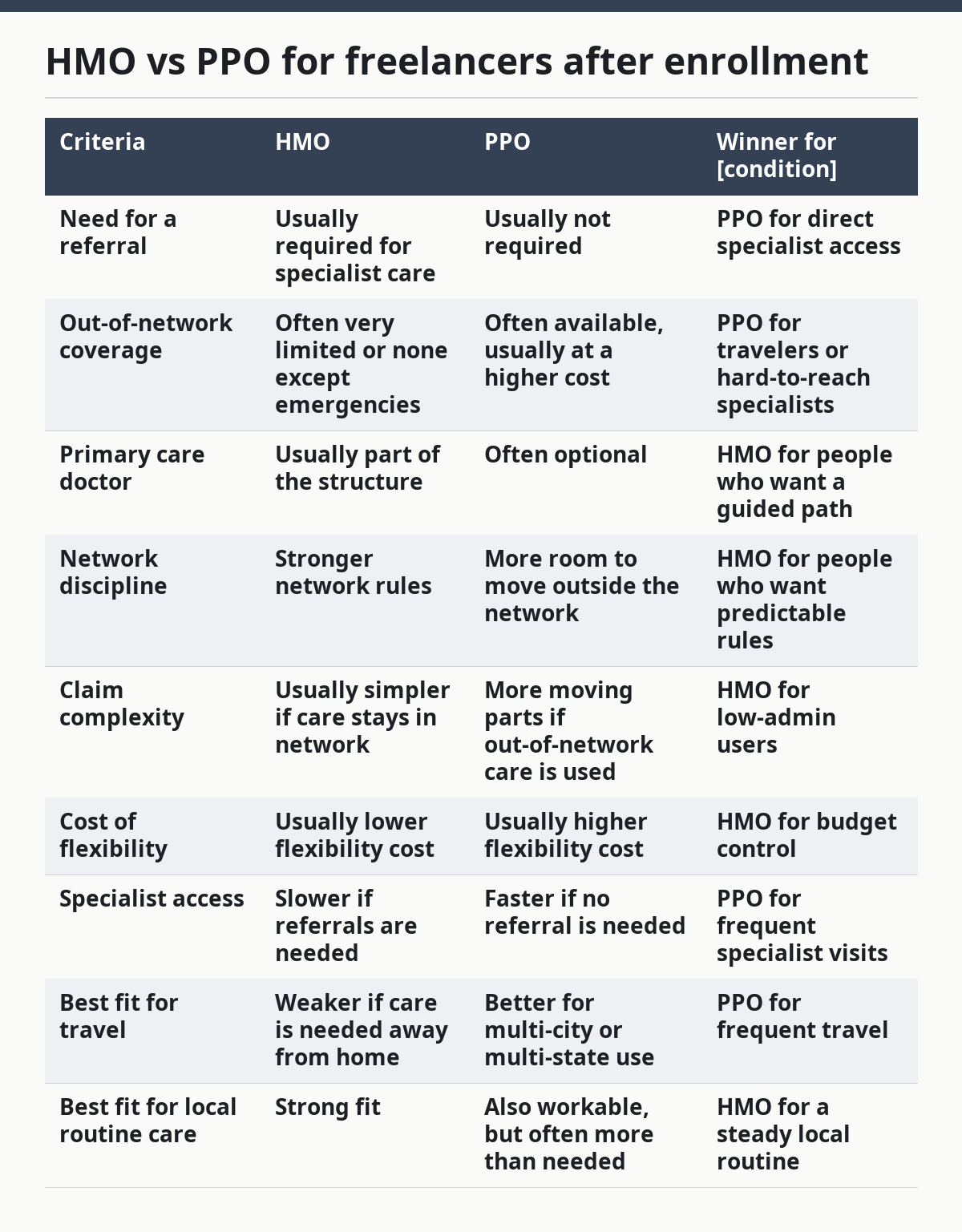
The table looks simple because the decision really is simple for most freelancers. If the freelancer mostly wants to keep care local and predictable, the HMO is the cleaner choice. If the freelancer needs more doors open, the PPO is worth the extra planning.
The catch is that neither plan type erases the basic rules of Marketplace coverage. A PPO still has a network. An HMO still has emergency coverage. Both can use deductibles, copays, and prior authorization. The point is not that one plan has rules and the other does not. The point is that the rules are different, and the freelancer has to match them to how care is actually used.
The best way to think about the choice is this: an HMO asks the freelancer to follow the system, while a PPO asks the freelancer to manage the system. Those are different skills. The right plan depends on which one the person is better at and willing to do.
What should you check before booking care?
A freelancer should check the network, referral rules, and authorization rules before booking care, because those three checks prevent most avoidable claim problems. The plan booklet and the insurer portal matter more than the front page of the Marketplace listing once the policy is active.
Start with the provider directory, but do not stop there. Directories can lag behind real-life changes, so the office itself should confirm whether the doctor, facility, and anesthesiologist if relevant are all in network. A specialist visit at an in-network office can still produce separate charges from an out-of-network facility or clinician. That is one of the most common ways a “covered” visit becomes a mess.
Then check whether the service needs approval. Imaging, procedures, and some specialty drugs often have prior authorization rules. If the plan wants approval first and the member skips that step, the claim can be denied even if the service itself is covered. That rule matters in both HMO and PPO plans, which is why the plan type alone is not enough.
The other useful habit is checking the deductible and copay status before the visit. A freelancer who has not met the deductible may owe much more than expected, even in network. That is not a plan failure; it is how the design works. The cleanest move is to understand the cost-sharing structure before the appointment, not after the bill.
For official consumer guidance, HealthCare.gov and CMS both explain how network status and plan rules affect what members pay. Those sources are plain enough for non-specialists and are the safest place to verify the basic rules before care is booked.
When does an HMO make more sense than a PPO?
An HMO makes more sense when the freelancer gets care mostly in one place, wants simpler rules, and does not need broad specialist access. That is the best use case, and it is strong enough that many freelancers overestimate the need for a PPO.
The HMO is especially good for someone who has a local primary care doctor, sees the same clinic often, and does not travel much for treatment. A referral-based system can keep the care path organized. It can also reduce the chance of wandering into out-of-network billing by accident. If the freelancer wants a plan that forces a pause before every major step, the HMO does that well.
The trade-off is real. The same system that keeps care organized can slow down access. If the freelancer wants to self-direct to a specialist, an HMO can feel restrictive. If care is needed in another city, the network may be too narrow. A person who values autonomy over structure often chafes at this type.
The HMO is also less appealing if the freelancer is managing a condition that needs frequent specialist visits. In that case, the referral step can become a recurring chore. It is not that the HMO fails; it is that the plan’s design asks for patience and coordination, and not every freelancer has time for that. For the right person, though, the trade is worth it.
When does a PPO make more sense than an HMO?
A PPO makes more sense when the freelancer needs choice, sees specialists often, or expects to use care in more than one place. The extra flexibility is the whole reason to pick it, and it is the strongest reason to pay attention to this plan type after enrollment.
A PPO is a strong fit for a freelancer who travels, splits time between cities, or wants to keep seeing a doctor outside a narrow local network. It is also useful if the freelancer does not want to ask for a referral every time a specialist is needed. That simplicity can save time and reduce delays, especially when health issues are not routine.
The downside is that flexibility can be expensive if the plan is used without discipline. Out-of-network care can cost much more, and the member may still face prior authorization rules. A freelancer who assumes a PPO means “anything goes” can get a rude surprise. The plan opens more doors, but it does not remove the need to check the cost structure before walking through them.
A PPO is often a poor fit for a freelancer who mainly needs local primary care, rarely sees specialists, and wants the lowest mental load possible. In that case, the extra flexibility may never be used enough to justify the added complexity. If the freelancer can already stay in network most of the time, the PPO may be paying for a feature that never gets touched.
What are the exception scenarios?
The overall rule flips in a few cases, and those cases matter because they can outweigh the normal HMO-versus-PPO logic. A freelancer should rethink the choice if any of these describe the real care pattern.
First, if a freelancer has a specialist who is only available out of network or in a different city, a PPO may become the practical choice even if an HMO looks cheaper on paper. The reason is simple: access beats theory when the doctor is the priority. In that case, the network gap is not a minor inconvenience; it is the main issue.
Second, if the freelancer barely uses care and only wants basic local visits, the HMO can be the better pick even if the PPO appears more flexible. Extra flexibility has little value if it never gets used. Paying for broad access without needing broad access is an easy way to overbuy.
Third, if the freelancer changes location often during the year, the PPO can be the safer choice because the plan can handle movement better. A freelancer who is in one state in March and another in September may find that an HMO’s local structure is too tight. The added freedom of a PPO can be worth the extra cost and complexity in that scenario.
Fourth, if the plan’s provider directory is weak in the freelancer’s area, neither HMO nor PPO is a good fit. A plan type cannot rescue a thin network. In that case, the better move is to reconsider the plan options entirely and compare the actual doctors and facilities first, not the label on the card.
So which one should a freelancer choose?
Choose an HMO if the freelancer wants local, predictable care and is fine using a primary care doctor as the first stop. Choose a PPO if the freelancer needs specialist access, travels often, or wants more provider choice without asking for a referral each time. Neither if the network is poor in the freelancer’s area or the plan’s rules are too narrow for the real care pattern.
That is the cleanest call. The right plan is the one that matches how care will actually be used after enrollment, not the one that sounds better in a Marketplace comparison chart.
A freelancer who stays put, sees the same clinic, and values simple rules will usually be happier with an HMO. A freelancer whose work life takes them across cities, who already has a specialist, or who wants the widest practical choice will usually be happier with a PPO. The difference is not abstract; it shows up in referrals, network limits, and the size of the bill.
The wrong choice is the one made from habit, not from use. A freelancer who picks a PPO out of fear, then never leaves the local network, pays for flexibility that goes unused. A freelancer who picks an HMO out of thrift, then needs out-of-network care, can face the opposite problem. The better plan is the one that fits the next 12 months, not the last one.
What if I do not know which doctors I need yet?
If the freelancer does not know which doctors will be needed yet, the safer default is usually the plan with the stronger local network and the clearer rules. That often points to an HMO if the care is likely to stay local, or a PPO if the freelancer expects more movement or specialist use. The choice should follow the most likely care pattern, not the worst-case fantasy.
A good check is to list the doctors, clinics, and medications already in use and compare those against the plan network before enrollment or at least before the first appointment. A plan that covers the current doctors well is usually more valuable than a plan that looks flexible in theory. The unknown part is not a reason to guess blindly; it is a reason to use the existing care pattern as the starting point.
What if I move or travel for work?
If the freelancer moves or travels for work, the PPO usually handles that reality better because it gives more room outside the home network. That matters when care is needed in a different city or state, even for a short period.
An HMO can still work for travel if the freelancer mainly needs emergency coverage and can wait for non-urgent care until returning home. But if travel is frequent or unpredictable, the tighter network rules can become a burden. A plan that is excellent in one ZIP code can be frustrating in another. The issue is not the plan label; it is whether the network matches the schedule.
Is a PPO always better for specialists?
A PPO is not always better for specialists, but it often is for speed and access. The reason is that PPOs commonly do not require a referral, which can shorten the path to an appointment.
That said, the better specialist plan is the one that includes the specialist in network and keeps the member’s share reasonable. A PPO with a weak network still causes problems. An HMO with a strong local referral system can work well when the specialist is inside the network and the primary care doctor coordinates the steps. The deciding question is not just “specialist or no specialist?” It is “how easy is the path, and what does it cost?”
Can I switch later if I picked the wrong plan?
A freelancer may be able to switch later during a qualifying life event or the next enrollment period, but the plan should not be chosen on that hope. Coverage decisions work best when the current plan is usable from day one.
The practical downside of waiting is obvious: the first claim, referral, or out-of-network visit can happen before a switch is possible. That is why the better move is to compare the actual providers, network rules, and cost-sharing structure before enrolling or as soon as the plan becomes active. A future switch is a backstop, not a strategy.
FAQ
Do freelancers have to use a primary care doctor with Marketplace coverage?
Freelancers do not always have to use a primary care doctor, but HMO plans usually make that the normal path. PPO plans often let the member see specialists without a referral, which is one reason they feel easier to use. The plan booklet and provider directory will show whether a referral is required for a given service.
What is the biggest mistake freelancers make after enrollment?
The biggest mistake is assuming “covered” means “cheap” or “covered anywhere.” A plan can cover a service and still make the freelancer pay a lot because of the deductible, coinsurance, or out-of-network rule. Checking the network before the appointment is the simplest way to avoid that problem.
Which plan is better if I work from home?
A home-based freelancer often does well with an HMO if care is local and routine. If the freelancer rarely travels for care and is happy with a narrow network, the HMO’s structure is a good fit. A PPO makes more sense only if the freelancer needs more choice than the local network can provide.
Why would anyone choose a PPO if it can cost more?
A freelancer chooses a PPO for access, not because it is simpler. The value is in fewer referral steps and more room to see out-of-network providers when needed. That flexibility can be worth it for travel, specialist care, or keeping an existing doctor, but it is wasted if the member never uses those features.
Drafted with AI; not yet reviewed by a person.