Eligibility and enrollment rules for freelancers — The Complete Guide

Last updated: November 20, 2026
Key Takeaways
- The same income can help in one program and rule you out of another.
- Health coverage depends on a qualifying event, Medicaid income limits, or projected Marketplace income.
- Freelancers usually enroll during open enrollment, unless a life change creates a special enrollment window.
- Tax-based programs use net self-employment earnings, not the label you use for yourself.
Freelancers usually qualify for the same health, tax, and benefit programs as employees, but the enrollment rules change when your income, paperwork, or work setup is irregular. Quick answer: eligibility is usually fine; enrollment is where freelancers get tripped up. The Complete Guide to Eligibility and enrollment rules for freelancers shows what changes, what doesn’t, and which deadlines matter.
What actually decides whether you can enroll

Since you freelance, the real question is not “Am I a freelancer?” but “Which program am I trying to join, and what proof does it want?” A marketplace health plan, a self-employed retirement account, and unemployment are all ruled by different forms, income checks, and dates. The same income can qualify you for one program and block you from another.
Here’s the catch: many freelancers assume they must wait for open enrollment or use business paperwork they don’t have yet. That’s only partly true. For health coverage through the ACA Marketplace, self-employment often counts as a qualifying income source, but you still need to show expected yearly income and household size. For tax-advantaged retirement accounts, your freelancing income from the year usually matters more than whether you have a registered company.
ACA rules rely on the Marketplace and Medicaid as the main reference points. See HealthCare.gov and your state Medicaid agency for current rules. Retirement accounts follow IRS guidance on self-employed retirement plans. Contractor classification can also pull in the IRS and your state labor agency. Different gate. Different key. For more on employer coverage rules, see HealthCare.gov’s special enrollment guidance. For federal tax timing, see the IRS self-employed retirement plans page.
- Pick the program first: health insurance, retirement, unemployment, or something else.
- List the proof it needs: income estimate, tax return, business records, proof of identity, or state ID.
- Check whether the rule is federal, state, or employer-run.
- Find the deadline: open enrollment, special enrollment, tax filing date, or plan start date.
- Submit the form only after you know which year’s income counts.
Quick check: if you can’t name the program and its deadline in one sentence, you’re not ready to enroll yet.
How freelancer health insurance enrollment really works
Need health coverage? The answer hinges on three things: a qualifying life event, income low enough for Medicaid, or projected income high enough for Marketplace subsidies. In plain terms, freelancers can enroll, but the route changes by income and timing. A slow month does not erase your eligibility; a too-low income estimate can change what you owe later.
Marketplace enrollment usually runs during open enrollment each year, with special enrollment periods after events like losing coverage, moving, getting married, having a baby, or certain changes in household status. If you’re self-employed, your expected annual income is what matters for subsidy checks, not just this month’s earnings. That estimate is often the hardest part for new freelancers.
In practice, the year is usually the better planning unit than the week, because coverage and subsidy rules look at annual income and annual deadlines. If your income swings hard, estimate low enough to be honest and high enough to avoid underestimating by a mile. If you qualify for Medicaid in your state, that may be faster and cheaper than buying a Marketplace plan, but state rules vary.
What to gather before you apply
- Last year’s tax return, if you have one
- Current year income estimate from freelance work
- Household size and filing status
- Social Security numbers or other ID for everyone in the household
- Proof of any loss of coverage or other special enrollment event
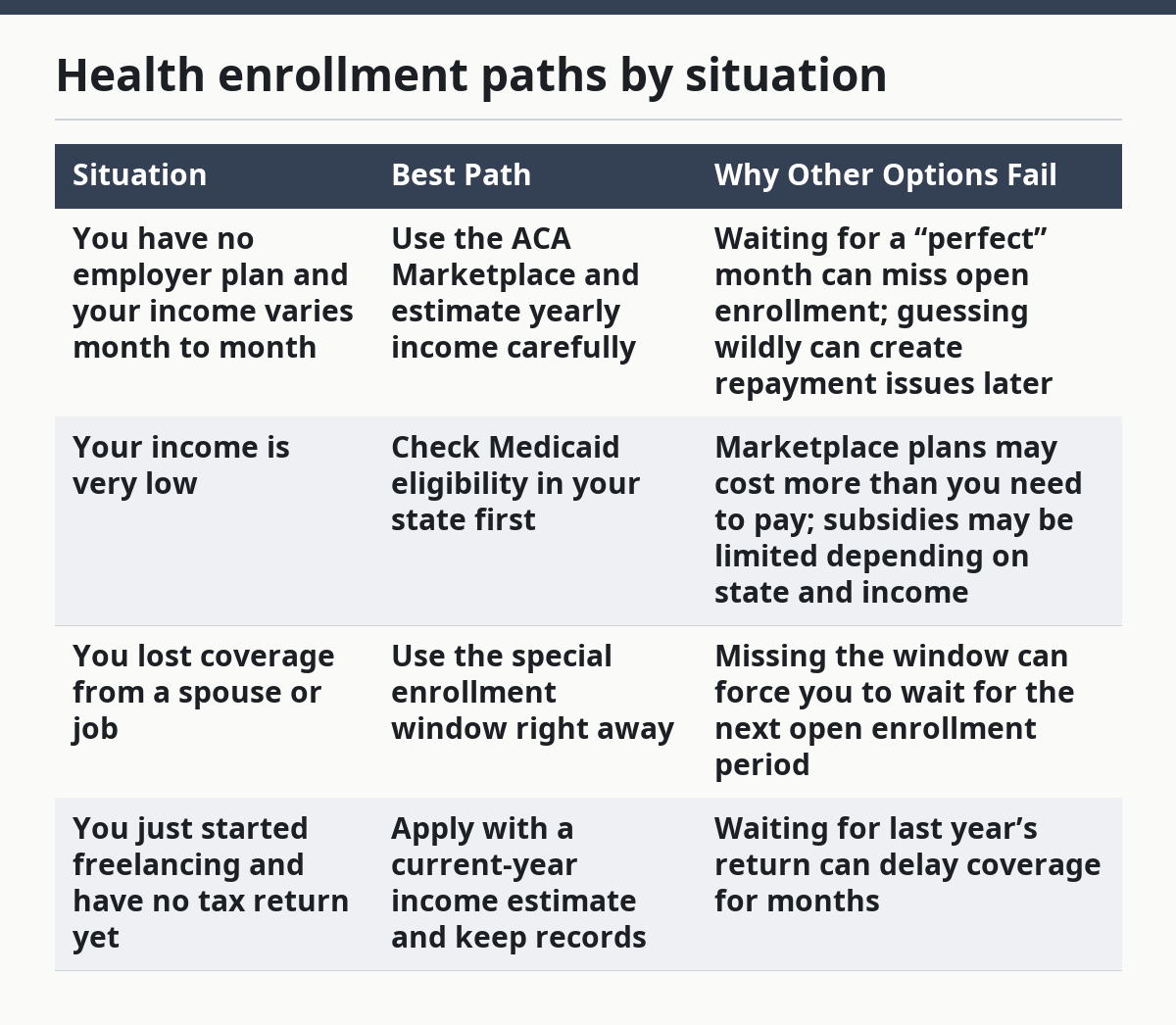
Health enrollment paths by situation
| Situation | Best Path | Why Other Options Fail |
|---|---|---|
| You have no employer plan and your income varies month to month | Use the ACA Marketplace and estimate yearly income carefully | Waiting for a “perfect” month can miss open enrollment; guessing wildly can create repayment issues later |
| Your income is very low | Check Medicaid eligibility in your state first | Marketplace plans may cost more than you need to pay; subsidies may be limited depending on state and income |
| You lost coverage from a spouse or job | Use the special enrollment window right away | Missing the window can force you to wait for the next open enrollment period |
| You just started freelancing and have no tax return yet | Apply with a current-year income estimate and keep records | Waiting for last year’s return can delay coverage for months |
Health enrollment is where freelancers get punished for sloppy estimates. If your income jumps from $18,000 to $52,000 during the year, your subsidy picture can change. Read the IRS and Marketplace notices, and keep every pay record.
- Estimate your annual freelance income using contracts, invoices, and likely repeat work.
- Count spouse income if the program asks for household income.
- Check Medicaid first if your income is near the low end.
- Use the Marketplace if Medicaid does not fit and you need a subsidy check.
- Report income changes during the year, not months later.
- Keep copies of every submission and confirmation number.
Quick check: if your income changes by thousands across the year, your biggest risk is not eligibility — it’s misreporting the estimate.
Can freelancers use open enrollment, or do they need a special period?

Freelancers use open enrollment for most health plans, but they can also qualify for special enrollment after certain life changes. Miss open enrollment with no qualifying event, and the answer is usually no until the next window opens. That catches a lot of people who think self-employment itself creates a special case.
Open enrollment is the annual window when you can sign up, change, or renew a Marketplace plan without a triggering event. Special enrollment periods are shorter and depend on facts like losing other coverage, getting married, having a child, moving to a new service area, or changes tied to certain household events. The exact dates and proof rules depend on the Marketplace and sometimes your state.
There is one common freelancer mistake: assuming quitting a job and starting freelance work always creates a special enrollment period. It can, if you lost job-based coverage, but starting freelance work by itself is not enough. If you kept your old plan and simply changed how you earn money, your enrollment path may not change at all.
How to handle timing problems
- Check whether you already have a qualifying life event.
- If yes, find the deadline for reporting it.
- If no, mark the next open enrollment date.
- Ask whether you qualify for Medicaid now.
- Compare the monthly premium with expected self-employed cash flow.
- Save proof of the life event if you need to upload documents.
On the flip side, freelancers with highly uneven income sometimes think they should wait for a better month to enroll. That can backfire. Coverage dates are tied to enrollment rules, not to your calendar mood. If you need care soon, the deadline matters more than the perfect premium.
Quick check: if your only “event” is that you left employee life and started freelancing, you probably still need to wait for open enrollment unless you lost coverage too.
How tax rules affect enrollment for self-employed freelancers
Tax-based programs look at net earnings from self-employment, not at whether you call yourself a freelancer. So profit, records, and filing status matter more than your invoice template. This is where many solo workers miss the line between hobby income and business income.
Retirement options for freelancers often include SEP IRAs, Solo 401(k)s, or traditional IRAs, but each one has different contribution rules and filing deadlines. The IRS sets the framework, and the account provider sets the paperwork. Miss the contribution deadline or set the plan up too late, and the current-year tax benefit can disappear even if your income was strong enough.
Tax filing status can also affect health subsidy calculations because Marketplace estimates look at household income and tax return details. If you have side income plus freelance income, add both. If you are married, your spouse’s income can matter even if your freelance business is separate. For IRS details on self-employed retirement options, see retirement plans for self-employed people.
What paperwork usually matters
- Schedule C or equivalent business income records
- Form 1099-NEC, if clients issued one
- Bank statements that support income estimates
- Prior-year tax return
- Spouse income details, if applicable
- Retirement plan paperwork from the provider
You do not need a formal LLC to qualify for many self-employed tax rules. A sole proprietor can often use the same basic framework if the income is real and reported properly. But weak records make enrollment and contribution decisions messy fast.
Tax-linked enrollment path
- Separate freelance income from non-freelance income.
- Check whether you have net profit, not just gross receipts.
- Pick the plan type that matches your tax goal.
- Confirm the setup deadline for that account or benefit.
- Keep evidence of earnings for the whole tax year.
- File on time and reconcile any subsidy or contribution issues.
Quick check: if your earnings are mixed with wages, tips, or a spouse’s income, your enrollment math starts with tax records, not with guesswork.
What proof do you need when you enroll as a freelancer?
Freelancers usually need more proof of income stability than employees do, even when the program itself is simple. If you are asked to prove eligibility, your records need to tell a straight story: who paid you, how much, when, and whether the work is ongoing. That is true for health subsidies, some public benefits, and some private plans.
The cleanest proof is a set of invoices, client contracts, bank deposits, and a recent tax return. If you just started and have no return yet, current invoices and bank records can still support your application. If your income is seasonal, be ready to show why your year’s total is higher or lower than one slow month suggests.
Different programs ask for different things. Health coverage may want projected annual income. Medicaid may want current income and household size. A retirement provider may only want identity and account forms. A state benefit office may want weekly earnings logs and proof that clients are not employees. For current federal Marketplace documentation rules, see HealthCare.gov’s application help.
A simple evidence stack
- Photo ID
- Social Security number or tax ID, if required
- 1–3 recent invoices
- Bank deposits tied to freelance work
- Last year’s tax return or Schedule C
- Proof of address
- Proof of any qualifying life event
When proof problems block enrollment
| Situation | Best Path | Why Other Options Fail |
|---|---|---|
| You have no tax return yet | Use current invoices and bank records | Waiting for a return can delay the application by months |
| Your income is seasonal | Show a full-year estimate with notes | A single slow month can make you look ineligible when you are not |
| You work through multiple clients | List each source clearly | Lumped totals can trigger follow-up requests |
| You recently moved | Bring proof of address and moving date | The wrong county or state can change the plan choice |
Here’s the catch: proof is not just for fraud checks. It also protects you from being assigned the wrong plan or subsidy. If the numbers are off, the enrollment result can be off too.
Quick check: if you cannot explain your income in one clean folder, the enrollment office will make you do it anyway.
What changes if you have more than one income source?
If you freelance and also have a W-2 job, the answer changes fast because the rules may use total household income, not just your freelance profit. Mixed income often widens your choices, but it also creates more paperwork. That is true for ACA subsidies, retirement contributions, and some state programs.
A lot of people think “part-time freelancer” means “different rules.” Usually it means “same rules, more pieces.” If your employer offers coverage, that plan may still count as affordable under federal standards, which can affect whether you qualify for Marketplace help. If you also freelance, your side income may raise your household income enough to change subsidy size without changing your actual cash flow much.
Retirement works the same way. A W-2 job may give you access to a 401(k), while freelance profit may let you open a SEP IRA or Solo 401(k). The two can coexist, but the contribution math changes. That is one reason people get surprised at tax time. For W-2 and self-employed retirement questions, see the IRS retirement plans overview.
Mixed-income decision steps
- List all income streams: W-2, freelance, interest, spouse income if relevant.
- Check whether employer coverage blocks subsidy help.
- Compare employer plan cost to Marketplace cost.
- Estimate total annual income, not just freelance income.
- Pick the retirement account that fits both income types.
- Review tax withholding, since side income usually has none.
A common trap is assuming your freelancing income is “small enough not to matter.” It may still matter for eligibility even if it barely changes your monthly budget. One extra $6,000 in annual profit can move a subsidy or contribution limit enough to change the plan choice.
Quick check: if your pay comes from two or more sources, enroll based on the full household picture, not the freelance line alone.
Edge cases where the normal advice breaks down
If your situation is messy, the standard “apply during open enrollment” answer is too thin. These cases need a different path, and they come up all the time with freelancers.
1) You just became self-employed after job loss
What changes: you may have a special enrollment period if you lost job-based coverage, but freelancing alone does not create one.
What to do instead: use the loss-of-coverage date, gather proof, and apply inside the allowed window.
2) Your income is near Medicaid limits
What changes: a small income swing can move you between Medicaid and Marketplace coverage.
What to do instead: run the estimate both ways and check your state’s Medicaid rules before enrolling elsewhere.
3) You have no prior tax return
What changes: proof of income is lighter, but the burden shifts to current invoices and bank records.
What to do instead: use current-year documentation and update the application as your income becomes clearer.
4) You earn in cash, apps, and invoices
What changes: the risk is underreporting income, which can break eligibility later.
What to do instead: track every deposit and transfer, then reconcile the full annual amount before you enroll.
5) You have a spouse with employer coverage
What changes: household income and employer-plan affordability can change subsidy eligibility.
What to do instead: compare the employer plan, Marketplace options, and the family’s full tax picture before you submit.
6) You freelance across state lines
What changes: plan networks, Medicaid rules, and state registration rules can differ by location.
What to do instead: use the state where you live for coverage decisions, then check whether your clients’ states create any separate tax or contractor issues.
Because these are the situations where one-size advice fails, the deadline, the proof, or the household math changes.
Quick check: if your case includes a move, a spouse plan, cash income, or a brand-new business, stop using generic rules and check the specific program first.
How to avoid the most common enrollment mistakes
If you want the cleanest result, treat enrollment like a recordkeeping task, not a one-day form fill. The mistake that hurts freelancers most is not applying — it’s applying with the wrong number, wrong date, or wrong household setup.
The most common error is underestimating annual income because the current month is slow. Another is missing a special enrollment deadline after a qualifying event. A third is forgetting that spouse income, child coverage, or employer coverage can change the whole result. Each one can lead to later corrections, repayment, or a denied application.
The fix is boring, but it works: keep a running yearly income estimate, update it after big client wins or losses, and save every confirmation page. If a program asks for documents, send them fast. If you move, change states, or gain other coverage, report it fast too.
A 7-point pre-submit check
- Is the program the right one for your goal?
- Is your income estimate annual, not monthly?
- Did you include spouse or household income if required?
- Did you check the right enrollment window?
- Do you have the needed proof documents?
- Are you using the correct state and address?
- Do you know what happens if your income changes later?
The truth is, freelancers do not need special sympathy from the system. They need a clean file and the right deadline. That is enough to keep most enrollment problems from becoming expensive ones.
Quick check: if your application is based on one good month, it is probably wrong.
FAQ: freelancer enrollment rules
Can freelancers enroll in health insurance any time?
Freelancers can enroll any time only if they qualify for a special enrollment window or a year-round program like Medicaid in some states. For Marketplace plans, open enrollment is the normal window. If you miss both, you usually wait for the next eligible period.
Do I need an LLC to qualify as a freelancer?
No, you usually do not need an LLC to qualify for freelancer-based enrollment rules. Many programs care about your income and records, not your business entity. A sole proprietor can often use the same enrollment path if the earnings are real and documented.
What if my income changes after I enroll?
Report the change as soon as the program requires it. For Marketplace coverage, changing income can affect subsidy amounts and may change what you owe at tax time. For other programs, the rule may be different, so read the notice that came with your approval.
Can I use last year’s tax return if this year is different?
Yes, but only as a starting point. Many applications ask for current expected income, especially if your work has just started or changed a lot. If last year no longer fits, current invoices and a written estimate matter more than the old return.
Is freelancing income enough to get coverage or benefits?
Sometimes yes, sometimes no. It depends on the program, your total household income, and your state. A steady freelance income can qualify you for Marketplace coverage, retirement contributions, and some other benefits, but the income threshold and proof rules decide the final answer.
Drafted with AI; not yet reviewed by a person.