
Last updated: November 19, 2026
Quick Answer: For most freelancers, the best health plan selection starts with a side-by-side comparison of total yearly cost, not monthly premium alone.
Key Takeaways
- Choose between lower premiums and lower total cost based on how much care you expect.
- For freelancers, the best marketplace tier depends on expected medical use, not the metal label alone.
- Compare deductible, out-of-pocket maximum, network, formulary, referrals, and copays before premium.
- Estimate yearly cost by combining premium, likely out-of-pocket spending, and expected extras.
The right health plan for a freelancer is the one that fits your expected care, cash flow, and tax situation without exposing you to a bill you cannot absorb. This guide to Health plan selection for freelancers — The Complete Guide compares premiums, deductibles, out-of-pocket maximums, provider networks, and prescription coverage as a single package, not as separate line items.
What a freelancer should decide first

The first decision is whether you need the lowest monthly premium or the lowest total cost if you actually use care. A freelancer with a tight, uneven income often focuses on premium first, but that can backfire if the plan has a high deductible and a narrow network.
Start with your likely usage over the next 12 months. If you expect one primary care visit, a handful of generic prescriptions, and no major procedures, a Bronze or high-deductible plan may be workable. If you have regular specialist visits, imaging, brand-name drugs, pregnancy care, or a chronic condition, a plan with a higher premium but lower cost sharing can be the cheaper choice in real life.
Therefore, the second decision is access. If you already see a doctor, check whether the plan uses an HMO, EPO, PPO, or POS network. The labels matter because they control referrals, out-of-network coverage, and how much of your favorite providers survive the switch. A plan that looks cheap on a comparison chart can become expensive fast if your clinic is out of network.
The third decision is tax treatment, and it is worth checking with a tax professional or licensed insurance broker before you enroll. If you buy coverage through an ACA marketplace, you may qualify for premium tax credits if your income falls in range. If you buy through a spouse’s employer plan, a professional association, or directly from an insurer, the tax picture can change. See IRS Publication 974 and IRS Publication 502 for guidance on tax credits and medical expense rules.
Health plan selection for freelancers starts with your risk profile
Health plan selection for freelancers starts with a simple risk question: how much medical spending can you tolerate in a bad year? That answer matters more than guessing which plan has the lowest sticker price.
A plan with a $350 monthly premium may look expensive next to a $220 plan, but premium is only one part of the bill. A plan with a $7,000 deductible and a $9,000 out-of-pocket maximum can cost far more than a plan with a $4,000 deductible if you need surgery, physical therapy, or maternity care. The premium is what you pay to hold the card; the deductible and out-of-pocket max are what you pay when the card is actually used.
Freelancers need to think in income bands, not annual salary myths. A month with strong client payment is not the same as a month with two invoice delays and a tax bill. That makes monthly premium especially sensitive for self-employed people, but it also makes surprise care costs more dangerous. A broken wrist does not wait for a better quarter.
One useful filter is to map your next year into three buckets: routine care, likely care, and worst-case care. Routine care includes preventive visits, a few labs, and common prescriptions. Likely care covers specialist visits, minor procedures, and ongoing medication. Worst-case care is the event that ruins a cheap-plan fantasy: a hospitalization, MRI, surgery, or a long course of therapy. If you cannot cover the deductible for worst-case care, the cheapest premium may be the wrong plan.
The plans most often misunderstood by freelancers are high-deductible health plans paired with health savings accounts. An HSA can be powerful because contributions are tax-advantaged and unused money rolls over, but the trade-off is straightforward: you shoulder more of the early-year cost exposure. For people who can fund the HSA and do not use much care, that can work well. For freelancers with thin reserves, it can become a stress machine.
Which marketplace plan tier makes sense for freelancers?
The best marketplace tier for a freelancer depends on expected medical use, not on the metal label alone. Bronze, Silver, Gold, and Platinum are shortcuts for cost sharing, but they do not replace a full comparison of deductible, copays, coinsurance, drug tiers, and network.
Bronze plans usually come with the lowest premiums and the highest cost sharing. They make sense for healthy freelancers who mainly want protection from catastrophe and can pay a large deductible if needed. Silver plans often sit in the middle and are the practical choice for many people because the trade-off between premium and cost sharing is more balanced. Gold plans can fit freelancers who use care regularly and want lower bills at the point of service. Platinum plans usually carry the highest premium and are mainly worth a look if you know you will use substantial care and can absorb the monthly cost.
The ACA marketplace has another wrinkle: premium tax credits and cost-sharing reductions. Those subsidies can materially change which tier is smartest. A Silver plan can become especially attractive if you qualify for cost-sharing reductions, because the deductible and copays may drop enough to beat a cheaper-looking Bronze option. This is one reason “the cheapest plan” is often a misleading phrase.
A freelancer also has to watch for subsidy cliffs and income estimates. If you understate income, you can owe money back at tax time. If you overstate income, you may miss savings you could have received. That is one reason I would never tell a freelancer to guess casually and move on. If income changes during the year, the marketplace should be updated.
One thing a generic article often misses: the most useful plan is sometimes the one that preserves access to one particular specialist or prescription. If a plan tier saves $60 a month but drops your dermatologist or puts a key drug in a painful tier, the “savings” are fake.
What should freelancers compare besides the premium?
Freelancers should compare the deductible, out-of-pocket maximum, network, drug formulary, referral rules, and copays before they compare premium alone. Those five items usually determine the real cost of the plan.
The deductible tells you how much you pay before most covered services start to share cost with the insurer. The out-of-pocket maximum caps what you spend on covered in-network care in a year, which is the number that matters if something serious happens. Copays are fixed amounts for a visit or prescription, while coinsurance is a percentage after the deductible. A plan with low copays but a brutal deductible can still be a bad deal if you need anything beyond routine care.
The provider network is where freelancers get burned most often. A plan may cover your region but not your specific hospital system, lab, or anesthesia group. One office visit can turn into a stack of claims if your doctor is in network but the facility is not. If you see specialists, check not just the physician but also the place where the care happens.
The drug formulary deserves equal attention. If you take medications regularly, look for the exact drug name and dosage on the formulary, then check the tier and whether prior authorization is required. A medication listed as covered can still be expensive if it sits on a specialty tier or needs step therapy first. If the formulary lists a drug on a restrictive tier, confirm whether an exception process exists before you rely on the plan.
Referral rules matter too. HMO plans often require a primary care physician to coordinate specialist care. That can keep costs down, but it can also slow access. PPO plans usually give more flexibility and sometimes higher premiums. For a freelancer who travels, moves often, or wants broad provider choice, that flexibility can be worth the extra monthly cost.
I would also look at telehealth, urgent care, mental health coverage, and physical therapy limits. Freelancers tend to ignore these until they matter. A plan with excellent hospital coverage but weak behavioral health access can be a poor fit if your work schedule is unstable or you rely on virtual visits.
How do freelancers estimate the real yearly cost?
Freelancers estimate the real yearly cost by adding premium, expected out-of-pocket spending, and likely extras, then comparing that total across plans. This gives a truer picture than looking at monthly premium alone.
A simple method works well. First, calculate annual premium by multiplying the monthly premium by 12. Then estimate routine care spending: office visits, common prescriptions, labs, and any recurring therapy or specialist care. Next, look at the deductible and ask whether you are likely to hit it. Finally, model a bad year and compare the plan’s out-of-pocket maximum to your savings.
Here is a practical comparison structure a freelancer can use:
| Metric | Plan A | Plan B | Change | Timeline |
|---|---|---|---|---|
| Monthly premium | $250 | $375 | +$125 | Monthly |
| Annual premium | $3,000 | $4,500 | +$1,500 | 12 months |
| Deductible | $6,000 | $2,000 | -$4,000 | Yearly |
| Out-of-pocket maximum | $8,500 | $5,000 | -$3,500 | Yearly |
| Specialist copay | $50 | $30 | -$20 | Per visit |
| Generic drug copay | $15 | $10 | -$5 | Per fill |
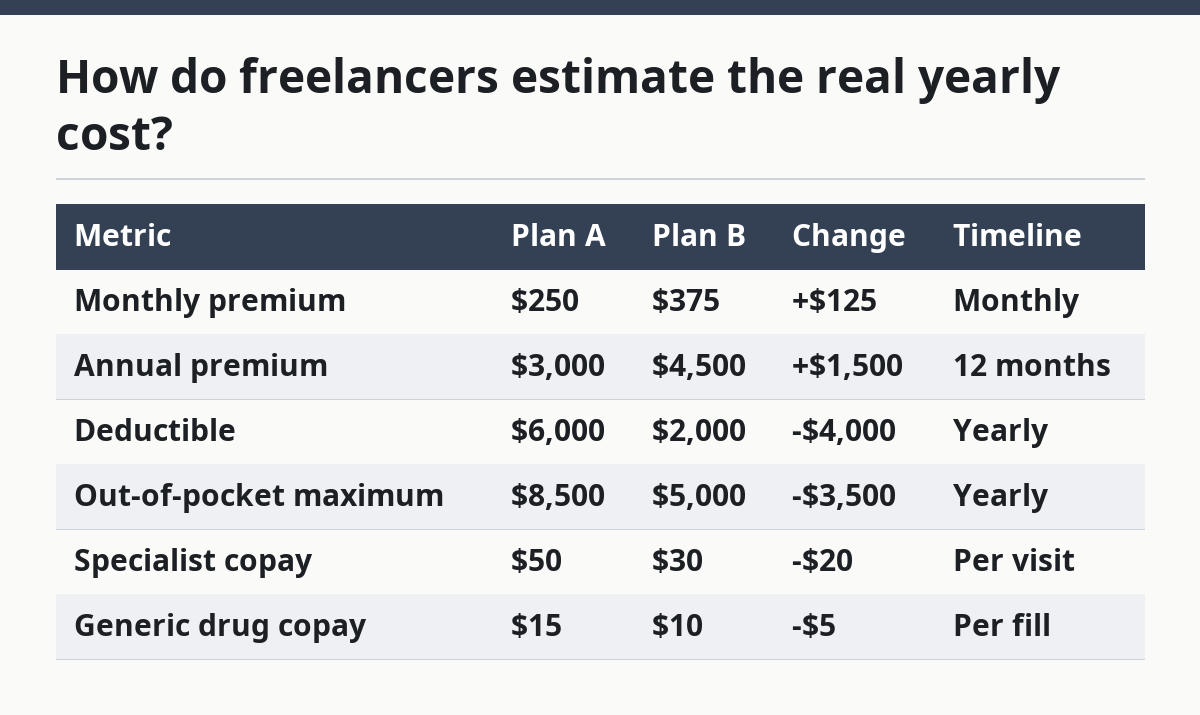
This table does not declare a winner because there is no universal winner. If you rarely use care, Plan A may be cheaper overall. If you expect regular visits or a surgery, Plan B may cost less despite the higher premium.
A detail that generic guides skip: compare the same doctor and same pharmacy under each plan if possible. The total cost can shift because of tiered networks or preferred pharmacies. One plan may reward mail-order prescriptions, while another penalizes them. One may use a narrow network that looks fine on paper but fails in your neighborhood.
If you are self-employed and eligible for an HSA, include the tax benefit in your math, but do not let the tax benefit hide the cash flow problem. A tax advantage in April does not help when a January lab bill lands on your credit card.
What mistakes cost freelancers the most money?
The most expensive freelancer mistake is choosing a plan for the premium and discovering later that the network, deductible, or drug coverage does not fit real life. The next most expensive mistake is guessing income or ignoring enrollment deadlines.
A narrow network is the classic trap. Freelancers often assume “my doctor takes most insurance” means they are safe. It does not. A plan can cover the clinic but not the specialist group, the imaging center, or the hospital where the procedure is done. That turns a reasonable premium into a pile of surprise charges.
Another mistake is treating the deductible like a worst-case ceiling. It is not. If the deductible is $4,000 and the out-of-pocket maximum is $9,000, the ceiling is the second number, not the first. People who stop reading after deductible often underestimate what a rough medical year can cost.
Drug coverage gets ignored until the pharmacy says no. A medication can be covered only after prior authorization, or only after cheaper drugs are tried first. That delay matters for freelancers because work schedules are less predictable, and every extra call or appeal takes time.
Deadlines matter too. Marketplace enrollment has fixed windows unless you qualify for a special enrollment period. Missing the deadline can leave a freelancer uninsured or stuck with a less suitable option for months. If your work situation changed recently — loss of employer coverage, a move, marriage, divorce, or a child — check whether you qualify for a special enrollment period rather than waiting for the next open enrollment.
The most honest drawback of plan shopping is that it takes time. To do it well, you need plan documents, provider searches, drug lists, and often a calculator. A quick browser session can leave you with a plan that looks fine and behaves badly.
Is an HSA a good fit for freelancers?
An HSA is a good fit for freelancers who can handle higher upfront costs and want a tax-advantaged place to save for medical spending. It is not a good fit for someone who cannot reliably cover the deductible or who needs frequent care right away.
An HSA only pairs with an HSA-qualified high-deductible health plan. That means the insurance plan is already structured around higher cost sharing. The advantage is that HSA contributions are tax-advantaged, funds roll over, and the account can build over time. For freelancers with irregular income, that rollover feature is valuable because it creates a medical buffer that does not vanish at year-end.
The drawback is obvious: the plan asks you to self-fund more of the first layer of care. If your cash reserve is weak, the HSA can become a wish list instead of a safety net. A freelancer who cannot contribute to the HSA at all may be holding the wrong kind of plan. The tax shelter is useful only if there is money in it.
An HSA also works best when you can keep receipts organized and avoid treating the account as a vague emergency fund. The rules around eligible expenses matter, and a freelancer who mixes personal spending with medical spending without tracking can create a mess. That is not a reason to avoid HSAs, but it is a reason to respect the bookkeeping.
The cleanest use case is a freelancer who is healthy, has some cash reserve, and wants lower premiums plus a long-term medical savings account. The weakest use case is a freelancer with ongoing specialist care, little cash buffer, and no room for a large deductible.
What should freelancers do during open enrollment?
Freelancers should use open enrollment to compare at least three plans side by side, verify doctors and drugs, and choose only after checking total annual cost. A rushed choice during open enrollment is how bad coverage gets locked in for a full year.
Start by updating your expected income if you buy through the ACA marketplace. Then list every provider you actually use: primary care, specialists, urgent care, therapist, and preferred hospital. Add every recurring prescription, including dosage. Compare each plan’s deductible, out-of-pocket maximum, premium, and formulary for that exact list.
Then read the Summary of Benefits and Coverage, not just the marketing page. The SBC is where the real cost-sharing language tends to live. If the plan summary looks promising, confirm network status directly with the provider and, if needed, the insurer. Network status can change, and a provider directory is not the same thing as a guaranteed coverage promise. HealthCare.gov and the IRS are reliable starting points for marketplace and tax information.
Freelancers should also think about timing. If your work income has a seasonal pattern, choose a plan you can carry through the lean months. A plan that only works if every invoice gets paid on time is fragile. The point of insurance is to survive inconsistency, not add another source of it.
If you are choosing between two nearly identical plans, pick the one with the better network and clearer pharmacy rules. Small differences in paper benefits are often less important than access and billing behavior.
For official plan and subsidy information, the most reliable places to start are HealthCare.gov and the IRS. HealthCare.gov explains marketplace enrollment and plan categories, while the IRS covers premium tax credits and HSA tax treatment.
FAQs
How do I know if I should choose a Bronze or Silver plan?
Choose Bronze if you want a lower premium and expect very little medical use, and choose Silver if you want a more balanced trade-off or may qualify for cost-sharing reductions. The better choice depends on whether you are protecting monthly cash flow or reducing your bill when care happens. If your income qualifies you for extra help, Silver can become the stronger option.
Can I deduct my health insurance premiums as a freelancer?
Possibly, but the tax treatment depends on how you are set up and what coverage you buy. Self-employed health insurance rules are specific, and the details matter enough that a tax professional or IRS guidance is worth checking before you claim anything. Do not assume all premiums are deductible in the same way.
What if I travel a lot or work from different states?
A PPO or a plan with broad national network access is often easier for frequent travelers, but you still need to check how care works outside your home area. Some plans only cover urgent or emergency care away from home, while others give more flexibility. The key question is whether you need routine care wherever you happen to be.
Is the cheapest premium ever the right choice?
Yes, if you have low expected medical use, enough savings to handle a high deductible, and a provider network that fits your needs. The cheapest premium is not automatically bad; it just shifts more risk to you. If you have ongoing care or a thin cash cushion, that same plan can be the wrong one.
Drafted with AI; not yet reviewed by a person.