
Last updated: November 19, 2026
Quick answer: Marketplace and exchange mechanics answer the same core question in different ways. A marketplace usually gives sellers flexibility; an exchange usually gives buyers a standardized, rule-based price and match. In this guide to Marketplace and exchange mechanics — The Complete Guide, the practical test is simple: if you need matching, custody, clearing, and price discovery, you are closer to an exchange; if you need discovery without hard standardization, you are closer to a marketplace.
Marketplace and exchange mechanics are the rules that decide how buyers, sellers, and the platform itself meet, trade, and get paid. If you are choosing between building a marketplace and running an exchange, the first question is not “Which model is better?” It is “Do I need matching, custody, clearing, and price discovery—or just a place where buyers can find sellers?” That choice affects fees, controls, compliance, and user trust.
A marketplace usually connects supply and demand without guaranteeing a price or a trade. An exchange usually goes further: it standardizes contracts, matches orders, and often enforces settlement rules. That difference changes everything about regulation, trust, fees, and what can break. In practice, the mechanics decide whether the platform acts as a directory, a brokered venue, or a market with formal rules.
I write about platform design, commerce systems, and market structure. That matters here because the hard part is not the homepage or the search bar; it is the machinery behind listing quality, matching, payment, dispute handling, and liquidity. For a broader framework, see platform governance and trust design, two-sided market growth, and payments and escrow basics.
Key takeaways
- A marketplace is built around discovery and transaction flow; an exchange is built around matching and market rules.
- The most important design choice is how much control the platform takes over price, identity, settlement, and dispute resolution.
- Marketplaces work best when products are heterogeneous and sellers need flexibility.
- Exchanges work best when the item is standardized and buyers need confidence that the contract means exactly one thing.
- The failure mode of a marketplace is low trust and low liquidity. The failure mode of an exchange is overcomplexity and regulatory drag.
- If the system cannot standardize supply, an exchange model usually becomes expensive bureaucracy.
- In 2024, the SEC’s Regulation ATS framework and related market-structure rules still shape how many trading venues operate in the U.S.; the category is not just a branding choice. See the SEC’s market structure resources and Regulation ATS overview at https://www.sec.gov/divisions/marketreg/mr-brokerdealer.shtml.
- The CFTC also distinguishes between market venues and derivatives trading systems in ways that affect how contracts, matching, and reporting are designed. See https://www.cftc.gov/LearnAndProtect/AdvisoriesAndArticles/TradePractice/index.htm.
What marketplace and exchange mechanics actually are
Marketplace and exchange mechanics are the operating rules that make a two-sided market function day to day. In plain English, they answer five questions: Who can list? How does a buyer find the right offer? How does a trade get matched? Who holds the money? What happens when something goes wrong?
A marketplace mechanic can be as simple as a directory plus messaging, or as structured as a managed checkout with escrow and rating systems. Think of Etsy, eBay, Airbnb, or a B2B procurement portal: the platform brings participants together, but the seller still has some freedom over product, price, and fulfillment. That is a useful shorthand, but it should be treated as a general example, not legal advice; if the structure affects money movement, custody, or regulated activity, consult a qualified professional and check the governing rules first.
An exchange mechanic is tighter. A stock exchange, commodities exchange, or crypto exchange normally uses a clear rulebook for order entry, priority, matching, and settlement. In many cases, the platform also defines contract size, tick size, trading hours, and acceptable instruments. The U.S. Securities and Exchange Commission describes exchanges and alternative trading systems under different regulatory frameworks, which is one reason the mechanics matter so much: the model itself affects compliance obligations. See the SEC’s Exchange Act resources at https://www.sec.gov/divisions/marketreg/mr-brokerdealer.shtml and the CFTC’s market structure material at https://www.cftc.gov/LearnAndProtect/AdvisoriesAndArticles/TradePractice/index.htm. For a deeper legal overview, see marketplace compliance basics and exchange rulebooks explained.
The easiest mistake is to treat these as branding choices. They are not. A marketplace is usually optimized for variety. An exchange is usually optimized for standardization. If you mix the two without deciding which one leads, you get a confusing platform: too rigid for sellers, too loose for buyers. That is not just a design issue; it is a model risk that can affect support load, conversion, and regulatory exposure. If you need a practical launch checklist, see how to structure a platform launch.
Which model fits your product?
The marketplace model wins when the thing being sold is not identical from seller to seller. That includes used goods, services, custom work, rental inventory, and niche B2B supply. If a buyer needs comparison, not perfect fungibility, a marketplace gives the seller enough room to differentiate while still centralizing discovery.
The exchange model wins when the instrument is standardized enough to be interchangeable. A futures contract is the cleanest example. One contract size, one expiry, one delivery rule, one matching engine. In that setting, the exchange can create deep liquidity because every order is competing in the same pool.
A useful way to judge fit is by asking whether the buyer cares more about “which seller?” or “which contract?”. If seller identity matters because quality varies, you want marketplace mechanics: profiles, reviews, lead routing, maybe escrow. If the contract matters more than the counterparty, you want exchange mechanics: uniform terms, order books, and strict matching priority. The distinction is practical, not theoretical, because it changes what users see and what the platform must enforce.
This is where generic advice goes wrong. Many articles say “build an exchange for efficiency.” That is backward if your supply is messy. Standardizing a messy supply chain can destroy the value buyers were actually buying. A custom furniture maker, for example, may never fit a real exchange model because design variance is the product. A shipping lane or commodity grade can fit one because the contract can be written tightly enough to remove ambiguity.
The decision usually turns on three concrete factors: price variability, product standardization, and fulfillment complexity. If all three are high, the marketplace model usually survives better. If all three are low, exchange mechanics become viable. In short, the more the market looks like a single tradable unit, the more exchange logic tends to work.
How matching, ranking, and liquidity really work
Matching is the heart of the system, and the wrong matching rule can ruin the whole market. A marketplace often uses search and ranking before it ever uses hard matching. An exchange usually uses an order book, where price-time priority is common in many venues. In simplified terms, the best available price is matched before worse prices, and among equal prices, earlier orders are often prioritized.
That distinction changes user behavior. In a marketplace, sellers compete through listing quality, response time, shipping speed, badges, and reviews. In an exchange, sellers compete by improving price, timing, or available size. One model rewards presentation; the other rewards quote quality. For examples of how ranking and search affect conversion, see search ranking for marketplaces and order types and matching basics.
Liquidity is the other key mechanic. On an exchange, liquidity means there are enough active orders that a buyer can trade quickly without moving price much. On a marketplace, liquidity means a buyer can find a suitable seller without too much search friction. They are not the same thing. A marketplace can have many listings and still feel dead if the listings are stale or unresponsive. An exchange can have a deep order book and still feel unusable if the contract design is too narrow for real demand.
The mechanics that shape liquidity are concrete:
- order types, such as market, limit, and stop orders;
- visibility rules, such as full book versus hidden interest;
- time-in-force rules, such as day, good-til-canceled, or immediate-or-cancel;
- inventory and availability freshness;
- maker-taker or fee incentives.
If the platform is a marketplace, the main job is to reduce search cost and increase trust fast enough that users act. If it is an exchange, the main job is to concentrate enough activity into one standardized pool that price discovery works. Those goals are related, but they are not identical.
A subtle but important point: too much ranking can hurt marketplace liquidity. If the platform hides too many listings behind opaque relevance scores, new sellers never get seen and buyers never see the full market. Too little ranking, and the buyer gets lost in noise. The right answer is usually a combination of rules: relevance, availability, conversion, and freshness. For a practical template, see listing freshness and visibility rules.
The honest side-by-side
The right choice depends on whether you need flexibility or standardization. A marketplace wins when seller variety is the feature; an exchange wins when sameness is the feature.
| Criteria | Marketplace | Exchange | Winner for [condition] |
|---|---|---|---|
| Product standardization | Works well with heterogeneous offers | Works best with uniform contracts | Exchange, when the product can be defined tightly |
| Pricing model | Seller-set, negotiated, or algorithmically suggested | Usually rule-based and continuously matched | Exchange, when transparent price discovery matters most |
| Trust burden | Platform must build trust through profiles, reviews, escrow, and support | Trust comes partly from contract standardization and venue rules | Marketplace, when counterparties are unfamiliar |
| Liquidity formation | Depends on search quality and seller responsiveness | Depends on pooled orders and matching depth | Exchange, when many buyers and sellers trade the same thing |
| Fulfillment complexity | Can absorb custom delivery, special terms, and variable service levels | Prefers clear settlement rules and standard outcomes | Marketplace, when delivery is messy or bespoke |
| Regulatory load | Often lighter, but varies by category and payments flow | Often heavier, especially with financial instruments | Marketplace, when the legal burden must stay lower |
| User control | Sellers usually retain more control over terms | The venue usually controls more of the rules | Marketplace, when seller autonomy is part of the value |
| Price discovery | Often indirect, with comparison and negotiation | Direct, visible, and continuous | Exchange, when buyers need a public market price |
| Scaling path | Grows through supply diversity and category expansion | Grows through depth in a narrow contract set | Exchange, when a narrow market can be made deep |
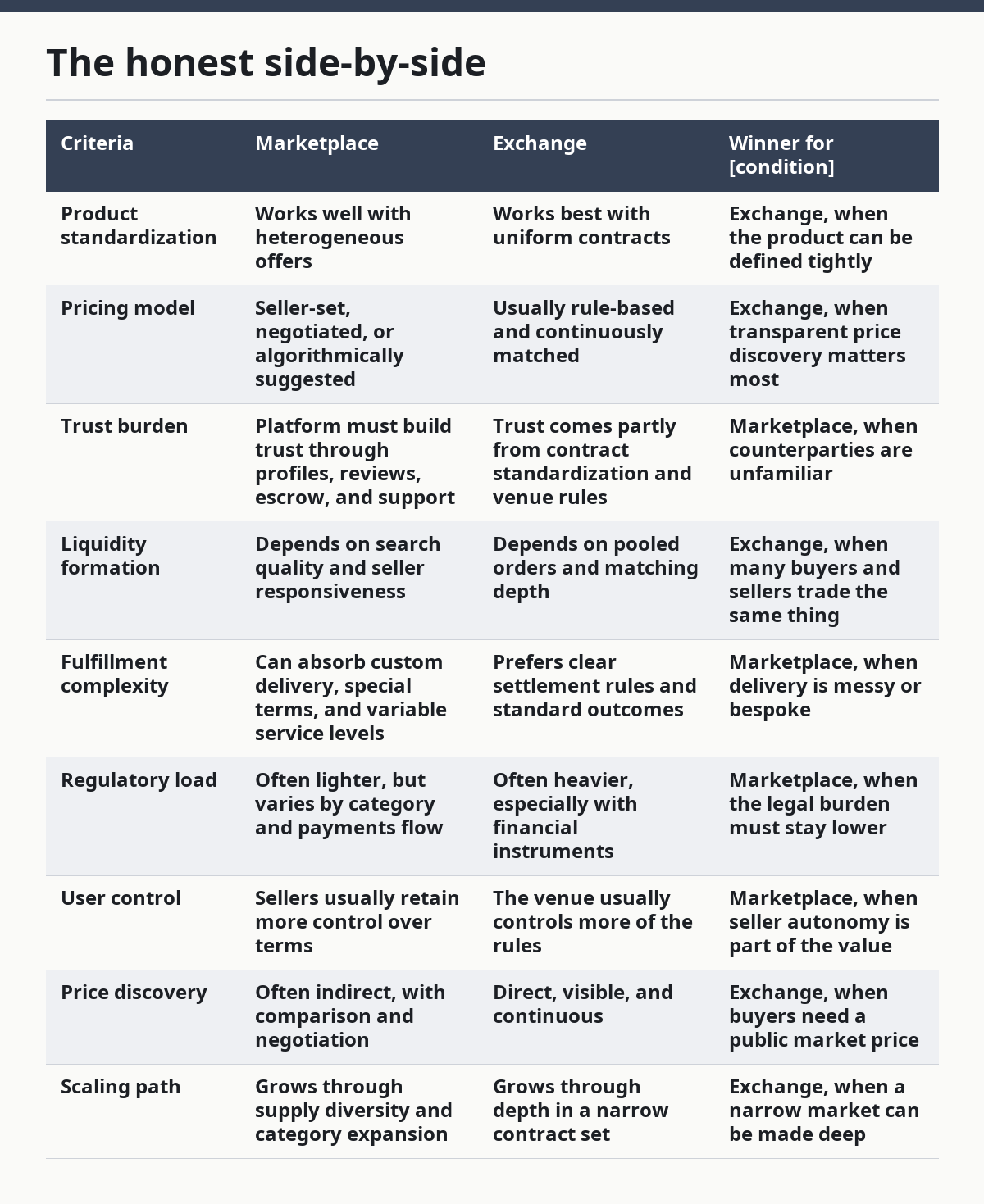
The table makes the real trade-off plain: a marketplace is forgiving, but it has to work harder to create trust. An exchange is precise, but it has to work harder to make the product fit its precision. For related strategy choices, see market design trade-offs and pricing strategy for platforms.
Marketplace mechanics: who should build one, and who should skip it?
A marketplace wins for operators who have messy supply and varied demand. That includes service platforms, local commerce platforms, rental inventory, creator services, niche industrial parts, and many B2B sourcing systems. If the seller needs flexibility in packaging, scheduling, or price, marketplace mechanics usually fit better than exchange mechanics.
The strengths are practical. First, the system can support nonstandard listings without forcing everything into the same box. Second, it can grow category by category, which is useful when demand is fragmented. Third, it can build trust with seller profiles, buyer reviews, escrow, dispute tools, and moderation. None of that requires a perfect contract. It requires good rules and consistent enforcement. In 2023, major marketplace operators continued to invest in identity checks, fraud detection, and support tooling because trust failures directly affect repeat usage and take rate.
The weaknesses are just as real. A marketplace can become a swamp of duplicate listings, stale inventory, and weak buyer confidence. If there is no strong identity check, fraud grows. If there is no payment control, disputes become expensive. If there is no supply freshness rule, search quality degrades. Those problems show up as lower conversion, slower repeat usage, and more support load.
A marketplace is wrong for a situation where the item must be identical and tradable at high speed. It is also wrong when the platform cannot afford the human and technical overhead of moderation, fraud controls, and support. If a category needs the discipline of a contract market, a loosely governed marketplace can become noisy fast. For implementation details, see identity verification for platforms and dispute resolution workflows.
For a builder, the key question is simple: can I let sellers differ without letting quality collapse? If the answer is yes, marketplace mechanics are the right tool. If the answer is no, the platform probably needs exchange-style standardization or it should not launch yet. The question is not whether the site can attract traffic; it is whether the mechanics can keep the market usable after the first 1,000 listings.
Exchange mechanics: when the stricter model wins
An exchange wins when the market needs a single, legible price and a clear matching rule. That is why exchanges dominate standardized financial products, quoted commodities, and other instruments where contract identity matters more than vendor identity. The exchange does not just connect parties; it shapes how the market behaves.
The strengths are obvious once the product is right. Price discovery is transparent. Matching is efficient. Participants can compare orders in one place. Standard contracts reduce ambiguity. In regulated markets, the exchange structure can also make surveillance and rule enforcement easier because the venue controls the format of trade.
The weaknesses are equally important. Exchanges are expensive to design, expensive to operate, and often expensive to regulate. They depend on narrow standardization, which means the model breaks down if the product changes too often or if participants need custom terms. A strict matching engine is a poor fit for a service that needs negotiation. For a higher-level overview, see regulated venue design and clearing and custody explained.
An exchange is also unforgiving when liquidity is thin. A beautiful order book is not useful if there are only a few participants and the spread stays wide. In that case, the platform looks sophisticated but behaves like an empty room. The mechanics can be technically elegant and commercially useless.
That is why exchange mechanics are wrong for most bespoke commerce. If the thing being sold is a consulting retainer, a custom fabrication job, or a delivery route with special conditions, forcing it into an exchange format usually creates friction rather than efficiency. The right move is to standardize only what can actually be standardized, then leave room for negotiation where the product demands it. When a venue does not need formal matching, adding it can slow adoption instead of improving it.
When the choice flips: exception scenarios that change the answer
The answer flips when the market has one of four special conditions. A marketplace is not always the safer choice, and an exchange is not always the smarter one.
-
The product is standardized but the sellers are not trusted.
If the item is identical but counterparty risk is high, exchange-like rules with clearing, escrow, or custody can beat a loose marketplace. This is common in financial products and some high-value B2B categories. -
The product is custom, but the quote needs to be visible.
In some services markets, a marketplace with exchange-style quote intake can work better than either pure model. The platform may show indicative pricing, then route the buyer into a negotiation workflow. -
The category is regulated as a financial venue.
Once law and supervision define the rules, the platform cannot simply choose a light marketplace structure. It may need market surveillance, reporting, or licensing. The regulatory wrapper can force exchange mechanics even if the founders wanted a simpler marketplace. -
The supply is fragmented but the contract can be standardized.
A marketplace may start the category, but once the platform learns the recurring patterns, it may need to harden into exchange-like rules to improve speed and reduce disputes. This is common when the early stage is messy and the mature stage demands consistency.
These exceptions matter because they show the model is not fixed at launch. The right mechanism can change as the category matures. A platform can begin as a marketplace and add exchange mechanics later, but only if the underlying product can be standardized without destroying demand. If the business depends on reviewable trust and flexible terms, keep marketplace mechanics. If the business depends on uniformity and settlement, move toward exchange rules.
The verdict: which one to choose and why
Choose a marketplace if the product is variable, the seller matters, and the deal needs flexibility in price, terms, or fulfillment. Choose an exchange if the product can be standardized tightly, buyers need a public price, and matching speed matters more than seller differentiation. Neither if the category cannot support trust controls, contract clarity, and enough active participants to create real liquidity.
That is the clean decision rule. If you are still deciding, ask one final question: would forcing every offer into the same contract make the market better, or would it erase what buyers actually want? If it erases value, build a marketplace. If it clarifies value, build an exchange. For teams weighing the two models, marketplace vs. exchange planning is a useful next step.
How to design the mechanics before you launch
The safest way to avoid a dead marketplace or a brittle exchange is to design the mechanics before you scale the acquisition plan. Start with the trade, not the logo. Write down how a listing becomes a match, how payment moves, how disputes are resolved, and what data the platform needs to keep the market healthy.
A practical design checklist looks like this:
- define the unit of trade in one sentence;
- decide whether price is fixed, negotiated, or matched;
- choose who controls identity verification;
- set the settlement path, including escrow or custody if needed;
- specify the dispute path before the first complaint arrives;
- decide what makes a listing stale after 24 hours, 7 days, or another meaningful threshold;
- define the moderation rules for fraud, duplicate supply, and abuse.
If those choices are vague, the platform will drift. Buyers will not know what to expect, sellers will game the system, and the support team will end up making policy in the inbox. If the choices are clear, the mechanics can do the work quietly in the background.
For anyone building a marketplace or exchange, this is the point most people miss: user growth does not fix broken mechanics. It magnifies them. The first 100 users can survive on manual work; the next 10,000 expose every unclear rule.
Drafted with AI; not yet reviewed by a person.