Last updated: November 19, 2026
Quick Answer: Most freelancers should review coverage changes within 48 hours and aim for zero uncovered days. If the change affects health insurance, first confirm the end date, the new effective date, and whether you have a Special Enrollment Period before you cancel anything. For Managing Coverage Changes as a Freelancer — The Complete Guide, the safest move is usually to compare health, disability, liability, and retirement decisions together, not one by one.
If your coverage changes, the right move is to update your protection before the old policy lapses, then compare replacement coverage against the risks your freelance work actually creates. For most freelancers, that means checking health coverage, liability coverage, disability coverage, and retirement savings rules in the same week—not one at a time.
Freelance work makes coverage changes harder because income is uneven, deadlines are tight, and one missed notice can leave a gap that costs real money. I write on insurance and coverage planning, and the biggest mistake I see is treating each change like a separate admin task instead of one risk-management decision. If you are unsure how a change affects your policy or tax position, consult a licensed insurance professional or tax professional; HealthCare.gov and the U.S. Department of Labor both explain key enrollment and continuation rules for coverage changes: https://www.healthcare.gov/coverage-outside-open-enrollment/special-enrollment-period/ and https://www.dol.gov/agencies/ebsa/laws-and-regulations/laws/cobra
Key takeaways
- A coverage change is not just a paperwork event; it can change your cash flow, tax bill, and personal risk on the same day.
- The first job is to identify which coverage changed: health, dental, vision, disability, liability, auto, or retirement.
- If the change affects health insurance, check whether you have a Special Enrollment Period, COBRA, a spouse’s plan, or a marketplace plan available.
- If the change affects business liability or disability coverage, read the exclusions and waiting periods before you assume you are protected.
- A short overlap can be worth the cost if it prevents a gap in essential coverage.
- The wrong time to improvise is after a claim, a medical bill, or a client dispute.
What changed, exactly?
The first step is to name the change in plain language: did your policy end, did your employer coverage disappear, did your income swing enough to affect subsidies, or did your client work become riskier than your old policy allows? That distinction matters because the fix is different in each case.
A generic article would say “review your coverage,” but that is too vague to act on. A freelancer who left a W-2 job and lost employer health insurance needs a Special Enrollment Period or another qualifying route. A freelancer who picked up higher-risk client work may need to revisit general liability, professional liability, or cyber coverage. A freelancer whose earnings jumped or dropped may need to update marketplace income estimates so the premium tax credit is not wildly off.
The real question is not “Do I need new coverage?” It is “Which protection stopped matching my life on the date of the change?” That date controls whether you can switch plans, whether there is a waiting period, and whether you can still use a qualifying event to enroll. If you do not know the date, find it first. Keep the notice, cancellation letter, HR email, policy declaration page, or renewal email that shows when the old arrangement ends.
One practical rule helps here: make a list with three columns—what changed, what it exposes you to, and what deadline applies. A freelancer who has no deadline can research slowly; a freelancer with a 30-day or 60-day election window cannot. That is the difference between a controlled transition and a gap you discover after the fact.
What should a freelancer check first when coverage changes?
A freelancer should check health coverage first, then income-protection coverage, then business liability. Health insurance is usually the most time-sensitive because enrollment windows are strict and medical bills arrive fast.
If the change is health-related, verify the end date of your current plan and the start date of the next one. Many employer plans end at month-end, but not all. Marketplace plans, COBRA continuation coverage, and spouse or partner plans each run on different rules. Do not assume the new policy begins the day after the old one ends unless the paperwork says so.
After health coverage, look at disability insurance if your income depends on your ability to work at a desk, on-site, or on camera. Short-term disability, long-term disability, and business overhead policies do not replace each other. A policy that replaces part of your wages for 90 days is not the same as one that pays a business expense for 12 months. The waiting period, benefit period, and definition of disability are the details that decide whether the policy is useful or decorative.
Then check liability. A freelance designer, consultant, copywriter, developer, photographer, or contractor may need professional liability, general liability, equipment coverage, cyber coverage, or a business owner’s policy depending on the work. Some client contracts may require specific insurance terms, and many policies are only useful if the limits and endorsements match the work. If your work changed, your old policy may still be in force while no longer fitting the work you actually do.
Do not ignore retirement contributions either. If you moved from W-2 employment to solo work, a SEP IRA, solo 401(k), or SIMPLE IRA may become relevant. That is not “coverage” in the insurance sense, but it is part of the same financial transition because it affects taxable income and long-term protection.
How do you replace health coverage without creating a gap?
You replace health coverage by picking the next plan before the old one ends, then matching the effective date so there is no uninsured day in between. That is the cleanest answer for most freelancers.
For many people, the choices are marketplace coverage, COBRA, a spouse’s employer plan, a partner’s plan, Medicaid if eligible, or a short-term policy where legal and appropriate. The right pick depends on income, medical needs, prescription coverage, and how long the gap will last. There is no universal winner.
A marketplace plan can be a strong long-term replacement when your freelance income is moderate or variable, because it can be adjusted during open enrollment or after a qualifying event. The drawback is that monthly premiums and deductibles can be hard to predict, and the provider network may be narrower than an employer plan. If you rely on a specialist, out-of-network care, or specific prescriptions, check the formulary and network before you enroll. The U.S. Department of Health and Human Services explains qualifying life events and special enrollment rules on HealthCare.gov, which is the first place to confirm timing: https://www.healthcare.gov/coverage-outside-open-enrollment/special-enrollment-period/
COBRA is often the best bridge if you need to keep the same doctors, the same prescription coverage, or the same pending treatment plan. The downside is cost: you generally pay the full premium plus any administrative charge allowed under the rules, so it can be expensive for a solo budget. That trade-off is real. COBRA is not wrong; it is just usually a short-term continuity tool, not a long-term freelance strategy. The U.S. Department of Labor has a clear overview here: https://www.dol.gov/agencies/ebsa/laws-and-regulations/laws/cobra
A spouse or partner’s plan can be the simplest fix if the household already has employer coverage. The catch is that not every plan permits every dependent relationship, and some plans charge a high dependent contribution. Medicaid, where eligible, can be the most affordable option, but eligibility is state-specific and income-based, so it is not a universal fallback.
Managing coverage changes as a freelancer when income moves up or down
Income swings can change your coverage even when your actual policy does not change, and that is where many freelancers get tripped up. The plan stays the same on paper, but the subsidy, tax treatment, or eligibility underneath it changes.
If your income drops, you may qualify for a different marketplace subsidy level, Medicaid in some states, or a lower-cost plan at renewal. If your income rises, the reverse can happen: subsidies may shrink, your estimated income may no longer match reality, and you may owe more at tax time if your estimate was too low. This is not a reason to panic; it is a reason to update your estimate quickly.
Treat income changes like coverage changes and report them as soon as the change becomes real, not months later. If you wait, you are asking for a surprise reconciliation when you file taxes or renew a plan. The IRS discusses premium tax credit reconciliation and Form 8962 on its own pages; that is the tax document to watch if you use marketplace coverage. If you are unsure how a change affects eligibility or filing, consult a tax professional or review the IRS guidance directly.
For retirement coverage, income changes can also alter how much you can save. A solo 401(k) or SEP IRA does not protect you from medical risk, but it can help stabilize the freelance side of the equation by lowering taxable income in strong years. That matters because a freelancer with volatile income is not just buying insurance; they are building a buffer against the year that starts strong and ends thin.
The honest drawback here is administrative fatigue. Every income shift can trigger a form, an update, or a recalculation. That is part of freelance life. The fix is not to ignore the system; it is to build one monthly review date and use it to check income estimates, premium payments, and renewal notices together.
What if your business coverage changes instead of your personal coverage?
Business coverage should change with your work, not behind it, and that is where freelancers often underinsure themselves. If the contract type, client size, or deliverables changed, your policy should be reviewed before the next project starts.
A graphic designer who begins handling client logins and file transfers has a different risk profile than one who only makes static artwork. A consultant who starts giving operational advice may need professional liability more urgently than a photographer whose main exposure is gear loss. A freelancer who stores client data may need cyber coverage or stronger data-handling practices. A contractor working at a job site may need general liability or commercial auto considerations that a home-based writer does not.
The key documents are the policy declaration page, the declarations or endorsements, and the exclusions section. Those pages tell you what the policy actually covers, what it excludes, and whether your new work fits within the insured operations. A policy can look broad and still exclude the exact thing that creates your claim.
This is where a lot of generic advice fails. It says, “Get general liability,” as if one policy fits every freelance business. It does not. A freelancer who never enters client property may not need the same liability setup as one who works on-site. Someone who does purely editorial work may not need the same limits as someone advising on regulated business decisions. If your work is high-stakes, read the wording. If the wording is unclear, ask the carrier or a licensed broker to explain the class of business, exclusions, and required endorsements before you renew.
The drawback is that the more customized the work, the less “set it and forget it” insurance becomes. That is annoying, but it is also the point. Coverage is supposed to follow risk.
The honest side-by-side
A marketplace health plan wins for freelancers who need a long-term replacement tied to changing income; COBRA wins for freelancers who need continuity with current doctors and treatments. The two are not interchangeable, and the wrong choice can cost either flexibility or familiarity.
| Criteria | Marketplace plan | COBRA | Winner for this condition |
|---|---|---|---|
| Keeping current doctors and prescriptions | May require a new network and formulary | Usually preserves the same plan design if you elect it | COBRA, if continuity matters more than cost |
| Long-term freelance affordability | Can be subsidized based on estimated income | You generally pay the full premium plus allowed charge | Marketplace plan, if income qualifies |
| Enrollment timing | Depends on open enrollment or a qualifying event | Usually available after loss of employer coverage if elected on time | COBRA for immediate bridge use |
| Flexibility as income changes | Can be updated when income changes | Premium stays tied to the prior employer plan structure | Marketplace plan |
| Administrative simplicity | Requires plan comparison and income updates | Election paperwork can be simpler, but premium billing can be heavy | COBRA, for short transitions |
| Best use period | Can work for a full year or longer | Usually best as a temporary bridge | Marketplace plan, for ongoing freelance life |
| Risk of a coverage gap | Low if you enroll on time and match the effective date | Low if elected within the allowed window | Tie, if deadlines are met |
| Fit for high medical use | Can be strong if the new plan covers needed care | Often stronger if the current plan already works well | COBRA, if care is already stable |
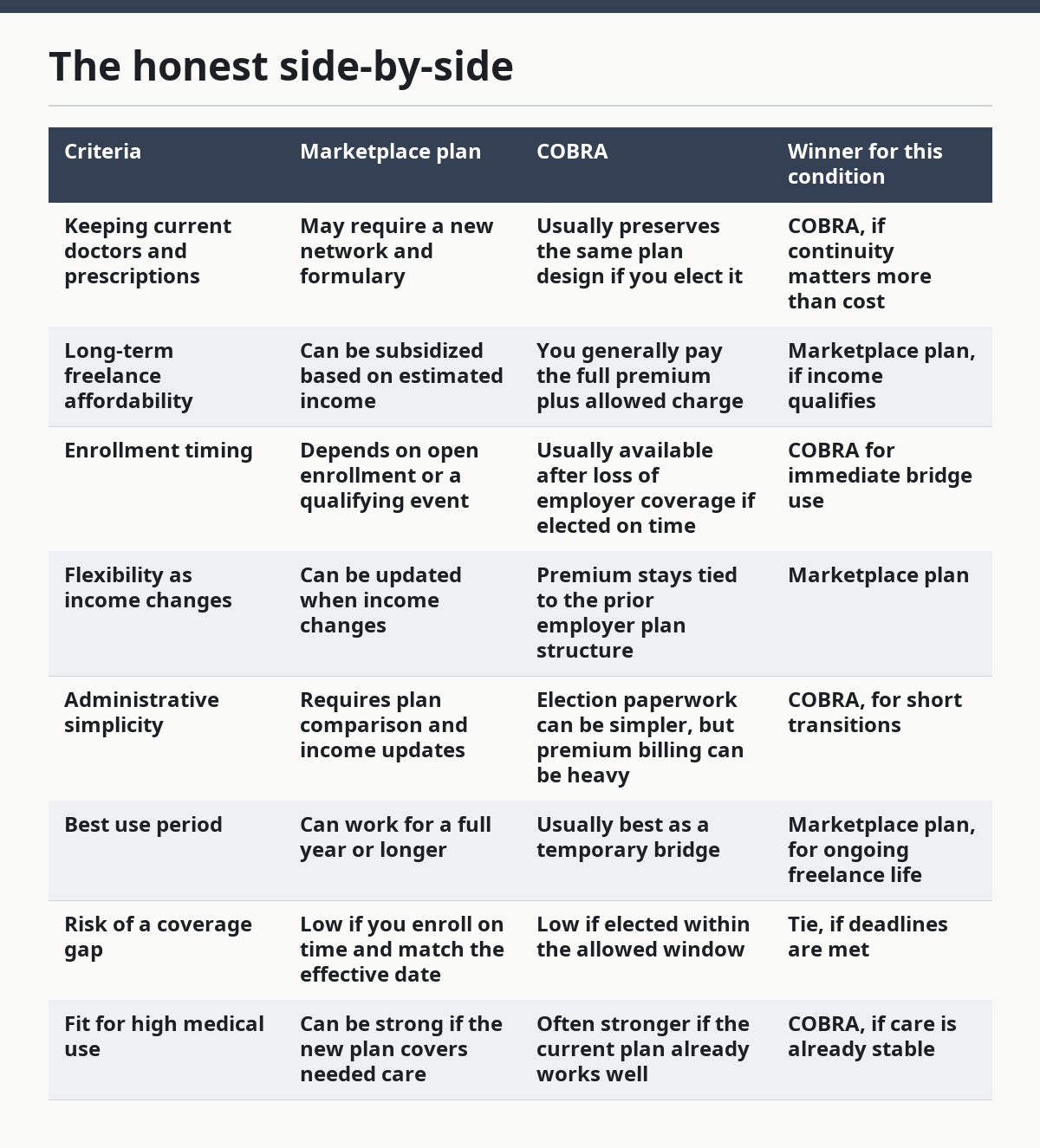
The table is blunt on purpose: marketplace coverage is usually the better freelance setup, but COBRA is the better short-term continuity tool. A freelancer who expects income to bounce around over the next 6 to 12 months usually benefits more from the marketplace. A freelancer in the middle of treatment, surgery follow-up, or prescription stability may rationally pay more for COBRA because the network continuity is worth it.
The weakness of the marketplace route is that you are taking on plan selection risk. The weakness of COBRA is that you may be paying for a familiar structure that no longer fits your budget. One option is cheaper because it transfers more risk to you. The other is pricier because it keeps the old arrangement intact.
When the best answer is not either of those options
Neither marketplace coverage nor COBRA is the right answer when the real problem is that your work, income, or family setup changed more than your current plan can absorb. In that case, the cleaner move is to change the whole strategy.
If your income is now low enough that you may qualify for Medicaid, check that first instead of stretching for a premium you cannot sustain. If your spouse or partner has an employer plan and the dependent cost is manageable, that may be the cleanest household solution. If your freelance income is still unstable and you are using short-term medical coverage as a bridge, stop and read the exclusions carefully. Short-term policies often do not behave like comprehensive health insurance, and they can leave exactly the kinds of bills freelancers fear most.
There are also times when the right answer is to restructure the business. A freelancer who is carrying client-facing risk without liability coverage should not treat health insurance as the only decision. If the work now includes advice, access to client systems, or physical presence on site, the business may need professional liability, general liability, and cyber coverage before it needs a cheaper health plan.
This is the section that most generic articles skip: the correct solution sometimes is not a swap, but a reset. If your current arrangement only worked when you were a W-2 employee, stop trying to preserve it piece by piece. Build a freelancer setup that matches your actual risks.
What should you do in the first 48 hours after a coverage change?
You should verify dates, preserve proof, and choose the next protection before the old one ends. That order matters more than shopping for the perfect policy.
In the first 24 hours, gather the cancellation notice, renewal email, policy declaration page, employer separation notice, or client contract change that triggered the review. Then identify the deadline: 30 days, 60 days, month-end, or open enrollment. If the deadline is not obvious, call the carrier, benefits administrator, or marketplace support line and get the election window in writing or by email.
In the next 24 hours, decide whether the problem is temporary or structural. Temporary problems often favor COBRA or a short bridge while you compare plans. Structural changes—new income level, new family status, new line of work—usually call for a longer-term replacement. Do not let urgency push you into the first plan you see unless it preserves access you truly need.
Then update the parts of your financial life that depend on the coverage choice. That includes automatic premium payments, tax estimates, client invoice reserves, and any contract language that requires proof of insurance. A freelancer who waits until the next billing cycle is already behind.
The practical rule is simple: no uncovered day, no undocumented assumption, no policy you have not read. That sounds strict because coverage gaps are expensive in ways people do not feel until they file a claim or hit a deductible they thought they had avoided.
Which choice is right for a freelancer?
Choose a marketplace plan if you want the best long-term fit for freelance income, subsidy flexibility, and a coverage setup that can change with your earnings. Choose COBRA if you need the old plan’s doctors, prescriptions, or treatment continuity for a short, defined bridge. Neither if your real issue is Medicaid eligibility, a spouse’s plan, or a business risk that requires liability or disability coverage instead of a health-plan swap.
That is the cleanest decision rule because it separates the temporary from the structural. A freelancer who expects more change in the next year should build around flexibility. A freelancer in active treatment or with a doctor network they cannot afford to lose should pay for continuity. A freelancer with a small or unstable business should not force a health-only solution onto a broader risk problem.
The wrong choice is the one made after the deadline. The right choice is the one made with the policy dates, the cash flow, and the actual work in front of you.
What if I miss the enrollment deadline?
If you miss the deadline, the next step is to check whether another qualifying event still opens a special enrollment period. A move, marriage, birth, adoption, loss of coverage, or some income changes can create a new window depending on the plan rules and your state.
If no new qualifying event exists, you may have to wait for open enrollment or use a temporary bridge where allowed. That is why proof and dates matter so much in the first 48 hours. Missing the deadline is not just inconvenient; it can force you into a less ideal plan for months.
Is COBRA always too expensive for freelancers?
No, COBRA is not always too expensive, but it is often expensive relative to freelance income because you usually pay the full cost of the prior employer plan structure. That can still be the right choice for a short period if you need uninterrupted access to specific doctors, medications, or ongoing treatment.
The real comparison is not COBRA versus “cheap.” It is COBRA versus the cost of switching networks, changing prescriptions, or risking a gap. If those costs are higher, COBRA may be the rational bridge.
Do I need to update liability coverage when my freelance work changes?
Yes, because the work itself determines the risk. A new client type, a new service, or access to client systems can change what your policy should cover even if the business name stays the same.
A freelancer should review exclusions, endorsements, and coverage limits whenever the deliverables change. If the policy only covered one type of service, the new work may not be insured unless you update it. This is especially important for consultants, developers, designers, and contractors whose exposure rises with the complexity of the work.
Should I change my retirement contributions when coverage changes?
Yes, if the coverage change also affects your income or tax picture. A lower income year may make a solo 401(k) or SEP IRA contribution easier to support, while a higher income year may require a bigger reserve for premiums and deductibles.
Retirement savings do not replace health coverage, but they do help stabilize the same freelance cash flow that pays for coverage. If the premium moved up and income moved down, you may need to rebalance both rather than treating them as unrelated decisions.
Drafted with AI; not yet reviewed by a person.