How freelancers compare family coverage choices when one person needs

Last updated: November 19, 2026
Quick answer: how freelancers compare family coverage choices when one person needs different care comes down to 3 numbers: the monthly premium, the family deductible, and the out-of-pocket maximum. Freelancers usually compare a family health plan against separate policies by asking one question: will one shared plan actually pay for the person who needs different care, or will separate coverage protect the household better? The right answer depends on the family deductible, the out-of-pocket maximum, and whether the spouse or dependent who needs special care uses the same doctors and drugs as everyone else.
Key takeaways
- A single family plan can simplify bills, but it can also make one person’s high use drain the household budget faster.
- Separate policies can work when one family member has very different care needs, but they add more cards, more claims, and more rules.
- The family deductible matters as much as the premium, because one person may have to spend a lot before the plan pays more.
- The out-of-pocket maximum can cap damage, but only after the household has already paid enough in covered costs.
- The better choice is usually the one that fits the person with the highest expected care needs, not the cheapest-looking premium.
For the background on plan fit, this page sits under the site’s plan selection and coverage fit hub. For standard plan terms, Healthcare.gov’s family coverage page and Healthcare.gov’s family deductible page are useful starting points, and the Kaiser Family Foundation has plain-English explanations of how family plans often work.
What is the real choice here?
The real choice is between one shared family health plan and two separate policies for the household. That choice matters most when one person needs different care, because that person can change the value of the premium, the deductible, and the out-of-pocket maximum for everyone else.
If the family shares one plan, the household usually has one premium and one set of rules. That can help when everyone mostly uses the same doctor network and similar types of care. If the household splits coverage, the spouse or dependent with different needs may get a plan that fits that care better, but the family now has two premiums and two claims systems to manage.
The part many generic articles miss is this: the cheapest premium is not the same thing as the cheapest year. A family plan with a lower premium can still cost more if one person’s care hits the deductible early. A separate policy can look expensive until you see how much better it matches one person’s prescriptions, specialists, or therapy.
When does a family health plan win?
A family health plan wins when the household wants one clear system and the person with higher care needs can use the same network and cost rules as everyone else. That is the better fit for freelancers who value simplicity, predictable billing, and fewer moving parts over fine-tuned coverage.
This choice works best when the spouse or dependent does not need very unusual care. If the family can use the same doctors, same pharmacy network, and same type of plan design, one family plan keeps the paperwork lighter. The plan also keeps one out-of-pocket maximum in play, which can matter when the household expects a lot of covered care in the same year.
The weakness is that one person’s heavy use can push the whole family toward the deductible and cost-sharing faster. If one family member needs frequent specialist visits, regular medication, or ongoing treatment, talk to a licensed benefits professional or insurance navigator and check the plan details before assuming the family plan is best. The family may reach the plan’s cost-sharing thresholds for the whole household before anyone else expected it. That can make a family plan feel expensive even when the premium looked fair at first.
This is the wrong choice for a household where one person needs a very different doctor network, a separate drug list, or care that is much more frequent than everyone else’s. It is also a poor fit if the family already knows that one member’s care will not line up well with the plan’s standard rules.
When do separate policies make more sense?
Separate policies make more sense when one family member’s care is so different that a shared plan would force the wrong network or the wrong cost structure on the whole household. That is the stronger move when the spouse or dependent has specialist-heavy care, different prescriptions, or a pattern of visits that makes one family deductible hard to share fairly.
The big advantage is fit. A separate policy can match the person’s care instead of making the whole family adapt to that one person’s needs. In a household where one person needs frequent care and the others rarely use services, separate coverage can stop the entire family from carrying one person’s cost burden inside a single family plan.
The drawback is that the household is now juggling more than one premium, more than one ID card, and more than one set of rules. That can raise the mental cost even before the financial cost is clear. It can also make it harder to compare apples to apples, because one policy may look better on premium while another is better on prescriptions, visits, or the family out-of-pocket maximum.
This is not the right answer for a household that wants simple administration or that uses the same doctors across the board. It is also a bad fit if the family would spend more time managing coverage than getting care. Separate policies only win when the care difference is large enough to justify the extra complexity.
How do family deductibles and out-of-pocket maximums change the math?
Family deductibles and out-of-pocket maximums change the math because one person’s care can affect the whole household under a family health plan. That means the person who needs different care may either help the family reach cost-sharing faster or make the family spend far more before the plan pays at a higher level.
A family deductible often works like a shared threshold. One person’s medical bills can count toward it, and once enough covered costs add up, the plan starts paying more under its rules. The family out-of-pocket maximum is the ceiling on covered spending for the household, but reaching it can still mean a lot of paid claims first.
Here is the comparison that matters most, and it is worth checking with the plan documents or a benefits adviser before deciding:
| Criteria | One family health plan | Separate policies | Winner for this condition |
|---|---|---|---|
| Monthly premium count | One premium for the household | More than one premium | Family plan when simplicity matters |
| Doctor network | One network to check | Two networks to check | Family plan when everyone uses similar providers |
| Family deductible | One shared threshold | Separate thresholds | Separate policies when one person’s care is very different |
| Out-of-pocket maximum | One household cap | Separate caps | Family plan when high use is likely across the family |
| Billing complexity | One set of claims rules | Two sets of claims rules | Family plan for low admin stress |
| Fit for one person’s special care | May be a poor match | Can be tailored better | Separate policies for different care needs |
| Prescription fit | Must work for everyone | Can be matched to the person | Separate policies when drug needs differ sharply |
| Risk of one person driving costs | Higher | Lower across the household | Separate policies when one person uses lots of care |
| Ease of tracking spending | Easier | Harder | Family plan for busy households |
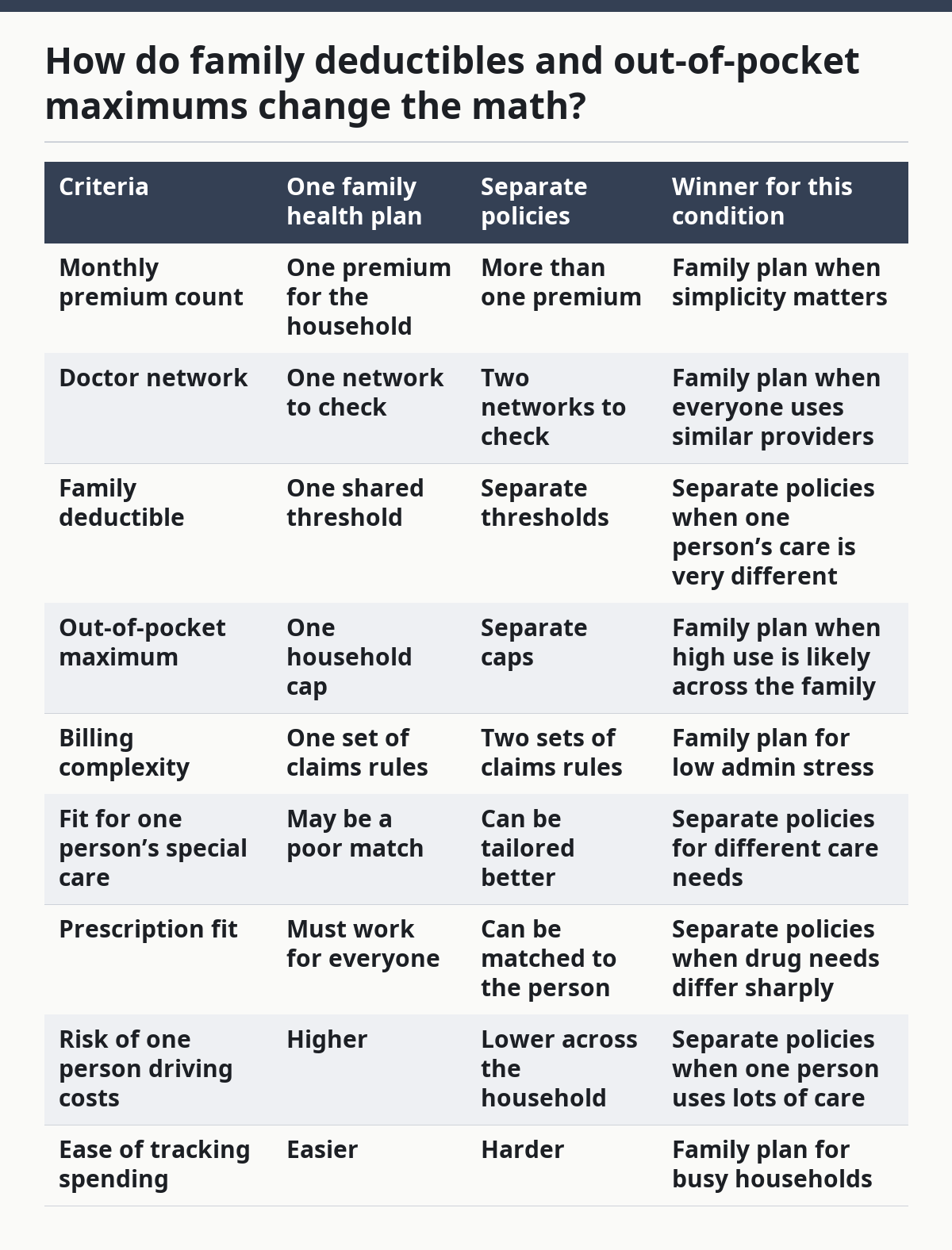
The key mistake is treating premium as the whole decision. A lower premium can hide a family deductible that is hard to meet, while a separate policy can look expensive until it avoids the wrong kind of cost sharing. The family with the person who needs different care should look at the full year, not just the monthly bill.
What should freelancers compare first?
Freelancers should compare the care pattern first, then the premium, because the care pattern decides which plan design is likely to work. If the spouse or dependent needs different care, the first question is not “which premium is lower?” It is “which plan actually fits that person’s doctors, drugs, and visit pattern?”
Start with three things: the network, the prescriptions, and the expected use. If the person with special needs already has a specialist or a drug that matters, that should drive the comparison. A plan that misses the needed provider or medication can create friction that no premium savings will fix.
Then compare the family deductible and the out-of-pocket maximum. Those two numbers show how much the household may have to spend before the plan starts helping more, and how much the year can cost in covered care. For a freelancer, that matters because income can be uneven, which makes a surprise bill harder to absorb.
Two good references for this type of comparison are Healthcare.gov and the Kaiser Family Foundation’s health reform guides. They help frame the terms, even though the final decision still depends on the household’s own care pattern.
When should the answer flip?
The answer should flip when the care difference is large enough that the household is paying for convenience instead of coverage. That happens in a few clear cases.
First, if one family member has a provider network that does not fit the other people at all, separate policies become the cleaner choice. A shared plan only helps if it can serve the people on it.
Second, if one person’s care is routine while another person’s care is frequent and specialized, one family plan may overcharge the whole household for a benefit only one person uses. In that case, the family should check whether separate policies reduce the total burden.
Third, if the family wants to keep one person’s medical use from affecting everyone else’s deductible path, separate coverage can give the household more control. That matters when one person has ongoing care and the others do not.
Fourth, if the family cannot handle the admin load of two plans, the flip does not happen. Simpler paperwork is still worth real money. A plan that is technically better but never gets used correctly is the wrong plan.
Which option should a freelancer choose?
Choose a family health plan if one shared network and one set of rules fit the whole household, even if one person needs different care. Choose separate policies if the spouse or dependent with different care has needs that would distort the family deductible, the provider network, or the prescription fit. Neither if the household has not checked the actual doctors, drugs, and yearly care pattern first.
That is the cleanest rule for freelancers. The plan should match the person with the most unusual care need, but only when the rest of the household can live with the added complexity.
Should a freelancer put everyone on one family plan?
A freelancer should put everyone on one family plan only if the family can live with one network, one deductible path, and one out-of-pocket maximum. That is often the simplest choice when the household uses similar doctors and does not expect one person’s care to dominate the year.
The risk is that one member’s higher use can make the family pay more under the shared plan. If the spouse or dependent needs care that looks very different from everyone else’s, a family plan may be efficient on paper but poor in practice.
When does separate coverage make sense for a household?
Separate coverage makes sense when one person’s care needs are clearly out of step with the rest of the family. That can mean a different provider network, a different prescription list, or a much higher level of use than the others.
It also makes sense when the household can handle two sets of premium payments and claims. If the family wants less paperwork, the financial benefit of separate coverage may not be worth the added hassle.
How do family deductibles work?
A family deductible is the amount the household must pay in covered costs before the plan starts paying more under its rules. In many plans, one person’s bills can count toward that family total, so one member’s care can move the whole household closer to cost sharing.
That helps some families and hurts others. If one person needs a lot of care, the family may reach the deductible faster, but that same fact can also make the year more expensive before the plan starts helping.
Drafted with AI; not yet reviewed by a person.