Last updated: November 19, 2026
Key Takeaways
- The exchange setup, not the plan type, is what usually changes for freelancers.
- State-run exchanges can be easier for freelancers who want local help and state-specific enrollment rules.
- Healthcare.gov is often the simpler path in federal marketplace states because the process is standardized.
- For freelancers, deadlines and documents are where the biggest differences show up.
A state health insurance exchange can make freelance coverage easier to shop, or it can add state-specific rules that matter at enrollment time. The main question in How do state health insurance exchanges differ for freelancers? is not whether a marketplace exists; it is who runs it, how deadlines are set, and how local enrollment rules affect a self-employed person who needs coverage without employer help. This is information, not financial advice, and a qualified adviser should be consulted for your own situation.
Freelancers who are comparing state exchanges with Healthcare.gov usually want one answer: which path gives the cleaner enrollment experience and the fewest surprises? For that question, the answer is simple. Use the exchange that covers your state of residence, then check whether your state runs its own marketplace or uses Healthcare.gov, because that determines where you shop, which dates apply, and where you confirm eligibility rules. For a broader overview of marketplace coverage for freelancers, see the Marketplace Coverage for Freelancers.
The real difference is who runs the exchange, not what the plan does
Therefore, the exchange itself is the difference that matters. A state-run exchange is administered by the state; a federally run marketplace is accessed through Healthcare.gov and operated by the federal system for states that do not run their own exchange. See Healthcare.gov and the KFF marketplace overview for the structure of the marketplaces.
For a freelancer, the plan categories are still the same basic marketplace metal tiers, but the enrollment experience can differ in a few practical ways. State exchanges may use their own websites, their own help lines, and their own notices about enrollment windows. Some states also set rules that are tighter than the federal baseline, especially around deadlines, special enrollment proof, or local outreach. That means a freelancer in one state can face a different application path than a freelancer in another state even if both are shopping for similar coverage.
This is why generic advice often misses the point. A freelancer does not usually need to learn the theory of the ACA marketplace again. They need to know where the application happens, whether the state has its own enrollment calendar, and whether a local exchange asks for extra documentation. The federal site, Healthcare.gov, still serves as the front door for many states, but in state-run systems the state exchange itself becomes the main place to compare plans and finish insurance enrollment.
The practical takeaway is not that one system is inherently better. It is that the state exchange can change the process around the plan, which is exactly where freelancers tend to run into deadlines and paperwork problems.
State-run exchanges: who they fit best and where they can be better
Because state-run exchanges are local, they often work better for freelancers who want state-specific guidance and a cleaner path to local enrollment rules. That advantage is real because the state agency can tailor notices, call centers, and deadlines to its own insurance market.
A freelancer who moves around, has irregular income, or needs a special enrollment period checked quickly may do better in a state-run marketplace if the state has built stronger consumer support. Some state exchanges also publish clearer local guidance on proof of qualifying life events, which can matter if you lose other coverage and need to enroll midyear. In a state-run system, the rules are still official marketplace rules, but the state may explain them in plainer language than a national portal does. For federal guidance on special enrollment periods, see Special Enrollment Periods.
The weakness is that state exchanges are not all equally easy to use. Some are smooth and well organized; others feel fragmented because the state has its own deadlines, its own login, and its own document requests. A freelancer who expects one national process can get tripped up by a state deadline that does not match the federal default. That can create a missed window if the applicant assumes the same timing applies everywhere.
A state exchange is usually the right fit for freelancers who live in a state with a strong exchange, clear guidance, and active consumer assistance. It is a weaker fit for someone who wants a single uniform process across state lines or who dislikes tracking local updates. The choice is not about better insurance in the abstract. It is about whether the state’s enrollment machinery helps or complicates a self-employed person’s application.
For reference, the federal marketplace has published state-by-state participation information through Healthcare.gov, and the National Association of Insurance Commissioners also explains state regulation of health coverage in plain terms. Those are useful anchors when you are checking how your own state handles enrollment.
Healthcare.gov states: when the federal marketplace is the simpler route
However, Healthcare.gov is the simpler route for freelancers in federal marketplace states because the application flow is standardized and the federal site handles enrollment for those states. That consistency is the main advantage.
If a freelancer lives in a state that uses the federal marketplace, the practical benefit is fewer local variations to memorize. The site gives one starting point for plan comparison, eligibility screening, and enrollment. That matters when freelance income changes during the year and the applicant needs to revisit the marketplace more than once. A single federal system can reduce confusion about where to start.
The downside is less local tailoring. Federal marketplace states rely on a national framework, so the guidance may feel less specific to a local insurance market. A freelancer who wants state-branded support, local enrollment events, or state-level consumer service may find the federal structure less personal. The platform still works, but it can feel less adapted to the quirks of a particular state.
This option tends to fit freelancers who prefer predictability over customization. It also fits people who do not want to keep track of multiple state-specific portals if they move, travel, or work remotely. The trade-off is that the national system may not surface every local nuance as clearly as a state exchange does.
Here is the concise version: if your state uses Healthcare.gov, that is the marketplace you use for enrollment. If your state runs its own exchange, you go there instead. Freelancers do not get to pick between them freely; the state determines the platform.
What changes for freelancers: deadlines, income timing, and local rules
So freelancers feel the difference most in deadlines and documentation. Those are the parts of marketplace coverage that can change a decision from easy to frustrating.
A state exchange may set its own enrollment deadlines, and those dates can differ from the federal marketplace schedule. That matters because freelancers often do not have a neat employer enrollment period. If income changes after a contract ends or a client drops, the question becomes whether the state exchange recognizes a special enrollment period and what proof it wants. A state may ask for specific documents, use its own online upload process, or set its own follow-up timeline.
This is also where income timing creates trouble. Freelancers often estimate yearly income from variable work, not a single salary. If the exchange process is clunky, the person may enter an estimate, qualify, then later need to update the estimate when work changes. The marketplace system can handle income updates, but the steps and prompts may differ by exchange. That means the local process matters as much as the plan list.
State rules can also affect language access, navigator availability, and notices about eligibility. Those are not cosmetic details. They shape whether a freelancer completes insurance enrollment on time or gets stuck halfway through. A state exchange can be better if it offers stronger help; it can be worse if it asks for more back-and-forth.
Therefore, the cleanest advice is to treat the exchange as part of the coverage choice. A freelancer is not just choosing a plan. They are choosing an enrollment system with its own deadline calendar, its own proof rules, and its own way of handling changes. If you are unsure, consult a licensed broker or navigator before you apply.
Side-by-side: state exchange versus Healthcare.gov
Overall, a state exchange is usually better for freelancers who want local guidance; Healthcare.gov is usually better for freelancers who want one national process. The difference shows up in the details that affect enrollment, not in the basic idea of marketplace coverage.
| Criteria | State exchange | Healthcare.gov | Winner for which condition |
|---|---|---|---|
| Who runs it | State agency | Federal government through Healthcare.gov | State exchange if you want local control |
| Enrollment portal | State-specific site | One federal site | Healthcare.gov if you want one familiar interface |
| Deadline handling | Can reflect state-specific dates | Uses federal marketplace timing for participating states | State exchange if your state publishes clearer local deadlines |
| Help and support | Often more locally tailored | National support structure | State exchange if local assistance matters |
| Special enrollment details | May have state-specific documentation rules | More standardized federal process | Healthcare.gov if you want consistency |
| Language and outreach | Can be customized by state | Broad national model | State exchange if your state has strong outreach |
| Moving between states | You may need to learn a new portal | Same federal brand in many states | Healthcare.gov if you may relocate |
| Rule complexity | Can be more varied | Typically more uniform | Healthcare.gov for simplicity |
| Best for irregular freelance income | Useful if state support is strong | Useful if you want a straightforward update process | Depends on how much help you need |
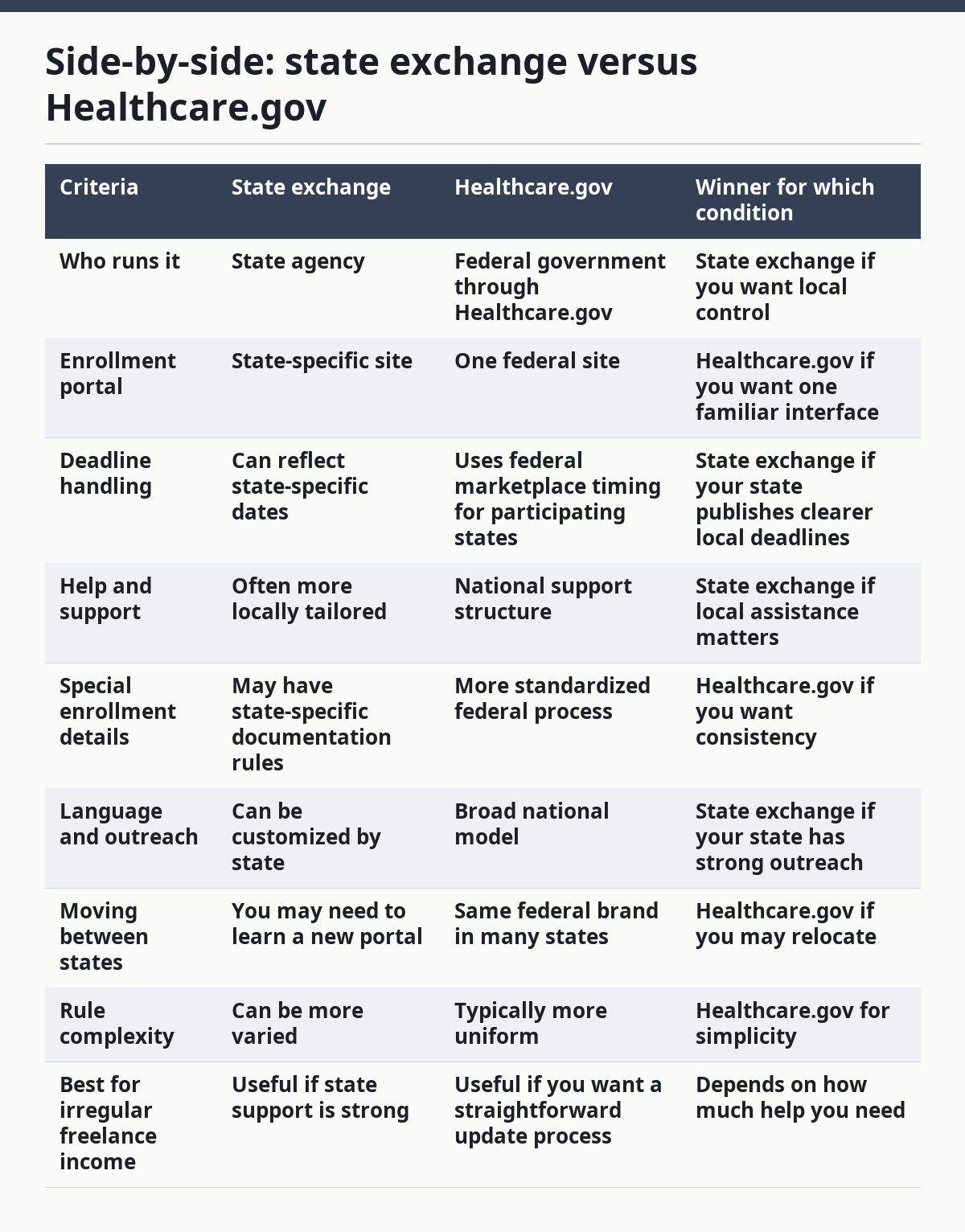
The table makes the main point clear: the choice is about process friction. A state exchange can give more tailored help, but it can also create more local variation. Healthcare.gov can be less personal, but it is easier to recognize and handle if you hate surprises.
For a freelancer, that difference often matters more than the plan labels themselves. The metal tier or insurer lineup may not change just because the portal changes, but the route to getting covered absolutely can.
Which one should a freelancer choose?
Before you choose, decide whether your state runs its own exchange. Choose a state exchange if your state runs one and you value local help, state-specific deadlines, or clearer consumer support. Choose Healthcare.gov if your state uses the federal marketplace and you want a more standardized enrollment process with fewer local variations. Neither if you need private employer-style coverage, are outside the marketplace eligibility rules, or have a situation too complex to handle without professional guidance.
That is the cleanest recommendation because it matches the real decision point. Freelancers do not need two theories of health insurance; they need the right enrollment channel for their state. A state exchange is the better choice when local guidance reduces friction. Healthcare.gov is the better choice when uniformity matters more than customization.
The wrong move is treating all marketplaces as interchangeable. They are not. State deadlines, document requests, and support channels can differ enough to affect whether a freelancer finishes enrollment on time. The plan may be a marketplace plan either way, but the path to getting it is not the same. If the choice is unclear, ask a licensed insurance professional.
When the usual answer flips
Once the usual answer flips, it is because your state’s exchange is hard to use, you are moving states soon, you need to resolve a special enrollment issue quickly, or your freelance income is changing so often that you need the simpler administrative path. In those situations, the “better” marketplace is the one that lets you complete enrollment with the least confusion.
A state exchange can lose its advantage when the local portal is clumsy or slow. It can also lose it if the state changes deadlines in ways that are hard to track. That creates more risk for a freelancer who is already juggling variable income and changing client work.
The reverse can happen too. A state exchange can be the better option if it offers better local assistance, better notices, or more understandable proof requirements than the federal route. That is why a state-by-state check is not busywork. It is the actual decision.
How do I find my state marketplace?
Next, find your state marketplace by checking whether your state uses its own exchange or Healthcare.gov. If your state runs a state exchange, it will usually have a dedicated enrollment website and state contact information; if not, Healthcare.gov will route you to the federal marketplace for your state. See HealthCare.gov and your state department of insurance.
The fastest check is to start with Healthcare.gov’s state marketplace information and confirm your state’s setup there. You can also look for your state health department or insurance department, which often links directly to the correct enrollment page. For a freelancer, that small verification step prevents the most common mistake: applying in the wrong place and missing the state deadline.
If you are unsure, use the official state or federal marketplace source rather than a blog summary. Marketplace rules change, and the enrollment path is one of the last places where guessing is costly.
Drafted with AI; not yet reviewed by a person.