How freelancers compare prescription drug coverage across health plans

Last updated: November 19, 2026
Key Takeaways
- Check the formulary first; the right plan is the one that matches your current prescriptions.
- Tiers often shape costs more than the monthly premium does.
- Generic drugs usually mean lower costs and fewer coverage hurdles.
- Specialty drugs need extra review because the rules can be stricter.
Freelancers compare prescription drug coverage across health plans by looking past “covered or not covered” and checking the formulary, drug tier, prior authorization rules, and refill options. Quick Answer: the best plan is often the one that fits your medicines, not the one with the lowest premium. That is the part of prescription drug coverage that changes what you actually pay and whether you can keep getting the medicine on time.
If you buy your own health plan, the drug section can look simple at first glance and still be expensive in practice. A plan that covers your medication may still put it on a high tier, require prior authorization, or force a 30-day retail refill when a 90-day mail-order pharmacy would be easier. The CMS formulary rules explain why that happens.
A reader who understands pharmacy benefits can pick a plan with fewer surprises. I write on health plan selection for freelancers, and the drug side is where the fine print matters most. For broader plan shopping, see the main health plan selection for freelancers hub and the article on how to compare health insurance premiums and out-of-pocket costs.
What freelancers should compare first in prescription drug coverage
The first thing to compare is not the premium; it is whether the plan’s formulary fits the medicines you already take. A formulary is the plan’s list of covered drugs, and the list is only the starting point. Two plans can both cover the same medication and still treat it very differently through tiering, refill limits, and utilization management. Consult a pharmacist or clinician if you are not sure how your prescription is classified, because the plan’s rules can change the final cost.
Start with the exact drug name, dosage, and form you use. A tablet and an extended-release capsule are not interchangeable on a formulary page, and a generic drug may be covered when the brand-name drug is placed in a much higher tier. If your prescription is a specialty drug, check whether the plan treats it as specialty pharmacy only; those drugs often have tighter rules and can require a separate dispensing channel. If the formulary wording is unclear, ask the plan or your prescriber before you enroll.
The practical comparison looks like this: does the drug appear on the formulary, which tier is it in, is there a generic version, and does the plan impose prior authorization or step therapy? Those details decide whether you pay a routine copay, a much higher coinsurance amount, or nothing at all until the plan approves the prescription. A lower tier often means a lower bill, but the exact amount depends on the plan design.
Use the insurer’s drug search tool, then confirm the result against the actual formulary document for the exact plan year. The search tool is faster; the PDF is usually more precise. If the two disagree, the PDF or summary of benefits is the safer reference. For a broader decision framework, this fits the same plan-selection process described in the main health plan selection for freelancers hub.
How drug tiers change what you pay
Drug tiers matter because they usually determine the size of the bill more than the premium does. A lower tier often means a generic drug or preferred brand-name drug with a lower copay, while a higher tier usually means a non-preferred brand or specialty drug with more cost-sharing. The exact structure varies by insurer, but the pattern is consistent: the farther up the tier ladder, the more expensive the prescription tends to be for the member.
Freelancers often miss the hidden cost here. A plan may advertise coverage for a medication but place it on a tier that makes it a poor deal compared with another plan. That is especially true when one plan uses flat copays and another uses percentage coinsurance for specialty drugs. A 20% share on an expensive medicine can be less predictable than a fixed copay, so check the drug and the plan rules together.
A simple way to compare is to map each of your prescriptions to the tier list before you compare premiums. One plan might look cheaper per month, but if your regular medicine sits on Tier 4 instead of Tier 2, the yearly total can move in the wrong direction quickly. That is the real trade-off: lower premium versus higher drug spending.
This is where a generic drug often wins. If your doctor can prescribe the generic version safely, the plan usually gives you the cleanest path through the formulary. Brand-name drugs can still be worth it when there is no substitute or when the generic has not worked for you, but that is the expensive route unless the plan gives the brand a preferred position.
The real difference between generic and brand-name coverage
Generic coverage wins for most freelancers because it usually gives the same active ingredient with lower out-of-pocket costs and fewer formulary hurdles. Brand-name coverage can still be the better fit when the brand is the only clinically appropriate option or when the plan’s formulary gives that brand a preferred tier.
That difference sounds simple, but it becomes meaningful when you compare real plan rules. Some plans cover both versions of a drug but only treat the generic as preferred. Others cover the brand-name drug only after the generic has been tried, which is where step therapy can appear. A few plans exclude the brand altogether unless the prescriber requests a medical exception.
The key point is that “covered” does not mean “easy to fill.” A generic drug may still need prior authorization in unusual cases, but it is much less likely to trigger extra paperwork than a brand-name drug or a specialty drug. For a freelancer who wants predictable monthly spending, the generic route is usually the safer choice. The FDA explains that generics have the same active ingredient as their brand-name counterparts.
Brand-name coverage is the better fit when the prescription is stable, the brand is clinically necessary, and the plan’s tier structure is still reasonable. It is the wrong fit for someone who takes several maintenance drugs and needs low-friction refills. In that case, a plan with stronger generic placement and a better mail-order pharmacy program usually beats a plan that advertises broad brand coverage but puts those drugs on high tiers.
A useful source for the mechanics of these tiers is the U.S. Centers for Medicare & Medicaid Services’ explanation of formularies and drug coverage, which lays out how plans categorize covered medicines. For plan design and consumer rights, check the insurer’s own formulary documents or your state insurance department’s consumer page.
Where specialty drugs and prior authorization change the math
Specialty drugs are the point where many freelancers should slow down and read every rule twice. These drugs are often expensive, may need special handling, and are commonly restricted to specific pharmacies or prior authorization. If your medicine falls into this category, the plan’s label “covered” is not enough to judge value.
Prior authorization means the insurer wants approval before it will pay. That can delay a first fill, a refill, or a dosage change. It can also create uncertainty for a freelancer who cannot afford a gap in treatment. Some plans use it only for a narrow set of higher-cost drugs; others apply it more broadly. The burden is not just paperwork. It can mean an extra call to the doctor’s office, a wait for review, or a denial that has to be appealed.
Specialty drug coverage also changes where you can fill the prescription. A plan may require a designated specialty pharmacy rather than a neighborhood chain. That can be fine if the shipping schedule is reliable, but it is a real problem if you need quick local access or if cold-chain handling matters.
This is the section where many generic comparison charts fail. They say “prescription coverage included” and stop there. For a freelancer with a specialty medicine, the real question is whether the plan makes access predictable. If it does not, a lower premium is not much of a bargain.
Is a mail-order pharmacy worth it for freelancers?
A mail-order pharmacy is worth it when you take a stable maintenance drug, can plan ahead, and want fewer trips to a store. It is usually less useful for one-off antibiotics, short courses, or medicines that need rapid changes. The best comparison point is whether the plan offers 90-day refills by mail and whether that refill counts the same as three 30-day retail fills or gives a discount.
Mail-order can improve convenience, and for many maintenance drugs it can reduce refill friction. That matters for freelancers because time lost on pharmacy trips is time not spent working. A 90-day supply also means fewer refill events to track during a busy month.
The drawback is flexibility. If your dose changes often, a mail-order setup can leave you with extra medication or the wrong supply length. Some plans also limit which drugs can be mailed or require the first fill to happen at a retail pharmacy before mail order becomes available. That matters when a new prescription is still being adjusted.
A freelancer who travels often or lives far from a preferred pharmacy may find mail order especially useful. A freelancer who switches medications frequently should treat it as optional, not essential. The better plan is the one that offers both retail and mail options without making either path difficult.
The honest side-by-side
The strongest plan for a freelancer is the one that gives the best access to the specific drugs they take, not the one with the slickest premium quote. If one plan has better tiers for your actual prescriptions and another has lower premiums but worse refill rules, the first plan often wins in real life.
| Criteria | Plan with stronger formulary fit | Plan with weaker formulary fit | Winner for this condition |
|---|---|---|---|
| Exact drug listed on formulary | Yes, for the exact dosage/form | Covered only in a different form or not listed | The plan that lists the exact prescription |
| Tier position | Lower tier for the medicine | Higher tier or non-preferred placement | The plan with the lower tier |
| Generic drug option | Preferred and easy to fill | Covered but not preferred | The plan that favors the generic |
| Brand-name drug access | Covered with fewer hurdles | Needs exception or high cost-sharing | The plan with simpler brand access |
| Prior authorization | None or limited | Required for routine fills | The plan with less authorization |
| Specialty drug rules | Clear specialty pharmacy pathway | Restricted or unclear | The plan with clearer specialty access |
| Mail-order pharmacy | Available for 90-day refills | Not offered or limited | The plan with mail-order convenience |
| Refill convenience | Retail and mail both workable | Frequent pharmacy friction | The plan with fewer refill barriers |
| Plan stability for the year | Rules match your current treatment | Likely to force a change in medication or pharmacy | The plan that preserves continuity |
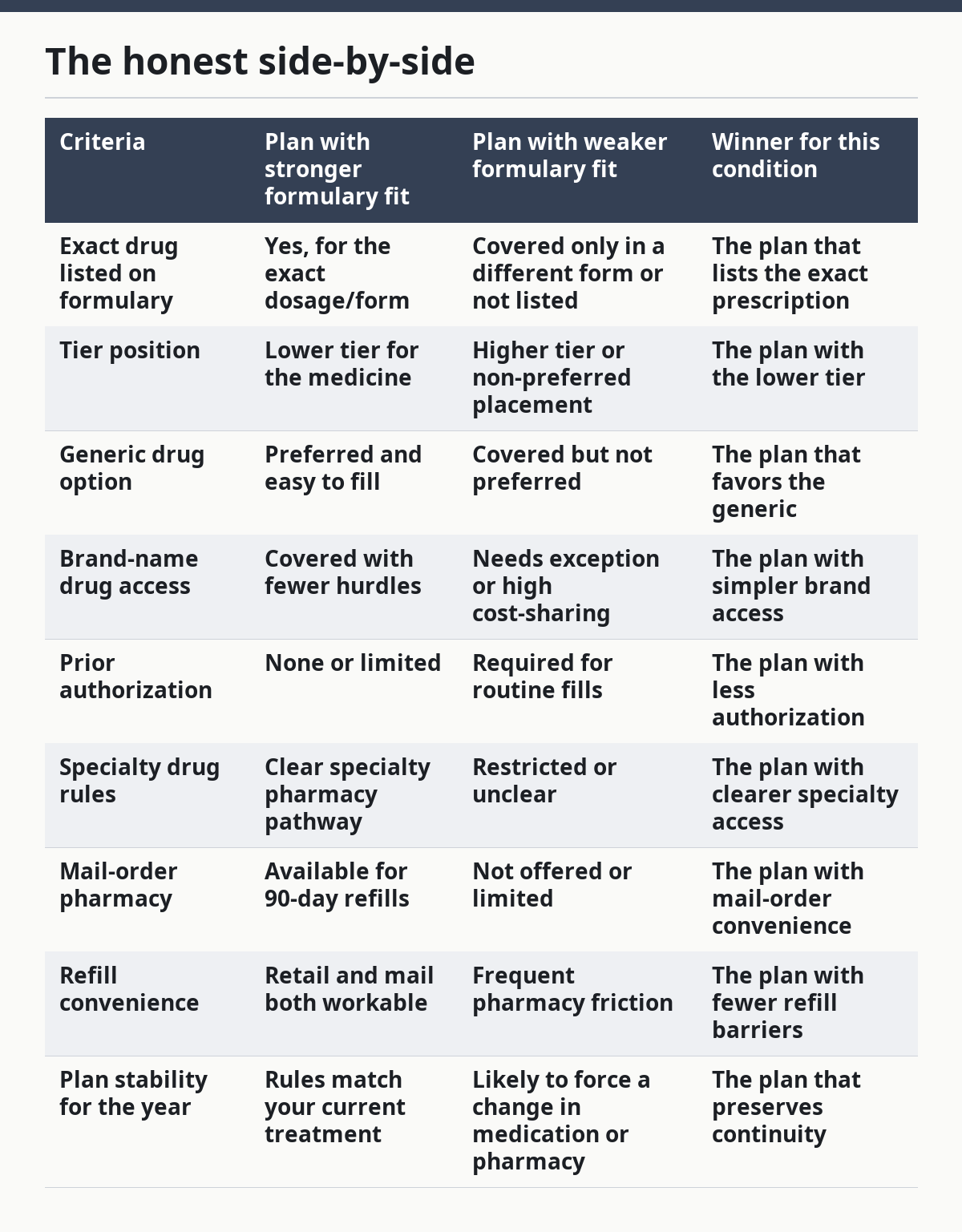
A freelancer who takes one or two maintenance drugs can use this table quickly. A freelancer with multiple prescriptions should treat it as a scoring sheet. The winning plan is not the one that looks best in a brochure. It is the one that causes the fewest interruptions and the smallest number of unpleasant surprises over a 12-month plan year.
When the choice flips
The verdict flips in a few specific situations, and these are worth stating plainly. If your only medication is a brand-name drug that one plan places on a preferred tier while the other treats it as non-preferred, the “better formulary” plan may be the only sensible choice even if its premium is higher.
If you rely on a specialty drug and one plan gives you a clear specialty pharmacy channel with manageable prior authorization while the other plan makes access uncertain, choose the plan with better access even when the premium is not the lowest. Stability beats theoretical savings there.
If you take only inexpensive generics and expect to refill at a local pharmacy every month, a plan with decent generic coverage and no mail-order benefit can still be enough. In that case, the premium may matter more than the extras.
If you move often or travel for work, a plan with a broad pharmacy network and mail-order refills becomes more valuable than a plan that looks slightly better on paper but is tied to one narrow pharmacy setup.
The verdict: which plan should a freelancer choose?
Choose the plan with the better formulary and lower tiers for your actual prescriptions if you take regular medications, need a brand-name drug, or expect any specialty-drug use. Choose the plan with the lower premium and simpler mail-order setup if you mainly use generics and refill stable maintenance drugs. Neither if the plan cannot clearly explain prior authorization, specialty-drug access, or where you can fill the prescription.
That is the cleanest rule for freelancers comparing prescription drug coverage across health plans. It puts the decision where it belongs: on your medicines, not on the marketing label.
What is a drug formulary?
A drug formulary is the plan’s list of covered prescriptions. It usually shows which drugs are covered, which tier each drug sits in, and whether extra rules apply. For freelancers, the formulary is the first place to check because it reveals whether a plan fits the medicines already in use.
How do drug tiers affect what you pay?
Drug tiers affect what you pay by sorting medicines into cost groups. Lower tiers usually mean lower copays or coinsurance, while higher tiers usually mean higher out-of-pocket costs. A drug can be covered and still be expensive if it sits in a higher tier.
Do all plans cover the same prescriptions?
No, they do not. Two plans can cover very different sets of drugs, and even when both cover the same medicine, they may place it on different tiers or require prior authorization. That is why freelancers need to compare the exact prescription, not just the label “prescription coverage.”
Drafted with AI; not yet reviewed by a person.