Last updated: November 20, 2026
Key Takeaways
- ACA coverage offers stronger protection; a fixed indemnity plan mainly offers simpler payouts and sometimes a lower monthly payment.
- A fixed indemnity plan pays a set amount for a covered service, not a percentage of the actual bill.
- ACA marketplace coverage is usually the better fit for most freelancers who need reliable insurance for routine care, specialist visits, prescriptions, and bigger medical events.
- ACA coverage usually wins for real-world protection, while an indemnity plan fits narrower needs with a simpler payout structure.
Freelancers comparing an indemnity plan with ACA coverage usually need one clear answer: ACA coverage is the safer default, and an indemnity plan only makes sense as a narrow backup when you can live with capped benefits and more out-of-pocket risk.
This guide settles the trade-off, the benefit limits, and the claim payout differences that matter most for how freelancers compare indemnity plans with ACA coverage.
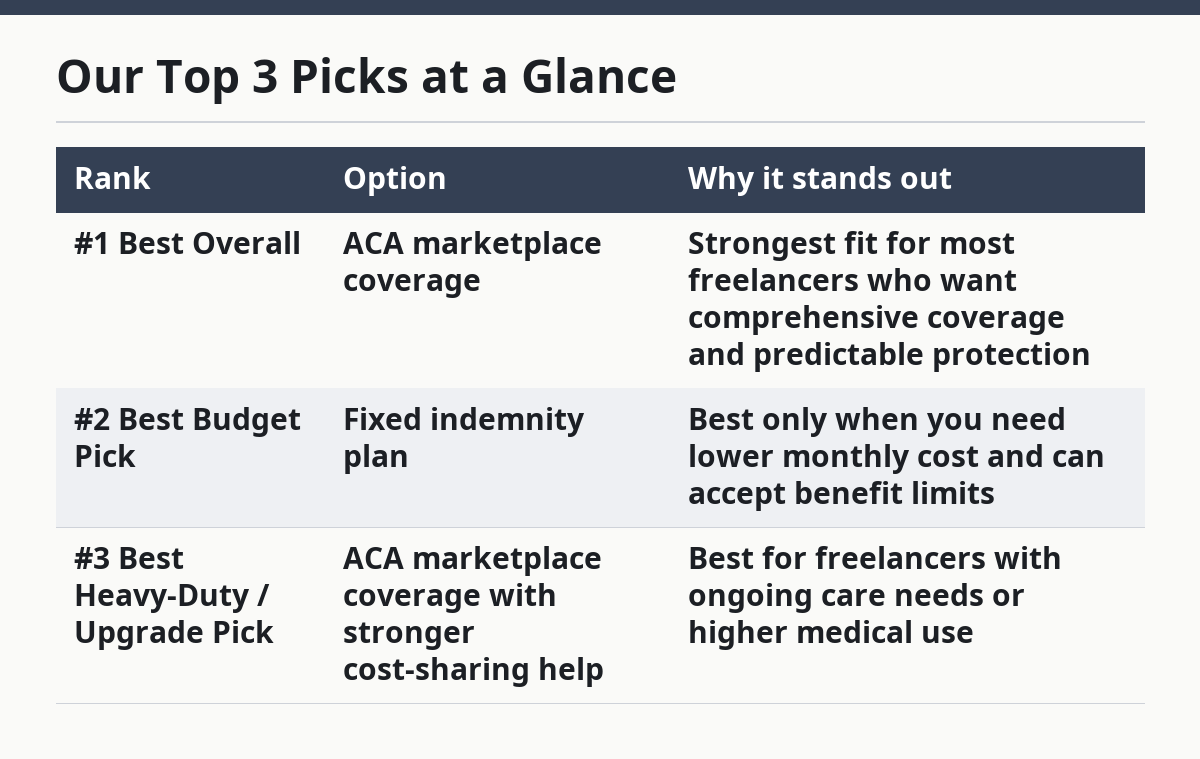
Our Top 3 Picks at a Glance
| Rank | Option | Why it stands out |
|---|---|---|
| #1 Best Overall | ACA marketplace coverage | Strongest fit for most freelancers who want comprehensive coverage and predictable protection |
| #2 Best Budget Pick | Fixed indemnity plan | Best only when you need lower monthly cost and can accept benefit limits |
| #3 Best Heavy-Duty / Upgrade Pick | ACA marketplace coverage with stronger cost-sharing help | Best for freelancers with ongoing care needs or higher medical use |
| Option | Best For | Core Spec | Standout Feature | Action |
|---|---|---|---|---|
| ACA marketplace coverage | Freelancers who want broad medical protection | Includes essential health benefits | No fixed payout cap for covered care in the same way indemnity plans use benefit limits | Compare plans on the ACA marketplace |
| Fixed indemnity plan | Freelancers who need a simple cash-style supplement | Pays a set amount per service or event | Can help with specific bills when used as designed | Read the benefit schedule line by line |
| Indemnity health plan | People who already have other coverage and want limited extra help | Benefit limit applies | Fast to understand, but not built to replace major medical coverage | Use only if the payout structure matches your risk tolerance |
I know the plan-type side of health coverage well enough to spot the traps freelancers miss: payout limits, excluded services, and the false comfort of a low monthly bill.
What’s the real difference between an indemnity plan and ACA coverage?
ACA coverage wins on protection, while an indemnity plan wins only on simplicity and sometimes a lower monthly payment. The difference is not cosmetic — it’s about how the plan pays, what it pays for, and whether your care is covered as medical insurance or as a fixed cash benefit.
For freelancers comparing indemnity plans with ACA coverage, the main issue is fit. A freelancer may want low premiums, but that does not change how the plan works. ACA marketplace plans must cover essential health benefits, while a fixed indemnity plan pays a preset amount for a covered event and can stop far short of the bill.
Here’s the catch: a “benefit limit” is not the same thing as full medical coverage. A fixed indemnity plan may pay a set dollar amount per hospital day, visit, or service, but it does not have to match the total charge. If the bill runs higher, the gap is yours.
- ACA coverage is built for comprehensive care.
- Indemnity coverage is built for fixed payouts.
- One protects against big, messy bills; the other mostly softens them.
How does a fixed indemnity plan pay claims?
A fixed indemnity plan pays a set amount for a covered service, not a percentage of the actual bill. That claim payout structure is the whole story, and it’s why the plan can look helpful on paper while still leaving a large bill behind.
Because the schedule controls the payment, a claim can be approved and still leave a gap. If the provider charges more, the insurer does not automatically absorb the rest the way a broader medical plan is designed to do. The benefit schedule controls the payout, and the schedule is often where people discover the real limit of the plan.
The most important thing to check is the benefit limit. If the plan pays $100 for a visit and the visit costs much more, the rest stays with you. That is not a small detail — it is the core difference between an indemnity plan and ACA coverage.
Key point: fixed indemnity coverage can help with cash flow, but it does not replace comprehensive insurance.
- Read the benefit schedule, not the marketing page.
- Look for per-day, per-service, and per-episode caps.
- Check whether the plan pays extra for hospital stays, imaging, or specialist visits.
- Ask what happens when the provider’s charge is higher than the fixed payment.
ACA marketplace coverage: who actually needs it?
ACA marketplace coverage is the better fit for most freelancers who need medical insurance they can rely on for routine care, specialist visits, prescriptions, and bigger medical events. It wins because the plan is designed to cover a broad set of services, not just send a fixed payout after the fact.
Since freelance income can change month to month, ACA coverage is built for that problem. It is not just about catastrophic protection; it is about access to covered services across the care path. A premium may look higher at first, but the full plan matters more than the monthly sticker price.
The weakness is cost and paperwork. Some freelancers look at monthly premiums and back away before they compare subsidies, deductibles, and provider networks. That can be a mistake. The right ACA plan can still beat an indemnity plan by a mile if you use doctors, medications, or ongoing care.
Who it fits best: freelancers who want one primary plan that covers more than emergencies.
- Better for ongoing prescriptions and follow-up care
- Better if you expect specialist visits
- Better if you want broader protection from large claims
- Better if you do not want to manage a patchwork of fixed payouts
The honest side-by-side
ACA coverage wins the comparison for real-world protection, while an indemnity plan only wins when your main goal is a narrower benefit with a simpler payout structure. The table below shows the decision points that actually change the outcome.
| Criteria | Indemnity plan | ACA coverage | Winner for this condition |
|---|---|---|---|
| Claim payout structure | Fixed amount per covered service or event | Coverage designed around medical bills and covered services | ACA coverage if you want fewer gaps |
| Benefit limit | Yes, the payout is capped by the schedule | No fixed indemnity-style payout cap for covered care | ACA coverage for larger claims |
| Essential health benefits | Often missing or limited | Required on ACA marketplace plans | ACA coverage for broad care |
| Routine doctor visits | May pay only a set amount | Usually covered under plan terms | ACA coverage for ongoing care |
| Specialist and imaging care | May leave large gaps | More complete coverage structure | ACA coverage for complex care |
| Monthly cost feel | Can look cheaper upfront | Can look higher upfront | Indemnity plan for short-term cash flow |
| Financial risk after a big claim | Higher | Lower | ACA coverage for risk control |
| Use as a supplement | Can work as a side benefit | Usually meant as primary coverage | Indemnity plan as a backup layer |
| Suitability for self-employed workers | Best for people with other coverage or low use | Best for most freelancers needing true insurance | ACA coverage for solo coverage |
Here’s the catch: the lower monthly bill on an indemnity plan can hide the real cost. If you use more care than the fixed schedule assumes, you carry the gap. That is why the “cheaper” option often becomes the expensive one later.
- ACA coverage is the safer primary choice.
- Indemnity coverage is a narrow tool, not a full shield.
- The winner depends on whether you need insurance or a cash benefit.
When does an indemnity plan make sense for a freelancer?
An indemnity plan makes sense only when you already know its limits and you want a narrow, defined payout rather than full medical coverage. It can work as a stopgap, a side policy, or a temporary bridge when a freelancer has another form of primary protection.
When the goal is short-term help, a fixed indemnity plan can fit. It is not a substitute for ACA coverage, but it can fit a very specific budget and risk profile. A low-need freelancer with another plan may value the simple payout more than broad benefits.
The downside is obvious once you read the fine print. Benefit limits can run out quickly, the payout structure may not track the real bill, and the plan may ignore the sort of care freelancers actually use most often. That means a visit, scan, or procedure can still create a painful balance due.
Best use case: a freelancer with another strong plan who wants a supplemental cash benefit.
- Short-term bridge, not long-term core coverage
- Lower-need users with a small medical budget
- People who want a fixed payout for a known service pattern
- People who can handle a large bill if the plan pays less than expected
What does ACA coverage cover that indemnity plans often miss?
ACA coverage usually wins because it includes the kinds of care that make medical bills unpredictable in the first place. That means the essential health benefits gap is the real fault line between the two options.
Need a follow-up visit, a prescription refill, lab work, or a specialist appointment? ACA coverage is built to handle that mix. A fixed indemnity plan often pays a predetermined amount, but it does not have to track the full range of services a freelancer may need over 12 months.
That matters because freelancers do not get sick on a neat schedule. One month can be quiet; the next can bring imaging, physical therapy, or a procedure. ACA marketplace coverage is the better fit for that reality.
Two authoritative places to compare the basics are the HealthCare.gov marketplace overview and the Centers for Medicare & Medicaid Services. Those pages explain marketplace coverage and how federal rules shape what plans must cover.
What ACA usually does better:
- Covers a broader set of services
- Handles bigger and messier claims more predictably
- Reduces the chance that a single event blows up your budget
- Works better as a stand-alone plan for a freelancer
The verdict: which one should a freelancer choose?
Choose ACA coverage if you need one primary health plan, use doctors or prescriptions, or want protection that is built for large and routine claims. Choose a fixed indemnity plan if you already have other coverage and only want a narrow cash-style benefit with clear limits. Neither if you think the indemnity plan will function like full insurance.
For a freelancer comparing indemnity plans with ACA coverage, the simplest answer is still the best one. ACA coverage is the right default for most freelancers because it is designed around actual medical needs, not just capped payouts.
The exception scenarios matter, though. If you already have spouse coverage, employer coverage, or another primary plan, a fixed indemnity policy can be a supplemental add-on. If you are comparing only on monthly cost, you are likely to miss the benefit limits that decide the real value.
- Pick ACA for standalone protection.
- Pick indemnity for limited supplemental use.
- Skip both if you need help with a very specific claim setup that requires reviewing the policy itself.
When should a freelancer reconsider both options?
A freelancer should reconsider both options when the plan documents are too vague, the benefit limits are too low for the care you expect, or the policy is being used to fill a gap it was never built to fill. That is where bad choices happen fastest.
As income swings from month to month, trying to solve a health insurance problem with the cheapest premium alone usually backfires. A fixed indemnity plan is not a cure-all, and ACA coverage still may not be right if you need a specific network, subsidy level, or cost-sharing structure that changes the math. When that happens, it is wise to compare the plan details with a licensed broker or other qualified professional before enrolling, and to review the HealthCare.gov plan finder if you want to compare options.
The best move is to pause when the policy language is doing too much work. If the plan’s benefit schedule, exclusions, or claim rules are doing more hiding than helping, the plan is probably wrong for you.
- Recheck the payout structure if the plan sounds “cheap”
- Recheck ACA options if you expect ongoing care
- Recheck the benefit limit before you sign anything
- Recheck whether you need primary coverage or only a supplement
Bottom line: for most freelancers, ACA coverage is the better core choice, and a fixed indemnity plan only belongs in a narrow supporting role.
Drafted with AI; not yet reviewed by a person.