Last updated: November 29, 2026
Quick Answer: use a 3-step network check before you compare premiums. For this Freelancer health plan network strategy — The Complete Guide, start with your doctors, your prescriptions, and your hospital or urgent care options. If most care happens in one city, with one doctor or one clinic system, a narrow HMO can save money; if you move a lot or want more specialist choice, a PPO can cost more but leave more doors open.
What does “network strategy” mean for a freelancer?
A freelancer health plan network strategy is the way you match a plan’s doctor and hospital network to how and where you actually get care. It is often not just “pick the cheapest premium.” It is a rules check: which doctors are in network, what happens if you leave it, and how much flexibility you need across 12 months, not just this month.
For a freelancer, that matters more than it does for many employees. Income can swing, cities can change, and the same year can include a home base, a coworking city, and a travel month. A plan network that fits a stable office job can fail fast when the person using it does not have one fixed commute or one fixed clinic.
The core mechanism is simple. In a network plan, the insurer negotiates rates with doctors, hospitals, labs, and pharmacies that agree to the plan’s rules. When care stays inside that network, the patient usually pays less. When care goes outside it, the bill can rise sharply, or the plan may pay very little, or nothing except in emergencies.
That is why the network is the first filter. Premiums show the monthly price of admission, but the network decides what the plan can actually protect. A cheap plan that excludes your OB-GYN, therapist, or local hospital is not cheap in practice.
For many freelancers, a good starting point is to list the exact care they use in a normal year. That may mean a primary care doctor, any specialist, a prescription drug list, one urgent care center, one hospital, and any recurring treatment. Once that list exists, the network strategy becomes a matching exercise instead of a guess. HealthCare.gov and the Kaiser Family Foundation both explain how network rules shape access and cost; see HealthCare.gov’s coverage basics and KFF’s health insurance explainers.
Key takeaways
- Network strategy is about fit, not just price.
- The cheapest premium can be a poor deal if the network misses your doctors.
- Freelancers need to think about where they live, travel, and work across a full year.
- Out-of-network care can turn a manageable bill into a costly surprise.
- Start with the doctors, drugs, and hospitals you already use.
How does a freelancer health plan network strategy work?
A freelancer health plan network strategy works by comparing where you get care with what each plan pays for inside and outside its network. The plan network controls three things that matter most: access, cost, and the risk of surprise bills.
The access part is the easiest to see. A network directory tells you which primary care doctors, specialists, labs, imaging centers, and hospitals are in the plan. If your preferred doctor is not listed, the plan may still be usable, but only if you are willing to switch providers or pay more out of pocket. HealthCare.gov says provider directories can help you check coverage, but you should still verify details directly.
The cost part is where most people get tripped up. A plan can have a lower premium and still cost more overall if it has a small network or poor specialist access. That is because the plan may push you to pay more each time you need care, especially for nonemergency visits outside the network.
The risk part is the part many freelancers miss. Network rules can vary by service type. A doctor visit may be covered one way, a lab another way, and a hospital stay another way. Even when a doctor is in network, a separate lab, anesthesiologist, or imaging center may not be. The result is a bill that looks small in the brochure and large in the mailbox.
The smartest way to handle this is to build a simple checklist before you compare plans. First, write down the providers you want to keep. Second, confirm whether they are in network for the exact plan year you are buying, not just the insurer’s general brand. Third, check the referral rule: some plans require a primary care gatekeeper before you see a specialist. Fourth, check whether the plan works well in the places you actually spend time.
A freelancer who stays mostly in one metro area may care more about a dense local network than about national reach. A freelancer who moves between states may care more about out-of-area access, even if that plan costs more. That is the strategy part: the “right” network depends on the pattern of your care, not a generic plan ranking.
A useful source for understanding plan rules is HealthCare.gov’s coverage basics and the Kaiser Family Foundation’s plain-language health insurance explainers. Those resources help clarify terms like deductible, copay, network, and out-of-network care before you compare any one plan.
HMO vs PPO: which network type fits a freelancer?
An HMO usually fits a freelancer who wants lower costs and can live within a smaller provider list, while a PPO usually fits a freelancer who wants more choice and can absorb a higher premium. That is the shortest honest answer, and it is the one most readers actually need.
An HMO, or health maintenance organization, tends to use a tighter network. Many HMOs require you to choose a primary care doctor and get referrals for specialists. If you stay inside the network, costs are often easier to predict. If you go outside it, coverage is often limited except in emergencies.
A PPO, or preferred provider organization, gives more freedom. You can usually see a specialist without a referral, and you often have some out-of-network coverage. That flexibility can matter if you travel, split time between cities, or want to keep an established specialist who is not in a narrow network.
The trade-off is straightforward. HMOs often ask you to give up choice in exchange for lower monthly cost. PPOs often ask you to pay more for the right to move around more freely. For freelancers, that trade-off hits harder because there is no employer plan to soften the gap.
Here is the clean comparison many freelancers need before they overthink the details:
| Feature | HMO | PPO | What it means for a freelancer |
|---|---|---|---|
| Monthly premium | Often lower | Often higher | Lower cash flow pressure with HMO; higher monthly burn with PPO |
| Provider choice | Narrower | Broader | PPO helps if you want more doctors or travel often |
| Specialist access | Often referral-based | Often direct | HMO adds an extra step; PPO is simpler for specialist care |
| Out-of-network coverage | Usually limited | Often available, with higher cost | PPO can reduce disruption if you leave your home area |
| Best fit | Stable care pattern | Flexible care pattern | Match the plan to how often your life changes |
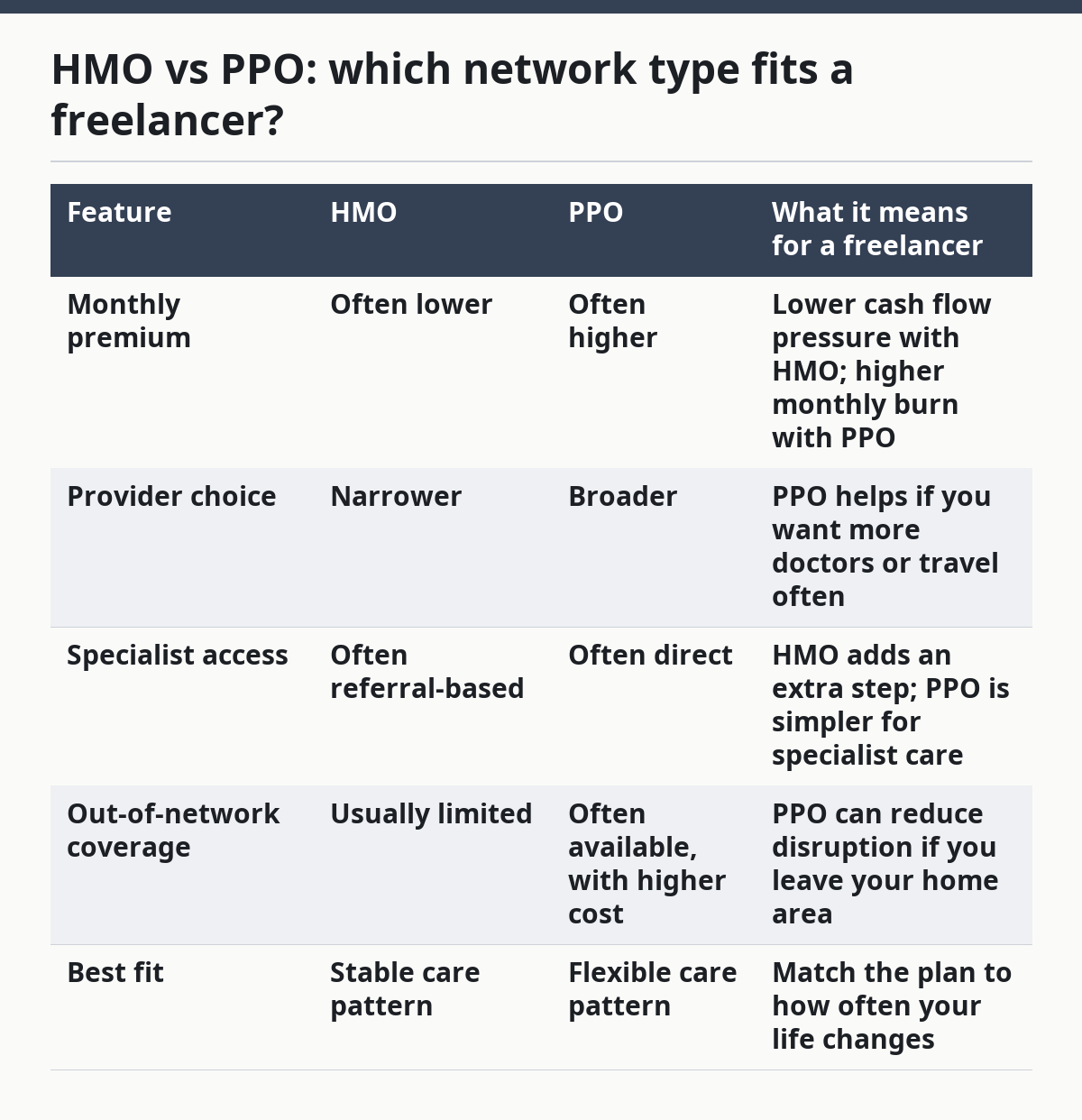
An HMO is usually wrong for a freelancer who splits time across states, wants to keep multiple specialists, or expects to need care far from home. A PPO is usually wrong for a freelancer whose income is tight and whose care is local, predictable, and simple. An in-between plan can exist, but the basic choice still works the same way: more flexibility usually costs more.
The plain-language version is this: if your care is local and routine, an HMO can make sense. If your life is mobile or your provider list is specific, a PPO is often easier to live with.
What should you check before choosing a network?
You should check doctors, prescriptions, hospitals, referrals, and travel before you choose a network. Those five checks tell you more than the glossy plan name on the front page.
Start with doctors. Search the exact plan directory for your primary care doctor and any specialist you already see. Do not assume that one insurer’s broad brand means every plan under it includes the same providers. Network participation can differ by plan, metal tier, and region. HealthCare.gov recommends confirming provider participation before you enroll.
Then check prescriptions. A network strategy is not only about visits. The drug formulary matters too, because the plan can cover one brand name drug cheaply and another at a very different cost. If a medication is central to your care, the network is only half the story; the pharmacy rules matter just as much.
Hospitals matter next. A local doctor in network is helpful, but a hospital out of network can still create a major bill. If you have a preferred hospital system, confirm whether it is in network for both routine and emergency care. Some plans may also treat certain facilities as in network while using separate contracts for some specialists who practice there, so it is worth verifying the details directly with the plan or a licensed professional.
Referrals are another major filter. An HMO may require a referral for specialist care, while a PPO often does not. If you know you will want a dermatologist, endocrinologist, therapist, or orthopedist during the year, the referral rule changes how much time and friction the plan will create.
Travel comes last, but for many freelancers it is the deciding point. A local-only network may be fine if you stay put. If you cross state lines, work seasonally, or spend part of the year in another city, ask how the plan handles care away from home. A plan that looks cheap on paper can become awkward the first time you need urgent care somewhere else.
This is also where a professional consultation can help. Health insurance rules can change by state and by plan year, and a licensed broker or benefits specialist can help interpret the directory and summary of benefits. That does not replace your own checklist, but it can keep you from missing a rule hidden in plain sight. For a second reference point, see KFF’s consumer coverage guides and HealthCare.gov’s plan comparison tools.
What mistakes cost freelancers the most?
The biggest mistake is buying a plan for the premium and not for the network. That mistake can cost a freelancer both money and time, because the plan can look affordable until the first specialist visit or the first out-of-network bill lands.
The second mistake is trusting a directory without confirming it. Provider lists can be stale, and doctors can move networks. A plan directory is a starting point, not a guarantee. If a specific provider matters, a direct office confirmation is safer than assuming the website is current.
The third mistake is ignoring the referral path. A freelancer may assume that all care works like a PPO because a friend’s plan did. Then the actual plan turns out to be an HMO with referral rules, which means the specialist visit gets delayed or redirected. That is not a small detail; it changes the path of care.
The fourth mistake is focusing on one number only. Premium matters, but so do deductible, copay, coinsurance, and out-of-pocket maximum. A plan with a lower premium can still cost more if the network is thin or if visits outside the network hit harder. The network and the cost-sharing design work together, not separately.
The fifth mistake is forgetting about the places you go outside your normal week. A freelancer may do most care near home but still need coverage while visiting family, working from a different state, or taking a short project trip. If the plan is built for one ZIP code and your life is not, the mismatch shows up fast.
Here is a simple before-and-after view of what changes when a freelancer chooses by network instead of by premium alone:
| Metric | Before | After | Change | Timeline |
|---|---|---|---|---|
| Provider match | Unknown | Doctors checked against the exact plan | Less guesswork | Before enrollment |
| Specialist access | Assumed | Referral rule confirmed | Fewer surprises | Before enrollment |
| Hospital fit | Not checked | Local hospital reviewed | Lower bill risk | Before enrollment |
| Travel fit | Ignored | Out-of-area care rules reviewed | Better flexibility | Before buying |
| Prescription fit | Unclear | Formulary checked | Fewer pharmacy shocks | Before buying |
This section matters because a bad network choice is not always obvious on day one. The mistake often shows up later, when the plan looks fine on a spreadsheet but poor in real life. That is why the network strategy is not a nice-to-have detail; it is the part that protects the rest of the plan.
How do you compare plans without getting lost?
You compare plans by ranking your real care needs first and the plan features second. That sounds simple, but it is the only method that keeps a freelancer from getting buried under plan jargon.
Start with the care you expect to use. List one primary care doctor, any ongoing specialist, the drugs you take regularly, and the hospital system you would want in a crisis. Once that list is set, compare each plan against it. A plan that misses two of the five items is usually not worth the time, even if the premium looks attractive.
Then compare network width. A broad network gives more choice and less friction, but it can also come with a higher premium. A narrower network can save money, but it asks you to accept a tighter list of doctors and facilities. For a freelancer, the right answer usually depends on whether income stability or provider choice matters more in the next 12 months.
After that, compare the plan rules that sit behind the network. Look at referrals, prior authorization, emergency coverage, and how the plan handles care in another city. These are the rules that decide whether a network is convenient or annoying. A freelancer who travels a lot may find that a broad PPO is worth the extra monthly cost because it lowers the chance of friction when life shifts.
One practical way to do this is to score the options on a simple 1-to-3 scale for each category: doctors, drugs, hospital, referrals, and travel. A perfect score is not the goal. A plan that fits your most important care is the goal. If the score is good but the doctors are wrong, the plan is still wrong.
This is also where many generic articles fail. They tell readers to “compare plans carefully” without saying what to compare. For freelancers, the important question is not “Which plan is best?” It is “Which network keeps my care stable when my work life changes?”
If a plan has a lower premium but misses your doctor, it can become the most expensive option in practice. If a plan has a higher premium but keeps your care simple, it can be the better value. That is the network strategy in one sentence.
Who is this strategy not for?
This strategy is not for someone who wants the cheapest monthly payment at any cost. A very narrow network can be a bad fit if the person already knows they need broad specialist access, frequent travel care, or a long list of preferred providers.
It is also not for someone who refuses to check the details. Network strategy only works when the provider list, referral rules, and drug formulary get reviewed before enrollment. If a reader wants a quick autopilot choice, a health plan is the wrong place to guess.
A narrow HMO is also a poor fit for freelancers with unpredictable location needs. If work moves between states, or family care requires regular trips, the plan can become a source of friction. The same is true for people who need continuity with a particular specialist that a directory does not include.
On the other side, a PPO is not automatically the right answer. If a freelancer has a stable care pattern, one city, and a tight budget, paying more for extra flexibility may not be worth it. More choice is not always more value.
The best plan is the one that matches your actual year, not your ideal one. That means the answer can change if your work changes, your family changes, or your medical needs change. A plan that was sensible last year may be wrong now.
How should a freelancer think about network strategy year to year?
A freelancer should treat network strategy as an annual review, not a one-time choice. Health plans reset, provider lists shift, and the shape of freelance work changes fast enough that last year’s answer can age badly.
A good annual review takes three steps. First, check whether your doctors and drugs still fit the same plan network. Second, review whether your travel or work pattern changed enough to justify more flexibility. Third, compare the total cost of the plan against the care you actually used, not the care you imagined using.
This review matters because freelancers rarely have a static health year. A year with steady local work can look very different from a year with travel, a new specialist, or a move. The right network strategy changes with those shifts. An HMO can be a clean, low-friction fit in one year and a poor fit in the next. A PPO can be worth the extra cost in a year with more movement, then unnecessary when life settles.
The best habit is to keep a short note with five items: doctor, hospital, prescriptions, travel pattern, and referral needs. That note makes next year’s decision easier because it gives the plan comparison a real baseline. Without it, the choice turns into a memory test, and memory is a weak tool when the details matter.
For broader reading, HealthCare.gov explains many of the core coverage terms that drive this decision, and the Kaiser Family Foundation has clear consumer guides that help decode the fine print. Both are useful when the network directory alone does not answer the whole question.
What questions do freelancers ask most often?
Is an HMO always cheaper than a PPO?
An HMO is often cheaper on premium, but that does not mean it is cheaper overall for every freelancer. If the HMO network misses your doctors or creates referral friction, the lower monthly cost can disappear in higher out-of-pocket spending or more time spent fixing care access.
Can I keep my doctor if I switch plans?
You can only know by checking the exact plan network for the new plan year. Insurer brand names are not enough, because different plans under the same insurer can use different networks. A direct directory search and a confirmation from the doctor’s office are the safest checks.
What matters more: premium or network?
The network matters more when you care about specific doctors, specialists, hospitals, or travel access. Premium matters more when your care is light, local, and predictable. For most freelancers, the right answer comes from balancing both, but the network should be checked first.
Is a PPO worth it for a freelancer who travels?
A PPO can be worth it if travel is regular, care is needed in more than one place, or provider choice is important. The extra flexibility often costs more, so the trade-off only makes sense when the plan reduces real friction, not just theoretical inconvenience.
What if I do not use much medical care?
A low-use year still deserves a network check. Even if you rarely go to the doctor, a bad network choice can become expensive the first time you need urgent care, a specialist, or a hospital stay. The plan should still fit the care you would need if the year changes quickly.
Drafted with AI; not yet reviewed by a person.