Self-Employed Health Insurance Eligibility and Enrollment Rules

Last updated: November 19, 2026
Key Takeaways
- Self-employment usually means you control your work income, but insurance eligibility can still be narrower than tax eligibility.
- Self-employed health insurance enrollment follows the same timing as other individual coverage: open enrollment first, then special enrollment periods, with insurer deadlines inside those windows.
- Eligibility is usually shown with income, identity, and sometimes business records that support self-employment earnings.
- Your enrollment window depends on open enrollment or a qualifying life event after a change in circumstances.
If you earn income from freelance work, contracting, consulting, a sole proprietorship, or another self-run business, the main question is simple: can you enroll in self-employed health insurance, and when? The answer depends on how your policy classifies you, what kind of business income you have, and whether you are enrolling through a government marketplace, an insurer, or a small-business plan. This article, Self-Employed Health Insurance Eligibility and Enrollment Rules — The Complete Guide, is information, not financial advice; for your own situation, especially if you also have spouse coverage, employees, or recent life changes, a qualified adviser should review the details. For U.S. Marketplace rules, see HealthCare.gov and IRS guidance on self-employed health insurance deductions. HealthCare.gov | IRS Publication 974
Who this applies to, and what you need before you start

This applies to people who work for themselves and need to sort out health coverage on a timeline, usually before a coverage effective date such as the first of the month or January 1. It also applies to people who have mixed income: part W-2 wages, part self-employment income, or a business that has not yet produced a full year of profit. The rules differ by country, and in the U.S. they also vary by state, carrier, and plan type, so the exact gatekeeping language matters.
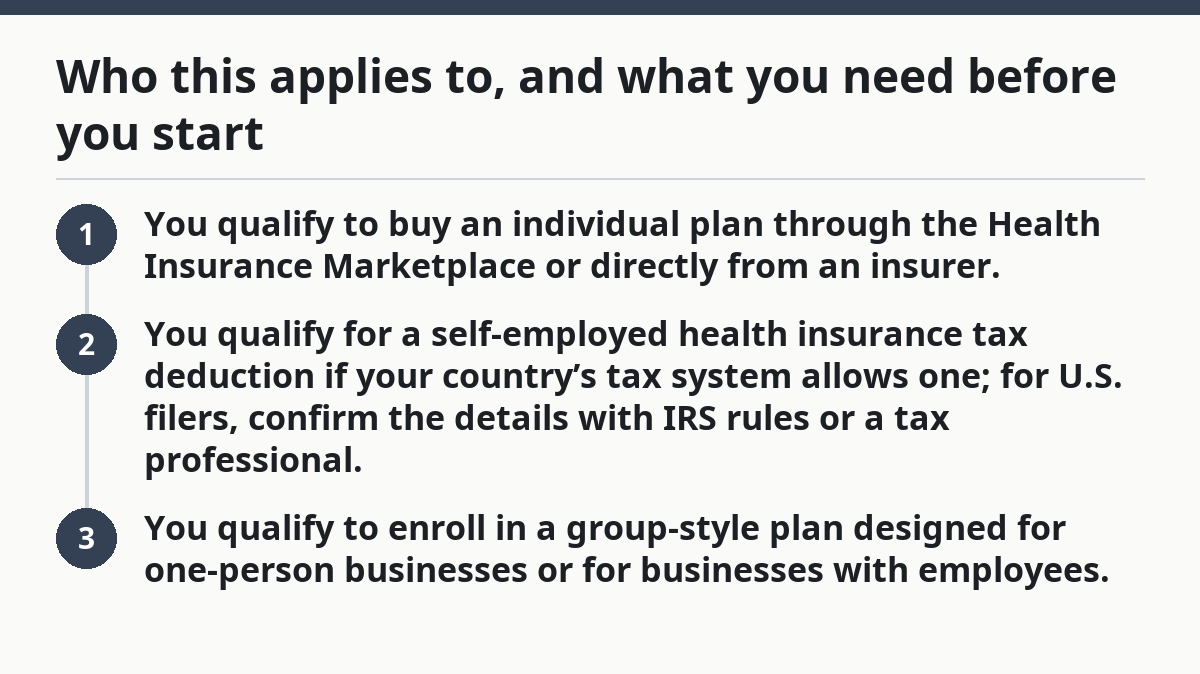
The first thing to know is that “self-employed” is not one universal insurance category. In practice, eligibility can mean one of three things:
- You qualify to buy an individual plan through the Health Insurance Marketplace or directly from an insurer.
- You qualify for a self-employed health insurance tax deduction if your country’s tax system allows one; for U.S. filers, confirm the details with IRS rules or a tax professional.
- You qualify to enroll in a group-style plan designed for one-person businesses or for businesses with employees.
Those are related, but they are not the same rule. A person can qualify for one and not the others.
Before proceeding, gather the items that usually decide the issue: your legal business structure, estimated annual net profit or other qualifying income, household information, tax filing status, and the date you want coverage to begin. If you have access to prior tax returns, keep Schedule C, Schedule SE, and any Marketplace eligibility notices handy, because those are the documents that usually settle disputes. If you do not have clear business income yet, or if you are newly self-employed after a job loss, the safer move is to verify the enrollment path with the marketplace or insurer before you rely on any assumption.
The part of this that people miss is timing. Health insurance enrollment is often controlled by an annual open enrollment window plus special enrollment periods, which are triggered by events such as losing other coverage, moving, marriage, birth, or adoption. If you are outside open enrollment, you often need a qualifying life event to sign up. That rule alone can decide whether you can enroll this week or must wait for the next window.
If your situation includes Medicare, Medicaid, COBRA, a spouse’s employer plan, or a business with common-law employees, this is not the place to guess. Those combinations can change eligibility, tax treatment, and whether a plan is even available to you; check the marketplace, insurer, or a qualified professional before you apply. HealthCare.gov special enrollment periods | CMS Marketplace rules
What counts as self-employed for health insurance purposes?
Self-employed usually means you earn income from work you control yourself, not from an employer’s payroll, but the insurance rule is usually narrower than the tax rule. A sole proprietor, independent contractor, partner in a partnership, S corporation owner, or freelancer may all be treated differently depending on the plan and the country’s tax rules; for the right classification, consult a professional if your structure is not straightforward.
For Marketplace coverage in the U.S., self-employment does not create a special type of health plan by itself. It usually means you are applying as an individual or family, and your income estimate determines whether you qualify for premium tax credits, Medicaid, or full-price coverage. The marketplace generally looks at expected household income for the coverage year, not just last year’s taxes. That is why a business that started mid-year can still qualify if projected income is high enough to fall into the subsidy range in the applicable state and year. HealthCare.gov income and household rules
For the self-employed health insurance deduction, the term of art is “above-the-line deduction,” which means an adjustment to income rather than an itemized deduction. In the U.S., that deduction has specific eligibility rules and does not usually apply if you are eligible for an employer-subsidized plan through your spouse or another employer-sponsored source. The key point is that eligibility for coverage and eligibility for a tax deduction are separate tests; if you are unsure, ask a tax professional or review IRS guidance. IRS Publication 535 | IRS Publication 974
A common misconception is that any 1099 income automatically qualifies you for special treatment. It does not. If your income is low, you may qualify for Medicaid instead. If your income is high, you may be able to buy coverage but not receive subsidies. If your income is inconsistent, the estimate still has to be honest and supportable; when the facts are unclear, confirm them with the marketplace or a tax adviser.
The safest way to think about it is this: self-employment can open certain insurance channels, but it does not override enrollment deadlines, income tests, or household-coverage rules. That is why a startup founder with no payroll history may still be eligible for an individual plan, while a part-time freelancer on a spouse’s employer plan may not get the same tax or subsidy treatment.
How do self-employed health insurance enrollment rules work?
Self-employed health insurance enrollment usually follows the same clock as other individual coverage: open enrollment first, special enrollment periods second, and insurer-specific effective dates inside those windows. The details are set by the marketplace, insurer, or group plan, and a missed deadline can push your start date by 1 to 6 weeks or longer, depending on the effective-date rules in your area. HealthCare.gov enrollment dates | KFF Marketplace timeline overview
Step-by-step enrollment process
- Identify the coverage channel you are using. Decide whether you are enrolling through the federal marketplace, a state marketplace, a private insurer, or a small-group plan. Verify the plan type before you apply, because the application questions and eligibility test are different. A problem shows up when the form asks for employer details you do not have or when the plan requires a business entity that you cannot document.
- Estimate your annual household income for the coverage year. Use a realistic 12-month projection that includes self-employment net income, spouse income if relevant, and other taxable income. Verify that your estimate is defensible against prior tax returns and current contracts. A problem appears if the number is obviously too low or too high compared with your business records, because that can affect subsidies or later tax reconciliation.
- Check whether you are inside open enrollment or have a qualifying life event. Open enrollment dates vary by state and year, and special enrollment periods usually require documentation such as proof of loss of coverage, marriage certificate, birth record, or move. Verify the trigger before you start the application. A problem exists if you cannot document the event within the required deadline, because the application may be denied or delayed.
- Gather identity and tax documents. Have Social Security numbers or taxpayer identification numbers, date of birth, address, immigration status documents if needed, and recent tax forms such as Schedule C or Schedule SE if the application asks for them. Verify that names and addresses match across the documents. A problem shows up when one record has a different spelling or outdated address, which can stall verification.
- Apply and choose an effective date that fits your enrollment window. Many individual-market plans start on the first of the month after enrollment, but exact rules vary by marketplace and carrier. Verify the proposed start date before you submit the application. A problem exists if your desired coverage date is earlier than the window allows.
- Review subsidy or tax-credit eligibility carefully. If your marketplace offers advance premium tax credits, compare the monthly amount against your projected income and household size. Verify that the household members listed are the same people you will file with. A problem appears if the application includes the wrong dependents or filing status, because that can distort the subsidy amount.
- Pay the first premium by the deadline. Without the initial payment, many plans do not activate. Verify the payment due date, amount due, and the method the insurer accepts, such as ACH, debit card, or paper check. A problem exists if the first bill is not paid on time; coverage may not begin even if the application was approved.
- Store the confirmation numbers and policy documents. Save the application confirmation, effective date notice, premium invoice, and plan summary. Verify that your plan number and subscriber name match your application. A problem shows up if you cannot prove the date you enrolled or the date your coverage starts, especially when a claim or tax issue arises later.
The practical rule is that enrollment is not complete when you “finish the application.” It is complete when the policy is issued, the first premium is paid, and the start date is confirmed in writing. If any one of those steps fails, assume the coverage is not yet in force.
What documents prove eligibility?
Eligibility is usually proven by income, identity, and, in some cases, business activity documents that show you actually have self-employment earnings. The insurer or marketplace does not usually need a perfect business history, but it does need enough evidence to support the application and, where relevant, the subsidy amount.
For U.S. Marketplace applications, the documents commonly asked for include:
- Recent tax return pages that show business income, such as Schedule C or Schedule SE
- Proof of current income, such as invoices, client contracts, bank statements, or profit-and-loss records
- Identity documents, including government ID and Social Security numbers where required
- Proof of a qualifying life event, if you are enrolling outside open enrollment
The exact document set depends on the case. A new consultant with no prior year business return may be asked for current contracts and projected income instead of a full tax history. A person who recently lost employer coverage may need a COBRA notice or termination letter.
One mistake is to think that a business license alone proves eligibility. It usually does not. A license may show that the business exists, but it does not prove current income, household composition, or open-enrollment status. Another mistake is sending more documents than requested without organizing them. A 40-page PDF full of unrelated bank activity can slow review instead of helping it.
Tax documents also matter for later reconciliation. If you receive advance premium tax credits in the U.S., the amount you get during the year can be adjusted when you file your return. That is one reason the application should match reality as closely as possible. A big income mismatch can produce an unwelcome correction later, so it is better to estimate conservatively but honestly.
If you are applying through a private insurer rather than a marketplace, ask what they mean by “proof of self-employment.” Some carriers want only payment information and identity confirmation; others want business registration or tax proof. The rule is not universal, and a plan that accepts one form of proof may reject another.
For readers outside the U.S., the same logic applies even when the forms differ. Eligibility still tends to be a combination of residence, income, enrollment window, and documentation. The terms change, but the paperwork problem is the same.
Which enrollment window applies to you?
Your enrollment window depends on whether you are using an annual open enrollment period or qualifying for a special enrollment period after a life event. That is the rule most people get wrong, and it is the rule that most often blocks an otherwise eligible applicant.
Open enrollment is the yearly window when you can sign up without needing a trigger event. The dates vary by jurisdiction. Special enrollment periods are shorter windows opened by events such as losing health coverage, marrying, having a child, adopting a child, moving to a new area, or sometimes gaining lawful status or other qualifying changes. The trigger must usually happen within a defined period, and the application often must be filed within 30 to 60 days of the event, depending on the system. HealthCare.gov SEP rules | CMS glossary
Here is the practical test:
- If it is open enrollment, you can usually apply directly.
- If it is not open enrollment, you need a qualifying event.
- If you have neither, enrollment usually waits.
That sounds simple until you add self-employment, because people often assume that starting freelance work itself creates a special enrollment right. Usually it does not. Starting a business may change your income, but it is not always a qualifying life event for coverage. A job loss, however, often is, because losing employer-sponsored coverage typically triggers a special window.
Coverage effective dates also matter. Some systems assign coverage starting the first of the next month if you enroll by a certain deadline; others use different cutoffs. Missing a deadline by even a day can shift the start by a full month. That gap matters if you are between jobs or have a claim coming up.
A good habit is to write down three dates before you do anything else: the date you lost or gained coverage, the date you intend to apply, and the date you want coverage to start. If those dates do not line up with the marketplace rules, stop and verify before submitting. The wrong assumption here can leave you uninsured for a month.
When should you stop and get qualified help?
You should stop and get qualified help when your self-employment income, household coverage, or tax situation makes the eligibility question hard to answer with normal marketplace rules. On a money issue, guessing is expensive.
You expect significant income swings over the year: That means your subsidy or deduction calculation may change midyear — use a tax professional or benefits adviser to project income realistically instead of relying on a rough guess.
You are married and your spouse has employer coverage: That can change both eligibility and tax treatment — confirm whether the spouse plan is considered affordable and whether family members can use another route.
You have employees or may soon hire them: That can move you from a one-person business into small-group rules — check whether you have crossed the line that changes the type of policy available.
You are on Medicaid, Medicare, or COBRA now: Those programs can alter what counts as a qualifying event — verify before dropping or replacing coverage, because a mistake can create a gap.
You are applying for premium tax credits or other subsidies: A wrong income estimate can affect what you owe later — get help if your income is hard to forecast, especially with irregular contract work.
You live outside the U.S. or split time across countries: Residency and tax residency can be decisive — use local guidance because U.S.-centered rules do not transfer cleanly.
The consequence of stopping here is usually delay, but that is better than an invalid application or a coverage gap. This is the point where a certified enrollment assister, benefits broker, or tax adviser can save more trouble than the consultation costs. If the situation is clean and you only need standard individual coverage during open enrollment, you may not need that help. If the facts are messy, you probably do.
Common mistakes that cause delays or bad outcomes
The most common mistakes are not about the form; they are about the assumptions behind it. A wrong assumption can cost you a month of coverage, a subsidy mismatch, or a rejected application.
-
Assuming any freelance income counts the same way.
A small side hustle, a one-off consulting fee, and a full-time business are not always treated alike. The consequence is an inflated or unsupported subsidy estimate. The better approach is to use the income type the application asks for and document it clearly. -
Missing the open enrollment or special enrollment deadline.
The consequence is waiting until the next window or losing the requested effective date. The better approach is to check the deadline first, then apply with a margin of several days rather than on the last day. -
Using last year’s tax return as the whole answer.
The consequence is a mismatch if this year’s earnings are different. The better approach is to project current-year income, then keep records that justify the estimate. -
Forgetting that first premium payment controls activation.
The consequence is an approved policy that never actually starts. The better approach is to treat payment as part of enrollment, not an afterthought. -
Ignoring household coverage rules.
The consequence is a subsidy or deduction that does not survive review. The better approach is to include the correct filing household and employer coverage status from the start. -
Dropping existing coverage before the new one is confirmed.
The consequence is a coverage gap that can last 30 days or longer. The better approach is to wait for written confirmation of the new policy’s effective date before ending the old one.
If you want the shortest version of the rule, it is this: do not let optimism replace documentation. Insurance systems are built around documents, dates, and definitions, not intent.
What changes if your business is not a simple sole proprietorship?
The standard rules need adjustment if you have a partnership, S corporation, multiple owners, employees, or mixed personal and business coverage. These edge cases are where many generic guides fail.
A partner in a partnership may have different tax treatment than a sole proprietor, and the health insurance rules may follow the partner’s reporting structure rather than the day-to-day business label. An S corporation owner can have different treatment again, including payroll considerations and different deduction mechanics. If the business pays you through wages, distributions, or guaranteed payments, the underwriting or tax evidence can look different from a standard Schedule C case.
If you have employees, even one common-law employee can change the kind of plan you are discussing. A solo individual policy is not the same thing as a small-group plan. Small-group coverage often has separate participation, contribution, and eligibility rules, and those rules vary by state and insurer. A business owner with a spouse on payroll can also run into family-member classification issues that look simple until the insurer asks for payroll records.
Another edge case is seasonality. A business that earns most of its income in four months of the year may still qualify for standard individual coverage, but the income estimate needs to reflect the whole year, not the busy season only. That matters for subsidies and, in some systems, for eligibility thresholds.
A final edge case is midyear status change. If you start the year as an employee and end it self-employed, or the reverse, you may have to coordinate two separate coverage systems. That is where people accidentally double-cover themselves or leave a gap between policies. The cleanest move is to compare the effective date of one policy against the termination date of the other and make sure there is no overlap unless you intentionally want one.
The rule here is not “special cases are impossible.” It is that special cases need precise classification. When the label on the business and the tax treatment do not match, the label alone is not enough.
What a good outcome looks like, and how to check it
A good outcome is a policy that starts on the date you expected, matches the household and income information you submitted, and can be documented later if the insurer, marketplace, or tax authority asks questions. You should be able to show the application confirmation, premium receipt, and plan effective date in less than 10 minutes.
A second good outcome is stability. If your income changes during the year, you update the marketplace or insurer promptly enough to avoid a large surprise at tax time or a subsidy correction you did not expect. If your family status changes, you update that too. The point is not perfection; the point is matching the policy to the current facts.
Here is the final check I would use before relying on a self-employed enrollment decision:
- Is the enrollment window open, or do you have a qualifying event?
- Can you document your business income and household situation?
- Do you know whether you are applying for individual coverage, Marketplace coverage, or a small-group plan?
- Have you confirmed the first premium due date and the start date?
- Have you checked whether a tax deduction or subsidy applies in your jurisdiction, and whether a professional should review it?
If the answer to any of those is “I’m not sure,” pause. Health insurance rules are not difficult because the concepts are impossible; they are difficult because a single wrong date or income assumption can change the result. For many self-employed people, the right move is straightforward once the facts are lined up. The hard part is refusing to guess before the facts are lined up.
Can I enroll if my income is irregular?
Yes, irregular income can still support enrollment, but the estimate has to be reasonable and documented. If your earnings vary by project or season, project a full 12-month income figure rather than using one strong month or one weak month. The problem is not variability; the problem is an estimate that cannot be defended later.
Do I need a business license to qualify?
No, a business license is not always required to qualify for self-employed coverage. Many systems care more about income, residency, and enrollment timing than about whether you have filed local business paperwork. Some insurers may ask for business documents, though, so keep your tax records ready.
What if I also have a W-2 job?
You can still be eligible, but the W-2 job may change your options. Employer coverage, household income, and tax filing status can affect whether you qualify for subsidies or a self-employed deduction. This is one of the cases where a benefits or tax professional is worth the time, because the answer depends on the exact employer plan and your household.
Is Marketplace coverage the same as a self-employed plan?
No, Marketplace coverage is usually individual health coverage, not a separate self-employed product. Self-employment may make you eligible to enroll and may affect subsidies or tax treatment, but the plan itself is typically the same type of individual policy other people buy.
Drafted with AI; not yet reviewed by a person.