Last updated: November 19, 2026
Quick answer: use the Marketplace exchange for your state. What is the difference between HealthCare.gov and a state exchange for freelancers? HealthCare.gov is the federal marketplace; a state exchange is run by the state, and the right one depends on where you live. For a freelancer, the practical difference is usually where you apply, who handles your enrollment, and which site serves your ZIP code. The U.S. Department of Health and Human Services explains the federal Marketplace here: https://www.healthcare.gov/marketplace-in-your-state/ and the Centers for Medicare & Medicaid Services covers Marketplace eligibility and enrollment rules here: https://www.cms.gov/marketplace. CMS also notes that Marketplace coverage is for individuals and families, not employer-sponsored coverage, and enrollment generally follows your state and household information.
Key Takeaways
- HealthCare.gov is the federal Marketplace option in states without their own exchange.
- Freelancers should apply through the exchange tied to their state of residence.
- In federal-exchange states, HealthCare.gov is usually the clearest starting point.
- In state-run exchange states, the state platform is the correct enrollment path.
As someone who reads health coverage rules for self-employed workers, I’m judging this as a destination choice, not a primer on ACA basics. For a freelancer, the wrong exchange is not a “different option” in the abstract — it can be the wrong doorway. HealthCare.gov and state exchanges both exist to route you into Marketplace coverage, but the state list determines which site actually applies. According to HealthCare.gov, the Marketplace serves residents through either the federal platform or a state-based marketplace.
The real difference between HealthCare.gov and a state exchange
HealthCare.gov wins as the simpler concept: it is the federal exchange, and it serves states that do not run their own full marketplace. A state exchange wins when your state runs its own platform, because that platform may handle plan shopping, enrollment, notices, and local rules in one place.
The difference is not about the health plans themselves in some universal sense. It is about administration. HealthCare.gov is the federal front door for the Marketplace in many states. A state exchange is the state’s version of that same marketplace function. If you are a freelancer, that distinction matters because your resident state determines where you start, where you submit, and which deadlines or support channels apply.
The biggest mistake generic articles make is treating these as two freely interchangeable websites. Consult the official Marketplace source for your state, or a professional assister if you are unsure. Your address decides which exchange applies. That is why a freelancer who moves from one state to another may need a different exchange entirely, even if the plan concept sounds the same. The resident rule is the hinge.
A useful way to think about it: HealthCare.gov is the federal fallback and default for many places; a state exchange is a local system built and run by a state that chose to operate its own marketplace. The plan category is still “Marketplace coverage,” but the application path is different. That is the part freelancers need to get right first.
Which one should a freelancer use?
A freelancer should use the exchange that serves the state where they live, not the one they like better. If your state uses HealthCare.gov, that is your starting point. If your state runs a state exchange, that is where you should apply.
That recommendation sounds blunt because the rule is blunt. Marketplace enrollment is tied to residency, and the exchange path is not a lifestyle preference. A freelancer in a HealthCare.gov state who tries to use a state exchange from elsewhere is wasting time; a freelancer in a state exchange state who goes to HealthCare.gov may get rerouted, but the detour still delays the task they actually need done. HealthCare.gov’s state page remains the best first check, and CMS is the other authoritative source for enrollment rules.
This matters most for independent workers because their coverage is often a solo decision, made without an employer’s HR department to correct mistakes. A full-time employee can sometimes be guided into the right channel by a benefits office, but freelancers usually do not have that backup. A freelancer has to check the state first. That means knowing whether the state uses the federal platform or its own marketplace before starting the application.
A practical clue: if you search for your state’s Marketplace and it points you back to HealthCare.gov, that state likely uses the federal exchange. If it points to a state-branded marketplace site, that state runs its own exchange. The federal source above keeps the state list current; use that, not a blog post from 2021.
This is also where the first honest drawback shows up. HealthCare.gov is not “better” just because it is federal, and a state exchange is not automatically smoother just because it is local. The right choice is mostly not a choice at all; it is the exchange your state uses.
HealthCare.gov: who it fits and where it can frustrate you
HealthCare.gov wins for freelancers in federal-exchange states because it is the standard entry point and the least ambiguous option. That matters when you want one site to tell you whether you can enroll, what documents you may need, and where to finish the application.
The federal site’s strength is consistency. It is built to serve states that do not run their own marketplace, so the user flow is familiar across those states. If you move from one federal-exchange state to another, the front-end process is likely to feel more familiar than learning a brand-new state portal. The federal CMS and HealthCare.gov pages are also the cleanest sources for core Marketplace rules, which is useful when you are sorting out self-employment income, household size, and enrollment windows.
The weakness is that it can feel less tailored. State exchanges sometimes present more local help, state-specific notices, or state branding that makes the system feel closer to the resident market. HealthCare.gov is broader by design. For a freelancer, that broadness can be a drawback when you want local hand-holding or a state-specific contact point. You may need to do a little more work to find your state’s consumer assistance resources.
Still, the bigger risk is not “less personalization.” It is using the wrong site because you assumed every marketplace works the same way. HealthCare.gov only fits cleanly when your state uses it. If your state runs its own exchange, HealthCare.gov is not the correct home base for your application, even if it still explains the general Marketplace structure.
Use HealthCare.gov if you want a federal system with a clear national path, especially if you are in a state that does not run its own exchange or if you are trying to confirm the official entry point before you spend time comparing plans.
A state exchange: when the local option is the better fit
A state exchange wins when your state built its own platform and you want the state-run path that actually governs enrollment there. For freelancers in those states, this is usually the correct and more direct route.
The main advantage is local control. State exchanges can set up their own layout, support structure, outreach, and in some cases their own coverage rules or enrollment communication. That can make the process feel more local and less generic. If you are self-employed and juggling variable income, a state exchange may also feel easier to handle if your state has made a point of simplifying the resident experience.
The trade-off is that every state exchange is its own system. That means the interface, terminology, and support flow can vary more than on HealthCare.gov. The convenience of a state-run system can disappear if the site is confusing or if the state’s consumer tools are thin. The difference is not theoretical: the application path can change from one state exchange to the next, which matters a lot when you are trying to finish enrollment quickly.
A freelancer should prefer a state exchange when the resident state runs one and the state site is clearly designated as the marketplace for that state. That is especially true if you want state-specific help lines, local notices, or a marketplace that may surface state-led assistance more directly than the federal site. KFF tracks state-based Marketplace structures and changes over time, which is useful when you are checking whether a state still runs its own exchange.
The downside is not small. State exchanges can be great in some places and merely adequate in others. That inconsistency is the price of local control. A freelancer who wants one universal experience across the country will not get it from state exchanges. The benefit is relevance, not uniformity. CMS and HealthCare.gov both point readers back to the state-specific enrollment path for that reason.
The honest side-by-side
HealthCare.gov and a state exchange are both Marketplace entry points, but they differ in administration, routing, and state fit. The table below is the quickest way to decide where a freelancer should go.
| Criteria | HealthCare.gov | State exchange | Winner for [condition] |
|---|---|---|---|
| Who runs it | Federal Marketplace platform | State government marketplace | State exchange if your state operates one |
| Where it works | States that use the federal exchange | Only the state that built it | The exchange tied to your residence |
| First stop for application | Common federal portal | State-branded portal | The site listed for your state |
| Ease of finding official rules | Centralized federal guidance | State-specific guidance | HealthCare.gov for general rule-checking |
| Local tailoring | Broader, less state-specific | More state-specific | State exchange when you want local notices |
| Consistency across states | More uniform | Varies by state | HealthCare.gov for repeat familiarity |
| Risk of using the wrong site | Lower if your state uses it | Lower if your state uses it | Neither, if you match site to state |
| Support channel feel | Federal help structure | State help structure | State exchange if you want local contacts |
| Best fit for moving states | Can be a temporary guide, not a permanent home | Must switch if the new state uses it | The new resident state’s exchange |
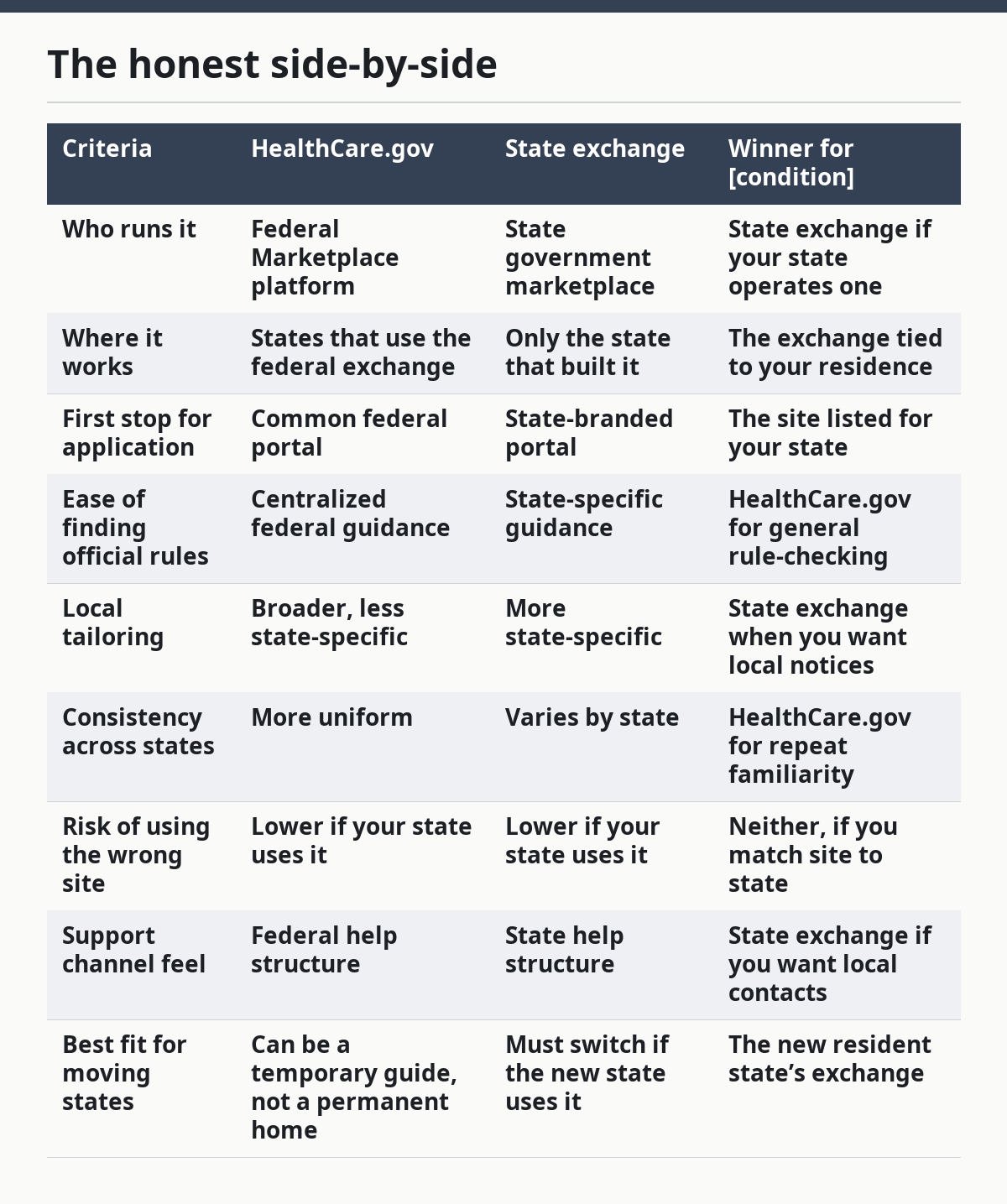
The table’s real lesson is simple: the best exchange is the one your state assigns you. There is no prize for choosing the “nicer” website. There is only the correct filing path. For official state routing, HealthCare.gov’s state directory and CMS guidance are the best references.
The verdict: which one to choose and why
Choose HealthCare.gov if your state uses the federal exchange and you want the standard national entry point. Choose a state exchange if your resident state runs its own marketplace and that is the site listed for enrollment. Neither is right if you are trying to shop outside your state’s exchange rules or you have not confirmed where your residency places you.
That is the cleanest answer for freelancers because residency drives the decision. If you live in a HealthCare.gov state, go there. If you live in a state exchange state, go there instead. Do not treat the sites as interchangeable. If you are unsure, check the official state page first or ask a certified assister before you apply.
The only real “wrong” choice is a site that does not match your state. A freelancer who is mid-move, splitting time between states, or using an old address needs to resolve residency first, then apply. That is where the question stops being about websites and starts being about eligibility. CMS and HealthCare.gov both make residency central to Marketplace enrollment.
When to reconsider the choice entirely
You should stop comparing websites and check your residence if any of these are true: you moved recently, you are using a mailing address in one state but living in another, your income changed sharply, or your household situation changed during the year. Those details can affect where you apply and whether you can enroll at all.
The biggest exception is a move across state lines. A new state can mean a new exchange, a new application path, and sometimes a new plan choice even if the coverage goal stays the same. Another exception is a state that changes its exchange status over time; the state’s current marketplace setup matters, not what it used a few years ago. The CMS Marketplace page and the state directory on HealthCare.gov are the safest places to verify that change.
A third exception, depending on the state, is confusion between “shopping for plans” and “submitting an application.” Reading about plans on one site does not always mean that is the place to finish enrollment. The official Marketplace page for your state is the source that matters.
If you want the broader freelancer coverage picture after this, the hub on freelance Marketplace coverage is the right next stop. This page is only about which exchange destination belongs to you.
Which exchange should I use if I move states?
Use the exchange for your new resident state once your move makes that state your home. If the new state uses HealthCare.gov, that is where you go; if it uses a state exchange, you switch to that system. The important detail is residency, not where you started the year.
Do all freelancers use the same marketplace?
No, freelancers do not all use the same marketplace. The exchange depends on the state where they live because some states use HealthCare.gov and others run their own state exchange. The Marketplace itself is the shared framework, but the application destination changes by residency and state system.
Drafted with AI; not yet reviewed by a person.