Last updated: November 19, 2026
Quick Answer: For How freelancers choose coverage for irregular income and uneven cash flow, the safest starting point is the premium you can pay in your worst month, not your average month. A 12-month cash-flow view is the practical test.
Freelancers choose health insurance by matching the premium to the months when cash actually lands, not by guessing at a yearly average. For How freelancers choose coverage for irregular income and uneven cash flow, the right plan is the one that can survive irregular income, seasonal slowdowns, and one bad quarter without forcing you to skip care or miss a premium payment.
Start with cash flow, not the plan brochure
Freelance income variability should drive the plan choice, because a premium that looks fine on paper can be painful in a slow month. The first job is to map when money comes in, then decide how much of that money can be held aside for health coverage before rent, taxes, and business costs eat the rest.
A simple 12-month view works better than a monthly snapshot. Put your expected income into a calendar by month, then mark the months that usually run light. Many freelancers have one or two strong seasons and several thin ones; the plan has to fit the thin months, not the best month.
Use this order:
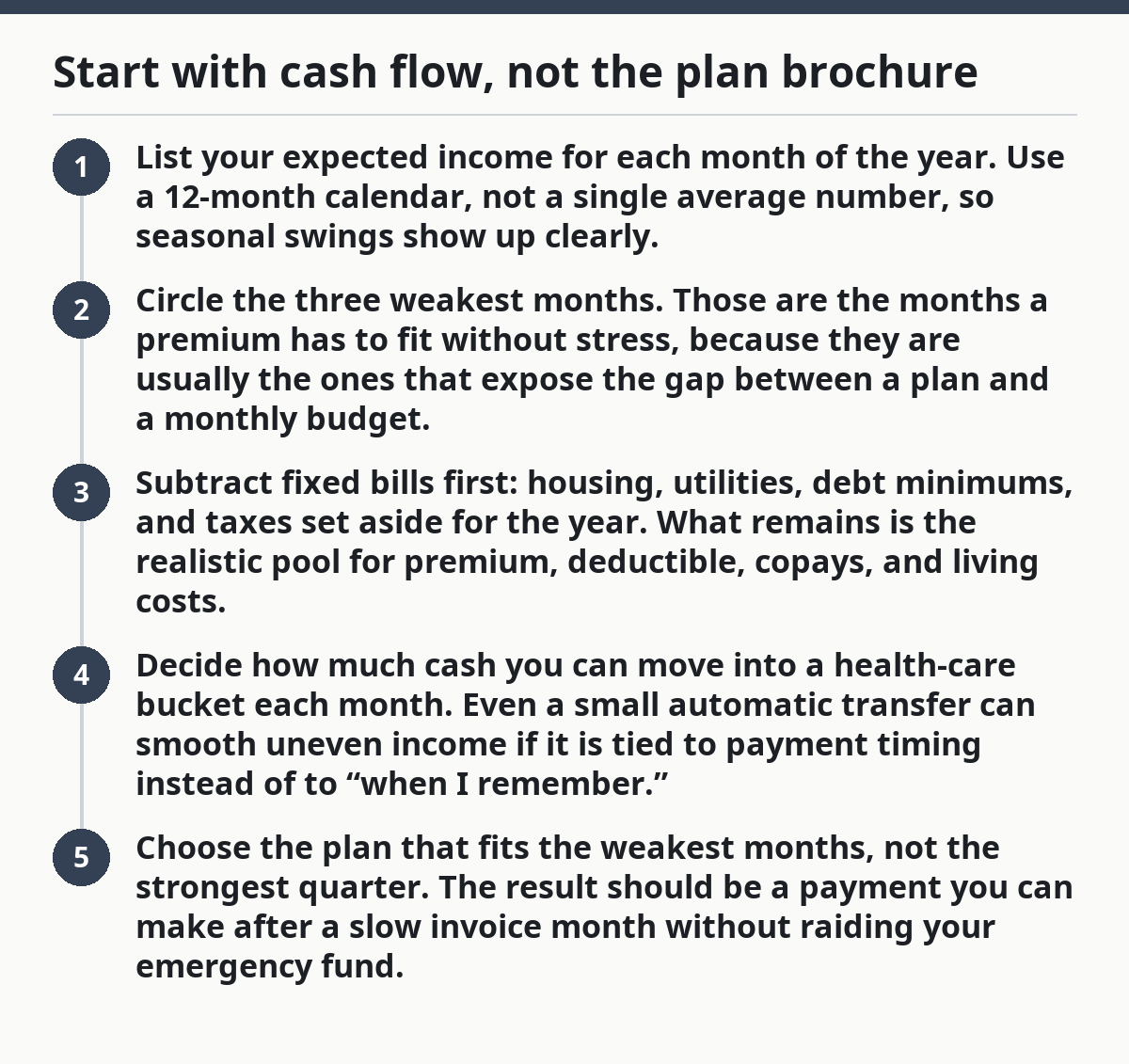
- List your expected income for each month of the year. Use a 12-month calendar, not a single average number, so seasonal swings show up clearly.
- Circle the three weakest months. Those are the months a premium has to fit without stress, because they are usually the ones that expose the gap between a plan and a monthly budget.
- Subtract fixed bills first: housing, utilities, debt minimums, and taxes set aside for the year. What remains is the realistic pool for premium, deductible, copays, and living costs.
- Decide how much cash you can move into a health-care bucket each month. Even a small automatic transfer can smooth uneven income if it is tied to payment timing instead of to “when I remember.”
- Choose the plan that fits the weakest months, not the strongest quarter. The result should be a payment you can make after a slow invoice month without raiding your emergency fund.
This approach is for freelancers with unstable cash flow and no employer subsidy cushion. It is not for anyone who already has steady monthly income or a locked-in budget that can absorb a higher premium every month without planning.
What should a freelancer look at first: premium or deductible?
A freelancer should look at the premium first, then pressure-test the deductible against the months when income dips. The premium is the bill you owe every month; the deductible is the bill you may owe later, sometimes in one large chunk.
That order matters when your income is uneven. A low-premium plan can still break your budget if the deductible is so high that one medical bill wipes out the cash you were using to smooth the year. A high-premium plan can be easier to live with if it prevents a large surprise later, but if monthly budgeting is uncertain, consult a licensed insurance professional. Healthcare.gov explains the premium-vs.-deductible trade-off, and the IRS notes that premium tax credits are tied to marketplace rules and income. https://www.healthcare.gov/choose-a-plan/your-total-costs/ https://www.irs.gov/affordable-care-act/individuals-and-families/premium-tax-credit
Think in three layers:
- Monthly premium: the fixed cost that hits whether you work or not.
- Out-of-pocket exposure: the deductible, copays, and coinsurance you might face if you need care.
- Cash timing: when the money arrives in your account versus when the insurer pulls the premium.
For freelancers with strong but irregular earnings, a midrange premium may offer a useful balance. It keeps the monthly bill from becoming a crisis while avoiding the very highest deductible levels. That is not a universal rule; it is a cash-flow rule. If one client pays late or a project stalls, the cheaper premium may still be the safer choice.
The wrong move is to choose the lowest premium just because the monthly bill looks comfortable in the first month. If the deductible is several times what you can set aside in a quarter, the plan can become expensive at the exact moment you need it most.
How do freelancers pay premiums when income comes in at odd times?
Freelancers pay premiums by creating a separate health-care reserve and funding it on a fixed schedule, even if client payments arrive unpredictably. The insurance company expects payment on time; your clients do not.
The most reliable setup is a dedicated savings bucket for premium payments. Move money into it right after each invoice is paid, or on a fixed day each month if your income is predictable enough to support that. If possible, keep at least one month of premium money ahead so a delayed payment does not force a late bill.
A practical cash-flow system looks like this:
- Set the premium aside as a non-negotiable line in the monthly budget.
- Fund it from every payment, not from whatever is left at the end of the month.
- Keep the reserve in a separate account so business spending does not blur into insurance money.
- Use autopay if the account can support it, because manual payments are easy to miss during busy weeks.
Timing matters more than total annual income in the short run. A freelancer earning well over the year can still miss a premium in March if January and February were slow. That is why the payment rhythm has to match the income rhythm. The Consumer Financial Protection Bureau recommends budgeting around cash flow, and HealthCare.gov says marketplace coverage deadlines and payment timing matter. https://www.consumerfinance.gov/consumer-tools/budgeting/ https://www.healthcare.gov/apply-and-enroll/
The main trade-off is flexibility versus discipline. Automatic transfers reduce the chance of missing a payment, but they can also tighten your cash if you set them too high. Manual transfers give more control, but they depend on memory, and memory is weak when client work spikes.
For a plan that is sold on the ACA marketplace, open enrollment is the usual time to choose or change coverage, and a special enrollment period can open the door after certain life events. The timing rules matter because the plan you can pick may be limited by when your qualifying change happens, not by your cash flow alone. If that part is unclear, speak with a licensed insurance professional.
Which annual plan feels affordable when income swings?
The annual plan that feels affordable is the one you can carry through both the best and worst months, not the one that only looks easy on a calculator. Annual affordability is about survival across 12 months of uneven receipts, not about squeezing the lowest sticker price out of one policy.
A good way to judge that is to test the plan against your low-income months. Imagine paying the premium for 12 straight months, then add one care-heavy month with a deductible hit. If the result would force you to delay rent, skip tax savings, or borrow to keep coverage active, the plan is too tight.
Some freelancers do better with a plan that has a higher premium and lower deductible because it stabilizes the year. Others need the opposite: a lower premium to protect cash during the slow season, even if the deductible is higher. The right answer depends on how volatile the income really is.
Use this rough filter:
- If your slow months are shallow and short, a higher premium may be tolerable because cash flow recovers quickly.
- If your income can drop for 2 or 3 months at a time, lower monthly premiums usually matter more.
- If your health needs are ongoing, the deductible and copays deserve more weight than they would for someone using the plan rarely.
The mistake is choosing based on optimism. A plan that only works if every invoice lands on time is not affordable for a freelancer; it is fragile. A plan that leaves room for late payments, tax set-asides, and one surprise medical visit is more honest, even if the monthly premium is a little higher.
For broader decision-making on plan types, the hub on Health plan selection for freelancers sits upstream of this page and covers the larger comparison framework.
What mistakes cost freelancers the most money?
The biggest mistakes are choosing a plan around average income, ignoring premium timing, and forgetting that cash flow can fail before annual income does. Each one costs money in a different way: late fees, coverage gaps, or emergency borrowing.
The first mistake is averaging the year and calling that a budget. A freelancer who averages a strong quarter with a weak quarter may overcommit to a premium that feels fine on paper but hurts in month 2 or month 10. The fix is to budget to the bottom half of the year, not the top half.
The second mistake is treating the premium like a bill that can wait. Health coverage is not like a utility that can be negotiated after the fact. If the payment is late, the consequence can be much bigger than a bounced check. That makes calendar discipline part of the insurance decision, and if the timing is unclear, consult a licensed insurance professional before the due date. The Kaiser Family Foundation and HealthCare.gov both emphasize that deadlines and coverage rules can change the outcome. https://www.kff.org/health-reform/ https://www.healthcare.gov/apply-and-enroll/
The third mistake is underestimating the deductible because no one wants to think about getting sick. That can turn a “cheap” plan into a hard-to-use plan. A freelancer with uneven income needs enough liquidity to handle at least a few months of medical uncertainty.
The fourth mistake is buying a plan that only works if every client pays on time. That is not a plan; it is a hope. One late payment can collide with the premium due date and trigger a domino effect across the rest of the month.
What to do instead is simpler: choose the plan that fits your worst realistic month, keep a reserve for the premium, and check the deductible against the cash you can actually set aside in a quarter. If that feels conservative, that is the point. Uneven cash flow punishes optimism.
How should seasonal freelancers think about open enrollment and midyear changes?
Seasonal freelancers should treat open enrollment as the main checkpoint and special enrollment period as the backup lane for major life changes. The calendar matters because the best choice is often not “the cheapest plan,” but the plan that matches the season you are entering.
If your work is seasonal, choose coverage with the season in mind. A photographer, tax preparer, or outdoor contractor may have very different income in peak months versus off-season months. The premium still arrives every month, so the plan has to be sustainable when work slows.
A useful habit is to review coverage before the season changes, not after the cash crunch has already started. That gives you time to compare the premium, deductible, and network fit while income is still predictable. If a special enrollment period opens because of a qualifying event, use that window carefully; do not assume every life change creates a new choice. HealthCare.gov lists qualifying life events and enrollment timing, and CMS explains marketplace enrollment periods in detail. https://www.healthcare.gov/screener/ https://www.cms.gov/cciio/programs-and-initiatives/health-insurance-marketplaces
When a freelancer gets busy, there is a temptation to upgrade too fast. A higher-premium plan can look harmless during a strong month, then become a burden once the season turns. The safer approach is to build a plan around the off-season and let the busy season create breathing room, not the other way around.
That rule is not for everyone. Freelancers with stable retained revenue, recurring contracts, or a large cash buffer may be able to carry a richer plan without stress. The person who should be most cautious is the one whose income comes in bursts and whose savings are thin.
Key Takeaways
- Choose coverage from your weakest months, not your best month.
- A premium that fits a monthly budget is useful only if the payment timing also works.
- The deductible matters because one medical bill can collide with uneven cash flow.
- Seasonal income calls for a plan that survives the slow stretch, not just the busy one.
- If a plan depends on perfect client payments, it is too fragile for freelance work.
How do freelancers budget for premiums when income changes month to month?
Freelancers budget for premiums by treating the payment as a fixed monthly bill and funding it from each client payment as money comes in. A separate reserve account helps because it keeps the premium from competing with rent, taxes, or business expenses. The goal is to stay one month ahead if possible.
Should you pick a lower premium or higher premium plan if your income is unstable?
A lower premium usually protects cash flow better when income is unstable, but only if the deductible is still manageable. If the higher-deductible plan would create a strain after one medical bill, it can backfire fast. The safer choice is the one your worst month can actually support.
What happens if you miss a premium payment?
Missing a premium payment can put coverage at risk, and the result depends on the insurer’s rules and timing. Do not count on being able to catch up casually. If a payment looks tight, contact the insurer or a licensed insurance professional right away and ask what the deadline and consequences are before the account goes past due.
Drafted with AI; not yet reviewed by a person.