How freelancers compare ACA metal tiers by expected use of care

Last updated: November 19, 2026
Key Takeaways
- Silver often fits freelancers with unpredictable care use.
- Bronze suits light-care years when monthly premium matters most.
- Silver is the middle-tier comparison point and may improve with subsidies.
- Gold fits regular care use when lower cost sharing matters.
Freelancers compare ACA metal tiers by expected use of care in one simple way: how often will I actually use the plan? This guide to how freelancers compare ACA metal tiers by expected use of care shows the trade-off clearly. Bronze fits light use, Silver fits mixed use, Gold fits regular care, and Platinum fits heavy care. The table and sections below show what each tier tends to reward, punish, and protect. Quick answer: Silver is often the starting point, but the best tier depends on expected care use.
Our Top 3 Picks at a Glance
- #1 Best Overall: Silver — a strong fit for freelancers with uneven care use who may qualify for cost-sharing reductions on the ACA marketplace.
- #2 Best Budget Pick: Bronze — a fit for freelancers who expect few visits and can tolerate higher bills when care happens.
- #3 Best Heavy-Duty / Upgrade Pick: Gold — a fit for freelancers who use care often and want lower cost sharing on visits, tests, and prescriptions.
| Product / Option | Best For | Core Spec | Standout Feature | Action |
|---|---|---|---|---|
| Silver | Freelancers with mixed or uncertain use of care | Middle-tier balance of premium and out-of-pocket costs | Best fit for cost-sharing reductions if you qualify on the ACA marketplace | Check current plans if your care use may change during the year |
| Bronze | Freelancers who expect rare care | Lowest premiums, higher cost sharing | Keeps monthly payments down when you mainly want backup coverage | Compare only if you can handle larger bills when care shows up |
| Gold | Freelancers who use care often | Higher premiums, lower cost sharing | Usually easier on frequent visits, labs, and prescriptions | Check current price if you know you’ll use services through the year |
I write about ACA marketplace plan fit for self-employed workers, and the pattern is always the same: the right metal tier depends on how much care you expect to use, not just what the monthly bill looks like.
What the ACA metal tiers really change for freelancers
How freelancers compare ACA metal tiers starts with the same trade-off every time: lower monthly premium versus lower bills when care happens. Silver usually wins for freelancers whose care use is hard to predict. Bronze, gold, and platinum each tilt the math in a different direction, but the same basic trade-off runs through all four tiers.
Picture this: you’re choosing coverage after a strong or weak income year, and you don’t know if you’ll need one urgent visit or a string of follow-ups. The tier you pick changes how much pain lands in your mailbox versus at the doctor’s office. That trade-off is the whole decision.
- Bronze: lower premium, higher share of costs when you use care.
- Silver: middle ground for comparison shopping.
- Gold: higher premium, lower share of costs for regular use.
- Platinum: highest premium, lowest share of costs for heavy use.
The ACA marketplace is where this comparison matters most, because metal tiers are standardized around cost sharing. That does not mean the plans are identical in provider networks, drug coverage, or referrals. It means the tier tells you how the plan is built to split costs, while the fine print still decides which doctors and medicines are in reach.
Healthcare.gov’s plan categories explain the metal tiers, and the KFF marketplace basics page is a good second stop if you want a plain-English map of the ACA marketplace.
- If you want the quick version, keep reading.
- The tier choice gets clearer once you match it to expected use of care.
Bronze plans: who should actually use them?
Bronze works best if you expect light care use and want the lowest monthly premium you can find on the ACA marketplace. If you mostly want coverage for the unexpected, Bronze can make sense. If you expect regular office visits, imaging, or ongoing prescriptions, Bronze can get expensive fast.
Picture this: you rarely see a clinician, you refill only one routine drug, and your main goal is to avoid a big premium payment every month. Bronze gives you that lower monthly bill. The catch is the higher out-of-pocket hit later.
Bronze is usually the weaker fit for freelancers who know they will use care several times a year. A lower premium does not help much if each visit, test, or prescription lands at a higher share of the bill. That gap matters most after the first few claims.
- Good match: healthy freelancers, low-visit years, backup coverage seekers.
- Bad match: people with chronic care, planned procedures, or frequent prescriptions.
- Watch out for: a “cheap” premium that turns into expensive care when you need it.
Bronze also tends to work better when you have enough cash flow to cover surprise costs. A freelancer with uneven income can be tempted by the small monthly bill and then get squeezed by the first real medical need.
Who Should Skip This: freelancers who expect regular care or ongoing medication are usually better served by Silver or Gold.
Buy this if: you are a self-employed worker with light care use and want the lower monthly premium.
Skip this if: you know you’ll need multiple visits or treatment this year; consult a licensed insurance professional or navigator and review Healthcare.gov’s plan categories before you decide.
Silver plans: why they are the default comparison tier
Silver wins for most freelancers because it sits in the middle and gives the cleanest comparison point. If your care use is uncertain, Silver is usually the tier that balances premium and out-of-pocket exposure without pushing you to either extreme.
Picture this: your year could go two ways — a quiet year with a couple of visits, or a messy year with labs, follow-ups, and a prescription list that changes. Silver is built for that middle path. It is the most flexible choice.
Silver matters even more because it is the tier tied to cost-sharing reductions for eligible enrollees on the ACA marketplace. That is a real reason to look at Silver first, not last. If your income fits the subsidy rules, Silver can lower what you pay when you actually use care, which changes the math more than a premium-only comparison ever will.
- Strength: strong balance for uncertain use of care.
- Strength: may become the best-value tier with cost-sharing reductions.
- Weakness: not always the cheapest monthly premium.
- Weakness: not the lowest-cost option for heavy, predictable care use.
A lot of freelancers make the mistake of comparing Bronze and Gold only. Silver sits between them for a reason. It can be the best choice when you do not want to bet too hard on being perfectly healthy or on needing care every month.
Who Should Skip This: freelancers with clearly heavy, ongoing care needs may save more with Gold or, in rare cases, Platinum.
Buy this if: you want the safest middle ground for a year that might change.
Skip this if: you already know your care will be frequent and expensive.
Gold plans: when paying more up front can make sense
Gold is the better choice when you expect regular care and want lower cost sharing every time you use the plan. If you see doctors often, fill prescriptions most months, or have planned treatment, Gold can beat Bronze and sometimes Silver in real use.
Picture this: you know the year will not be quiet. There are follow-ups on the calendar, one specialist in the mix, and a prescription you do not want to fight over each month. Gold is built for that pattern. It rewards frequent use.
Gold is not magic. It usually means a higher monthly premium, and that money is gone whether you use care or not. That is the real downside. If your care use turns out lighter than expected, you may pay more than you needed to. But if care use is steady, Gold often softens the pain of each visit and refill.
- Good match: chronic conditions, ongoing prescriptions, repeated visits.
- Good match: freelancers who want lower friction at the point of care.
- Bad match: people who only need the plan as backup.
- Bad match: anyone trying to keep monthly premium as low as possible.
Gold also deserves a look if a freelancer has enough steady income to pay the premium but wants to avoid larger bills during the year. That is a common pattern for self-employed workers who can budget monthly but hate surprise charges later.
Who Should Skip This: freelancers with very light care use are often paying for protection they won’t use.
Buy this if: you expect regular medical use and want lower cost sharing.
Skip this if: your care use is rare and you mainly need a low monthly payment.
Platinum plans: the rare case where the top tier wins
Platinum is the best fit only when care use is heavy enough that lower cost sharing matters more than the high premium. For most freelancers, Platinum is overkill. For a narrow group with frequent treatment, it can still make sense.
Picture this: your calendar already has repeated visits, tests, and prescriptions, and you know the plan will be used often, not just occasionally. Platinum cuts the share you pay when care happens, so the tier can work if use is high and predictable. That is the only case where it shines.
The problem is obvious: you pay a lot each month to get that lower cost sharing. If care use drops, you may spend more than you needed to. That is why Platinum is usually the hardest tier to justify for a freelancer with variable income and uncertain care. It asks you to pay for the year you fear, even if that year never arrives.
- Strength: lowest cost sharing among the metal tiers.
- Strength: can suit very frequent care use.
- Weakness: high premium makes it a poor default choice.
- Weakness: wasteful if the year is calmer than expected.
Platinum is not the “best” plan for most freelancers. It is the plan for a narrow case where medical use is so frequent that the monthly premium becomes a smaller part of the total bill.
Who Should Skip This: freelancers with light or moderate care use should usually compare Silver or Gold first.
Buy this if: you have very frequent care use and want the lowest point-of-service costs.
Skip this if: you want the best balance between premium and use, not the highest monthly bill.
The honest side-by-side: which tier wins by use of care?
Bronze wins only when care use is light enough that low premium matters more than everything else. Silver wins when use is uncertain or mixed. Gold wins when care use is regular. Platinum wins only when care use is heavy enough to justify the premium.
Picture this: you want one chart that tells you where each tier belongs without making you read the whole policy book. Here it is. The point is not which tier sounds nicer. The point is which tier matches the way you actually use care. Use pattern beats label every time.
| Criteria | Bronze | Silver | Gold | Platinum | Winner for this condition |
|---|---|---|---|---|---|
| Monthly premium pressure | Lowest | Middle | High | Highest | Bronze for cash-flow tight months |
| Best fit for uncertain care use | Weak | Strong | Fair | Weak | Silver |
| Best fit for frequent visits | Weak | Fair | Strong | Strongest | Platinum if use is very heavy |
| Best fit for routine prescriptions | Weak | Fair | Strong | Strongest | Gold or Platinum |
| Best fit for low medical use | Strong | Strong | Weak | Weak | Bronze |
| Best fit for subsidy value on ACA marketplace | Fair | Strong | Fair | Fair | Silver |
| Best fit for predictable annual care | Weak | Fair | Strong | Strongest | Gold |
| Best fit for protecting monthly budget | Strong | Fair | Weak | Weak | Bronze |
| Best fit for reducing point-of-care bills | Weak | Fair | Strong | Strongest | Platinum |
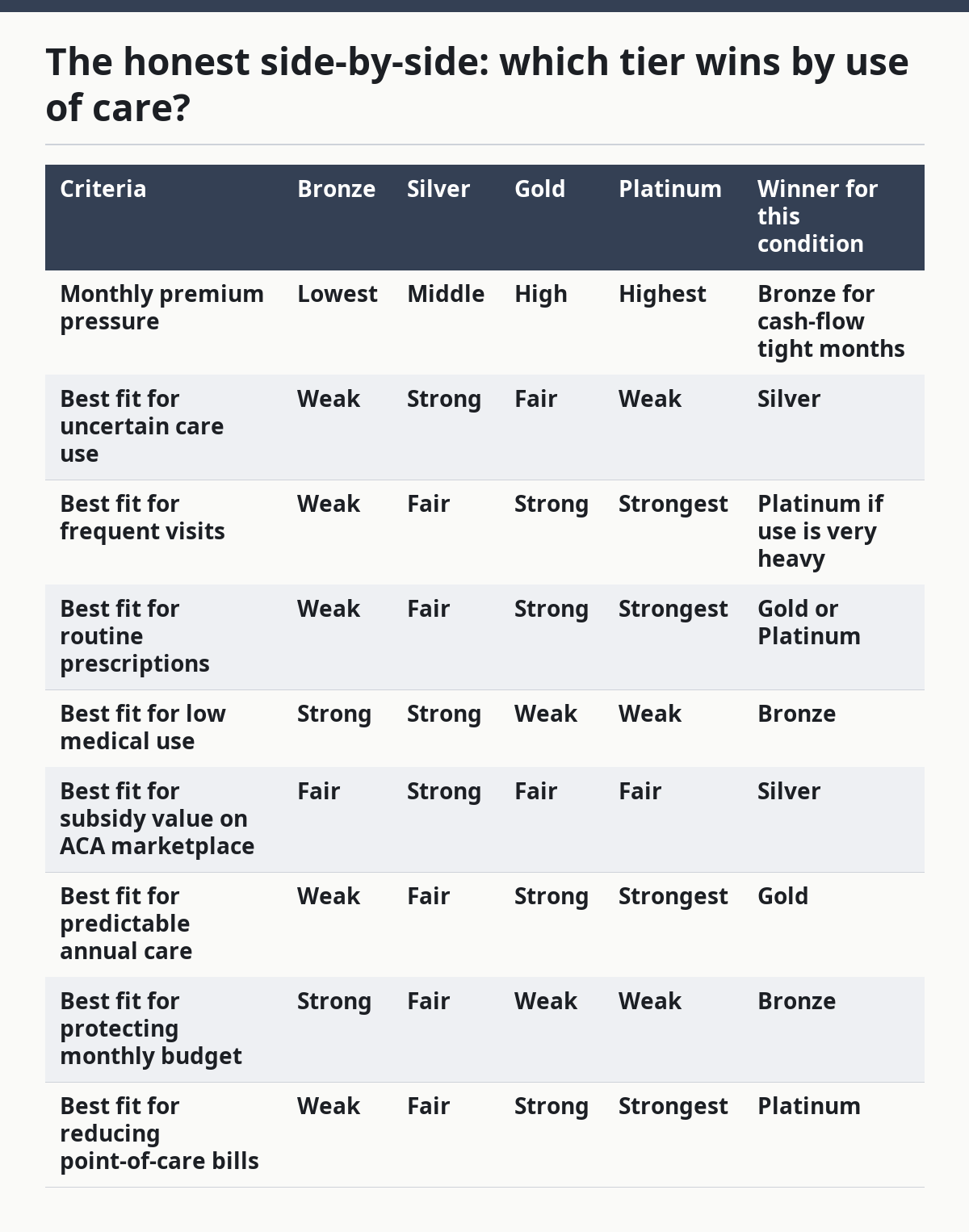
Here’s the catch: the “best” tier changes if your use of care changes. A freelancer with one quiet year and one busy year may pick differently each open enrollment period. That is normal.
- If your use is low, Bronze can win.
- If your use is mixed, Silver usually wins.
- If your use is regular, Gold can win.
- If your use is intense, Platinum can win.
What most freelancers miss when comparing tiers
Silver is the smartest place to start, but it is not automatically the final answer. The mistake is treating metal tiers like a pure premium contest when the real question is how many services you expect to use and how often.
Picture this: you compare two plans by monthly price, then discover one has the better fit for your use of care because you have three specialist visits and two prescriptions in a typical month. That is the kind of mismatch this page is meant to prevent. The tier should match the pattern, not the sticker price.
Three things usually get missed:
- A cheap premium can hide high use-costs. Bronze can look friendly until care shows up.
- A higher premium can buy lower friction. Gold and Platinum can reduce the bite at visits and fills.
- Subsidy eligibility can change the math. Silver gets special weight on the ACA marketplace because cost-sharing reductions can make it more valuable than its middle-tier label suggests.
That is why the right question is not “Which metal tier is best?” It is “How much care will I actually use?”
If you want the full plan-selection framework, the hub page on sits above this one and covers the broader decision tree.
The verdict: which ACA metal tier should a freelancer choose?
Choose Bronze if you expect very light care use and need the lowest monthly premium. Choose Silver if your care use is mixed, uncertain, or you may qualify for cost-sharing reductions on the ACA marketplace. Choose Gold if you know you’ll use care often. Choose Platinum if your care use is heavy enough that the premium is worth it. The best answer depends on the number of visits, prescriptions, and follow-ups you expect during the year.
Drafted with AI; not yet reviewed by a person.