Health Insurance Rules For Freelance Households — The Complete Guide

Last updated: November 20, 2026
Health insurance rules for freelance households — The Complete Guide
Quick Answer: Freelance households usually have to handle health insurance themselves, and in this guide the key rules come down to how you enroll, how you prove income, and how you share coverage across a household. The Health insurance rules for freelance households — The Complete Guide is usually a 2-plan-type decision at the start: HMO or PPO, then a check of doctors, budget, and changing freelance income.
Freelance households usually have to handle health insurance themselves, and the main rules in Health insurance rules for freelance households — The Complete Guide come down to how you enroll, how you prove income, and how you share coverage across a household. The biggest choice is often HMO vs PPO, but the real job is making sure the plan fits your doctors, your budget, and the way freelance income changes during the year.
Health and tax rules change by country and by plan, so a qualified adviser should review your own situation before you make a final decision. If you are unsure about eligibility, subsidies, or tax reporting, consult a licensed broker, tax professional, or benefits adviser and compare the current rules on Healthcare.gov and the IRS.
Key takeaways
- Freelance households do not follow one single rulebook; plan rules, tax rules, and enrollment windows can all differ.
- The HMO vs PPO choice matters, but network access, referrals, and out-of-pocket costs matter just as much.
- Income swings can change what you qualify for, especially if your coverage is tied to an ACA marketplace plan.
- Household size, shared custody, and spouse or partner coverage can change what counts as affordable.
- A plan that looks cheap up front can cost more later if the network is narrow or the deductible is high.
Who this applies to
This applies to freelance households that buy individual health insurance, get coverage through a marketplace, or mix freelance income with a spouse’s employer plan. It assumes the household is trying to compare HMO and PPO plans and needs to understand the rules before enrolling, changing plans, or filing taxes.
The phrase “freelance household” covers more than one setup. It can mean a solo freelancer, a couple where one person freelances and the other has a W-2 job, or a family where one income is steady and the other changes month to month. The rules still depend on the same core pieces: who is in the household, what income is counted, and which plan type is being offered.
On a U.S. marketplace, the plan label matters because HMO and PPO plans usually handle networks and referrals differently. The federal marketplace at Healthcare.gov explains plan types and enrollment basics, while the IRS handles tax filing rules for premium tax credits and reconciliations. Those are the two sources most households need to understand first: Healthcare.gov and the IRS.
The hard part is that freelance income is uneven. A household may look eligible for help in one month and less eligible in another, and that can affect marketplace subsidies and tax filing later. A general rule that works for a salaried family can break down for a household whose income moves every quarter.
What makes freelance insurance different?
Freelance insurance is different because the household has to match a plan to irregular income, not just to a fixed paycheck. That means the plan choice, the enrollment window, and the tax form all matter at once, especially when the household uses an ACA marketplace plan.
A salaried worker often has one employer plan, one paycheck pattern, and one benefits office. A freelance household may have to compare marketplace plans, a spouse’s employer plan, COBRA, or coverage through a professional association. Each route has different rules for who can join, when the household can enroll, and what happens if income changes after enrollment.
For marketplace coverage, the household may qualify for advance premium tax credits, which are subsidies used to lower monthly premiums. Those credits are based on estimated annual household income, not just the current month. If the estimate is off, the IRS can require a tax-time adjustment on Form 8962, which is one reason freelancing creates more paperwork than a standard job does.
Therefore, the cheapest monthly plan is not always the cheapest annual plan, because a plan with a low premium can still have a higher deductible, narrower network, or stronger limits on out-of-network care. A PPO may give more provider choice, while an HMO may keep costs tighter if the network fits the household well. The right question is not “Which plan is best?” but “Which rules match this household’s doctors, meds, travel, and cash flow?”
How do HMO and PPO rules differ?
HMO and PPO plans differ mainly in how they handle networks, referrals, and out-of-network care. That difference is the core of the decision for most freelance households, because it changes how easy the plan is to use and how expensive a mistake can be.
An HMO is a health maintenance organization. In plain terms, it usually asks the member to stay inside a defined network and often uses a primary care doctor as the gatekeeper for specialist care. A PPO is a preferred provider organization. It usually gives more provider choice and may cover some out-of-network care, but that flexibility often comes with higher premiums or higher cost-sharing.
Here is the comparison that most freelance households need first.
| Feature | HMO | PPO |
|---|---|---|
| Doctor choice | Usually more limited | Usually broader |
| Referrals | Often required for specialists | Often not required |
| Out-of-network care | Usually limited or not covered except emergencies | May be covered, but often at a higher cost |
| Monthly premium | Often lower than a PPO | Often higher than an HMO |
| Best fit | Households with a stable local network | Households that need flexibility or travel more |
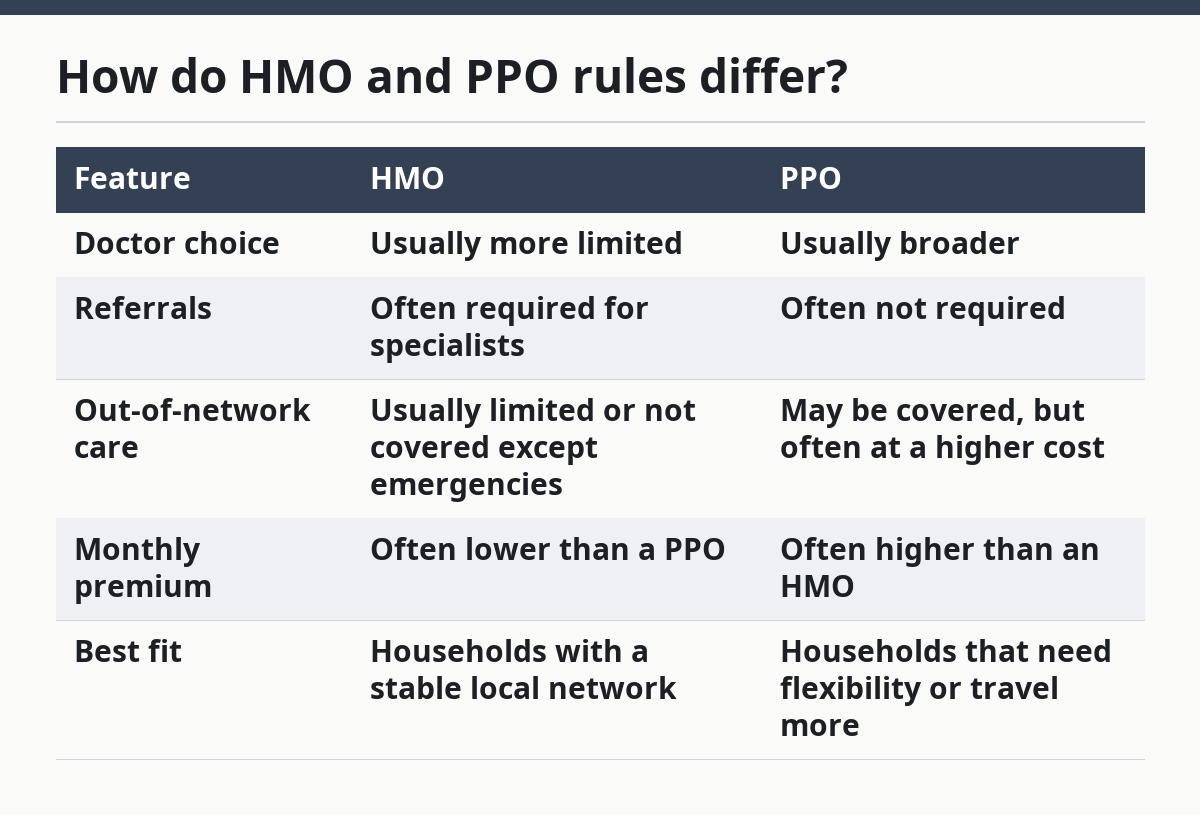
That table does not settle the choice by itself. A household with a favorite specialist, a child in ongoing care, or frequent travel may find a PPO easier to live with. A household that mainly uses local primary care and wants lower fixed costs may find an HMO easier to manage. The wrong fit is expensive in a very ordinary way: surprise bills, referral delays, and a plan that looks cheaper only on paper.
One more rule matters here. “PPO” does not mean “all care is covered everywhere,” and “HMO” does not mean “no choice at all.” The actual plan document controls the details. The Summary of Benefits and Coverage, often called an SBC, tells the member what is covered, what needs a referral, and what the cost-sharing looks like for common services. That document matters more than the plan name on the front page.
How do you set up coverage step by step?
Freelance coverage works best when the household checks the plan rules in the same order the rules will be enforced: household, income, enrollment, doctors, drugs, and tax forms. Skipping steps is how people end up with a plan that looks fine in October and breaks in April.
- List every person in the coverage unit. Write down each household member who may be on the plan, including spouse, children, and dependents. Verify the ages, tax status, and whether anyone has separate employer coverage. A problem shows up if you guess on household size, because that can change both eligibility and tax treatment; if the household is unsure, consult a licensed broker or tax professional and check the current marketplace rules on Healthcare.gov.
- Estimate annual household income for the full year. Use the best available estimate for freelance income, spouse income, and any other taxable income for the year. Verify that the estimate matches the tax household, not just the freelancing business. A problem shows up if you use one strong month and ignore the rest of the year, because marketplace subsidies are based on annual household income; if the estimate is uncertain, consult a tax professional and review IRS Form 8962.
- Check whether the household qualifies for a marketplace plan or another source of coverage. Compare the marketplace option with any employer plan, COBRA option, or spouse coverage. Verify whether there is an affordable employer offer in the household, because that can affect subsidy eligibility. A problem shows up if someone assumes marketplace help is automatic, because the rules can change when employer coverage is available.
- Compare HMO and PPO networks before looking at price alone. Check the current doctors, clinics, hospitals, and prescriptions in each plan’s network. Verify that the plan documents name the providers the household actually uses. A problem shows up if the plan is cheap but the doctors are out of network, because the savings may vanish at the point of care.
- Check referrals, prior authorization, and out-of-network rules. Read how specialist visits, imaging, surgery, and emergency care are handled. Verify whether the plan needs a primary care referral or prior authorization for common services. A problem shows up if the household needs specialist care and the plan slows access with extra steps.
- Match the monthly premium to the likely yearly out-of-pocket cost. Compare the premium, deductible, copay, coinsurance, and out-of-pocket maximum. Verify the total picture for a routine year and a high-use year, not just the premium alone. A problem shows up if the household only checks the monthly bill, because a low premium can hide a high deductible.
- Read the SBC and the drug formulary before enrollment closes. The SBC is the standard benefits summary, and the formulary is the plan’s list of covered drugs. Verify the tier for each medicine, the refill rules, and any special limits. A problem shows up if a needed drug is missing or placed in a high-cost tier; if that happens, consult the insurer or a licensed adviser before enrolling.
- Keep proof and calendar the follow-up tasks. Keep the enrollment confirmation, income estimate, and any subsidy notices in one place. Verify the deadline for reporting income changes and the date to review the plan for the next open enrollment. A problem shows up if the household cannot prove what it reported, because tax reconciliation and coverage disputes become harder to fix later.
This process is not glamorous, but it is the cleanest way to avoid the usual freelance mistake: choosing on instinct and fixing the consequences later. Healthcare.gov has plan comparison tools and explanations of coverage types, and the IRS explains how premium tax credits are reconciled at tax time on Form 8962. Those two reference points are the backbone of the process for many U.S. households.
What should you check before you choose a plan?
You should check the doctors, prescriptions, referrals, and annual cost before you choose a plan, because those four pieces determine whether the coverage actually fits the household. The plan label alone, including HMO or PPO, does not tell the whole story.
For example, start with the providers. If a household has ongoing care, the first check is whether the current primary care doctor, pediatrician, therapist, or specialist is in network. In an HMO, that can matter a lot because the network is usually tighter. In a PPO, out-of-network care may still be possible, but the cost can rise quickly.
Next check medication. A drug that is covered on one plan may sit on a different tier on another plan, which changes what the household pays at the pharmacy. The formulary is the technical word for the plan’s drug list. If a medicine is not on the formulary or needs prior authorization, that can affect both cost and timing.
Then check the plan structure. Premium, deductible, copay, coinsurance, and out-of-pocket maximum are not interchangeable terms. Premium is the monthly payment for coverage. Deductible is what the member pays before the plan begins to share many costs. Copay is a flat amount for a covered service. Coinsurance is a percentage share of the cost. Out-of-pocket maximum is the most the member has to pay for covered care in the plan year, subject to the plan rules.
Finally check the tax side if the household uses marketplace coverage. A freelance household may estimate income conservatively, then find out at tax time that the household owed more than expected or qualified for less help than planned. That is not a plan-design problem; it is an income-reporting problem. The IRS rules matter here because the subsidy and the tax return have to match.
A plan can fail the household even if the premium looks good. That is why the best comparison is not just “HMO or PPO?” by itself. The better question is “Which plan covers this household’s care, at this household’s likely income, with the fewest surprises?”
When does the standard approach not apply?
The standard HMO-versus-PPO comparison does not apply cleanly in five common situations, and each one changes the decision in a specific way. In those cases, the household should slow down and check the plan rules line by line, because the default advice can mislead.
One household member has ongoing specialist care: This means referrals and network access may matter more than the monthly premium — check whether the plan makes specialist visits easy or slow. If the plan needs repeated referrals, a narrow HMO can become awkward even if it is cheaper on paper.
The household’s income changes sharply during the year: This means the subsidy estimate may be unstable — update the income estimate when the year changes, not just at tax time. If the estimate drifts too far, the household can face a correction when the return is filed.
A spouse or partner has employer coverage available: This means the household has to compare all available coverage sources, not just the marketplace — check whether the employer plan changes subsidy eligibility. If the employer offer is considered affordable under the applicable rules, the marketplace math can change.
The household lives or travels outside one service area: This means network limits become more important — verify where routine care and emergency care are covered. If the family splits time between locations, a plan with a tight local network can be hard to use.
The plan excludes a needed drug or treatment: This means the plan is not a fit, even if the premium is attractive — review the formulary and authorization rules before enrollment, and consult the insurer or a licensed professional if the needed care is unclear. If the needed care is not covered or is heavily restricted, the plan may create repeat denials.
Each of these situations changes the choice because the standard premium-first comparison leaves out a real cost: time, access, paperwork, or tax adjustment. That is why freelance households should treat HMO and PPO as operational rules, not just labels, and they should verify the details with a licensed adviser or insurer when the situation is complex.
What mistakes do freelance households make most often?
Freelance households usually make the same six mistakes, and each one creates a different kind of problem. Most of them start with trying to save money on the premium and stop there.
The first mistake is choosing from the monthly price alone. That can leave the household with a high deductible or a narrow network that costs more over the year. The better alternative is to compare premium, deductible, copays, coinsurance, and out-of-pocket maximum together.
The second mistake is assuming all doctors in the same system are in network. That is a real trap with both HMO and PPO plans. The correct alternative is to verify each doctor and facility by name in the plan directory, then confirm the answer in the SBC or with the insurer.
The third mistake is ignoring the drug formulary. A plan can look fine until a needed medication turns out to be restricted or expensive at the pharmacy. The correct alternative is to check each medicine by name, dosage, and refill pattern before enrollment ends.
The fourth mistake is underestimating annual income. Freelancers often know this month’s bill better than this year’s tax picture, but marketplace help is usually based on annual household income. The correct alternative is to use a full-year estimate and update it when work volume changes.
The fifth mistake is assuming an HMO always means no flexibility and a PPO always means easy access. That oversimplifies both plan types. The correct alternative is to read the actual benefit rules, because the plan document controls the referral and out-of-network details.
The sixth mistake is forgetting the tax form trail. Marketplace subsidies and year-end tax filing connect through forms such as 1095-A and 8962, and mismatches can create confusion. The correct alternative is to save every enrollment notice, income estimate, and insurer letter in one file for the year.
These mistakes do not just create annoyance. They can cause delayed care, surprise bills, or tax-time corrections. That is a lot to risk for a plan decision made after only 10 minutes of comparison.
What if the household has mixed coverage?
Mixed coverage means the household uses more than one type of plan, and that is common in freelance life. One person may be on an employer PPO, another on a marketplace HMO, or a child may be on a different policy because of custody or job status.
The first rule is to treat each person’s coverage as separate unless the plan documents say otherwise. A family does not automatically get the same provider network just because the household shares a tax return. If one person is covered through an employer and another through the marketplace, the rules for subsidy eligibility and enrollment can differ.
The second rule is to check the tax household, not just the insurance household. The IRS looks at the tax return when it applies premium tax credit rules, so a spouse’s income can matter even if that spouse is not the one running the freelance work. That is why a household with one freelancer and one W-2 earner should check the whole return, not just the freelance Schedule C.
The third rule is to watch for changes in family status. Marriage, divorce, birth, adoption, and loss of other coverage can all change what the household can enroll in and when. For a freelance household, those changes can arrive mid-year and affect both plan choice and subsidy math.
The practical test is simple: if more than one person is covered differently, do not assume the same rules apply to everyone. A clean file with each person’s plan, provider list, and tax document is worth keeping for the full plan year, especially when the household has mixed coverage from employer, marketplace, or individual policies.
How do tax forms fit into the picture?
Tax forms fit into the picture because marketplace coverage and freelance income often meet again at tax time. For many households, the main forms are 1095-A for marketplace coverage and 8962 for premium tax credits, with other coverage forms depending on the household’s situation.
The key point is that the subsidy is not a gift that disappears after enrollment. It has to match the annual household income that was reported and the coverage that was actually used during the year. If the estimate was too low or too high, the tax return may have to correct it.
That is especially important for freelance households because income can rise or fall during the year. A strong quarter can push the annual estimate upward, while a slow year can bring it down. The IRS rules are built around the full-year return, not just the month when coverage started.
The best practice is to keep one folder for the year with every insurance document. That folder should include enrollment notices, income estimates, plan summaries, premium notices, and any letter from the marketplace or insurer. When tax time arrives, the household can compare the forms before filing instead of trying to rebuild the year from memory.
A common mistake is waiting until April to sort out a mismatch. By then, the household may have lost the best chance to understand what changed and why. The better habit is to review the coverage after any major income shift, then again before tax filing.
What does a good result look like?
A good result looks like a plan the household can actually use without surprise limits, surprise bills, or tax-time confusion. For a freelance household, that usually means the doctors are in network, the medications are covered, the premium fits the budget, and the annual income estimate is close to reality.
It is not about finding a perfect plan. It is about finding a plan that matches the household’s real pattern of care and money flow. An HMO can be a good fit when the network works and the household wants structure. A PPO can be a good fit when flexibility matters more and the household can absorb a higher monthly cost or wider range of cost-sharing.
The cleanest sign of a good result is that the household can explain the plan in plain language. Which doctor is covered, which drug needs approval, which form is saved for taxes, and what happens if income changes. If those answers are clear in 5 minutes, the household is in much better shape than one that chose a plan based on price alone.
The wrong result is also easy to spot. A plan that saves a little each month but blocks needed care, misses a subsidy rule, or forces repeated billing disputes is not a good match. The label HMO or PPO matters, but the actual rules matter more.
What if freelance income changes after enrollment?
If freelance income changes after enrollment, the household should update the income estimate as soon as the change is clear enough to matter. That helps keep marketplace subsidies closer to the final annual total and reduces the chance of a mismatch at tax time.
Is an HMO always cheaper than a PPO?
No, an HMO is not always cheaper than a PPO in every way that matters. Premiums are often lower on an HMO, but the household still has to check the deductible, copays, and whether the doctors and drugs fit the plan.
Can one freelance household use different plan types?
Yes, one freelance household can use different plan types if the coverage sources differ. One person may be on an employer PPO while another uses a marketplace HMO, but each person’s network, subsidy, and tax situation has to be checked separately.
What matters more, network or premium?
Network often matters more when the household already has doctors, specialists, or prescriptions it wants to keep. Premium matters too, but a lower monthly bill can be a bad deal if the plan does not cover the care the household actually uses.
Where should a freelancer check the rules first?
A freelancer should check the marketplace or insurer plan documents first, then confirm the tax side with the IRS guidance for premium tax credits. Healthcare.gov and the IRS Affordable Care Act guidance are the two most useful starting points for U.S. households comparing HMO and PPO coverage.
Drafted with AI; not yet reviewed by a person.