How freelancers get prior authorization approved

Last updated: November 20, 2026
Quick Answer: freelancers usually need 3 things to get prior authorization approved: the exact service, the medical reason, and the insurer’s required form or code. How freelancers get prior authorization approved is mostly about sending one clean packet for a test, surgery, or referral and then following up until the insurance company gives a written yes.
Key takeaways
- Prior authorization is not a guess-and-wait process; it is a paper trail the insurer reviews before it pays.
- The cleanest requests name the medical service, the diagnosis, and the reason the service is needed.
- Freelancers should treat the clinic, the specialist, and the insurance company as one chain that has to stay in sync, and they should confirm the process with the clinician’s office or a benefits specialist.
- Denials often come from missing details, not from the service itself.
- A referral and a prior authorization are related, but they are not the same thing.
What prior authorization means for a freelancer
Prior authorization means the insurance company wants to review a medical service before it agrees to cover it. For freelancers on Marketplace coverage, HealthCare.gov notes that coverage rules can vary by plan, and that can apply to a test, a surgery, or a referral to a specialist; the request usually goes through the clinician’s office, not the patient alone.
The review is meant to check medical necessity. In plain terms, the insurer wants to know whether the service fits the diagnosis, whether a less costly option was tried first, and whether the service meets the plan’s rules. The process is sometimes called precertification, preapproval, or prior authorization, but the idea is the same: no approval, no payment promise.
This is where freelancers get tripped up. A plan can look fine on monthly cost, yet still require prior authorization for certain services. The important question after enrollment is not “Do I have coverage?” but “What does this plan require before I get the service?” That is why this page sits inside the larger guide to how freelancers use Marketplace coverage after enrollment.
A referral is a separate piece. A referral is a direction from a primary care clinician to a specialist, while prior authorization is the insurer’s approval for the service itself. A referral may be enough for one specialist visit and not enough for an MRI, outpatient surgery, or a procedure done in a hospital setting. If both are needed, the request has to satisfy both rules.
One practical limitation: prior authorization is not always fast. Even a complete request can take days, and a missing code or unclear note can push it back into the queue. That means it is often smart to start early, before the test date or surgery date is fixed.
What do you need before the request goes in?
You need three things before the request goes in: the exact service, the right clinical reason, and the correct insurance details. Without those, the insurer cannot match the request to the plan, and the office staff may have to start over.
The service should be specific. “Specialist visit” is too vague if the office really needs approval for a neurology referral, a colonoscopy, or outpatient surgery. The diagnosis matters too, because medical necessity review is built around the reason the clinician gives, not the patient’s preferred label for the problem. The insurer also needs the member ID, group number if the plan uses one, and the provider’s tax ID or similar office identifier.
Here is the cleanest way to prepare the request:
- Ask the clinician’s office what item needs approval. Get the exact name of the test, surgery, or referral so the office submits the same wording on the form.
- Confirm the plan’s rule before the appointment starts. The office can check whether the service needs prior authorization, precertification, or both, which avoids a wasted visit.
- Gather the medical facts the insurer will ask for. This usually means the diagnosis, prior treatment, and why the requested service is needed now; for plan-specific documentation, check the insurer or ask a benefits professional.
- Make sure the insurer sees the right provider. If the specialist or facility is out of network, approval rules can change and the request can stall.
- Ask who will track the request. One staff member should own the follow-up so the file does not sit for 2 weeks with no answer.
A generic article often misses the billing side. The request is not just a medical note; it is also an administrative file. One wrong procedure code or one typo in the member ID can slow the review even when the doctor agrees the service is needed.
How do you get prior authorization approved step by step?
You get prior authorization approved by submitting a complete request, supporting it with medical necessity, and following up until the insurer issues a written decision. The process is usually a short chain of calls, forms, and chart notes, not a single button click.
The table below shows how the workflow changes by service type.
| Service type | What usually has to be shown | Who usually sends the request | Common weak spot |
|---|---|---|---|
| Test | Why the test is needed now and what problem it answers | Clinician’s office | Missing diagnosis or wrong test code |
| Surgery | Why surgery is medically necessary and why a less intense option is not enough | Surgeon’s office | Incomplete chart notes or missing facility details |
| Referral | Why the specialist visit is needed and whether the plan requires a referral before the visit | Primary care office or referring clinician | Referral sent after the appointment was already scheduled |
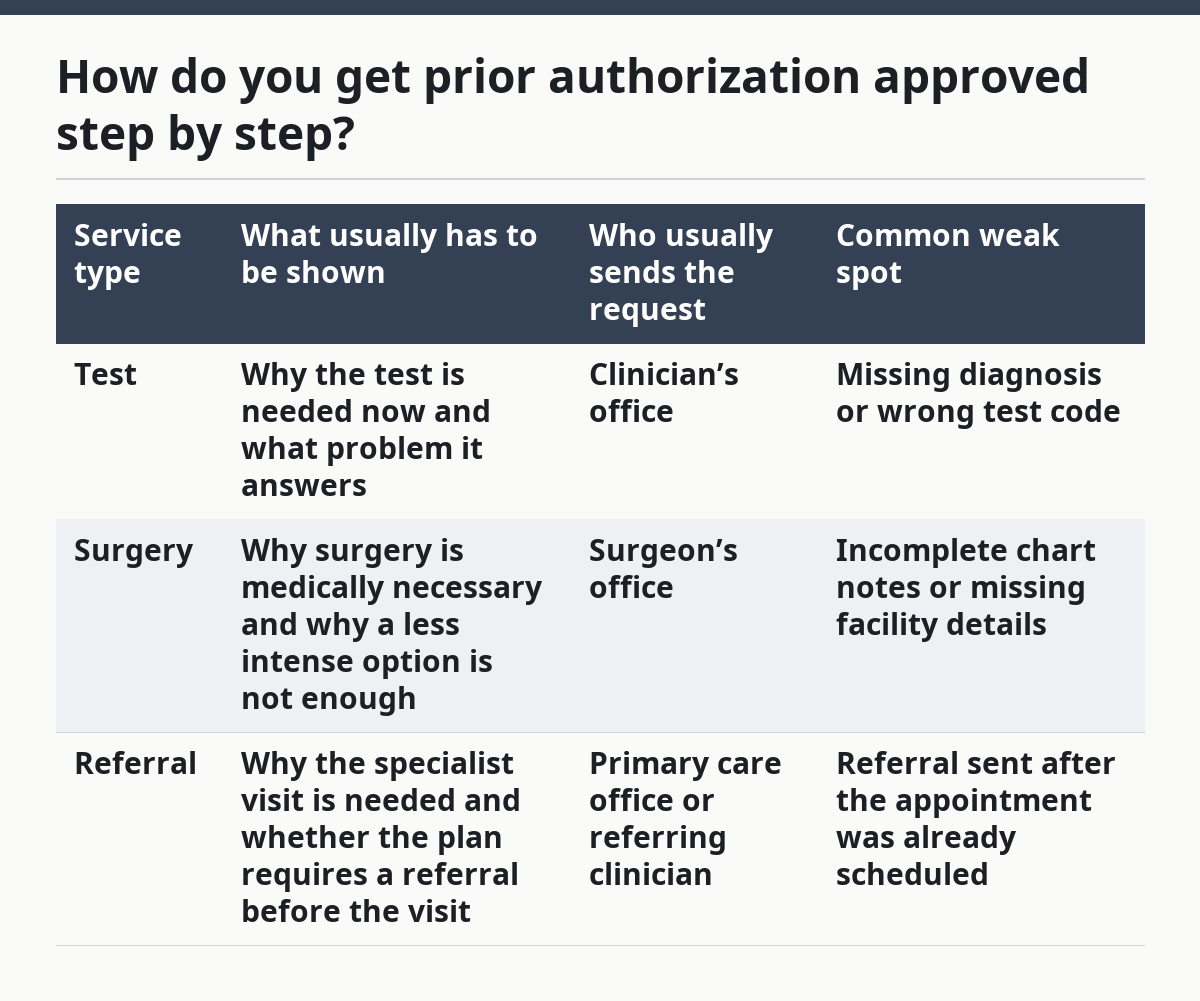
The review usually works best when the request is built around the insurer’s own checklist. Some plans want a form, some want chart notes, and some want both. A clean packet usually includes the service code, the diagnosis code, the reason the service is needed, and the name of the place where it will happen.
A practical way to move the request forward is to keep 4 points aligned: the office, the insurer, the service date, and the patient. If one of those changes, the request can go stale. For example, a surgery approved for one facility may not carry over to another site without a new review. A referral approved for one specialist may not work for a different doctor in the same group.
The best approval requests are boring when they are complete and easy to review. They do not ask the reviewer to guess what the clinician meant. They show the diagnosis, explain the medical necessity, and use the same exact service name on every page. That simple discipline matters more than chasing the right person on the phone.
What slows approval down?
Prior authorization slows down when the request is incomplete, unclear, or sent to the wrong place. The most common delay is a missing detail the insurer needs for medical necessity review.
The first problem is mismatch. If the clinic says “specialist visit” but the plan needs a referral for a cardiology consult, the insurer may send it back. The second problem is missing proof. If the chart note does not explain why the test or surgery is needed, the reviewer has little to approve. The third problem is timing. If the request is started only after the appointment is set for tomorrow, the office may not have enough time to finish the paperwork.
A few other mistakes show up often:
- No follow-up number or reference number. Without it, the office cannot prove the request was received.
- Wrong provider or facility name. That can force a new review.
- Assuming the referral equals approval. It often does not.
- Waiting for the patient to chase every call. The clinic and insurer need to talk directly, because they hold the codes and chart notes.
The cost of a delay is not just annoyance. It can mean rescheduling a test, moving a surgery date, or paying more out of pocket while the file is still under review. The fix is simple but not glamorous: ask for the reference number, get the name of the person who submitted the request, and check back if nothing has moved after a few business days.
This is not the page for choosing a plan. It is the page for using the plan you already have. If the service is urgent, the usual advice about careful paperwork still applies, but the medical team should guide the timeline.
What happens if the insurance company says no?
If the insurance company says no, the next step is to ask why, then decide whether the request can be corrected or appealed. A denial is often about missing information, not a final judgment on the service itself.
The first move is to get the denial in writing and read the reason. The insurer may say the service was not medically necessary, the request lacked records, the wrong code was used, or the service did not meet the plan rule. That reason tells the clinician’s office what to fix. If the office can submit more records or correct the code, the request may be reconsidered without a full dispute.
If the denial stands, the appeal path starts with the plan’s instructions. Keep the denial letter, the reference number, the clinician’s notes, and any call logs in one place. The appeal is stronger when it answers the insurer’s reason directly. For example, if the reviewer said the chart note was too thin, the appeal should add the missing clinical facts rather than repeat the same one-page summary.
One practical trade-off is time: appeals can take time, and a rushed appeal with weak records often goes nowhere. It is better to send a complete file than a fast file. For a test or surgery date that is already close, the clinician’s office should also talk to the patient about whether to reschedule or pay while the review is pending.
For common benefit and coverage questions after enrollment, the broader hub on how freelancers use Marketplace coverage after enrollment should sit next to this guide.
How do freelancers stay on top of the process?
Freelancers stay on top of the process by tracking the request like a job ticket, not a one-time ask. The cleanest way is to keep one page with the date, the service, the office contact, the insurer contact, and the reference number.
That record matters because freelancers often manage care between work blocks. If a request sits for 3 business days with no answer, the paper trail makes it easier to call back and ask, “Who has the file now?” It also helps if the provider office says they never got the insurer’s fax or portal message. The record gives both sides the same starting point.
A simple tracking list works well:
- Service requested
- Date the request was sent
- Name of the submitting office
- Reference number
- Denial or approval date
- Next action
This is also the point where referral and prior authorization can get tangled. A referral may be approved, but the actual procedure may still need a separate preauthorization. If the specialist orders a new test, that new order can require its own review. One approval does not cover every future step.
The best mindset is practical, not anxious. The goal is not to win an argument with the insurer. The goal is to make the file complete enough that the insurer can say yes without guessing.
What services usually need prior authorization?
Services that are costly, specialized, or easy to overuse often need prior authorization. That can include some tests, some surgeries, and some specialist referrals, but the exact rule depends on the plan and the medical service. The safest move is to ask the clinician’s office before the appointment, because a service that looks routine to the patient may still need precertification.
Who submits the request?
The clinician’s office usually submits the request. In practice, that may be the surgeon’s office, the specialist’s office, or the primary care office, depending on who is ordering the test or referral. The patient may still need to supply insurance details or sign forms, but the office usually sends the medical records and codes.
What if authorization is denied?
If authorization is denied, the first step is to read the denial letter and identify the stated reason. The clinician’s office may be able to correct missing details, send more records, or file an appeal under the plan’s rules. A denial does not always mean “never,” but it does mean the next step has to answer the insurer’s reason directly.
Drafted with AI; not yet reviewed by a person.