
Last updated: November 21, 2026
Quick answer: 8 steps. A freelancer applies for Marketplace health insurance by making a Marketplace account, entering household and income details, comparing plans, and enrolling during Open Enrollment or after a qualifying life event. In the article How to Apply for Health Insurance Through the Marketplace as a Freelancer: related questions, the main point is simple: use your tax household, your expected yearly income, and your doctors and drugs to compare plans before you enroll. This is general information, not financial advice; the rules for subsidies, family size, and income can change by country and by year, so a qualified adviser should review your own situation.
Who this applies to
This applies to a freelancer, contractor, gig worker, or self-employed person who needs health coverage through the U.S. Health Insurance Marketplace. It assumes you know your basic household details, your expected income for the coverage year, and whether anyone else on your tax return needs coverage too.
This is for someone who is applying on their own or with a spouse, not for someone already offered affordable employer coverage from a full-time job. If you have Medicare, Medicaid, or job-based coverage already, the Marketplace may not be the right route for you, and the application questions change in ways that matter for eligibility and tax credits. For a quick overview of enrollment timing, see Open Enrollment basics and qualifying life events.
Key takeaways

- Your Marketplace application is built around two things: who is in your household and what you expect to earn this year.
- The application can lead to premium tax credits, but only if the income details are entered correctly and kept updated.
- HMO and PPO plans can both appear on the Marketplace; the difference affects doctors, referrals, and out-of-network costs.
- A mistake on income or household size can change your subsidy and create tax trouble later on Form 1095-A.
- If your situation includes Medicare, Medicaid, employer coverage, or a big income swing, the standard application may need extra review.
How do I apply step by step?
You apply by creating a Marketplace account, entering your tax household and income, and then selecting a plan that fits your doctors, drugs, and budget.
- Gather the papers you need first. Have Social Security numbers or document numbers, birth dates, and the income details you expect for your coverage year. If asked, have proof of current coverage or immigration status ready too. Verify that you can answer questions for every person on the application; a missing spouse or child can change the result. If you cannot estimate income at all, that is a problem because the Marketplace uses that figure to screen for savings.
- Set up your Marketplace account. Go to the federal Marketplace site or your state exchange and create a login. Verify that your email works and that you can save your application without losing it. If the site will not let you move forward, the likely issue is an identity check or a browser problem, not the plans themselves. See [how account setup works](/marketplace-account-setup).
- Enter your household exactly as you file taxes. List yourself and anyone you claim on your tax return, even if they do not need coverage. Verify that the household count matches your tax picture, because subsidy calculations depend on it. If the household list is wrong, the problem is not cosmetic; it can change eligibility for tax credits.
- Estimate your annual self-employment income. Put in the income you expect for the full coverage year, not just one strong month. Verify that the figure includes freelance work, side jobs, and other taxable income the application asks about. A number that is far too low can make you look eligible for more help than you should get; a number that is too high can raise your monthly premium.
- Answer the coverage questions line by line. The application asks about access to employer coverage, tax filing, dependents, and other coverage like Medicare or Medicaid. Verify each answer before you submit, because one wrong yes-or-no can move you into the wrong eligibility path. If you are unsure how to answer a coverage question, stop and get qualified help before you submit. The Marketplace uses tax-style household and income information.
- Compare plans by metal level, doctors, and drugs. Look at premiums, deductibles, copays, and the provider directory for each plan. Verify that your primary doctor, specialists, and prescriptions appear on the plan’s list if they matter to you. If a plan looks cheap only because it hides a high deductible or excludes your doctor, that is a warning sign. For plan terms, see [Marketplace plan types](/marketplace-plan-types).
- Check whether you qualify for savings before you enroll. The Marketplace may estimate premium tax credits based on your income and household size. Verify that the subsidy shown on screen matches the income you entered and that you understand it is tied to your tax return. If the estimate seems far larger than expected, recheck your income and household entries before you accept it.
- Enroll and save every confirmation page. Submit the application, select the plan, and keep the confirmation number, insurer name, and effective date. Verify that you can download or print the final summary, because you may need it later for taxes or billing. If you do not get a confirmation, assume the application did not finish and check the account before you stop.
The main source for the federal process is HealthCare.gov, and the tax side is tied to IRS rules for the premium tax credit: HealthCare.gov and IRS premium tax credit guidance. Those pages are the right place to confirm current forms and timing before you submit anything.
What should I check before I compare plans?
You should check your doctors, prescriptions, and likely yearly spending before you compare plans. A plan with a low monthly premium can still cost more over 12 months if the deductible is high or your medications are not covered well.
Freelancers often focus on the monthly premium and miss the rest of the cost structure. That is where HMO and PPO plans matter. An HMO, or health maintenance organization, usually expects you to stay in a set network and may require referrals. A PPO, or preferred provider organization, usually gives more out-of-network flexibility, but that flexibility often comes with higher costs.
| Feature | HMO | PPO |
|---|---|---|
| Typical doctor access | Use in-network doctors and facilities | More freedom to see out-of-network providers |
| Referrals | Often needed for specialists | Often not needed |
| Cost control | Usually easier to predict | Usually more flexible, often more expensive |
| Best fit for | Someone who wants a tighter network and lower predictable cost | Someone who wants wider provider choice |
| Main risk | Limited choice if your doctor is outside the network | Paying more if you use out-of-network care |
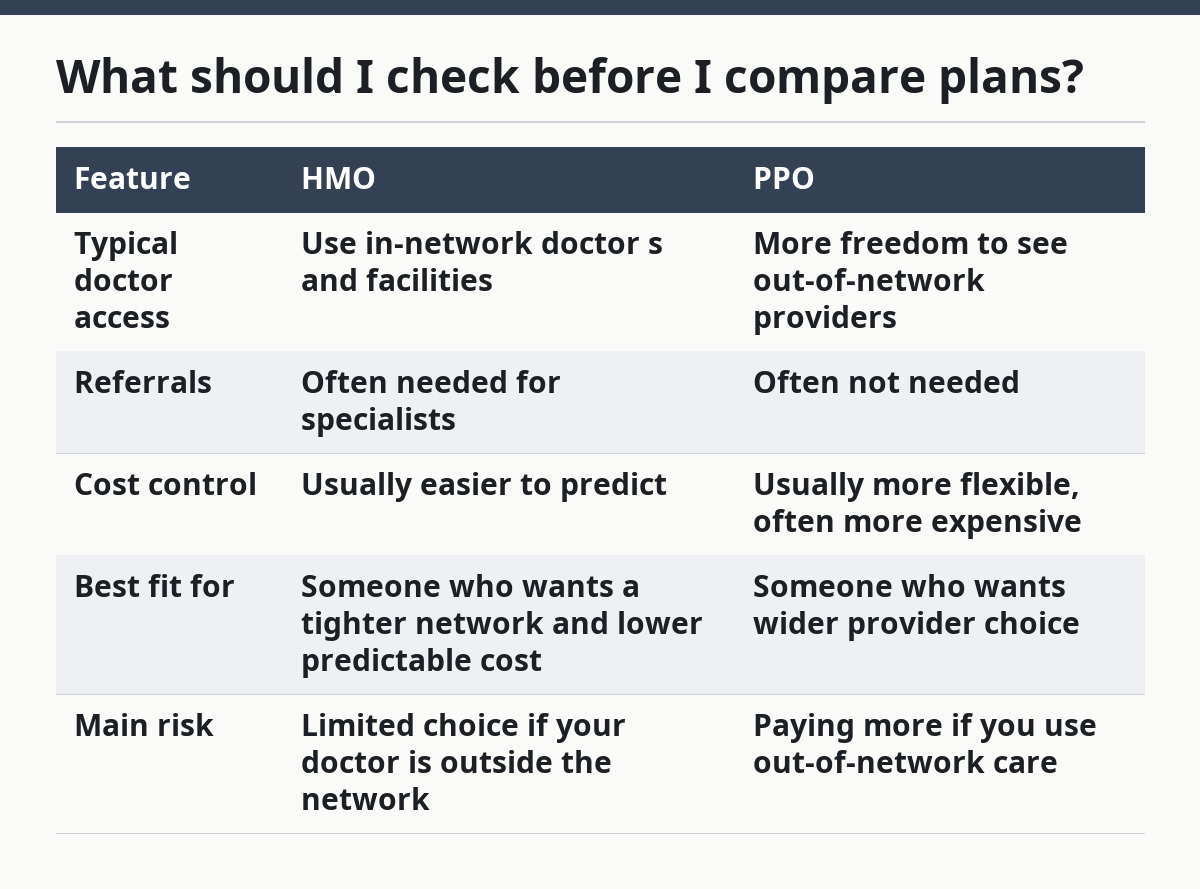
If you are choosing between HMO and PPO on the Marketplace, the right question is not which one sounds better. It is whether your actual doctor list, prescriptions, and travel habits fit the plan rules. For a freelancer who works in different cities or states, network limits can matter more than the monthly premium.
When should I stop and get help?
You should stop and get qualified help if the Marketplace application no longer matches a simple freelance income setup. That matters because the wrong enrollment path can affect monthly subsidies, tax filing, and whether the plan you picked is even valid for your household.
You expect your income to swing a lot during the year: That means your subsidy estimate may change after enrollment — talk with a qualified adviser or Marketplace assister before you finalize the income figure.
You have Medicare, Medicaid, or employer coverage in the same household: Those programs can change eligibility questions — check the application rules before you submit.
You recently moved, married, divorced, had a child, or lost coverage: Those are qualifying life events, and they can open a Special Enrollment Period, often with a 60-day window — verify your dates before you apply.
You do not know how to report self-employment income: The Marketplace uses expected annual income, not a guess based on one invoice — get help if you cannot separate business income from deductions or other earnings.
You are seeing a subsidy amount that seems far too high or far too low: That usually means the household or income data need review — correct the application before you accept the plan.
You are applying for someone else’s household too: Tax-filing rules can be complicated when children, stepchildren, or separated spouses are involved — confirm the tax household before moving forward. See who counts in a tax household.
What mistakes do freelancers make most often?
Freelancers most often make five mistakes: they underestimate income, forget household members, ignore provider networks, choose a plan on premium alone, and fail to update the Marketplace after a change.
First, income underestimation can lead to too much advance premium tax credit. That may lower monthly payments now but create a repayment problem later when taxes are filed. The correct alternative is to use a realistic 12-month estimate and update the Marketplace if your earnings change.
Second, some people list only themselves and leave out a spouse or dependent who belongs on the tax return. That can distort subsidy eligibility. The correct alternative is to match the application to the tax household, not the living arrangement.
Third, some people buy the cheapest premium without checking whether their doctor or prescription is in network. The consequence can be surprise bills or a plan that is cheap only on paper. The correct alternative is to check the provider list and drug formulary before enrollment.
Fourth, some freelancers miss the enrollment window and assume they can sign up anytime. Open Enrollment has a limited period, while Special Enrollment Periods depend on a qualifying event. The correct alternative is to keep track of dates and act as soon as your window opens.
Fifth, people forget to report a major income change after enrollment. That can distort subsidy calculations for the rest of the year. The correct alternative is to update the Marketplace promptly after a material change in earnings, family size, or other coverage.
What if my situation is not standard?
You need to adjust the application if your freelance income is seasonal, mixed with W-2 wages, or paired with a spouse’s employer coverage. In those cases, the standard “one income number” approach can miss the real picture.
Seasonal income is the clearest edge case. If your work spikes in one quarter and disappears in another, the Marketplace still wants an annual estimate, not a peak-month number. A freelance writer who earns most income from January through April should not enter a full-year amount based only on those four months.
A second edge case is mixed income. If you freelance and also have a part-time job with wage income, both income streams usually matter. The application may also ask whether the employer coverage is affordable under the Marketplace rules, which is one reason the exact employer offer matters.
A third edge case is household complexity. If a spouse has coverage through work, or if a dependent has separate coverage, the application can change based on who files taxes together. The wrong tax-household setup can cause the wrong subsidy result, so this is one of the places where a qualified helper can save a lot of cleanup later.
What happens after I enroll?
After you enroll, you should watch for confirmation, premium bills, and any request to verify information. A successful enrollment usually means you receive a plan confirmation and an insurer bill or welcome notice, often before coverage starts.
The first thing to check is the effective date. Marketplace coverage does not always begin the same day you submit; the start date depends on when you enroll and whether you qualify for a Special Enrollment Period. The second thing to check is payment. Missing the first premium can delay or cancel coverage, so confirm the insurer’s payment instructions as soon as they arrive.
You should also save the Form 1095-A when it comes time for taxes. That form reports Marketplace coverage and is used to reconcile advance premium tax credits. If the numbers on that form do not match your records, that is a sign to review the application and any income updates before filing.
What are the related questions freelancers ask most?
Can I apply if I only freelance part of the year?
Yes, if you expect freelance income during the coverage year and you meet the Marketplace rules for your household. The key is to enter a realistic annual estimate, not just the months when work is strong.
Do I need a tax return to apply?
Not always, but the application uses tax-style household and income information. If your prior-year return is not a good guide because your income changed, use your current-year estimate and keep records that support it.
Is an HMO or PPO better for a freelancer?
Neither is automatically better, because the better fit depends on your doctors, prescriptions, travel, and budget. An HMO can work well if your care stays inside one network, while a PPO can fit better if you need more provider choice.
What if my income changes after I enroll?
You should report a material income change to the Marketplace as soon as possible. That can change your subsidy estimate and may reduce the chance of a tax problem later.
Can I use the Marketplace if I live in a state with its own exchange?
Yes, but the application still follows your state’s Marketplace rules, and the site may differ from HealthCare.gov. The general steps are the same, but state deadlines and forms can vary.
Should I submit the application myself or get help?
Submitting it yourself is fine if your income, household, and coverage situation are straightforward. If you have mixed income, dependents, prior coverage complications, or a large income swing, a qualified adviser or Marketplace assister is the safer path.
Drafted with AI; not yet reviewed by a person.