
Last updated: November 28, 2026
Quick Answer: For most freelancers with recurring specialist visits, a PPO is the better fit because it usually reduces referral delays and makes follow-up care easier to schedule. If the specialist is already in-network and the care path is stable, an HMO can still work, but you should confirm the plan details with a health professional and review the insurer’s rules before you decide. For a public overview of how these plans differ, see HealthCare.gov’s HMO and PPO pages.
For freelancers who see the same specialist again and again, HMO vs PPO for freelancers with recurring specialist visits often comes down to access rather than the plan label. A PPO is usually the better fit because it gives faster access and fewer referral delays. An HMO can still work if the specialist stays in-network and the primary care physician is willing to manage the paperwork, but that setup is tighter and less forgiving.
The useful lens here is not the plan label alone; it is how specialist, referral, network, primary care physician, and health plan rules affect repeat follow-up care.
Key takeaways
- A PPO is usually the safer pick for repeat specialist visits because it reduces the chance that a referral rule slows down care.
- An HMO can work when the specialist is in-network and visits are predictable, but the plan often puts the primary care physician in the middle.
- If specialist follow-ups need prior approval or a care plan review, the HMO usually creates more friction.
- The main risk with a PPO is cost sharing that can be harder to predict, especially if the specialist is not in the main network.
- The wrong choice is not “HMO” or “PPO” by itself; it is the plan that makes a necessary follow-up harder to schedule or pay for.
What actually changes between an HMO and a PPO?
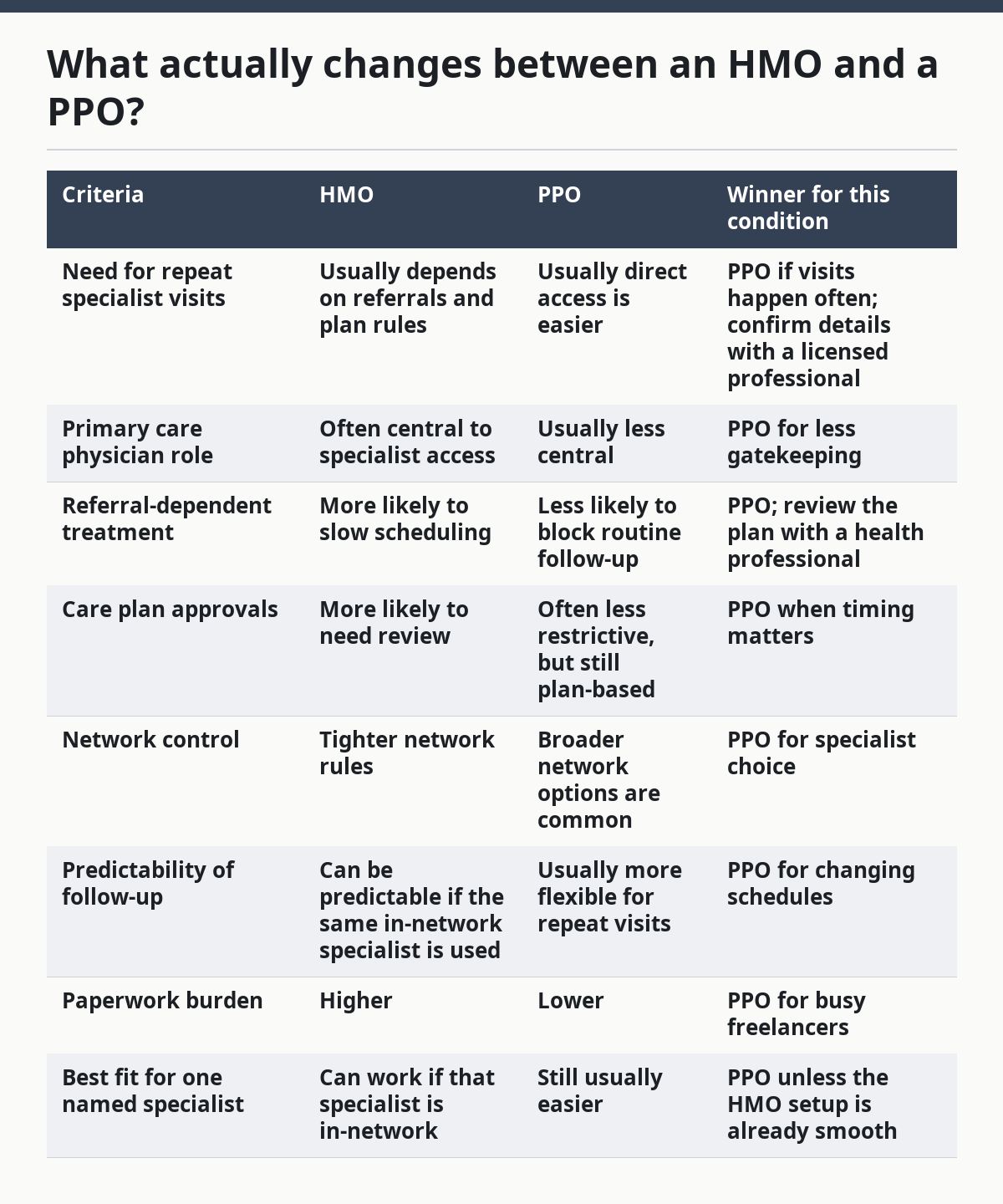
The real difference is control: an HMO usually manages specialist access more tightly, while a PPO usually gives more direct access to the specialist network. HealthCare.gov’s HMO and PPO plan pages describe the basic split clearly: HMOs tend to require in-network care and a primary care physician’s referral for specialist visits, while PPOs are built around more flexibility. See also HealthCare.gov’s guide to types of health insurance plans and Medicare’s explanation of HMOs and PPOs.
That matters for freelancers because recurring specialist care is not a one-time event. A follow-up appointment, a care plan update, and a new approval can all add delay if the plan is built around gatekeeping. If the specialist is part of a long-running treatment plan, the question is not “Which plan is cheaper on paper?” It is “Which plan lets the next visit happen without extra steps?” If that answer is unclear, check the insurer or a licensed broker before enrolling.
For a reader comparing two health plans, the better plan is the one that keeps routine specialist access predictable over a full year, not just at enrollment time.
| Criteria | HMO | PPO | Winner for this condition |
|---|---|---|---|
| Need for repeat specialist visits | Usually depends on referrals and plan rules | Usually direct access is easier | PPO if visits happen often; confirm details with a licensed professional |
| Primary care physician role | Often central to specialist access | Usually less central | PPO for less gatekeeping |
| Referral-dependent treatment | More likely to slow scheduling | Less likely to block routine follow-up | PPO; review the plan with a health professional |
| Care plan approvals | More likely to need review | Often less restrictive, but still plan-based | PPO when timing matters |
| Network control | Tighter network rules | Broader network options are common | PPO for specialist choice |
| Predictability of follow-up | Can be predictable if the same in-network specialist is used | Usually more flexible for repeat visits | PPO for changing schedules |
| Paperwork burden | Higher | Lower | PPO for busy freelancers |
| Best fit for one named specialist | Can work if that specialist is in-network | Still usually easier | PPO unless the HMO setup is already smooth |
Why an HMO can work for specialist care
An HMO can work when the specialist is already in the network and the referral chain is stable. If the primary care physician knows the care plan and the specialist visits are routine, the HMO can keep the system orderly. That can be a decent fit for a freelancer who values a single point of contact more than open access.
The strength of an HMO is structure. The same structure becomes the weakness when a follow-up depends on getting approval before the next visit. A freelancer with a packed calendar may not want to wait on office calls just to keep a recurring appointment moving. HealthCare.gov’s HMO guidance makes clear that the trade-off is tighter control in exchange for less flexibility. For a general public explanation, see HealthCare.gov.
HMO strengths
- Usually keeps care inside a defined network.
- Can make a primary care physician the main coordinator for a specialist plan.
- May fit someone whose specialist visits are regular and easy to schedule months ahead.
HMO drawbacks
- Referral-dependent treatment can slow down repeat visits, so it is worth confirming the rules before enrolling.
- Care plan approvals can add another step before the next appointment.
- A freelancer with an unpredictable schedule may feel boxed in.
Who should skip an HMO
- Anyone whose specialist follow-ups are time-sensitive.
- Anyone who does not want to depend on a primary care physician for every repeat visit.
- Anyone whose specialist may change during the year.
Why a PPO usually wins for recurring specialist visits
A PPO usually wins because it lowers friction. For recurring specialist visits, that matters more than a long list of plan features. If the specialist is already established and the care plan runs on regular follow-up appointments, the PPO is better at keeping the next visit from turning into a paperwork exercise.

That flexibility is useful for freelancers because work days change. A plan that lets specialist access happen without a referral bottleneck is easier to live with when a deadline, client call, or travel date moves around. PPOs are not magic, though. They can still have network limits, and the costs can be less tidy if the plan’s rules are not checked carefully. For cost and network basics, KFF explains how HMO and PPO coverage differ.
PPO strengths
- Usually easier to book specialist visits directly.
- Less dependence on a primary care physician for routine specialist care.
- Better when the same specialist is seen again and again over a year.
PPO drawbacks
- Can still have network rules that affect what gets paid cleanly.
- May cost more in premiums or cost sharing, depending on the plan.
- If the specialist is outside the preferred network, the convenience can shrink fast.
Who should skip a PPO
- Anyone who is certain the needed specialist is already covered cleanly under an HMO.
- Anyone who prefers a strict care structure and does not mind referral steps.
- Anyone who is choosing only on the label and has not checked the network.
What matters most in the side-by-side?
For repeated specialist care, the most important factor is not the broad category; it is how the plan handles the next appointment. A PPO wins on speed and flexibility, while an HMO can win only when the specialist path is already well established and the rules do not get in the way.
This is the comparison that should actually drive the choice:
| Factor | HMO | PPO | Better if… |
|---|---|---|---|
| Specialist access | Usually routed through the primary care physician | Usually more direct | You want fewer steps |
| Referral need | More likely | Less likely | You hate delays |
| Follow-up appointments | Can be smooth if pre-arranged | Usually smoother | Visits happen often |
| Care plan approvals | More likely to matter | Often less of a barrier | Timing matters |
| Network choice | Narrower | Broader | You want flexibility |
| Paperwork | More of it | Less of it | You are busy |
| Plan structure | Tight and managed | More open | You value control |
| Risk of friction | Higher | Lower | You need predictable access |
HealthCare.gov is the clearest public source for the basic HMO/PPO split, and the summary is consistent: HMOs trade flexibility for control, while PPOs trade some structure for easier access to providers. See also Medicare’s overview of plan types.
Which one should a freelancer choose?
Choose a PPO if specialist visits are recurring, you need fast follow-ups, and you do not want a referral to stand between you and the next appointment. Choose an HMO if the specialist is already in-network, the primary care physician is central to your care, and the plan’s approval steps are not likely to disrupt the schedule. Neither is a good choice if your specialist is outside the network you can realistically use.

That is the clean call. For this exact use case, the usual answer is PPO.
When should the choice flip?
The verdict flips in 3 common cases. However, an HMO can make sense if the specialist relationship is already settled and the plan’s network is the only one that includes the right doctor; if that is the case, confirm the details with the insurer or a licensed professional before enrolling. Second, a PPO may not be worth it if you rarely need specialist follow-up and want a tighter, more managed plan. Third, if your specialist visits are tied to a referral-dependent treatment path, a plan that looks flexible on paper can still be the wrong choice if it does not cover the actual care pattern, so verify the referral rule with a health professional.
A fourth case is practical, not medical: if you can only choose between two specific health plans, the winner is the one whose specialist network already includes the doctor you need. A perfect plan type cannot fix a missing specialist.
How should freelancers think about follow-up appointments?
Therefore, freelancers should think about follow-up appointments as the real test of the plan, not the first visit. A good plan is the one that makes the second, third, and fourth specialist appointment feel routine. If each follow-up requires a new approval, a referral check, or a call to the primary care physician, the plan is adding work to a schedule that is already unstable.
That is why the better option for recurring specialist visits is usually the PPO. The HMO is only the better deal when the whole referral chain is already working and the specialist stays in the same network for the full year.
Can an HMO cover recurring specialist care?
Yes, an HMO can cover recurring specialist care if the specialist is in-network and the plan accepts the ongoing care pattern. The catch is that the path is usually less direct, and the primary care physician often stays involved. For one specialist with predictable follow-ups, that can be manageable. For a freelancer with shifting deadlines, it can become a nuisance fast.

The practical question is not “Can it cover it?” but “How much friction will it add to every visit?” That answer decides whether the HMO is tolerable or annoying.
What matters most if I see specialists often?
In short, the most important thing is specialist access without delay. If the plan makes every visit depend on a referral, network check, or care plan approval, a freelancer will feel that friction quickly. In that situation, a PPO usually fits better because it keeps the next appointment easier to reach.

If the specialist is already in the HMO network and the process is stable, the HMO can still work. The better choice is the one that protects follow-up timing, not the one with the nicer label on the card.
Drafted with AI; not yet reviewed by a person.